
10 min read
Text-Link Patient Intake for Oracle Health: No App Required | Curogram
Aubreigh Lee Daculug
:
May 6, 2026
By the time they arrive, your staff already has verified data inside Cerner.
Check-in time drops from 8–10 minutes to just 2–3 minutes. On-time appointment starts improve by around 12%, and clinical staff stop drowning in data entry.
The result is a calmer waiting room, faster appointments, and a patient experience that feels prepared instead of rushed.
SMS patient intake and pre-visit form completion turn the front desk into a welcome point, not a bottleneck.
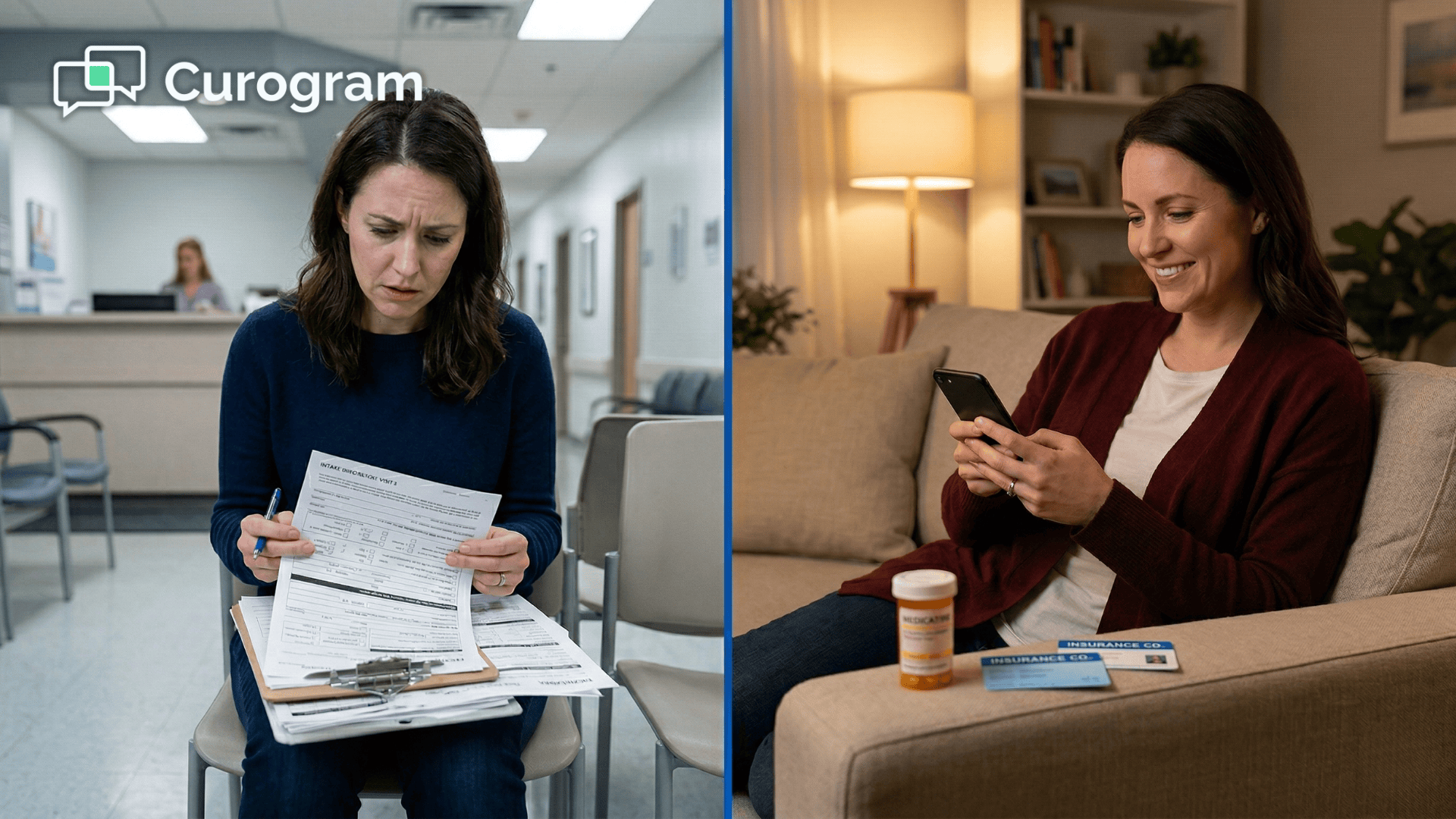
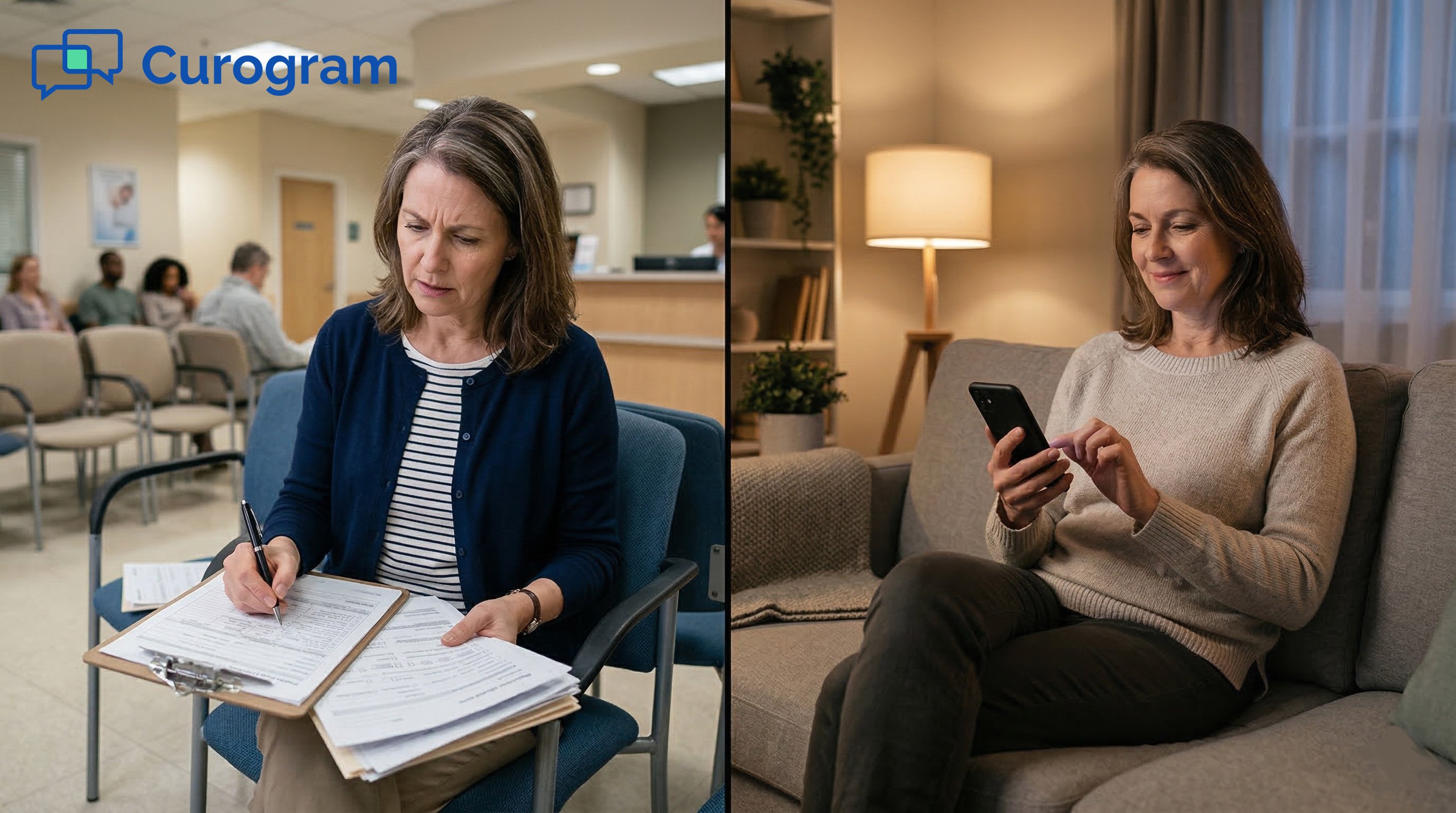
Picture a Tuesday morning in your clinic. The waiting room is full. A new patient walks in for a 9:00 a.m. appointment, and the front desk hands them a 19-page paper packet.
They sit down. They scribble through demographics, insurance details, surgical history, medications, allergies, and consent forms. They forgot their insurance card. They can’t remember the name of that medication their cardiologist switched them to last month.
It’s now 9:12. The provider is ready. The patient isn’t.
This scene plays out across medical practices every single day. And it’s costing you more than time. It’s costing you trust, clinical capacity, and your reputation as a modern, organized clinic.
The hard part is that none of this is your team’s fault. They’re doing exactly what the workflow demands, asking the same questions, retyping the same answers, and chasing the same missing details.
The workflow is the problem.
Now flip the scene. The same patient gets a friendly text two days before their visit.
They tap a secure link, fill out everything from their couch in under three minutes, and walk in already “checked in.” Staff greet them by name, verify their ID, and send them straight back.
That’s the shift this article is about. We’ll walk through why in-office paperwork quietly drains your day, why most fixes fall short, and how SMS patient intake and pre-visit form completion change the experience for both your patients and your team.
If you run a medical practice on Cerner or any modern EHR, this is one of the easiest wins on the table.
And once you see the numbers, it’s hard to unsee them.
The Real Cost of Paper Intake at the Front Desk
Most practices know paper intake is slow. What they often miss is how much it actually costs them, in hours, in dollars, and in patient trust. Once you break it down, the picture gets uncomfortable fast.
What patients actually feel during in-office check-in
New patients form an opinion about your clinic in the first 90 seconds. Right now, that opinion is being shaped by a clipboard.
They walk in expecting care. They get paperwork. Nineteen pages of it, asking for information they may have already given over the phone when they scheduled.
They sit and write for 8 to 15 minutes. Half the fields come out incomplete because they don’t have their insurance card on them or can’t remember a medication name.
Then they hand the forms back, and a staff member fires off follow-up questions:
Pharmacy name, allergy details, emergency contact.
It feels less like a welcome and more like an intake interview.
Patients tell us they feel “processed,” not “cared for.” And that feeling sticks long after the visit ends.
The hidden hit to staff time and accuracy
After patients finish writing, your team has to type. Every line on that paper form gets manually entered into the EHR. A typical front-desk check-in stretches to 15–25 minutes per new patient once you add waiting, form review, data entry, and insurance verification.
Multiply that across 15–20 new patients a day and you’re losing 3–6 hours of productive staff time, every single day.
Here’s what the manual patient intake workflow looks like when you trace it end to end.
A single new patient typically spends 8–15 minutes filling out paper forms in the lobby, which alone can eat up to 3.75 hours of waiting room time across 15 patients.
Then staff spend another 3–5 minutes per patient reviewing and clarifying answers, adding roughly 1.25 hours to the day. Manual EHR data entry takes another 4–7 minutes per patient, draining up to 1.75 more hours.
Finally, insurance verification follow-up adds 2–4 minutes per patient, which puts another hour on the pile.
Add it all together and a single new patient can consume 17–31 minutes of total staff time, with the daily impact reaching nearly 7.75 hours.
For your team, that means almost a full staff shift consumed by intake work that doesn’t require clinical judgment. It’s expensive, and it’s preventable.
Why repeat questions break patient trust
The damage doesn’t stop at the front desk, either. It follows the patient straight into the exam room.
The medical assistant opens the chart and asks,
“When was your last refill?” The provider walks in and asks, “Any past surgeries we should know about?”
The patient already wrote that down. Twice, maybe.
This kind of repeat questioning quietly erodes confidence in three specific ways:
- It signals that information isn’t being read or shared internally.
- It makes the visit feel longer and more bureaucratic than it should.
- It plants doubt about whether complex care details will be tracked correctly.
That doubt translates into lower satisfaction scores, fewer five-star reviews, and slower word-of-mouth growth.
In healthcare, perception of preparedness is part of clinical quality.
The cascade effect on your schedule
The trust problem is bad enough on its own. But it’s usually paired with a scheduling problem you can actually feel by mid-morning.
When 15–20 new patients each lose 10 extra minutes to paperwork, you accumulate 1–2 hours of compounding delay.
That’s why the 9:00 a.m. appointment becomes a 9:25 start, and the 11:00 a.m. patient waits 40 minutes past their slot.
This means your providers fall behind, your medical assistants rush room turnovers, and your last patients of the day wait longer than anyone. Patient satisfaction, online reviews, and provider burnout all get hit at once.
Why Common Fixes Don’t Solve the Problem
If paper intake is the problem, why hasn’t it been solved already?
Most practices have tried. The issue is that the usual fixes were built for the technology of a decade ago, not for how patients actually behave today.
Where portals, emails, and kiosks fall short
Three solutions tend to dominate the conversation, and each one has a built-in ceiling:
- Patient portals require account creation, password resets, and app navigation. Industry data consistently shows portal adoption hovering around 30–40%.
- Emailed PDFs end up in spam folders, get opened on a desktop the patient never returns to, or stall because the form can’t be signed easily on a phone.
- Lobby kiosks simply move the bottleneck five feet to the left. The patient still fills out forms in your waiting room, and the appointment still starts late.
Each of these tools assumes the patient will come to your system. The modern patient expects the opposite.
What patients actually use every day
Look at any adult patient’s phone. The most-used app on it isn’t a portal. It’s the messaging app.
Texting has near-universal adoption across age groups, with open rates above 95% within the first few minutes.
That’s why SMS patient intake and pre-visit form completion finally close the loop the older tools couldn’t. You meet patients on the channel they already trust, with no new accounts and no friction in the way.

How Pre-Visit SMS Intake Changes the Patient Experience
The shift from paper to SMS isn’t just a format change.
It changes who does the work, when it happens, and how the patient feels walking through your door. The best way to see it is to follow the workflow from the patient’s phone all the way into Cerner.
Forms completed before patients ever walk in
Here’s how it works for the patient. One or two days before the appointment.
They get a simple text:
“Hi Maria, your visit with Dr. Lee is on Thursday. Please complete your intake here: [secure link].”
They tap. They fill out demographics, history, insurance, and consents on their phone.
No app to download. No password to remember. No portal to navigate.
Industry benchmarks show around 92% of patients complete intake on the first SMS send. Compare that to email open rates near 20% and portal adoption under 40%, and the difference is dramatic. Texting wins because everyone already knows how to use it.
When patients fill out forms at home, they have their insurance card in hand.
They can call their pharmacy. They can text their spouse to confirm a family history detail.
The data you receive is more complete and more accurate than anything written hastily in your lobby.
Check-in becomes a greeting, not a process
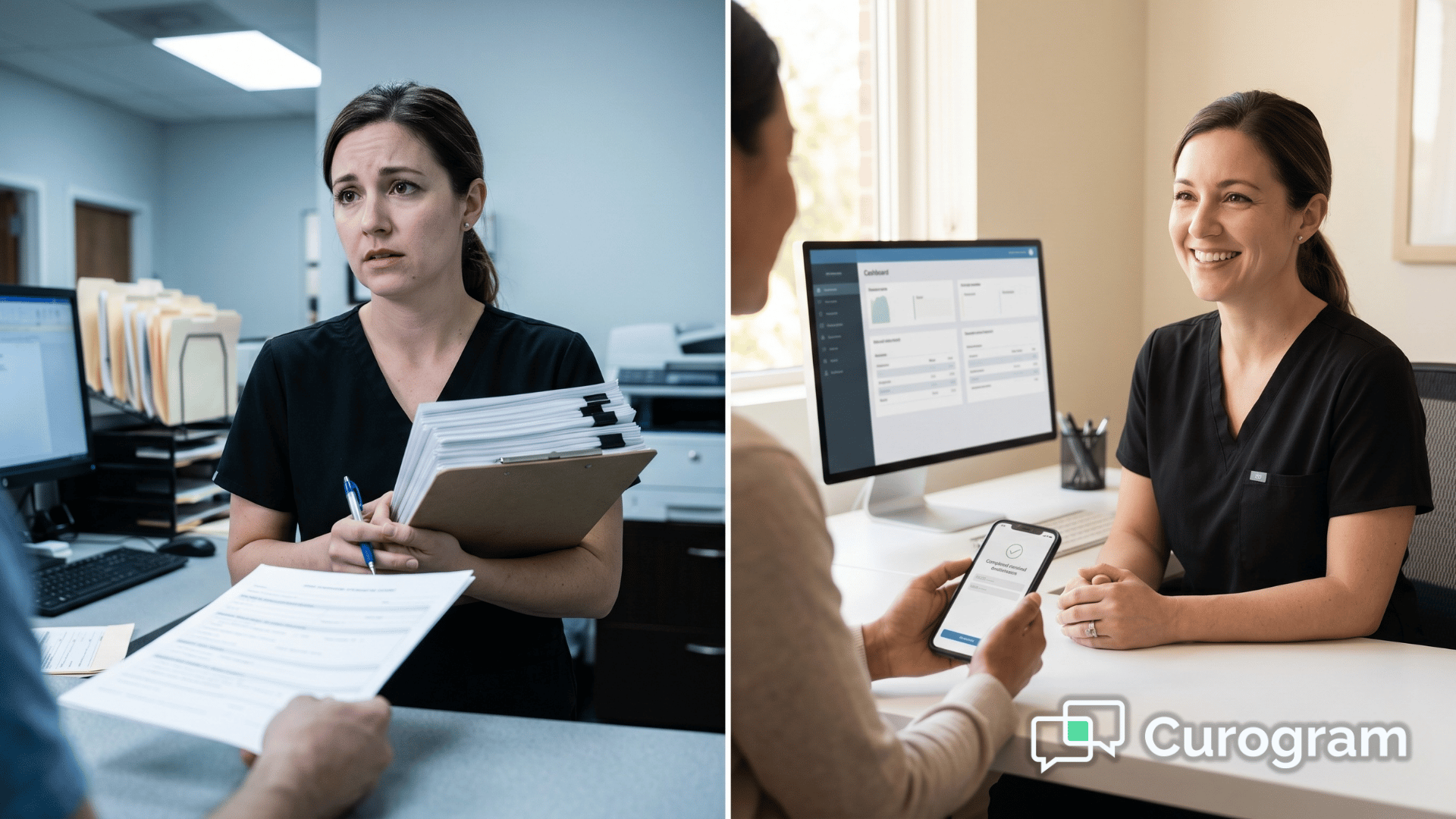
Because the work is already done, the front-desk experience flips entirely. When the patient arrives, your team already has their full chart populated in the EHR. Check-in turns into a 2–3 minute interaction: confirm identity, verify the phone number on file, and walk them back.
Here’s what the time savings look like in practice:
| Workflow stage | Paper intake | Pre-visit SMS intake |
|---|---|---|
| Form completion | 8–15 minutes (in lobby) | 2–3 minutes (at home, before visit) |
| Staff data entry | 4–7 minutes | 0 minutes (auto-synced to EHR) |
| Total check-in time | 15–25 minutes | 2–3 minutes |
| On-time appointment starts | Baseline | ~12% improvement |
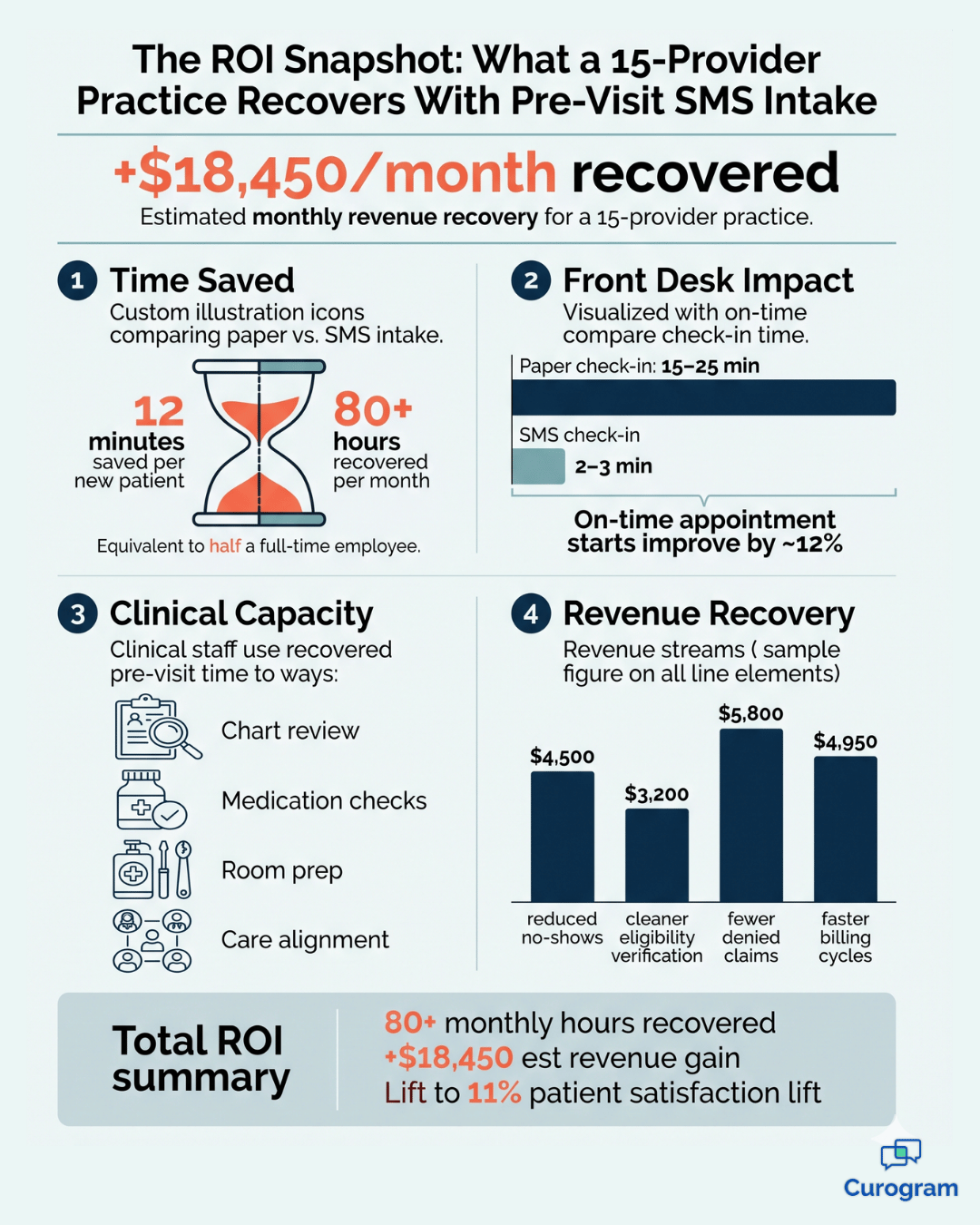
For your team, that recovered time turns into real capacity. If pre-visit SMS intake saves 12 minutes per new patient and you see 20 new patients a day, that’s 4 hours of front-desk time returned every day, or roughly 80 hours per month.
That’s the equivalent of half a full-time employee, freed up without any new hires.

Clinical staff finally get pre-visit time back
The time savings don’t just stay at the front desk. They flow upstream into the clinical side of the visit, where they matter most.
Your medical assistants and nurses didn’t go into healthcare to retype insurance information. With pre-visit SMS intake, they don’t have to.
Because forms flow directly into Cerner before the patient arrives, clinical staff can use that pre-visit window the way it was meant to be used:
- Reviewing the chart and recent test results before the patient walks in.
- Flagging medication interactions or allergy concerns proactively.
- Preparing the exam room and any equipment specific to the visit.
- Aligning with the provider on care goals and likely clinical questions.
This is where the benefit goes from “efficient” to “clinically meaningful.” Providers walk into the room already informed. They can lead with the clinical conversation instead of asking, “So tell me about your medical history.”
Patients notice. They feel seen. They feel like the clinic was ready for them—an effect supported by studies in social-emotional learning, where preparedness and responsiveness directly improve perceived care quality.
Better insurance verification, fewer billing surprises
There’s one more downstream win that often gets overlooked, and it shows up in your billing department.
When insurance information arrives 24–48 hours before the visit, your billing team has time to verify coverage, flag prior authorization issues, and resolve discrepancies before the patient walks in.
That means fewer surprise bills landing in patient mailboxes weeks later. Fewer angry phone calls to your front desk. Fewer denied claims sitting in your AR.
For a 15-provider practice, even a small reduction in eligibility-related denials can recover thousands of dollars per month in clean-claim revenue.
Combine that with reduced no-shows from automated reminders, and you have a finance story that pays for the platform several times over.
What Modern Practices Get When Intake Just Works
So what does all of this look like when it’s humming?
A clinic that feels different the moment you walk in
Your waiting room is calmer. Your front desk team smiles more because they’re greeting people, not chasing forms. Your providers start on time. Your billing team isn’t firefighting.
Patients fill out intake from their living room and walk into a clinic that already knows them. They tell their friends. They leave better reviews. They come back.
This is the version of patient experience that modern practices are aiming for. It’s not flashy technology for its own sake. It’s removing friction so the human moments, the greeting, the reassurance, the clinical conversation, can actually happen.
Where Curogram fits into the workflow
Curogram was built exactly for this.
As a HIPAA-compliant 2-way texting platform that integrates with almost any EMR
It handles the entire pre-visit workflow in one place:
- SMS appointment reminders that reduce no-shows.
- Secure intake forms patients complete on their phone, no app required.
- Patient signatures and consent collection captured digitally.
- Structured data flowing straight into Cerner or your EHR of choice.
Front-desk staff can be trained in under 10 minutes. Patients don’t need any training at all because they already know how to text.
That’s the point. The best technology in healthcare is the kind that disappears into the workflow.
Schedule a Demo and See the Difference Yourself
Here’s the honest takeaway. Paper intake isn’t just outdated. It’s actively working against your team and your patients.
Every day you keep that 19-page packet at the front desk, you’re paying for it in staff hours, delayed appointments, billing rework, and patient trust.
Those costs don’t show up on a single invoice, which is exactly why they’re so easy to ignore. But they’re real, and they compound.
The good news is that fixing it isn’t a multi-year IT project. SMS patient intake and pre-visit form completion can be live in your clinic in days, not months. Your patients don’t need an app. Your staff doesn’t need a long training. Your EHR doesn’t need to be replaced.
If you’re a medical practice running Cerner or any modern EMR, the question isn’t whether to automate intake. It’s how soon you can start recovering those 7+ hours a day your team is losing to paperwork.
Imagine your next Monday morning. The waiting room is half as full. Check-ins take three minutes. Your providers start on time. Your medical assistants actually have a chance to breathe between patients.
And the new patient who walks in at 9:00 a.m. leaves thinking, “That was the most organized clinic I’ve ever been to.”
That’s the experience Curogram is built to deliver, and we’d love to show you exactly how it would work inside your practice.
Schedule a demo with our team today. We’ll walk through your current intake workflow, show you what pre-visit SMS intake looks like in your specific specialty, and run the numbers on how much time and revenue you can realistically recover.
Frequently Asked Questions
It’s usually the opposite. When patients aren’t buried in paperwork at check-in, your staff can actually greet them, make eye contact, and have a real conversation. The personal touch gets stronger, not weaker, because the administrative friction is gone. Patients consistently report higher satisfaction when they feel respected, prepared for, and welcomed instead of processed.
SMS patient intake is an option, not a mandate. Patients who prefer paper or need accessibility support can still complete intake in person, on a tablet, or with staff assistance. Most clinics see around 92% completion via SMS, and the remaining patients are easily accommodated through hybrid options. You get the efficiency without leaving anyone behind.
Yes, when it’s done right. Curogram uses secure links that direct patients to encrypted forms rather than sending PHI through standard SMS. The text message itself contains only generic information, while the form data is transmitted and stored in a HIPAA-compliant environment and synced directly into your EHR.
Forms are mapped to Cerner’s structured fields so that completed patient data flows in as discrete data, not as a PDF attachment. Demographics, history, allergies, medications, and consent records land where your clinical team expects to find them. No double entry, no scanning, no manual transcription.
Most practices see meaningful changes within the first two to four weeks. Check-in times drop almost immediately. Within a month, on-time appointment starts typically improve by around 12%, and front-desk staff report a noticeable reduction in repetitive phone calls and form-related questions.