


Automated Google Reviews for SUD Treatment Centers on Opus
💡 SUD treatment centers serve hundreds of patients a year, yet most show only a handful of Google reviews — often skewed low. Automated Google...
7 min read
Aubreigh Lee Daculug
:
July 3, 2026
A no-show in primary care is a gap in the schedule. In SUD treatment, it can be the moment a recovery stalls — and that one distinction changes everything about how you handle it.
That is the part most reminder tools miss.
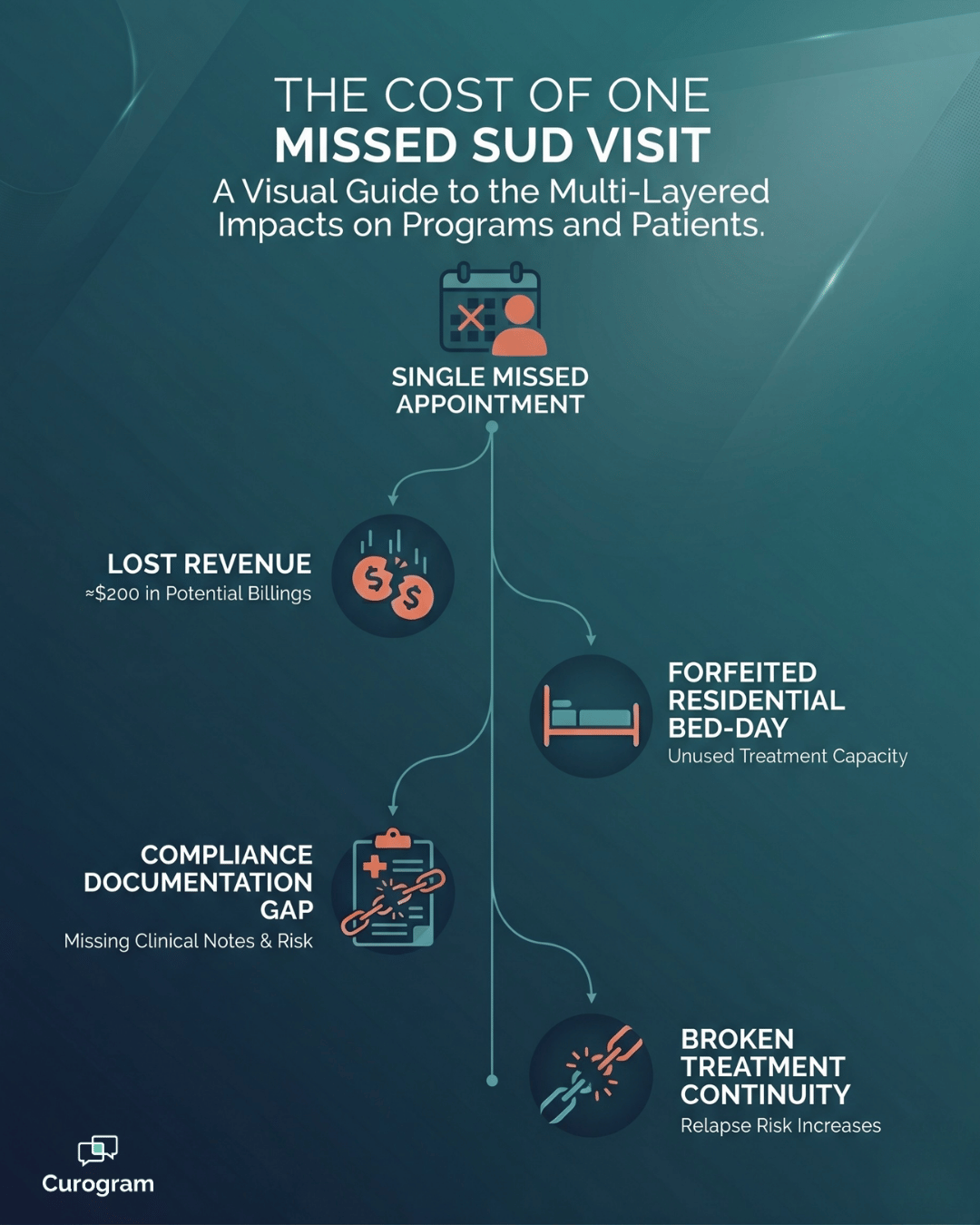
When a patient skips an IOP session, you do not just lose revenue. You lose treatment continuity, risk a documentation gap, and sometimes lose the patient entirely. The clinical stakes are real, and higher than most software accounts for.
Think about a residential program with a missed bed-day, or a group session where one empty seat signals a person quietly slipping away. These moments rarely show up as line items, but they shape outcomes more than any billing report ever will. Each one is a person, not a number.
Here is the frustrating part.
Most SUD centers running Opus have a clean clinical record and no easy way to reach patients before they disappear. The chart is intact. The communication layer is not.
So the front desk picks up the slack. Staff call patients one by one, confirm visits by hand, and field a flood of "where do I park?" questions all day long. Hours that should go to intake and insurance verification get burned on the phone instead.
It sounds like a scheduling problem. It isn't. It is a communication gap — and the good news is that it is fully fixable without replacing your EHR.
This guide shows how to reduce no-shows in SUD treatment on Opus using automated, two-way texting that runs right alongside your clinical system.
You will see why these visits get missed, how reminders that patients can actually reply to change behavior, and what one real clinic saved when it finally closed the gap.
The fix is simpler than it might look.
In general medicine, a no-show is mostly an inconvenience. In SUD care, it is a clinical event.
A skipped IOP session can break treatment continuity, leave a documentation gap for compliance, and cost a residential program a paid bed-day. One missed visit can even put a patient at risk of discharge. The schedule recovers. The treatment plan may not.
The numbers back this up. The industry no-show rate for psychiatry sits around 23%, according to ProspyrMed (2024).
For comparison, the Curogram platform average for psychiatry is 11.03% — about 52% below that benchmark.
The money adds up fast, too. The average revenue lost per missed visit is roughly $200, and annual no-show losses average about $150,000 per practice (ProspyrMed 2024). For a busy SUD center, that is real budget walking out the door.
~$114,000 |
| Annual revenue one Curogram client recovered after closing its no-show gap. |
For teams running Opus, the hard part is not the clinical work. The record is solid. What is missing is the layer that keeps patients showing up. That is the gap we will close next.
Most no-shows are not about patients who stopped caring. They are about friction in getting back through the door.
As one practice put it, their "front desk is fielding 80+ calls a day just for directions and confirmations." That is the symptom.
The causes sit deeper, and in SUD care they tend to cluster around three issues:
That last point is the quiet killer. Most Opus practices send reminders by hand or through one-way systems.
When the patient texts back "I can't make it," the message goes nowhere.
So staff fill the gap manually — calling patients, leaving voicemails, and chasing confirmations. Those hours should go to intake processing and insurance verification. Instead they vanish on the phone. The work feels endless because the system was never built to answer back.

The fix is not a new EHR. It is a communication layer that sits on top of the one you already use.
Curogram's Opus integration connects through a Direct DB link, so the whole flow runs on its own.
Here is how it works, start to finish:
That last step is what most systems miss.
When a reminder can actually be answered, the patient who would have quietly disappeared instead replies "running late" or "can we move to Thursday?" — and you keep them in care.
The cadence matters for SUD care, too. An IOP program running three visits a week needs a different rhythm than weekly individual therapy or a first intake. You set a unique reminder sequence for each, so patients get the right nudge at the right time.
Curogram reminders reach patients through SMS, which sees about a 98% open rate. Almost no one ignores a text.
door.
65.5% |
| Drop in no-shows for one Curogram client within 90 days, with no extra work for staff. |
Compliance is built in. Every message is encrypted and logged, and the platform follows 42 CFR Part 2, so no SUD diagnosis details ever appear in a patient-facing text. The patient sees a simple reminder. The protected information stays protected.
In practice, this means your team stops dialing and starts managing exceptions. The reminders run on their own. Staff step in only when a patient actually needs them.

Numbers make this concrete. Atlas Medical Center put automated, two-way reminders to work and tracked the result over a single quarter.
Their starting point was a 14.26% no-show rate in March 2023. Ninety days after rolling out Curogram, that rate dropped to 4.91%.
That final rate is 74% below the primary care industry average of about 19% (MGMA Stat 2024/25).
In plain terms:
For every 100 booked visits, Atlas went from losing 14 to losing 5.
The recovered revenue lands near $114,000 a year. For your team, that is roughly a full-time salary recovered from visits that used to slip away.
The best part is how little it asked of staff. The reminders fired automatically from the schedule sync, so the team did not add a single manual step. (This reflects Curogram client data from clinical settings.)
The same mechanism applies directly to SUD programs on Opus — only here, each saved visit protects engagement that has clinical weight, not just billing impact.
Let's name it plainly. The no-show problem in SUD care is not a scheduling problem. It is a communication gap.
Curogram closes that gap with very little lift on your end:
You add the communication layer Opus was never built to provide, and nothing about your charting workflow changes.
This is also where clinical-note tools fall short. If you are weighing options, Curogram vs TherapyNotes is worth a look — TherapyNotes handles notes well but does not offer the communication automation a SUD center needs. Curogram adds what the EHR leaves out.
So the path forward is simple. Keep Opus for the clinical record, and let Curogram handle the messages that keep patients in care. You can also see how Curogram serves behavioral health clinics for the full picture
You already know the cost of an empty chair in SUD treatment. It is not just a number on a report or a gap in tomorrow's calendar. It is a person who needed one more reminder, one more chance to reply, one more reason to come back through your door.
The good news is that closing this gap does not mean tearing anything out. Your Opus record stays exactly where it is. The clinical workflow your team trusts does not change at all. You simply add the piece that has been missing — a way to reach patients, and a way for them to reach you.
Consider the difference over a single quarter. Fewer manual calls go out, and a front desk that once chased confirmations handles intake instead.
A no-show rate that drops toward Atlas Medical's 4.91% keeps revenue on the books that used to vanish, often in the range of six figures a year.
More than the dollars, it is the continuity that matters. Every visit kept is a patient who stays connected to treatment instead of slipping away in silence. In SUD care, that continuity is the whole point of the work.
Reducing no-shows in SUD treatment on Opus does not require a bigger team or a brand-new system. It requires a smarter communication layer that runs on its own and answers back the moment a patient reaches out.
You do not have to take our word for any of this. See it working with your own Opus instance, with your own appointment types and your own patient flow, before you commit to anything.
Book a Demo and watch Curogram close the no-show gap inside the EHR you already use. Your patients — and your front desk — will feel the difference far faster than you expect.
No. Curogram sits on top of Opus as a communication layer. Your clinical records, notes, and workflows stay exactly where they are. The integration adds texting, reminders, and confirmations without changing how your team charts.
Yes. Curogram is HIPAA-compliant and follows 42 CFR Part 2. Every message is encrypted and logged, and no SUD diagnosis details ever appear in a patient-facing text. Patients see a simple reminder, and protected information stays protected.
Very little. The Opus integration connects through a Direct DB link, so appointments sync automatically. There is no IT project to manage, and staff training takes about 10 minutes.
Yes, and that is the point. Reminders are two-way, so patients can confirm, reschedule, or ask a question by text. Your staff see every reply in one dashboard and respond in real time.
Results often show up within a single quarter. Atlas Medical Center cut its no-show rate from 14.26% to 4.91% in 90 days — a 65.5% drop — while recovering roughly $114,000 a year, with no added manual work for staff.
💡 SUD treatment centers serve hundreds of patients a year, yet most show only a handful of Google reviews — often skewed low. Automated Google...
💡 42 CFR Part 2 patient communication with Opus carries a stricter bar than standard HIPAA. Substance use disorder records — including the simple...
💡 SMS reminders support treatment protocol adherence for ketamine and TMS patients at Osmind practices by sending automated, HIPAA-compliant texts...