
Reducing No-Shows in SUD Treatment Centers on Opus EHR
 Aubreigh Lee Daculug : Jul 3, 2026, 2:00:00 PM
Reduce missed appointments in your SUD program with automated, two-way reminders integrated with Opus EHR.

A family has spent weeks gathering the courage to ask for help. They finally open a laptop, search for a nearby treatment center, and start reading. Within seconds, they form an opinion — not from your outcomes, but from a row of stars and a few reviews.
For many substance use disorder (SUD) treatment centers, that row of stars tells the wrong story. You may treat hundreds of people a year through residential, IOP, and outpatient care. Yet your Google profile shows a 2.5-star rating and barely a dozen reviews.
It feels unfair because it is. The patients who do best — the ones who finish treatment and rebuild their lives — rarely circle back to leave a review. The few who do post sometimes write during a hard moment.
So your public reputation gets shaped by the loudest fraction, not the typical result.
This matters more than it might seem. Online ratings are now the first filter families use, and they decide fast. A weak profile quietly turns away people who would have thrived in your program. And those families almost never come back for a second look.
The frustrating part is that the fix is not more clinical excellence; you already have that. The real gap is in how reviews get collected — or rather, how they don't.
Most centers ask for reviews by hand, if at all. Staff focus on care, not marketing, and asking someone in recovery for a review can feel awkward. That hesitation is human, but it is also expensive.
Here is the good news: you do not have to choose between protecting patients and protecting your reputation.
With the right setup on Opus, review collection can run quietly in the background — respectful, automatic, and timed for the right moment. It only needs the right system behind it.
Most SUD treatment centers are busy, treating hundreds of people each year across residential, IOP, and outpatient care. Yet your Google profile rarely reflects that scale.
It is common to find a center that treats 400 patients a year and shows fewer than 30 reviews.
The math does not add up — and there are three clear reasons why.
Add these up and a pattern appears: your rating ends up shaped by the small group who post on their own, which tends to skew negative. We have seen incoming prospects with ratings of 1.8, 2.5, and 2.9 stars — none of which matched the care being delivered.
That gap costs real money. Acquiring a new patient through paid ads runs about $250 to $350 each, based on SovDoc 2024 and industry estimates.
A strong, high-volume Google profile pulls people in on its own, which lowers what you spend to be found. In practice, every patient who discovers you through reviews is a patient you did not have to buy.
Here is a quick example:
Say 10 new patients a month find you through your Google profile instead of paid ads. At $300 each, that is $3,000 saved every month, or about $36,000 a year.
For your team, that is budget you can put back into care instead of clicks.
It helps to see it from the outside.
A parent comparing three centers does not read your clinical notes or your success rates;
They see a number next to a star, decide in seconds, and move on.
A thin profile makes that snap judgment work against you, even when your program is the strongest of the three.
Manual review collection sounds simple, but in a SUD setting it rarely holds up. Two pressures pull against it from the very start.
Your clinical team is focused on outcomes, discharge planning, and aftercare. A Google review is not a natural part of that work, so it slips down the list every single day.
Timing makes it harder. Asking during active treatment feels wrong, and asking weeks later means chasing someone who is no longer in regular contact.
Both take effort and follow-through that a busy front desk simply does not have.
So most centers end up collecting reviews passively, if at all.
The passive return rate sits around 5% to 10%, based on Curogram client data from Optima Medical in Scottsdale, AZ. Automated campaigns lift that number sharply, because the ask no longer depends on anyone remembering to send it.
Even the occasional manual ask does not fix this:
One strong month, when a staff member remembers to ask, gets erased by three quiet ones.
Reviews need to arrive steadily to build trust, and steady is exactly what a manual process cannot promise.
The gap also compounds over time, because every month without a steady stream of fresh reviews lets a few unhappy voices define your rating. Over a year, that quiet drift can be the difference between a profile families trust and one they scroll right past.
The lesson is simple:
When a task relies on spare time, it does not scale, and your reputation pays the price.
This is where automation changes the picture;
Curogram handles review requests so your staff never has to.
Here is how it works in practice:
For SUD programs, timing is everything, so Curogram recommends post-discharge or program-completion triggers instead of post-visit ones. That way, requests reach people who have finished their program — not those still in active treatment.
This is what thoughtful automated Google reviews for a SUD treatment center on Opus should look like: scalable, but never tone-deaf.
The connection runs on Curogram's Direct DB integration, which syncs appointment and discharge data straight from Opus. No manual exports, and no extra steps for staff.
The patient side is just as light:
They get one short text, tap the link, and leave a rating in under a minute — no app to download and no account to create.
That low effort is a big reason automated requests convert far better than a flyer at the front desk or an email that never gets opened.
Two real examples show what this can do at scale.
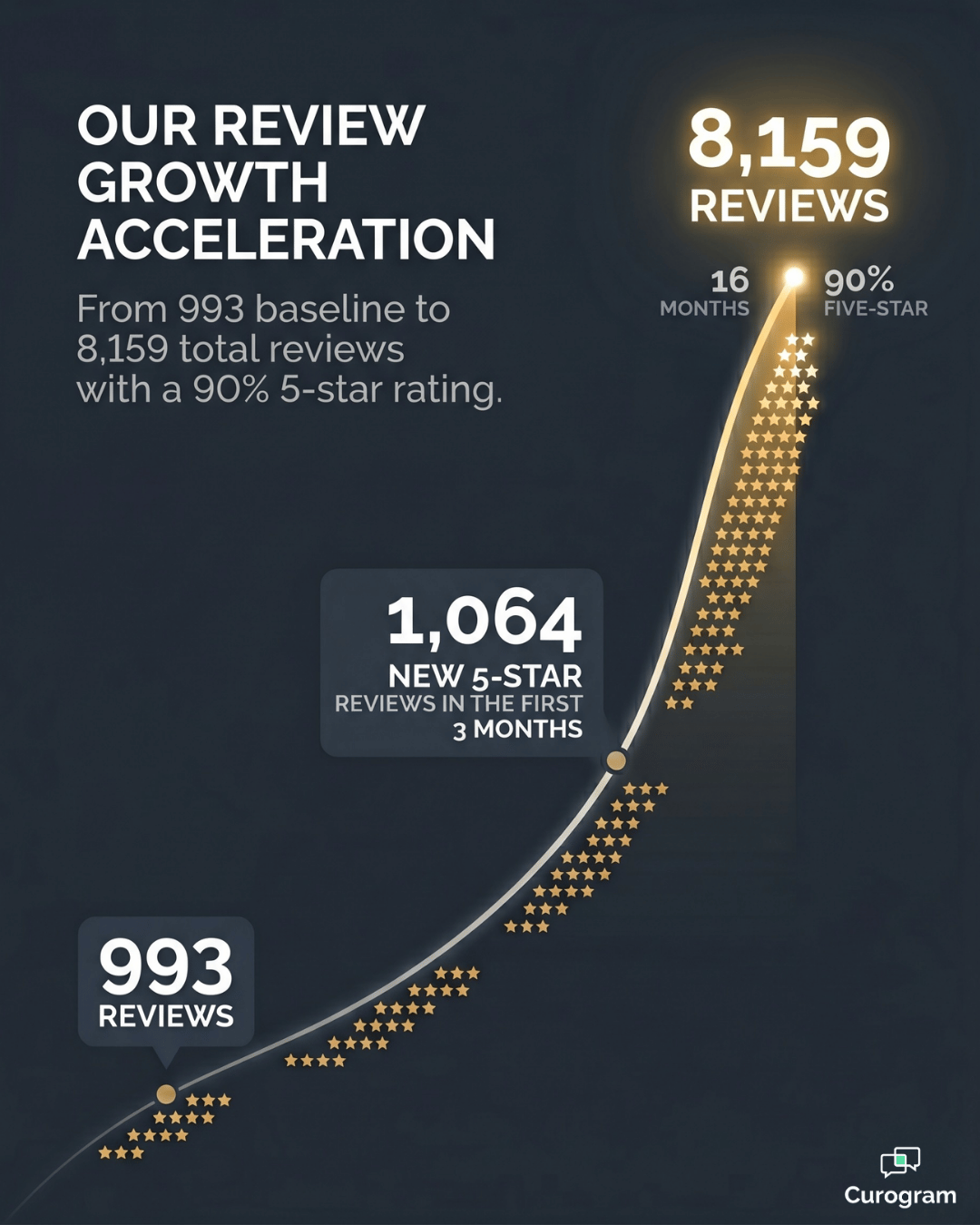
Optima Medical, a multi-location primary and immediate care group in Scottsdale, AZ, grew from 993 to 8,159 Google reviews in 16 months.
About 90% of participating patients left five-star reviews. In the first three months alone, the practice collected 1,064 new five-star reviews — more than 20 years' worth of organic growth, compressed into a single quarter.
Kern Gastro moved from fewer than 50 reviews with shaky 3.8–4.5 ratings to over 1,500 reviews at a steady 5.0 stars across six years.
By 2023, it passed what Curogram calls the Digital Authority Threshold — 1,000+ reviews at 5.0 stars. That level of trust is nearly impossible to build by hand.
For your SUD care program, the engine is the same — only the timing changes. Curogram still pulls discharge data from Opus and sends the request on its own, but it waits for the moment that fits recovery rather than a routine visit, and that one adjustment is what makes high-volume review growth work in a clinical setting like yours.

Reviews are not vanity metrics; for a SUD program, they shape who walks through your door.
The choice often comes down to a quick gut check.
A family scanning results sees two centers:
One with 60 reviews at 3.6 stars, another with 600 at 4.8.
Even when the care is similar, most will call the second one first;
Volume and rating together signal safety, and that signal is doing your marketing before anyone picks up the phone.
There is a compounding effect, too:
More reviews and higher ratings lift where you appear in local search, which means more families see you in the first place.
More views lead to more calls, and more calls give you more patients who can leave reviews — a loop that builds on itself once it starts turning.

Put plainly, a strong rating works around the clock. It markets your program, backs up referrals, and trims your ad spend while you sleep. If you want to see how this fits a bigger plan, see how Curogram serves behavioral health clinics.
Getting started is lighter than most teams expect. Two short steps stand between you and automated reviews.
Curogram's implementation team configures the Direct DB integration with Opus and sets up your review triggers around your real discharge workflow. Staff training takes about 10 minutes, and after that the system runs on its own.
You also get to decide when requests go out. Work with Curogram's team to pick the right trigger points for your program — post-residential discharge, IOP completion, or an outpatient milestone that fits how you care for patients.
Compliance stays intact the whole way. The review text comes from your own number and simply links to your public Google page, so no clinical detail ever travels in the message, which keeps the process both respectful and safe for patients in recovery.
You can also watch the results come in: Curogram shows you how many requests went out and how many turned into reviews, so the impact is easy to see.
For your team, that means clear proof the system is working, not a black box you have to trust.
Once it is live, review collection becomes something you no longer think about. It simply happens, quietly and consistently, in the background.
Your clinical outcomes are strong; the problem is that almost no one searching for help can see that yet. The care is real; the proof isn't showing up online.
Right now, your Google profile is built from a handful of voices — not the hundreds of people your team has helped move toward recovery. That mismatch is quiet, but it is costly.
It turns away families who would have thrived with you, and it pushes you toward paid ads at $250 to $350 per patient just to be found.
The fix is not more effort from an already stretched team. It is a system that collects reviews the right way, at the right moment, without anyone having to remember.
That is exactly what Curogram does on Opus. After discharge or program completion, it sends a respectful text from your own number, with a direct link to your Google page. Patients who finished treatment — the ones most likely to speak well of you — finally get an easy way to share their experience.
The results speak for themselves: practices using this approach have turned small, shaky profiles into thousands of five-star reviews, often in months rather than years.
For your program, that means lower acquisition costs, stronger referrals, and a reputation that finally matches the care you provide. It also means staff who see, in real time, that their hard work is making a difference.
You do not have to overhaul anything. The integration syncs with Opus, training takes minutes, and the system runs from day one.
So let your profile tell the real story. Book a Demo to see automated review collection working alongside your Opus EHR — built for the realities of SUD care, and ready to grow your reputation as fast as you earn it.
 Aubreigh Lee Daculug : Jul 3, 2026, 2:00:00 PM
Reduce missed appointments in your SUD program with automated, two-way reminders integrated with Opus EHR.
 Aubreigh Lee Daculug : Jun 4, 2026, 1:00:00 PM
Missed ketamine or TMS sessions disrupt treatment protocols. Curogram’s automated reminders keep patients on track—Atlas Medical Center hit 4.91%...
 Aubreigh Lee Daculug : Jun 20, 2026, 1:00:00 PM
Ensure your patient texting meets 42 CFR Part 2 confidentiality standards. Encrypted, consent-based messaging for Opus EHR.