

9 min read

Protocol Adherence Reminders for Osmind Patients | Ketamine & TMS

Protocol Adherence Reminders for Osmind Patients | Ketamine & TMS
💡 SMS reminders support treatment protocol adherence for ketamine and TMS patients at Osmind practices by sending automated, HIPAA-compliant texts that match each protocol's cadence.       

Curogram delivers these reminders through SMS, reaching patients even when they don't open the Osmind app.

This matters because interventional psychiatry protocols depend on consecutive attendance. A ketamine series spans 6 sessions in 2–3 weeks. TMS requires 36 sessions over 6–9 weeks.

Curogram clients see an 11.03% psychiatry no-show rate versus the 23% industry average, a 52% reduction that helps patients complete their full course of treatment.


Your patient walked out of ketamine session 3 lighter than they've felt in years. The fog lifted. They smiled at the front desk for the first time since their intake.

Then session 4 came. And the chair stayed empty.

This is the quiet heartbreak of interventional psychiatry. Not the patient who never responds to treatment, but the one who responds beautifully, then disappears mid-protocol. The neuroplasticity window starts closing. The momentum stalls.

By the time your team reaches them by phone two days later, the rhythm of the protocol is broken.

Here's what makes this so frustrating: it's almost never about the treatment failing. It's about the communication system failing.

The Osmind app sits on a phone that the patient hasn't opened in days because their depression makes opening apps feel impossible. The reminder notification gets buried under social media alerts and email pings. The patient who needs the reminder most is the one least likely to see it.

Interventional psychiatry serves patients whose conditions actively interfere with the behaviors needed to complete treatment.

Treatment-resistant depression dulls motivation. PTSD creates avoidance. Chronic pain limits planning. Asking these patients to actively check an app to stay on protocol is asking them to do the exact thing their illness makes hardest.

This is where SMS reminders treatment protocol adherence ketamine TMS patients Osmind becomes more than an operational question. It becomes a clinical one.

A text message arrives passively. It shows up on the lock screen patients check 80+ times a day. It requires no login, no engagement, no app open.

For Osmind practices, that one channel can be the difference between a completed protocol and a broken one. Let's unpack why.

The Hidden Cost of the Mid-Protocol Drop-Off

Interventional psychiatry isn't like a missed therapy session you can reschedule next Tuesday without clinical consequence. The treatment mechanism itself depends on session timing. Stretch the gap, and you stretch the result.

Ketamine builds its antidepressant effect through closely spaced infusions.

Each session opens a neuroplasticity window the next session reinforces. Insert a 9-day gap into a protocol designed for every-other-day spacing, and you're no longer running the protocol the evidence supports.

TMS follows the same logic. Consecutive daily sessions create cumulative cortical changes. Skip three days mid-protocol and the cortical stimulation from the previous treatment fades before the next one builds on it.

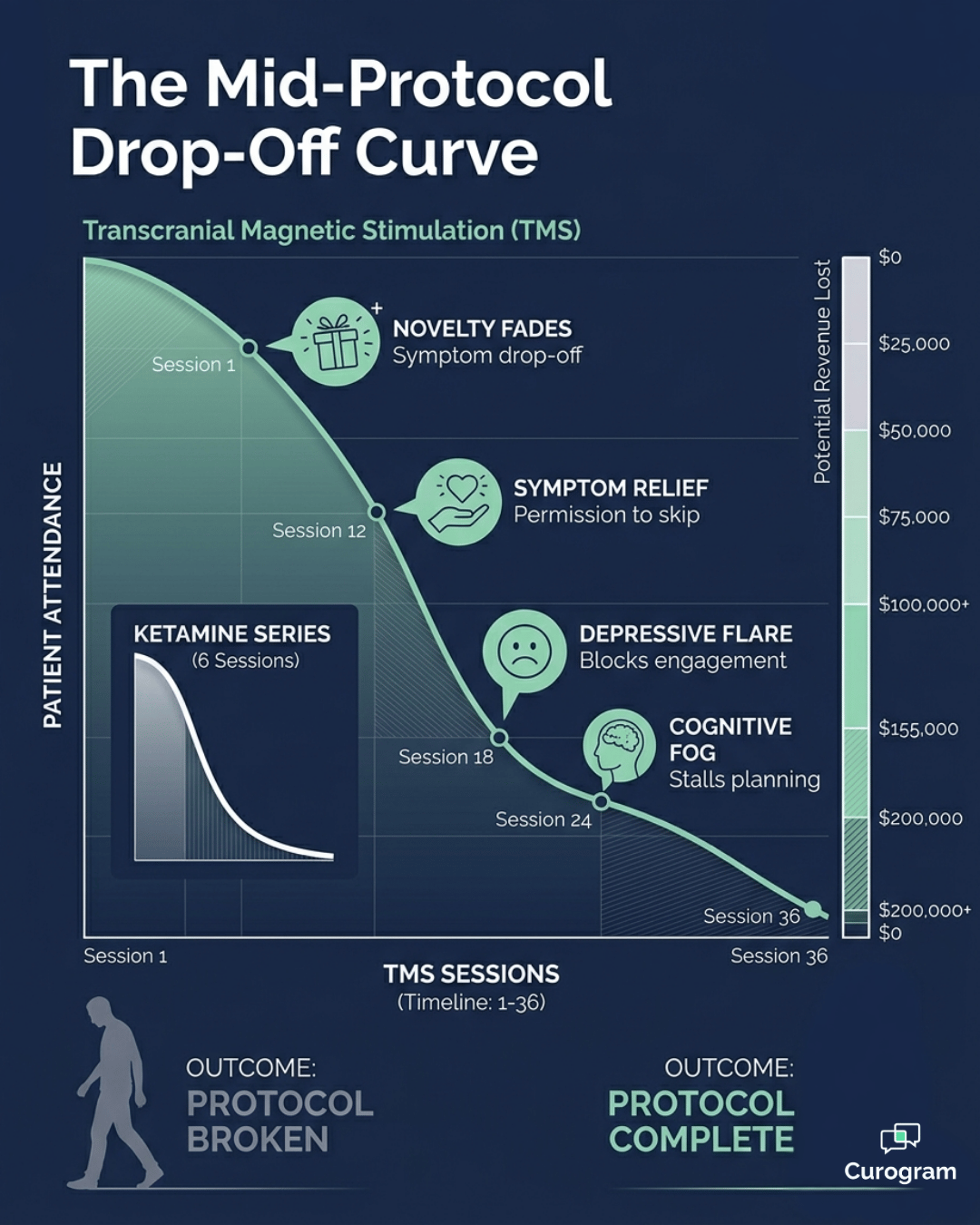
The drop-off pattern is also predictable. Industry data on multi-session psychiatric protocols suggests patient dropout ranges from 20% to 40%, with most attrition happening in the middle sessions, not the first or the last.

That mid-protocol cluster is where three forces collide at once:

  • The novelty of starting treatment has worn off, so willpower alone is no longer carrying the patient.
  • Early symptom improvement makes a missed session feel "safe" to skip, even though the protocol isn't complete.
  • The clinical conditions being treated (depression, PTSD, chronic pain) are most likely to flare and interfere with attendance.

None of those forces show up on a chart. They show up as empty chairs.

What Mid-Protocol Drop-Off Actually Costs

Think about a single TMS patient who completes 20 of 36 sessions.

At $250–$350 per session, that's $4,000 to $5,600 in lost protocol revenue from one chair. Now multiply that by even five drop-off patients in a quarter, and the math gets uncomfortable fast.

Protocol Type Sessions Required Typical Per-Session Revenue Revenue Lost Per Mid-Protocol Drop-Off
Ketamine series 6 sessions $400–$800 $1,200–$3,200
TMS protocol 36 sessions $250–$350 $4,000–$5,600
Spravato 8 sessions (induction) $600–$900 $2,400–$5,400

For your team, that's not just revenue lost. It's clinical outcome lost.

A patient who paid for hope and got partial treatment may have invested in something that never reached therapeutic threshold, not because the treatment doesn't work, but because attendance gaps compromised the mechanism of action.

This is the appointment adherence interventional psychiatry SMS reminders gap that no clinical excellence alone can close. The treatment can be perfect. If the patient doesn't arrive, the protocol breaks.

Why App-Based Reminders Miss the Patients Who Need Them Most

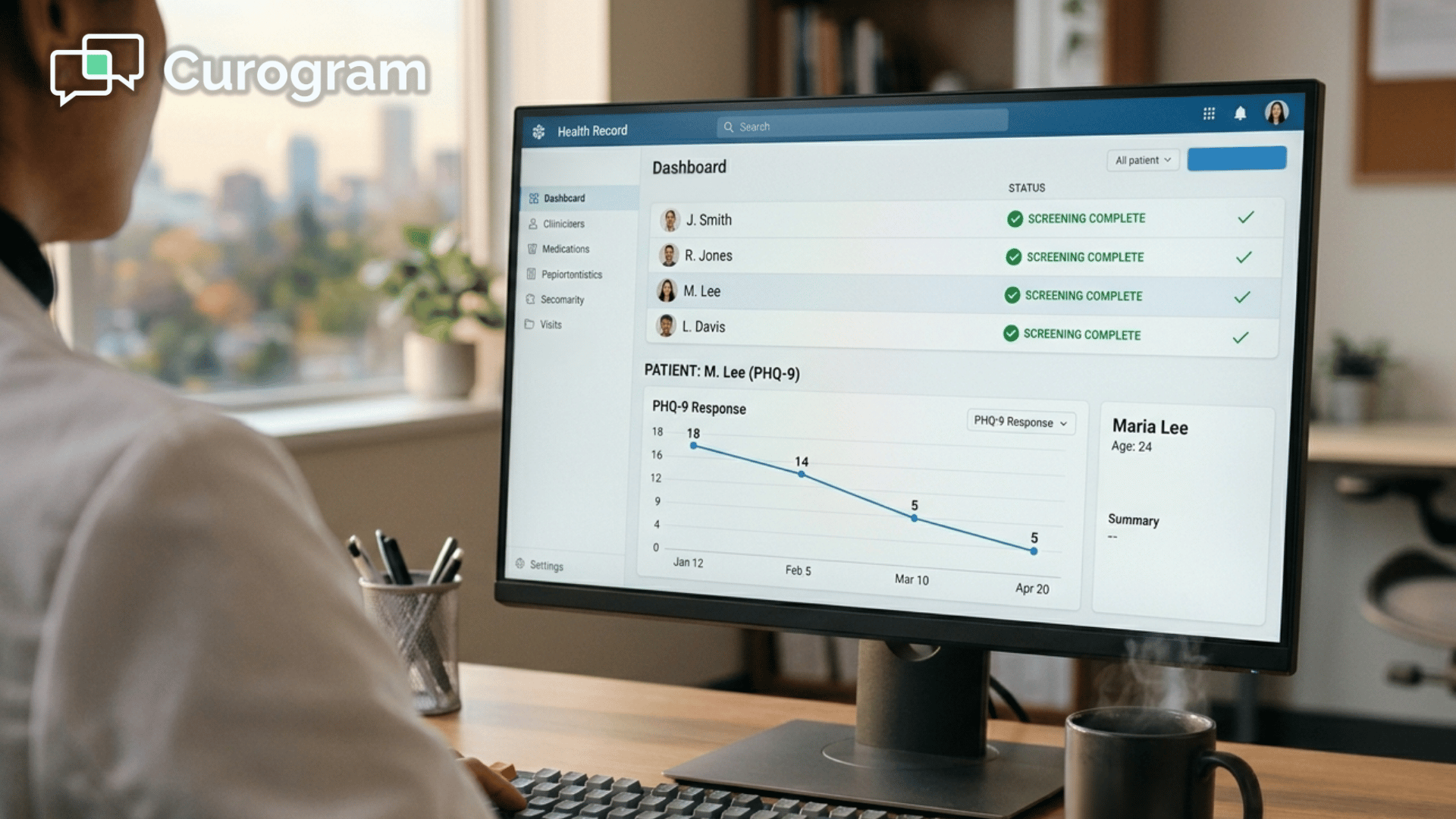
Osmind does what it was built to do beautifully. It tracks the clinical protocol. It documents outcomes. It supports your charting workflow. But the app-based reminder model has a structural blind spot: it only reaches patients who open the app.

Walk through who's most likely to open the app: engaged, organized patients with stable mood, intact executive function, and a habit of checking notifications. In other words, the patients least at risk of missing a session in the first place.

Now consider who's least likely to open the app:

  • The patient deep in a depressive episode who hasn't unlocked their phone in three days.
  • The PTSD patient avoiding technology because notifications spike their hypervigilance.
  • The treatment-resistant depression patient whose cognitive fog makes navigating any new interface feel exhausting.

These are the patients the reminder system needs to reach. These are the patients the app misses.

Vertical infographic showing the mid-protocol drop-off curve for ketamine and TMS patients across sessions.

The Inverse Engagement Problem

Here's the uncomfortable inverse: app engagement and clinical need run in opposite directions.

The sicker the patient, the less they engage with the app. The less they engage, the more invisible their reminders become. The more invisible the reminders, the higher their dropout risk.

It's a system that quietly selects against the patients who need protocol support the most. And it's not Osmind's fault. No EMR app is designed to function as a behavioral intervention. That's a different tool, with a different job.

SMS bypasses the engagement requirement entirely.

A text shows up whether the patient opens an app or not. It arrives on the screen they check reflexively, dozens of times a day, often without realizing they're doing it. That passive visibility is the entire point.

How Curogram Becomes the Bridge Between Treatment Intent and Treatment Completion

Here's where Curogram fits. It's not a replacement for Osmind. It's the communication layer Osmind doesn't try to be.

Osmind tracks your clinical protocol:

The treatment plan, the session documentation, the outcome measures.

Curogram handles the patient's path to the chair:

The reminders, the confirmations, the follow-ups when they go quiet. Two systems, complementary jobs.

The TMS protocol no-show prevention Osmind patients piece works through automated, HIPAA-compliant SMS sequences that match your treatment cadence.

A ketamine patient gets reminders timed to their every-other-day schedule.

A TMS patient gets daily reminders that match their consecutive-session protocol.

A Spravato patient gets reminders that include the post-dose monitoring period.

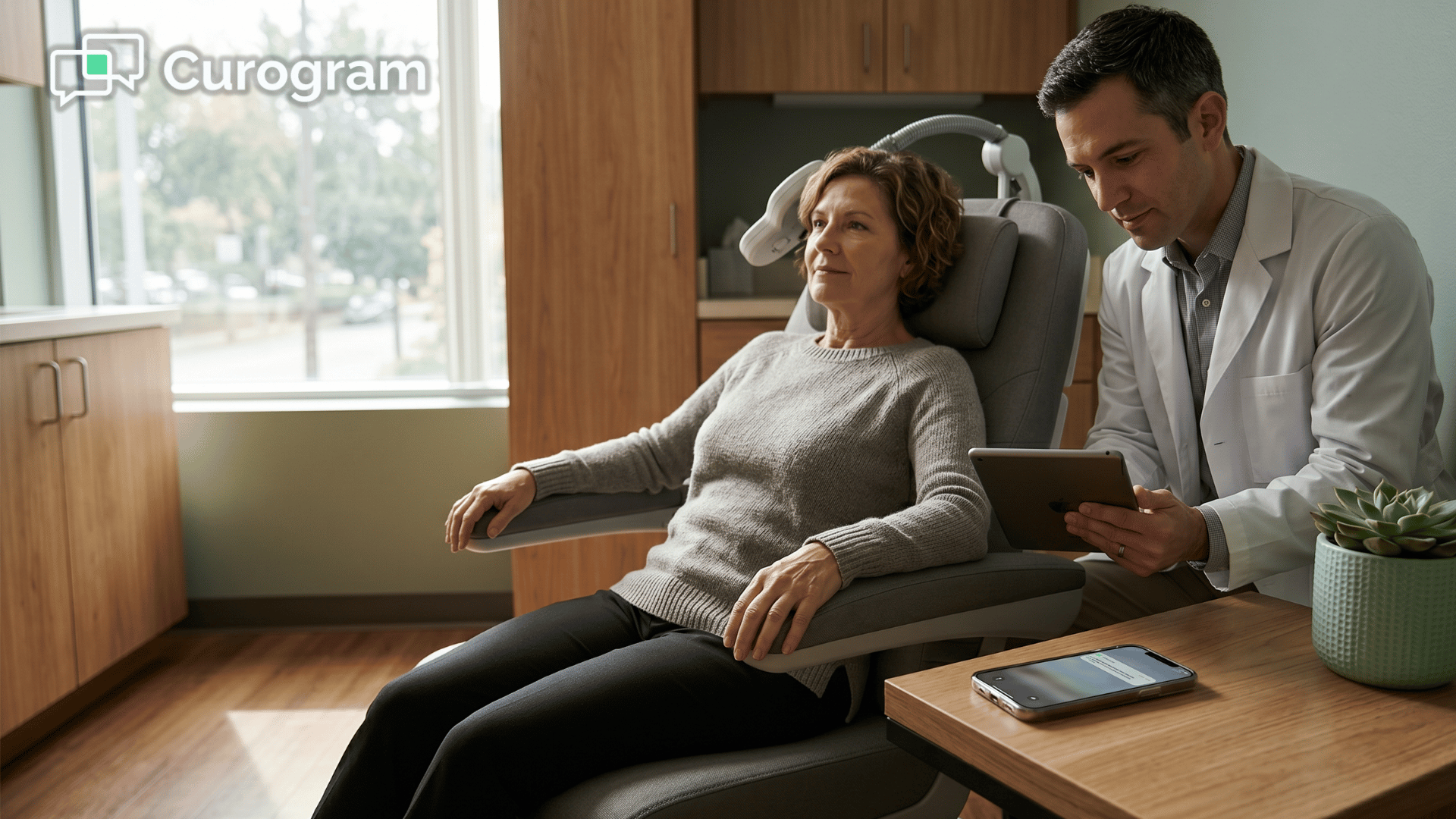
Clinic staff reviewing appointment dashboard as a relaxed patient waits, showing smooth scheduling flow.

Protocol-Aware Reminder Sequences in Practice

Curogram's reminder templates are fully customizable, which means they can do more than just say "you have an appointment tomorrow." They can carry context that supports adherence.

  • Session number framing: "Session 4 of 6 tomorrow at 10 AM" reinforces proximity to completion.
  • Progress framing for longer protocols: "Session 22 of 36, you're past the halfway mark" reinforces momentum at the exact point dropout risk is highest.
  • Pre-session instructions: NPO reminders before infusions, monitoring period heads-up for Spravato, any practice-specific prep.

No-shows cost you money! Reduce missed appointments by up to 75% with Curogram's automated, customizable smart reminders.  

Each message is a small behavioral nudge. None of them require the patient to open an app, log in, or actively engage. The reminder shows up. The patient reads it without thinking about it. The protocol stays intact.

For your team, that means the ketamine infusion series completion rate text reminders question stops being a hope and becomes a workflow.

You stop relying on the patient to remember a difficult appointment during their hardest week. You let the system carry them through.

Where Curogram Lives Alongside Osmind

Function Osmind Curogram
Treatment plan documentation Yes No
Session-level clinical notes Yes No
Outcome tracking Yes No
Automated SMS reminders App-based only Yes, true SMS
Two-way patient texting Limited Yes
Confirmation and no-show tracking dashboard Limited Yes

There's no data conflict, no workflow disruption, no double entry. Curogram operates as a seamless add-on that handles the communication layer while Osmind owns the clinical record.

What Protocol Completion Looks Like With the Right Reminder System

Curogram clients in psychiatry see an 11.03% no-show rate versus the 23% industry average. That's a 52% reduction in missed appointments.

For a protocol-dependent specialty, those numbers translate directly into three compounding wins:

  • More completed series, which means more patients reaching therapeutic threshold.
  • More predictable chair utilization, which means less wasted clinical capacity.
  • More retained revenue, which means more reinvestment into staff and capacity.

Atlas Medical Center pushed it further. They dropped from a 14.20% no-show rate to 4.91% in three months. That means 95% of scheduled sessions filled.

For an interventional practice, that's the difference between protocols that limp to a finish and protocols that hit the clinical benchmarks they were designed to hit.

~32 of 36 sessions Average sessions completed per TMS protocol at Curogram's 11% no-show rate, versus ~28 of 36 at the industry-average 23% no-show rate.

Those four extra sessions are often what gets a patient across the therapeutic threshold.

A Realistic Scenario for Your Practice

Let's run the math on a hypothetical TMS practice putting 200 patients through full 36-session protocols per year.

With a 23% industry-average no-show rate, only around 120 of those patients reach the full 36 sessions, and estimated annual protocol revenue lost climbs past $200,000.

At Curogram's 11% no-show rate, that lost revenue drops to roughly $50,000–$70,000.

This means a practice running 200 protocols a year could retain six figures in revenue simply by closing the communication gap.

In practice, that's the salary of a senior tech, the cost of a second TMS chair, or the runway to expand into Spravato. The numbers move because the patients show up.

For your team, the bigger story is the patient retention interventional psychiatry automated reminders effect. Patients who complete protocols become patients who refer other patients. Patients who drop off mid-protocol rarely come back, and they rarely refer.

A Patient's Path From Session 1 to Session Complete

Consider a patient with treatment-resistant depression starting a ketamine series. Session 1 happens. The Curogram reminder went out the night before and the morning of. Patient confirmed both.

Sessions 2 and 3 follow the same rhythm. By session 4, the patient is having a hard week. They haven't opened any app in three days. But the text arrived at 6 PM the night before and again at 8 AM the morning of. They saw both on their lock screen. They came in.

Session 6 closes the protocol. The patient reports the best sustained mood improvement they've experienced in years. The treatment worked because the patient completed it. The patient completed it because the reminder met them where their condition allowed them to be reached.

That's the entire treatment-resistant depression appointment attendance SMS story in one arc.

Build the Communication Layer Your Protocols Deserve

Your treatment protocols are clinically sound. Your providers are skilled. Your Osmind workflow handles the documentation. The missing piece isn't medical, it's behavioral, and it lives in the gap between session 3 and session 4.

That gap closes when the reminder system stops requiring active engagement and starts meeting patients on the channel their condition actually allows them to use. Text arrives. Patient sees it. Patient comes in. The protocol stays whole.

Curogram exists to be that layer. HIPAA-compliant SMS reminders that integrate with Osmind, match your treatment cadence, and reach patients on bad days, not just good ones.

A 52% reduction in no-shows isn't a marketing number. It's hundreds of patients who completed their protocols instead of stalling out at session 4.

For interventional psychiatry, that's not an operational upgrade. It's a clinical safety net.

Schedule a Demo to See this in your Workflow. Bring your hardest scheduling problem, and we'll show you what the bridge looks like in your practice.


Frequently Asked Questions

Can reminders include session count or protocol progress to motivate patients?

Yes. Curogram's reminder templates are fully customizable, so you can include session numbers like "Session 4 of 6 tomorrow," progress framing like "You're past the halfway mark of your TMS protocol," and any pre-treatment instructions specific to that session. This contextual messaging reinforces protocol momentum and helps patients see proximity to completion. That kind of behavioral nudge supports attendance during the mid-protocol sessions where dropout risk is highest.

What if patients feel overwhelmed by text messages during a difficult treatment period?

Message frequency and timing are entirely configurable by your practice. You can set gentle, non-intrusive cadences, like a single text 24 hours before an appointment, or build more active sequences for patients who benefit from extra touchpoints. Patients can always opt out by replying STOP. Many interventional psychiatry patients actually report that a simple, friendly text reminder reduces anxiety because it removes the uncertainty of "when is my appointment again?"

Does Curogram track protocol completion data or just individual appointments?

Curogram's dashboard provides appointment-level confirmation and attendance data. Clinical protocol tracking (treatment plans, outcomes, session documentation) remains in Osmind, where it belongs. Curogram's data shows patterns in confirmation rates, response times, and no-show frequency across your patient panel. That operational data helps practices spot patients at risk of dropping off before they actually miss a session, so your team can intervene proactively rather than reactively.

How does Curogram integrate with Osmind without creating double data entry for staff?

Curogram syncs appointment data one-way from Osmind, so your front desk schedules in Osmind as usual and reminders fire automatically from Curogram. There's no separate calendar to maintain, no manual upload, and no parallel workflow. Your team keeps doing what they already do inside Osmind. Curogram handles the SMS layer in the background, which means zero added administrative burden during go-live or daily operations.

Is Curogram's SMS reminder system HIPAA-compliant for sensitive psychiatric appointments?

Yes. Curogram is fully HIPAA-compliant, with a signed Business Associate Agreement (BAA) included in every account. Reminder content is configurable so you control exactly what's referenced in the message, whether that's a generic "appointment reminder" or a specific session detail. For interventional psychiatry practices handling sensitive treatment information, this matters: you can support adherence without exposing protected health information in a way that compromises patient privacy or regulatory standing.