
.jpg) Mira Gwehn Revilla
Mira Gwehn Revilla
1 min read
Expand Access with InSync Telehealth
 Jo Galvez : Apr 30, 2026, 6:56:06 PM
💡 Telehealth has changed how behavioral health practices deliver care. For organizations using InSync EMR, virtual visits improve access while...

You see it every week. Patients delay follow-up visits because they cannot return in person. Others drop off after imaging or test results because scheduling feels inconvenient. Over time, these gaps quietly reduce both care quality and revenue.
For many practices, access is the real bottleneck. When patients must take time off work, travel long distances, or wait weeks for a slot, they often choose to wait or skip care entirely. These delays affect outcomes and weaken trust. They also reduce opportunities for billable follow-ups.
Telehealth offers a practical solution. It allows practices to connect with patients when location or time would otherwise be a barrier. When used correctly, it supports continuity of care without adding staff or office space. This is especially important for small and mid-sized practices using Office Ally.
Expanding access to Office Ally telehealth is not just about convenience. It is a business decision that affects retention, efficiency, and long-term growth. Virtual visits can replace missed follow-ups, support post-visit discussions, and extend care beyond physical walls.
This article explores the business risks of limited access, how telehealth improves return on investment, and what executives and IT leaders gain from virtual care. It also includes a clear revenue example and practical next steps for moving forward.
The goal is simple. Help you understand how access affects care, and how telehealth helps practices grow in a sustainable way.
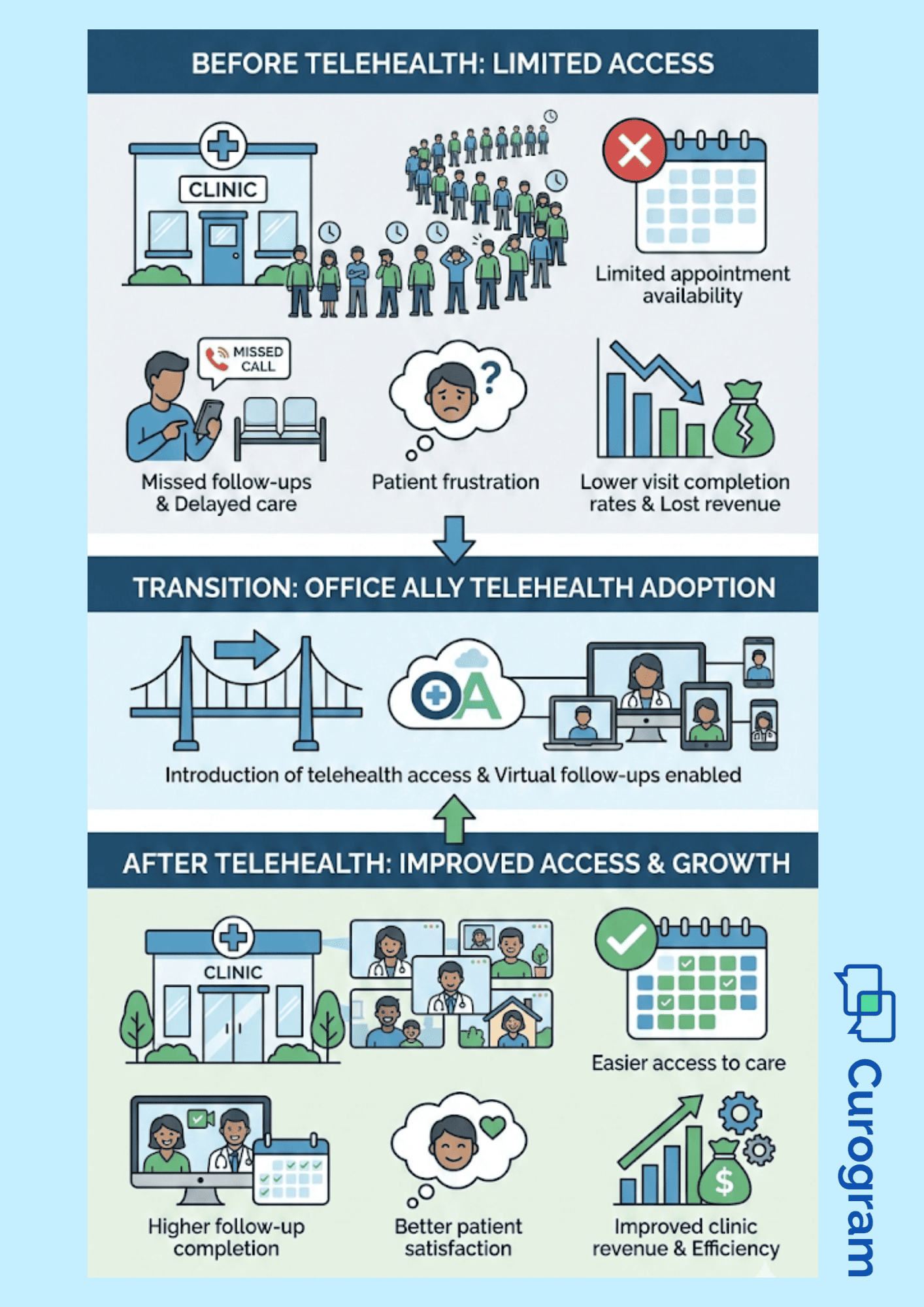
When practices rely only on in-person visits, access becomes limited by time and location. Patients who cannot return easily often delay care. These delays can lead to frustration and disengagement.
One common risk is dissatisfaction after results are ready. Patients may wait days or weeks to discuss imaging or test findings. During this time, anxiety grows and trust weakens.
Lower retention is another issue. When follow-ups feel inconvenient, patients are less likely to return. Over time, this reduces lifetime patient value.
Missed opportunities also affect revenue. Many follow-up conversations are billable but never happen. Without virtual options, these visits are often skipped.
Staff workload can increase as well. Teams spend more time rescheduling or chasing patients who did not return. This creates inefficiency and burnout.
Competition adds pressure. Practices that do not offer telehealth may lose patients to those that do. Expectations around virtual access continue to rise.
Without telehealth, growth depends on physical expansion. This requires more rooms, more staff, and higher costs. For many practices, that is not sustainable.
Over time, limited access creates a cycle. Fewer visits reduce revenue, which limits investment in better care tools. Telehealth helps break this cycle.
Telehealth changes how follow-up care is delivered. Instead of missed visits, patients can connect remotely. This keeps care moving forward.
Virtual consults reduce missed follow-ups. Patients are more likely to attend when visits fit into their schedule. This improves completion rates.
Telehealth also expands reach. Practices can serve patients who live farther away or have mobility limits. This increases patient volume without expanding space.
Each completed follow-up represents revenue that would otherwise be lost. These visits often require less time and overhead than in-person appointments.
Staff efficiency improves as well. Scheduling becomes simpler and gaps in the calendar shrink. This supports better use of provider time.
For Office Ally users, telehealth integrates into existing workflows. There is no need to overhaul systems. This lowers adoption friction.
Expanding access Office Ally telehealth helps practices grow while controlling costs. It aligns care delivery with how patients live today.
Executives focus on growth, stability, and patient retention. Telehealth supports all three. It keeps patients connected between visits.
Retention improves when follow-ups are easy. Patients are less likely to drop off after initial care. This strengthens long-term relationships.
Telehealth also improves network efficiency. Providers spend less time on no-shows and rescheduling. Resources are used more effectively.
IT leaders benefit from simplified deployment. Modern telehealth tools integrate with existing systems. This reduces technical risk.
Security and compliance remain critical. Well-designed platforms support secure communication and documentation. This protects patient data.
Competitive positioning matters. Patients expect virtual options as part of modern care. Offering telehealth keeps practices relevant.
Leadership gains clearer visibility into performance. Virtual visit data supports better planning and forecasting. This helps guide investment decisions.
An imaging group faced frequent missed follow-ups. Patients often delayed result discussions due to travel constraints.
After adding telehealth, providers conducted virtual follow-ups. Completion rates increased significantly.
Over one year, the group generated $400K in additional revenue. These gains came from visits that previously did not occur.
Costs remained stable. No new staff or physical space was added.
Start by reviewing where follow-ups are lost. Identify visits that could move to virtual care.
Next, assess patient demand and provider readiness. Small steps can deliver measurable impact.
Last but not least, expand access and improve outcomes with telehealth for Exa. Book your demo today.
Curogram helps practices adopt telehealth without disruption. The platform supports secure virtual visits within existing systems.
Office Ally users benefit from streamlined integration. Providers can offer virtual follow-ups with minimal training.
Patients receive clear instructions and easy access. This reduces friction and increases attendance.
By supporting expanded access to Office Ally telehealth, Curogram enables sustainable growth without added complexity.
Access shapes every part of patient care. When patients cannot connect easily, outcomes and revenue both suffer. Over time, small gaps create large losses.
Telehealth offers a practical way forward. It removes barriers without increasing overhead. For many practices, it is the simplest path to growth.
Expanding access Office Ally telehealth supports follow-ups, retention, and provider efficiency. With Curogram supporting secure virtual visits and patient communication, practices can offer telehealth without disrupting existing workflows.
As patient needs evolve, flexibility matters more than ever. Telehealth helps practices meet those needs while protecting margins.
By focusing on access, practices can improve care and financial stability at the same time. The result is stronger relationships and sustainable growth.
Expand access and improve outcomes with telehealth for Exa. Book a demo today.

1 min read
Jo Galvez : Apr 30, 2026, 6:56:06 PM
💡 Telehealth has changed how behavioral health practices deliver care. For organizations using InSync EMR, virtual visits improve access while...

1 min read
Sharee Narciso : Dec 12, 2025, 6:00:00 PM
💡 Telehealth helps expand access DrChrono telehealth practices rely on to serve more patients without adding physical space. Expand access for...

1 min read
Jo Galvez : Dec 18, 2025, 2:30:00 PM
💡 You rely on Allscripts PM to run daily operations, but access limits can quietly slow growth. Patients expect virtual care options. Missed...