

7 min read
Notenetic SMS Closure Notifications for Behavioral Clients
Aubreigh Lee Daculug
:
June 21, 2026
Notenetic's Client Portal carries these closure notifications, but it only reaches the clients who actually log in, and most behavioral health clients do not check a portal before every visit.
SMS broadcasts solve this. Curogram runs alongside Notenetic and sends HIPAA-compliant text alerts to filtered client lists in seconds, so a weather closure or group room change lands directly on the lock screen with no login needed.
For substance use clients covered by 42 CFR Part 2, message routing protects confidentiality, and the text never names a diagnosis or a program.
Every message includes a "Reply STOP" opt-out, so clients always stay in control.
Some problems hide in plain sight, and this is one of them.
A behavioral health client wakes up early, leaves work, and drives 45 minutes through icy roads to reach her session. She is already anxious when she pulls into the lot, walks to the door, and finds it locked. The office closed two hours ago, and nobody managed to reach her in time.
The closure notice did go out, posted to Notenetic's Client Portal at 7:35 AM. But she never logged in, because almost nobody opens a portal before a morning appointment. The information existed; it simply never reached the person who needed it.
This gap is quiet, and it is surprisingly expensive. Every missed closure burns your staff's time, frustrates your clients, and slowly chips away at their trust. In behavioral health, trust is not a nice-to-have feature; it is the ground the entire relationship stands on.
Here is the hard part: your portal is working exactly as designed.
It faithfully carries the message, but it waits for the client to come and find it. And the clients who struggle most with anxiety, focus, or active substance use are the least likely to go looking.
So the message just sits there. The client drives. The door stays locked.
There is a far simpler way to reach people, and it is the device already sitting in their hand.
A text appears on the lock screen with no login, no app, and no hunting through old email. Sending SMS broadcasts to behavioral health clients gives a Notenetic practice the closure notification channel it is missing, with alerts that fire the second a decision is made.
This article shows you why the portal alone falls short, how a parallel text layer fixes it, and what truly changes when clients finally know.
The Real Cost of a Missed Closure
The villain in this story is not your staff or your software. It is the missed closure, the moment a change to the schedule never reaches the person it affects. It looks small. It is not.
When the weather closes your office
Say a winter storm rolls in, so you make the call at 7:30 AM and close for the day. You update the portal at 7:35 AM, but by 9:15 AM, three clients have already left work, driven through dangerous roads, and found a locked door.
None of them logged in that morning, and honestly, why would they?
A therapy practice closure notification only helps when it lands somewhere the client genuinely looks, and the portal is rarely that place.
When a group room moves at the last minute
Now take a typical Wednesday DBT group. The room changes, the update posts to the portal at 11 AM, and by 2 PM, 8 of 22 members arrive at the old room.
Some wait and some leave, so the session starts late and the focus the clinician carefully planned for is gone before the real work even begins.
A simple group therapy room change alert by text would have reached all 22 members at lunch. Instead, an invisible administrative gap quietly undercut the clinical care.
The slow trust cost you never see
Every missed closure is a small withdrawal from the client's trust, and "they didn't tell me" gradually becomes a pattern. Over time, that pattern lowers both engagement and attendance.
In most industries this is merely an annoyance, but in behavioral health it carries real clinical weight. The operational gap quietly becomes a therapeutic one.

Here is the same problem laid out plainly:
| What goes wrong | What it costs your practice |
|---|---|
| Client drives to a closed office | Lost trust, an apology call, a likely reschedule |
| Eight clients miss a room change | A late start, diluted group focus, wasted clinician time |
| Repeat "they didn't tell me" moments | Lower engagement, higher dropout, weaker outcomes |
None of this ever shows up on a report, which is exactly what makes it so dangerous. The gap stays completely invisible until the day you finally close it.
A Real-Time Text Layer That Reaches Everyone
So how do you reach the clients a portal consistently misses?
You meet them where they already are. That is the role Curogram plays alongside Notenetic, acting as a real-time awareness layer that sends HIPAA-compliant text alerts to the exact group that needs them.
Here is how a single broadcast works in practice:
- You pick the cohort, whether that is 22 DBT members, 80 active clients facing a snow day, or one IOP group.
- You write a short, plain message about a closure, a room change, or a time shift.
- You send, and within seconds every client gets a normal-looking text on the phone they are already holding.
There is no portal login, no app to download, and no email attachment to hunt for. A behavioral health weather closure SMS lands on the lock screen at 7:35 AM, and the client sees it on her way out the door.
Built for sensitive caseloads
Behavioral health carries privacy rules that general medicine simply does not. For substance use treatment clients covered by 42 CFR Part 2, broadcast routing protects confidentiality at every step.
You get three clean ways to handle those clients:
- Exclude them from mixed-group broadcasts entirely.
- Send them neutral wording that never hints at a program.
- Keep them on a separate broadcast track of their own.
The text itself never carries a diagnosis, so a closure simply reads as a closure. Every message also includes an automatic "Reply STOP" that keeps clients in control.
Why it fits behavioral health so well
This is really about how your clients already use their phones. They glance at incoming text alerts all day without thinking about it, yet they rarely log into a clinical portal on purpose.
Strong IOP cohort communication depends entirely on that everyday habit.
A room change at 11 AM reaches the whole group at lunch, seen without a login and acted on within seconds, which is the difference between a message that merely exists and a message that actually arrives.
What Changes When Clients Actually Get the Message
When the message reliably reaches people, the entire experience changes. Clients stop wondering whether they missed something, and they start trusting that you will reach them when it genuinely counts.
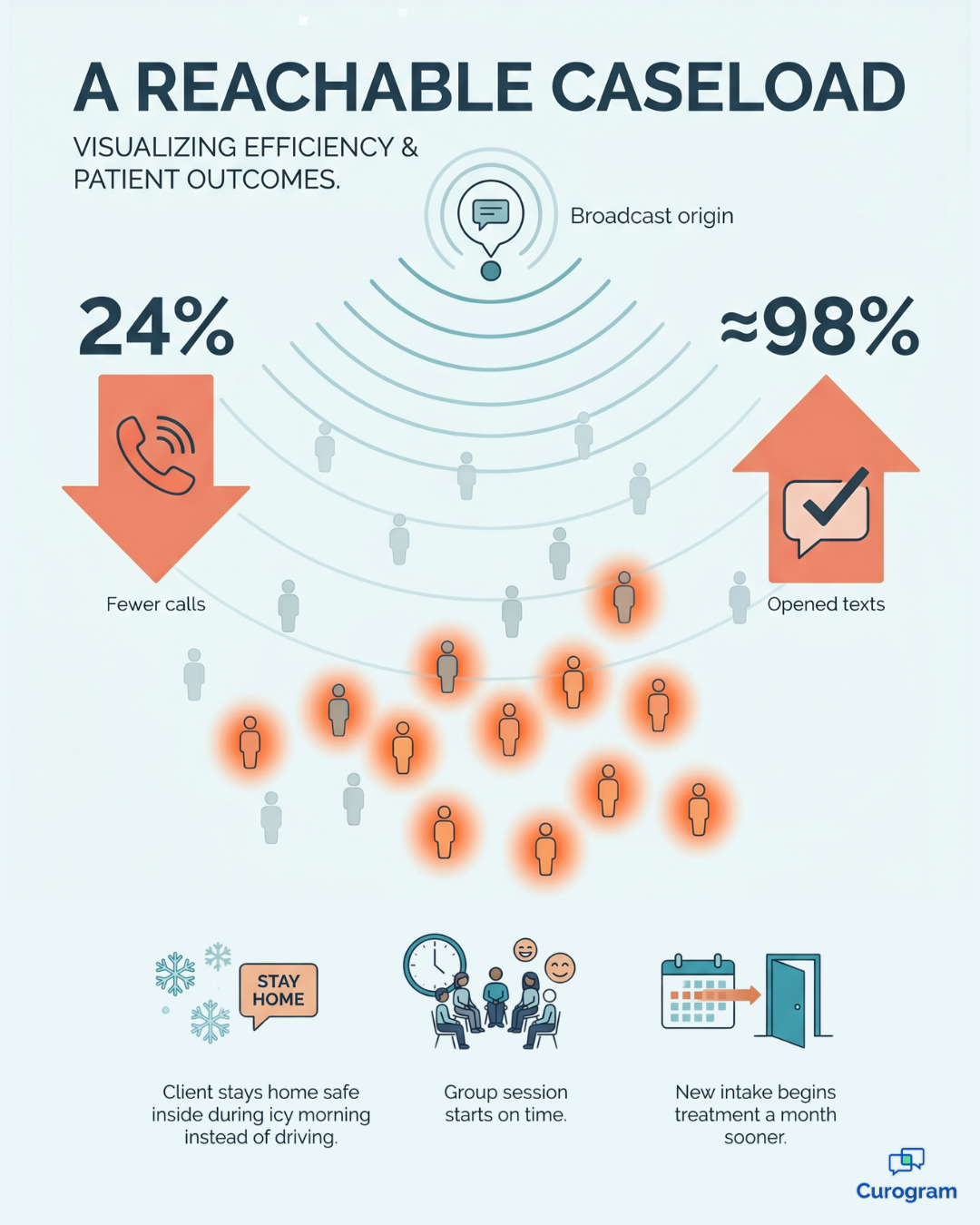
River Valley Family Health Center cut phone call volume by 24% on the Curogram platform.
A good share of that drop came from clients who stopped calling to ask whether the office was open, simply because they already had the text. As COO Jessica Sweet said, the two-way texting capability has significantly improved how the practice communicates with patients.
The math behind that is refreshingly simple. Texts get opened at a rate near 98%, far above either email or a buried portal notice, so when you send a closure alert you can trust it gets seen, usually within minutes.
That is the long-standing gap in mental health practice client notifications, finally closed for good.
Here is what it actually looks like on a normal day:
- A psychiatry client checks her phone over coffee at 7:40 AM, sees the snow closure, and stays home, avoiding a 45-minute drive through ice.
- A DBT member sees the 11 AM room change before lunch and walks calmly into the right room at 2 PM.
- A new IOP intake spots a waitlist opening, replies to confirm, and starts treatment a full month sooner.
None of these clients had to log in or remember a password. They just got a text and acted on it, and that is what stronger Notenetic client awareness looks like day to day.
Don't Let Another Client Find a Locked Door
Notenetic's Client Portal does its job well. It holds your schedule, your notes, and your record of every change, but it always waits for clients to come to it. And in behavioral health, most of them simply will not, especially not before a morning session during an overwhelming week.
So the portal becomes a record for you rather than a signal for them. Your client needs to know that the room moved or the office closed.
A text message tells her directly, while a portal can only hope that she remembers to check.
That is the whole difference. Notenetic keeps your version of the schedule, and a real-time text layer keeps your clients aware of every change to it. One is built for your files, and the other is built for their day.
Trust in behavioral health is built in small moments, and a timely heads-up is clearly one of them. So is a locked door at the end of a 45-minute drive. Every single week, you quietly choose which kind of moment your clients actually get.
The good news is that the fix is genuinely simple, because you do not replace a single thing. You add a parallel channel that reaches your whole caseload in seconds, on the device your clients already check.
Your staff stops fielding "are you open?" calls, your groups start on time, and your clients stop driving to locked doors. The quiet trust withdrawals finally stop adding up.
You have seen the problem and you have seen the gap, so now see exactly how fast you can close it.
Schedule a Demo and watch how quickly Curogram reaches your entire behavioral health caseload alongside Notenetic. We will walk through your real scenarios together and show you how each one plays out.
Frequently Asked Questions
You control who gets each broadcast, so 42 CFR Part 2 rules are respected at every step. You can leave substance use clients out of mixed-group texts, send them neutral wording that never hints at treatment, or run them on a separate list entirely. The text never names a diagnosis or a program, so a closure text simply reads as a closure. This privacy control is built directly into the workflow, not bolted on afterward.
That is fully supported. Curogram captures TCPA-compliant consent at sign-up and adds a "Reply STOP" opt-out to every message, with each client's preferences tracked on their own profile. A client can opt out of group broadcasts but still text your front desk one-on-one, or drop SMS entirely and stick with the portal or phone. The point is that you respect the choice instead of forcing a single channel on everyone.
This is exactly what broadcasts are built for. The text goes out the moment you make the call, often around 7:35 AM, and most behavioral health clients glance at a text on their lock screen long before they would ever open a portal. Practices that use Curogram for weather closures usually find the locked-door problem mostly disappears after the very first storm.
No, and that is really the whole point. Curogram runs as a parallel layer alongside Notenetic, so you keep your existing schedule, notes, and records exactly where they already live. Your team does not learn a new system or change its daily workflow. You simply gain a fast text channel for the moments a portal cannot reach.
In seconds. You filter the list, type a short message, and send it to the exact group that needs it, whether that is one IOP cohort or 80 active clients at once. There is no calling tree and no waiting on staff to work down a long phone list. A single snow-day decision at 7:35 AM can reach everyone before they leave the house.