

8 min read
Notenetic Google Reviews Automation for Behavioral Health
Aubreigh Lee Daculug
:
June 18, 2026
Notenetic runs your documentation, billing, and telehealth, but it has no built-in way to ask for reviews.
Curogram fills that gap. It works beside Notenetic and sends an automated post-visit survey by text. Happy clients get routed to your Google profile. Unhappy clients get routed to private feedback you can fix.
The proof is real. River Valley Family Health Center went from 101 reviews at 1.67 stars to 479 reviews at 5.0 stars in 22 months.
Your practice does excellent clinical work. Clients improve. They stay in care. They quietly refer their friends and family.
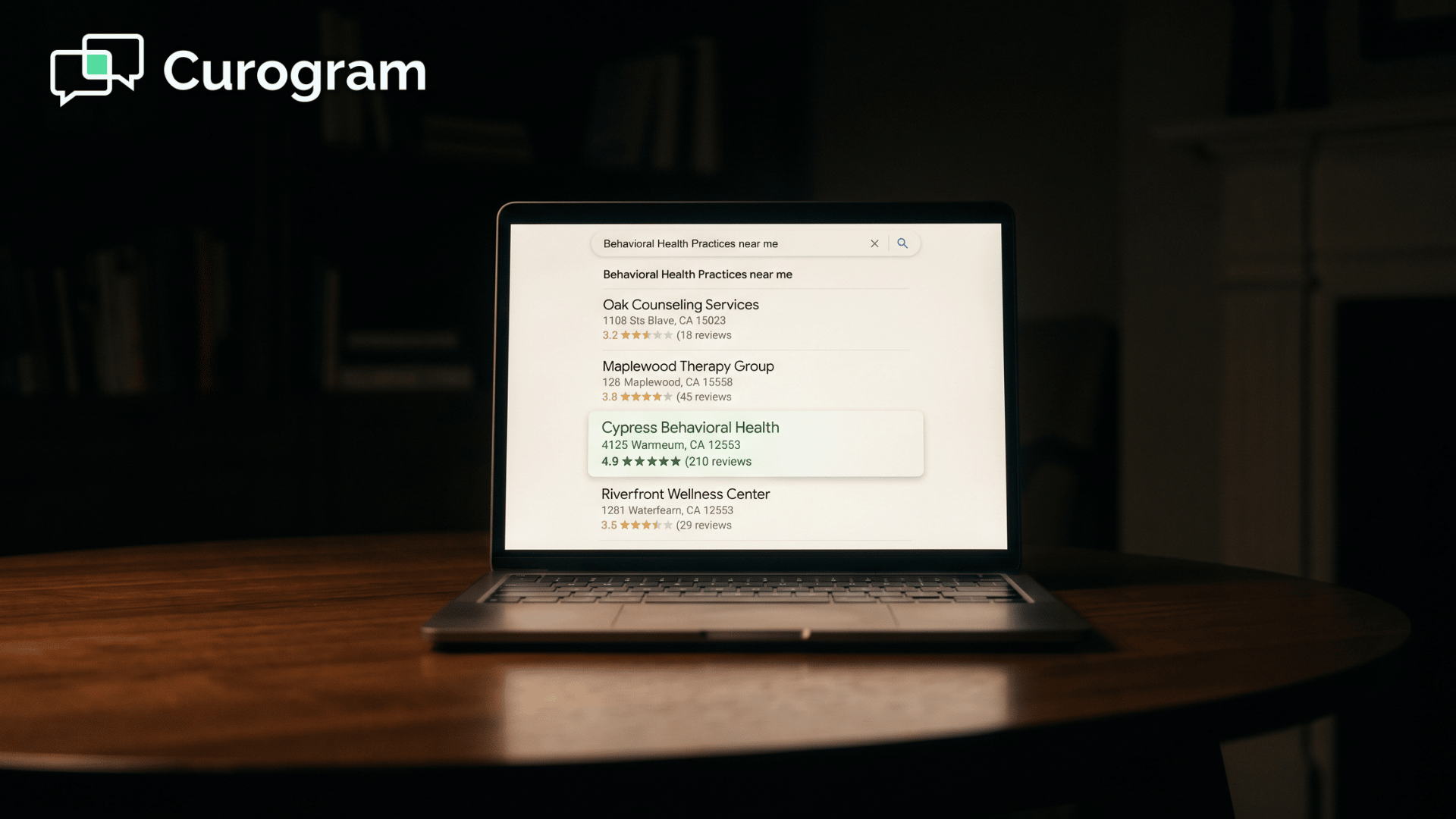
Then someone new searches "therapist accepting new patients" in your city. Your practice barely shows up.
They never see the trauma-informed care. They never see your retention numbers. They see a thin profile with a few old reviews and a so-so star rating.
That is the whole problem in one moment.
The care is excellent. The public signal is silent. And in behavioral health, that silence costs you more than you think.
Here is why. A new client choosing a therapist or psychiatrist is not picking a coffee shop. They are deciding to share trauma, ask about medication, or admit a problem. The trust bar is high.
A strong, recent, positive Google profile is not a nice extra. It is the front door.
Now think about what most practices actually do about reviews. Almost nothing.
Most owner-therapists feel awkward asking. Most managers have no time. And most behavioral health software, Notenetic included, does not ask for you.
So the reviews never come. The profile stays frozen in 2019. And the clients who need you most quietly choose someone else. Not because your care is worse than the practice down the street. Simply because, in one search, they never saw it.
It sounds like a small thing. It isn't.
The good news is that this gap is fixable, and you do not have to switch your EHR to fix it. You do not have to beg for stars at checkout. You do not have to bolt on a clunky tool that connects to nothing.
You just need a system that asks the right clients at the right time, automatically. That is what the rest of this article is about.
When Excellent Care Stays Invisible Online
Imagine two practices in the same city.
Both deliver strong, evidence-based care. One shows up in search with 200 recent reviews at 4.9 stars. The other shows up with 11 reviews from 2019 at 3.8 stars.
The clinical work might be identical. The new client will never know. They choose the profile, not the practice.
The Mismatch That Quietly Costs You Clients
Notenetic gives you what you need to run the clinical side. Documentation, billing, and embedded telehealth all live there. What it does not include is a review request workflow, an automated post-visit survey, or a Google Business Profile connection.
So practices that want a steady flow of reviews have to build the habit by hand.
That usually means one of three workarounds:
- Asking each happy client at checkout, which feels uncomfortable in behavioral health.
- Sending a one-off email that almost no one opens.
- Paying for a separate tool that does not connect to anything else you use.
None of those stick. The result is a behavioral health Google Business Profile that quietly falls behind.
Why Behavioral Health Has a Higher Trust Bar
In primary care, a patient often picks the in-network doctor with decent reviews and moves on. Behavioral health is different.
Your future client is weighing something far more personal. They are deciding whether to trust you with trauma, medication, or recovery. That choice carries real weight.
This is why therapy practice online reputation matters more here than almost anywhere else in healthcare.
A strong profile lowers the fear of reaching out.
A weak one quietly raises it.
The Opening Almost Nobody Is Taking
Here is the part most owners miss. Behavioral health is the least likely segment of healthcare to manage its reputation on purpose.
That means the field is wide open. The first practice in your area to build a 200-review, 4.9-star profile becomes the default referral for the whole metro.
In practice, that is your competitor's missed chance, sitting right on the table. The only question is whether you pick it up first.
How Curogram Builds Your Reputation in the Background
This is where Curogram comes in. It works as a parallel text layer beside Notenetic, quietly turning everyday visits into public proof.
The idea is simple. After an appointment, the right client gets one friendly text asking how things went. From there, the system handles the routing for you.

The Survey in Four Simple Steps
Here is how Curogram's automated survey and rating requests work, step by step:
- A client finishes an appointment, and Curogram sends a single SMS asking about their experience.
- If they reply happy, they are routed straight to your Google profile to leave a review in one tap.
- If they reply unhappy, they are routed to a private feedback channel that only your team sees.
- Your team reads that private note and follows up directly, before it ever becomes a public 1-star review.
That last step is the quiet hero. It is a safety valve that keeps one bad day from turning into a permanent public stain.
Working Around Notenetic's Missing API
Notenetic does not currently offer a public API, so the survey does not write back into the chart. That sounds like a limitation, but in practice it rarely is one.
Instead, the client and visit list live in Curogram, and the post-visit text fires based on appointment timing there. Your documentation, scheduling, and billing stay in Notenetic, untouched. For most small and mid-sized practices, that setup is exactly right.
Tuned for Behavioral Health Sensitivities
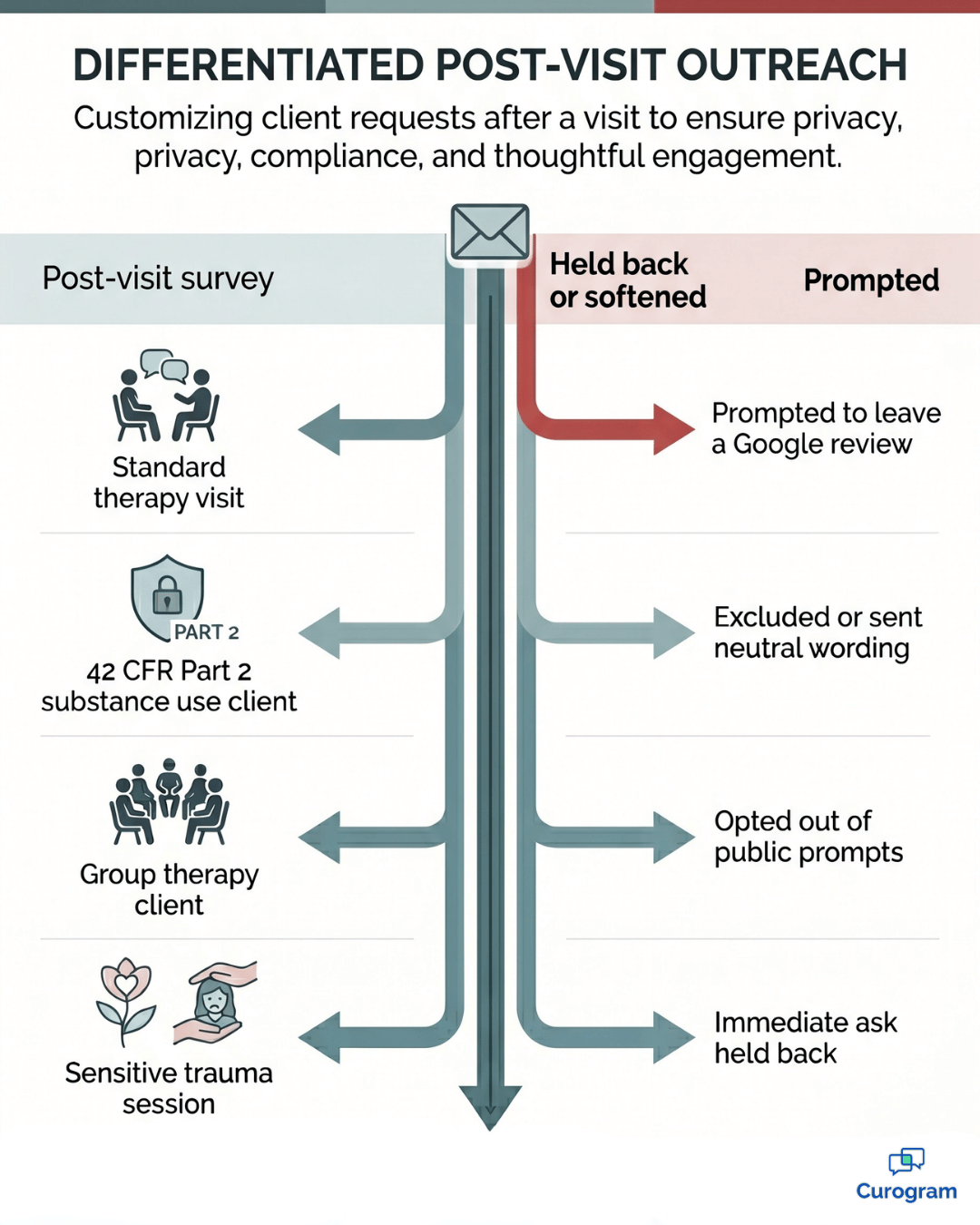
The behavioral health fit is the part that matters most. Not every appointment should trigger a review prompt, and Curogram is built to respect that.
You can exclude substance use clients covered by 42 CFR Part 2, or send them neutral wording that never flags the treatment relationship. You can opt group therapy clients out of public prompts entirely. You can hold back immediate asks after sensitive trauma sessions.
This is what good Notenetic reputation management looks like in behavioral health. It is not a blast to everyone.
It is the right ask, to the right client, at the right moment.

What Happens When Your Reputation Finally Shows Up
So what does this actually change? The clearest answer is in the numbers.
The Proof From Two Real Practices
| Practice | Starting point | Result | Time frame |
|---|---|---|---|
| River Valley Family Health Center | 101 reviews at 1.67 stars | 479 reviews at 5.0 stars | 22 months |
| Optima Medical | 993 reviews | 8,159 reviews | 16 months |
Let's put those numbers in plain terms.
River Valley grew its review volume by 474% and lifted its rating by 3.33 stars. That is the difference between a profile new clients scroll past and one they trust on sight.
The team felt it day to day, too. As COO Jessica Sweet put it, "Implementing Curogram has been a game-changer for our team. The two-way texting capability has significantly improved how we communicate with patients." Phone call volume also dropped 24% along the way.
Optima Medical shows what this looks like at scale. The practice grew from 993 to 8,159 reviews in just 16 months, a 721% jump.
When Review Volume Becomes a Moat
At that level, something powerful kicks in. Local SEO starts to compound, and the practice becomes the default search result in its area. Fresh psychiatry clinic Google reviews and steady mental health practice reviews stop being a chore and start being a moat.
For your team, the shift is easy to picture. The same clinical quality you already deliver finally shows up where new clients are looking.
You move from excellent-but-invisible to visible. That is the whole point.
Where This Fits Into the Workflow You Already Run
By now the results probably make sense, and the fair next question is a simpler one: exactly how much work is this for your team?
The honest answer is that it amounts to very little, because the review request is not a separate new project. It rides along with the appointment reminder cadence you already have.
In fact, the ask lands best right after the appointment reminders your practice already sends. The client gets a reminder before the visit and a short survey after it, all on the same text thread they already trust.
Here is what your team does, and does not, have to take on:
- No new logins to learn. The survey runs on its own once it is set up.
- No chasing clients for reviews. The text does the asking at the right moment.
- No awkward checkout conversations. Nobody has to request a review face to face.
- No exposure to surprise public reviews. Unhappy feedback is caught privately first.
That is the real point of automation here. The system carries the steady, repeatable work so your staff can stay focused on care.
And because it runs on the same SMS channel as your reminders and two-way messages, there is nothing extra to bolt on. One thread, one experience, no new tab open all day.
For your team, that means a growing review profile without a growing to-do list.
Let Your Best Work Show Up Where New Clients Look
Here is the simple version of everything above. Notenetic runs the clinical side of your work. Curogram runs the public-facing trust signal that brings your next client through the door.
Think about how those two jobs differ. Notenetic is your record of the care you give. It holds the notes, billing, and the schedule. It is built for you.
Curogram is built for them. It shapes the moment a stranger decides whether to trust you with something deeply personal.
In behavioral health, asking happy clients for reviews is not self-promotion. It is access work.
Every honest review you collect is a small signal that helps the right new client find their way to the right provider. Someone searching late at night, scared and unsure, scrolls past the silent profiles and stops on the one that looks alive and trusted. That one could be yours.
The clinical excellence is already there. You have done the hard part for years. The only thing missing is a system that lets that excellence show up where people are actually looking.
That system does not require switching your EHR. It does not require awkward asks at checkout. It runs quietly in the background, sending the right message to the right client at the right time.
So stop letting your best clinical work stay invisible to the searchers who need it most. The clients are out there right now, quietly ready to reach out. They just have to be able to find you in the first place.
You can see exactly how this works for a practice like yours in a short, behavioral-health-specific walkthrough.
Schedule a Demo with Curogram, and we will show you how to turn your everyday visits into the reputation new clients search for. No long-term contract required.
Frequently Asked Questions
Yes, when it is done with the right safeguards. Curogram's post-visit survey is configurable by practice, by appointment type, and by client. That means substance use clients under 42 CFR Part 2, sensitive trauma sessions, and group therapy clients can be excluded or sent neutral wording that never flags the treatment relationship. The prompt itself never contains diagnostic content, and clients can opt out with a single reply. The honest framing is that access for future clients depends on current clients choosing to share their experience, only when they want to and never when it would be inappropriate.
No. The survey routes happy clients to leave a public Google review and unhappy clients to a private feedback channel your team can act on. This is the key safety valve. A 1-star Google review is permanent and public, while private feedback gives you a chance to make things right, or simply learn from it, without exposing that client's experience. River Valley's jump from 1.67 stars to 5.0 stars depended on exactly this mechanism.
Curogram runs as a parallel communication layer, with the appointment and client list kept in Curogram. The post-visit survey triggers based on appointment timing inside Curogram, not a write-back into Notenetic. For most small and mid-sized behavioral health practices, this setup is exactly right. The workflow runs automatically and never touches the Notenetic chart of record.
Sooner than most owners expect. Because the survey fires after each visit, the first new reviews can land within days, not months. The bigger profile shift takes longer to build, of course. River Valley reached its 5.0-star profile over 22 months, but the momentum starts the very first week prompts go out, and steady weekly visits turn into a steady weekly stream of reviews.
Yes. Curogram is built for healthcare, with a signed BAA and HIPAA-compliant SMS. The survey prompt never includes diagnostic details, the reason for the visit, or anything that flags the treatment relationship. Clients simply get a neutral message asking how their visit went, which keeps the whole workflow safe even for sensitive behavioral health care.