
7 min read
Why Behavioral Health Clients Choose Therapists on Google
Aubreigh Lee Daculug
:
June 19, 2026
Notenetic records the care you deliver. It doesn't build the public reputation that brings new clients to your door.
Curogram runs alongside Notenetic, sending an automated text after each visit that routes satisfied clients to your Google profile.
The proof: River Valley moved from 1.67 stars to 5.0 stars in 22 months — turning a damaged profile into a front door clients trust.
She has been thinking about reaching out for months. Tonight, at 11:47 PM, in a quiet room with the lights turned low, she finally types four words into her phone: "therapist accepting new patients."
Three practices appear at the top of the screen, and she will choose one of them before she falls asleep.
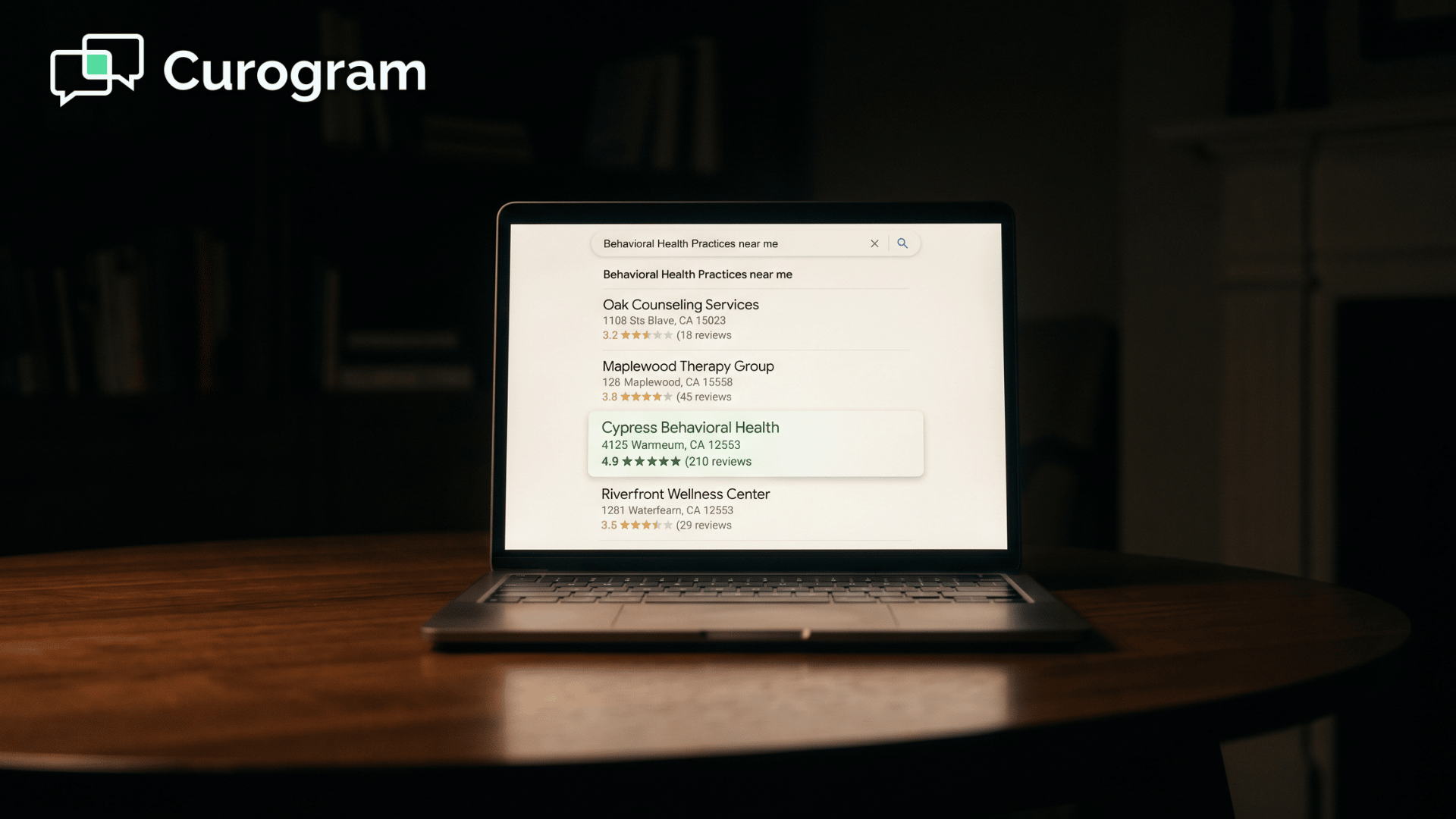
This is where the behavioral health new client decision actually gets made. Not on your website. Not in your waiting room. It happens on a search results page, in the handful of seconds it takes to scan a star rating and skim a few recent reviews.
For someone finding a therapist online, those stars carry an enormous amount of weight. The choice to reach out at all is fragile and easily abandoned. A thin or outdated Google profile gives an already anxious person every reason to close the tab and promise themselves they'll handle it some other day.
And "some other day" often quietly becomes never at all. This is how good clients slip away.
Here's the uncomfortable part.
The practice with the strongest clinical care does not automatically win that moment. The practice with the strongest public profile does. Mental health provider selection now begins inside a search bar, and that search bar rewards visible, verifiable trust rather than quiet excellence.
Building behavioral health practice reputation through Google reviews is the piece Notenetic was never designed to handle. Notenetic faithfully runs your clinical record.
It does nothing about the public signal that determines whether a complete stranger will trust you enough to actually call.
That gap is steadily costing you clients you never even realized were searching for you.
The good news is that it is fixable — and it doesn't require changing a single thing about the excellent care you already provide every day.
The 11:47 PM Search That Decides Everything
Let's stay with that searcher for a second, because her hesitation is the whole story.
In primary care, a weak Google profile is a small annoyance. The patient needs a physical, so she calls anyway. The trust threshold is low because the stakes feel low.
Behavioral health is different.
A handful of pressures unique to this field raise the bar a practice has to clear before someone is willing to pick up the phone:
- Anxiety and stigma make reaching out feel risky to begin with.
- A past bad experience leaves people cautious and slow to trust again.
- The vulnerability of disclosure makes choosing the wrong provider feel deeply personal.
Stack those together and you get a far higher trust threshold than almost any other specialty faces. This is exactly why psychiatry practice reviews matter so much here. The therapist Google search trust gap is the difference between a call and a closed tab.
Now look at what she's comparing.
| What she sees | Practice A | Practice B |
|---|---|---|
| Review count | 11 reviews | 200+ reviews |
| Average rating | 3.7 stars | 4.9 stars |
| Most recent review | 2019 | Last week |
| Recent posts | None | Trauma-informed care, Medicare accepted |
The clinical care at Practice A might be every bit as good. Maybe better. But she can't see that. She sees a profile that feels abandoned, and she picks Practice B.
Here's what makes it worse.
Every client Practice A loses is also a future review it never earns. The gap doesn't hold steady — it widens, month after month, search after search.
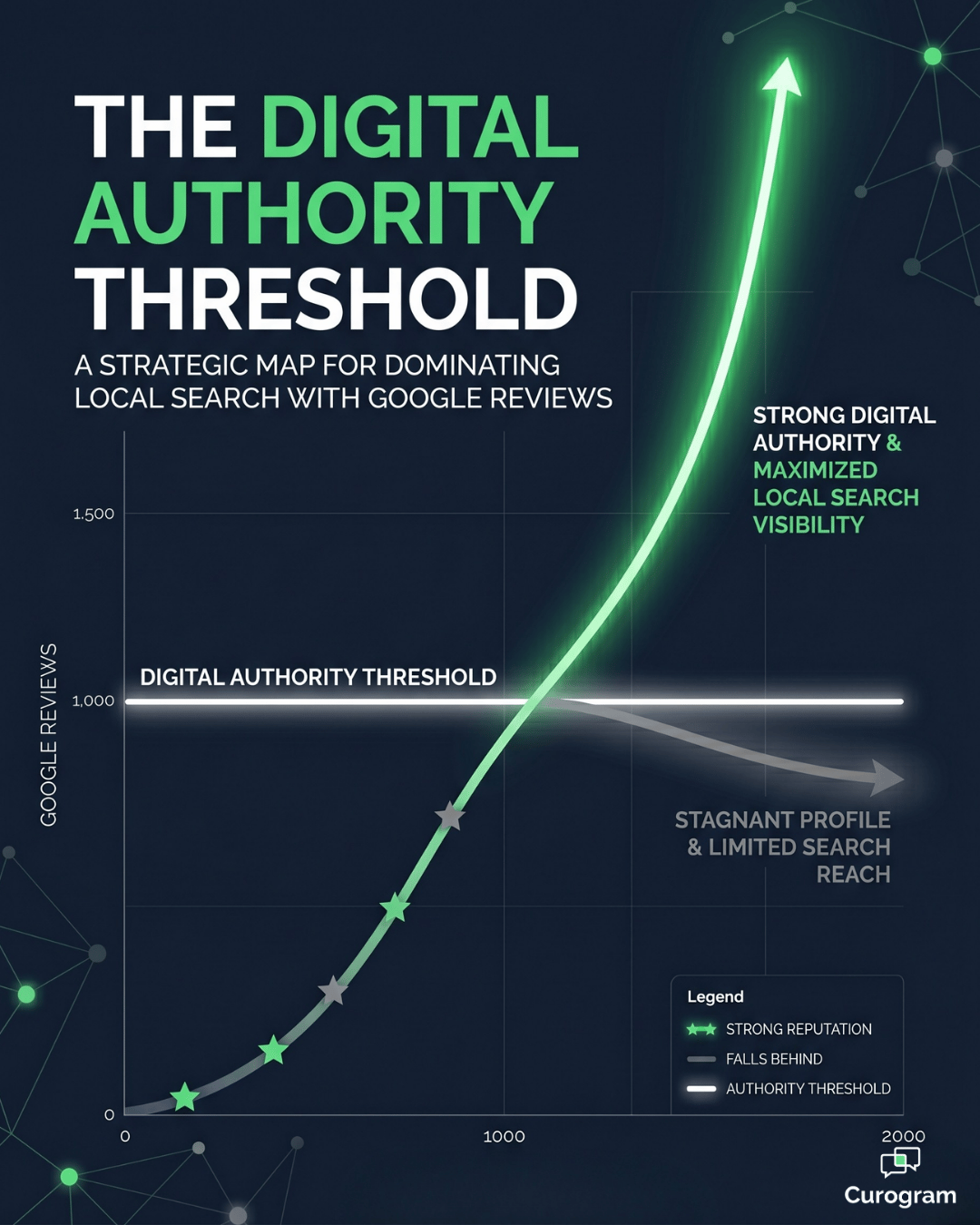
There's a tipping point on the other side, too. Optima Medical grew from 993 reviews to 8,159 in 16 months. Once a profile crosses roughly 1,000 reviews, local search momentum starts feeding itself, and the practice becomes harder and harder to beat.
Thin profiles fall behind. Strong ones pull away.

How Happy Clients Become Your Front Door
So how do you build that signal without turning your front desk into a marketing team?
This is where Curogram works alongside Notenetic — not replacing it, just adding the layer it was never meant to cover. Curogram quietly turns the satisfaction your current clients already feel into the public proof your next clients are searching for.
Here's the simple version of how it runs.
One text after the visit
After a completed appointment, Curogram sends a single SMS asking how things went. No app to download. No login. Just a question a person can answer in one tap, hours after they've left your office.
Smart routing that protects everyone
What happens next depends on the answer:
- Happy clients get a one-tap link straight to your Google Business Profile to leave a public review.
- Unhappy clients get a private feedback form that comes to you directly — so you can fix the issue, and it never lands in public.
This single fork does two jobs at once. It grows your positive reviews and gives you an early warning system for the rare client who left unhappy.

Built for behavioral health rules, not bolted on after
This is the part generic review tools get wrong. For substance use treatment clients covered by 42 CFR Part 2, the SMS can drop any treatment-specific language, or skip those appointment types entirely.
Group therapy clients can be left out of public routing. Confidentiality isn't an afterthought here — it's a setting you control from the start.
And there's a reframe worth sitting with. Asking a happy behavioral health client for a review isn't self-promotion. It's access work.
Every honest review is one more piece of evidence the next searcher needs to take the next step. The care you already deliver simply becomes findable by the people who need it most.
What Changes When Your Profile Earns Trust
Numbers tell this part better than adjectives do.
River Valley Family Health Center moved from 1.67 stars to 5.0 stars in 22 months. Sit with that starting point for a moment. A 1.67-star profile doesn't just fail to attract new clients — it actively pushes them away.
The turnaround came from no clinical change at all, just a steady workflow asking satisfied clients to share their experience.
Then there's scale. Optima Medical went from 993 reviews to 8,159 in 16 months — a jump of more than 720%. That's the difference between a profile a searcher scrolls past and one that anchors the top of local results.
What does that mean for your team in practice? Three shifts:
- More inbound reviews, on autopilot. The asking happens in the background, after every eligible visit, without your staff lifting a finger.
- A rating that signals trust on first sight. The 11:47 PM searcher sees a recent, high-volume profile and reads it as "this practice is real, active, and worth a call."
- Compounding momentum. Each new review makes the next client more likely, which earns the next review. The gap with thinner competitors stops widening against you and starts widening for you.
Put plainly: your practice moves from "known only by word of mouth" to findable at the exact moment someone is ready to reach out. That late-night search ends in a phone call to you — not a hesitation that loses the client to a competitor, or to no provider at all.
That's the whole point. The strong behavioral health first impression you'd make in person finally shows up where the decision is actually happening.
Let The First Search Find You
The first decision a new client makes about your practice happens well before they ever call. Your Google profile is the front door — and Notenetic, for all the things it does well, simply doesn't build it.
Think about the two systems sitting side by side.
Notenetic is the record of the care you deliver. Curogram is the first impression of whether someone should trust you with that care in the first place. One looks inward at your clinical work. The other looks outward at the anxious person deciding whether to reach out at all.
Together, they turn what already happens inside your office into something new clients can actually see from theirs.
You don't need to change your clinical approach. You don't need a marketing department, an awkward script at checkout, or a staff member manually chasing reviews. You need a quiet, automated workflow that runs in the background and asks the clients who are already glad they came.
That is the entire gap. It really is that simple to fix.
Right now, every single week, people who would have been a genuinely good fit for your practice are searching, hesitating, and choosing someone else — not because that competitor is better, but because it simply looks more trustworthy from the outside.
You can close that gap. The clinical care is already there. The only missing ingredient is the public signal that lets the right people actually find it.
Stop letting prospective clients hesitate on a thin profile and quietly slip away. Build the trust signal that makes the next call the obvious one.
See exactly how this works for a practice like yours, with your specific appointment types and confidentiality rules in place. Schedule a Demo, and we will show you the gap — and how quickly you can close it.
Frequently Asked Questions
It depends entirely on how and when you ask. Curogram's survey can be configured per appointment type and per client, so trauma sessions, substance use treatment visits, group therapy, and other sensitive contexts can be excluded from prompts completely. For routine medication management, established therapy maintenance, and other lower-risk visits, the text arrives 2 to 6 hours later in neutral language. Most of the discomfort owners feel comes from imagining a manual ask at checkout — an automated, easy-to-decline text removes that pressure for everyone.
The routing logic is configurable per client and per appointment type. Clients covered by 42 CFR Part 2 can be excluded from prompts altogether, or sent neutral requests that never mention or imply treatment content. The SMS itself contains no diagnostic language, and any client can opt out with a single reply. Part 2's stricter confidentiality rules are treated as a core design constraint, not a box checked after the fact.
Most practices see review volume start to climb within the first 30 to 60 days, as the automated workflow generates a steady stream of inbound reviews. The rating shift takes longer — River Valley's 1.67-star to 5.0-star turnaround unfolded over 22 months, because crowding out old negative sentiment with verified positive feedback takes time. Optima Medical's scale outcome ran 16 months. Reputation builds durably rather than overnight, and the system keeps running quietly the whole way through.
No. Curogram runs alongside Notenetic as a separate layer, not a replacement for it. Your clinical record, scheduling, and notes stay exactly where they are today. Curogram simply adds the public review workflow that Notenetic was never built to handle, so your team keeps the system it already knows and gains the front door it was missing.
That feedback never lands on your public profile. When a client signals they were unhappy, Curogram routes them to a private form that comes straight to you instead of to Google. This gives you a chance to follow up and make things right before frustration ever becomes a public review. In practice, it works as an early warning system — you hear about a problem privately, while your public profile keeps reflecting the clients who were glad they came.