9 min read

Google Review Automation for Notenetic Clinics | Curogram

Google Review Automation for Notenetic Clinics | Curogram
💡 Google reviews automation for Notenetic mental health practices works through a second texting layer. It sends the same review invite to every client after a visit. Notenetic handles notes, billing, telehealth, and the client portal. Review requests sit outside all four.
  • One text goes out once the visit is marked complete, with a direct link to your Google profile
  • Every client gets that same link, since Google's April 2026 policy bans sorting requests by who seems happy
  • The copy names no diagnosis, no clinician, and no service, so none of it is PHI
  • Replies land in a staff inbox, so a complaint reaches a person before it reaches Google
  • Based on our internal data, one multi-location practice added 1,064 new 5-star reviews in three months with Curogram post-visit surveys
Curogram runs beside Notenetic as a second layer. Nothing inside the EHR changes.

Most behavioral health practices we talk to have fewer than 15 Google reviews. Some have four. The clinical work is strong, clients stay in care, and the profile still reads like a business that opened last month.

That gap is the whole problem. Google reviews automation for Notenetic mental health practices closes it without putting a single awkward ask inside a therapy hour.

Prospective clients research hard before they reach out. Calling a therapist is a vulnerable act, and people put it off for weeks.

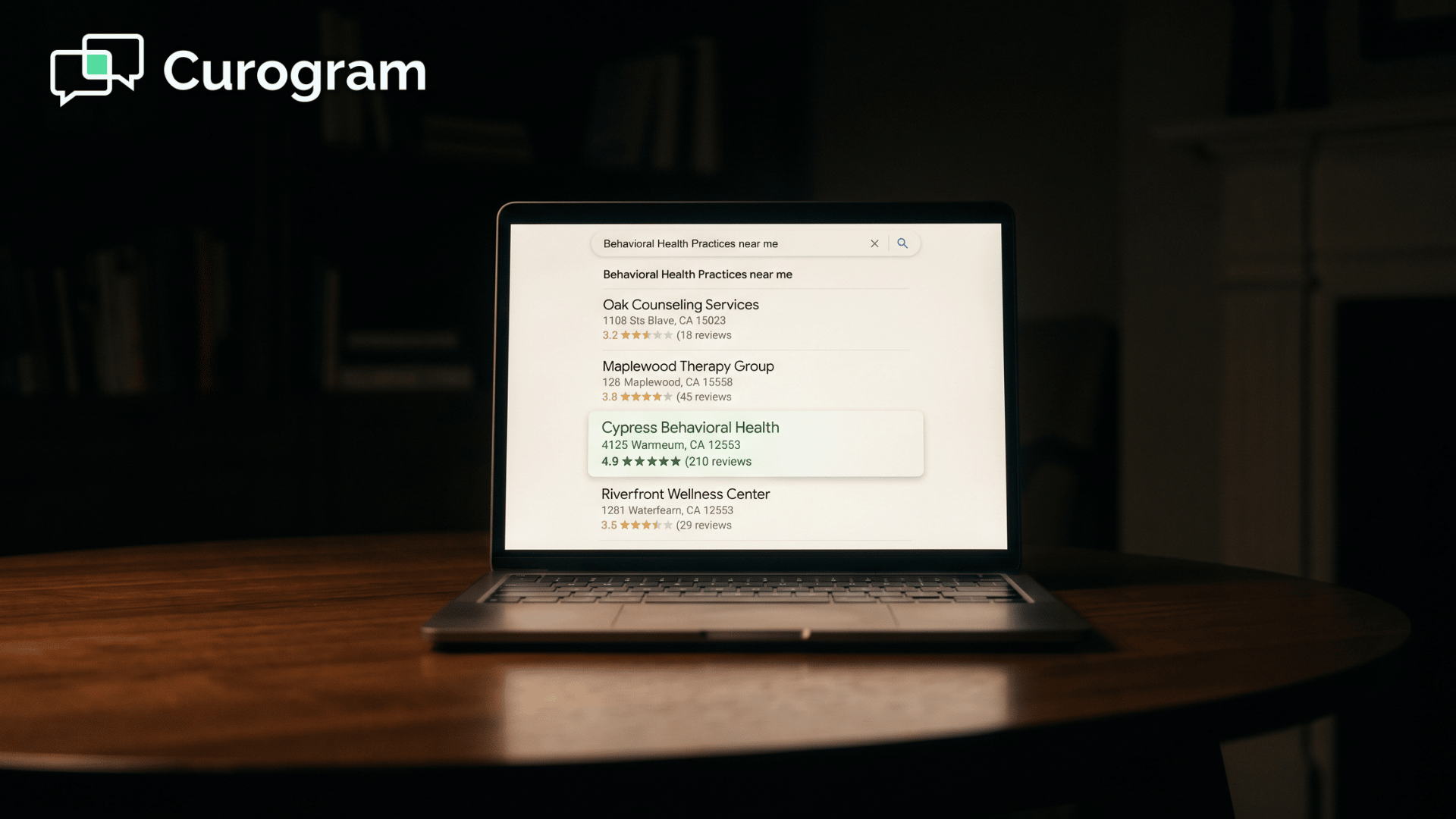
Based on our internal data, 90% of new patient leads look at a Google Business Profile before they ever load the website. A profile with four reviews reads as risk, and they scroll down to the practice below yours.

Notenetic does its job well. Progress notes, assessments, claims to thousands of payers in two clicks, secure telehealth, a client portal for documents and messages. None of that touches your public reputation, and none of it was built to.

One warning before you build anything. In April 2026, Google updated its Maps content policy and began enforcing a rule that already existed: you may not survey people first, then send the Google link only to the happy ones.

Plenty of reputation software still ships with that behavior switched on. If yours does, turn it off this week.

What follows is the version that survives an enforcement sweep. Same message, every client, sent by text after the visit, with a real reply channel for anyone who would rather talk to you than post.

Why Good Behavioral Health Practices Stay Invisible

Someone deciding to start therapy runs a predictable sequence. They search a symptom and a city. Map pack first, then the star rating, then the review count, then two or three actual reviews.

Only after all that do they decide whether to dial.

Review count carries more weight than most owners expect. Four reviews at a 5.0 rating loses to 60 reviews at a 4.6. A small count reads as a small or brand-new practice, and someone about to describe their worst month does not want to feel like a test case.

Recency does similar work. A newest-review date from two years ago suggests a practice that stopped growing, or closed, or stopped caring.

Most practices file behavioral health online reputation management under marketing, somewhere below the website refresh.

Put it under intake instead. That profile is the front half of your funnel, and it runs whether or not you staff it.

Where Notenetic Stops

Notenetic's feature set is public and specific: custom documentation, insurance billing, telehealth, and a client portal. Clients use that portal to view and sign documents, message their clinician, and check upcoming appointments.

All four face inward. They serve the clinical record and the payer. Nothing in that stack reaches out after a session to ask how it went, and nothing publishes where a stranger can read it.

Call that a design decision, not a flaw. An EHR built for Medicaid claims and progress notes has no business owning your Google listing

Post-visit surveys sit outside what the Notenetic EHR was built to do, so the ask has to live somewhere else or it doesn't happen at all.

Why Nobody Asks

Front desk staff know they should ask. Watch what actually happens instead.

A client comes out of session at 3:52. They're quiet, or they've been crying, or they're fine but visibly done talking. Two people wait in the lobby and the voicemail light is blinking. Your receptionist confirms next week and says have a good weekend.

Asking that person for a Google review right then feels wrong, because it is wrong. Google agrees, and now bans requests made while someone is still on your premises.

Clinicians won't ask mid-session either, and they shouldn't. So the ask slides to "later," and later has no owner.

Years pass this way. Review counts at behavioral health practices sit flat for long stretches. Clients aren't unhappy. Nobody ever built a moment where asking was appropriate.

The 2 Traps Practices Fall into Instead

Frustrated owners usually reach for one of two fixes. Both do damage.

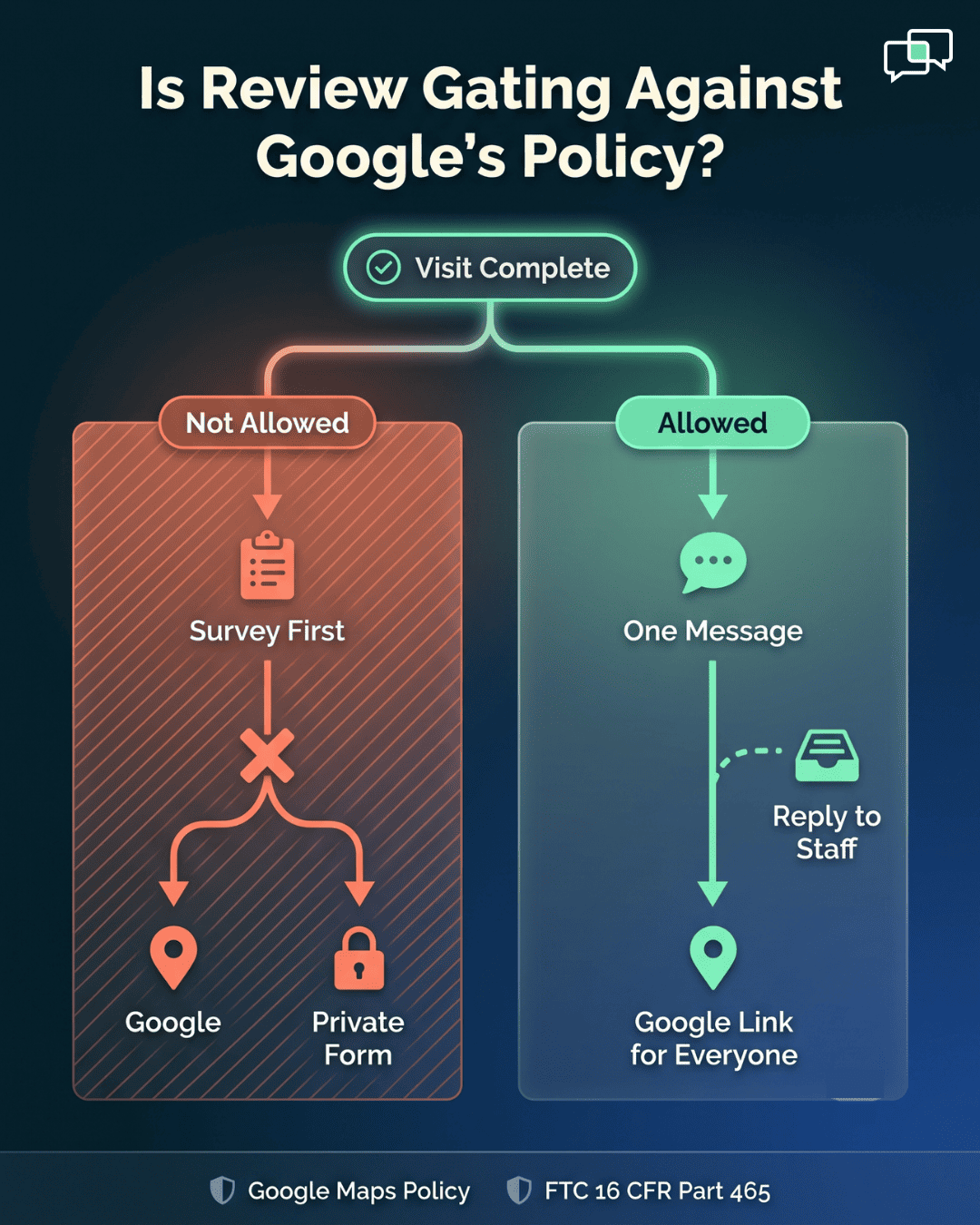
Trap one is gating. Send a survey, ask for a rating, route the 5s to Google and the 2s to a private form. It feels responsible.

Google prohibits it outright as selective solicitation of positive reviews. Its April 16 and 17, 2026 update paired that language with real enforcement. In the US, gating also runs into the FTC's Rule on the Use of Consumer Reviews and Testimonials, 16 CFR Part 465, in force since October 2024.

Trap two is worse for behavioral health. A bad review appears, the owner writes a defensive reply, and the reply confirms the person was a client.

OCR settled with Manasa Health Center in 2023 for $30,000. The Kendall Park, New Jersey psychiatric practice had disclosed protected health information for four patients while answering negative Google reviews, including mental health diagnosis and treatment detail. OCR Director Melanie Fontes Rainer put it plainly at the time: this is not allowed.


Confirming that a named person was ever a client is itself a disclosure. For a psychiatric or counseling practice, that one sentence is the entire risk.

Infographic comparing gated and compliant Google review request flows for behavioral health clinics

The Trust Builder: One Message, Sent to Everyone

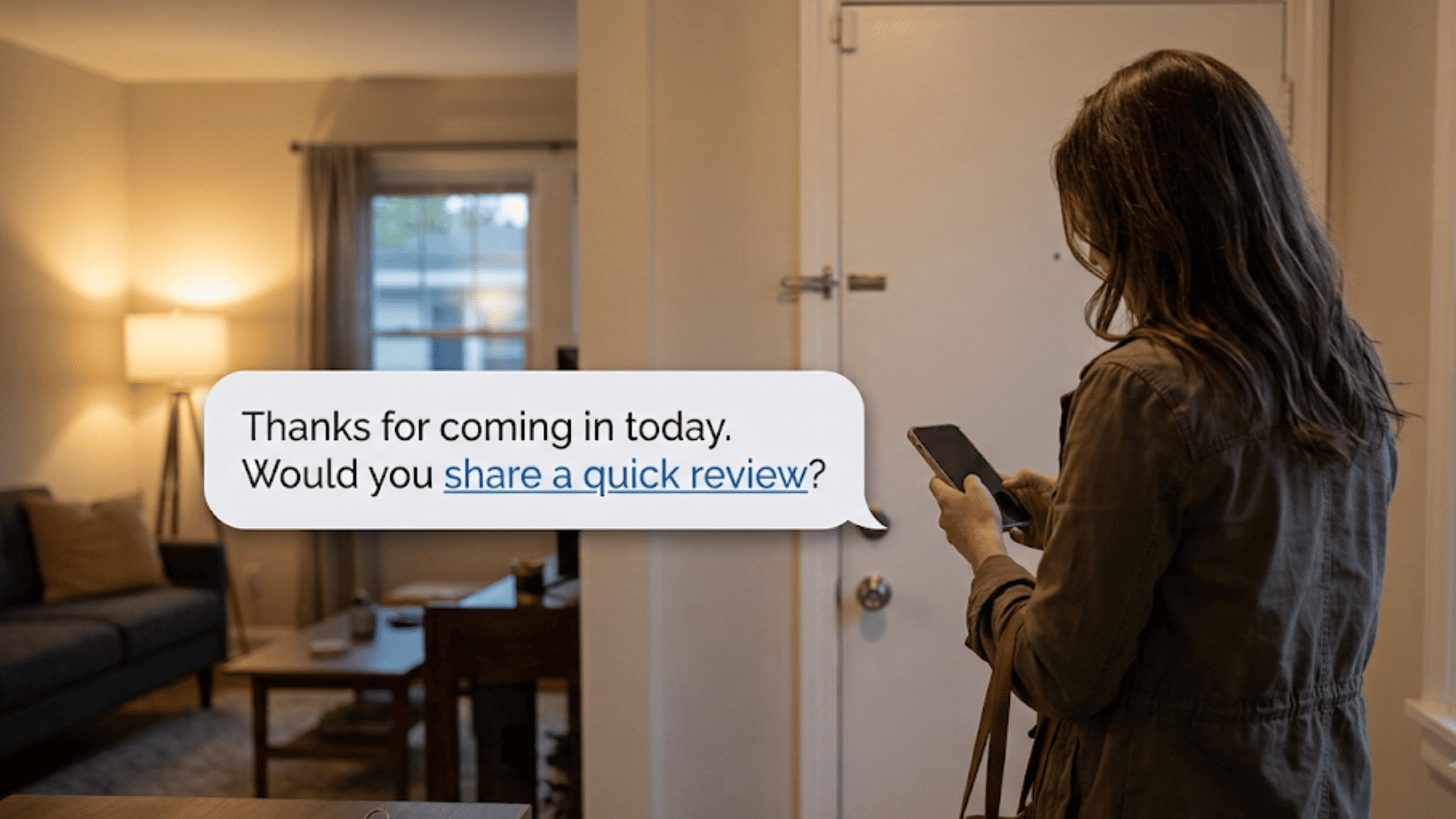
An appointment gets marked complete in the schedule. A short text goes to that client's mobile number. It thanks them and carries a link to your Google profile.

If they reply instead of clicking, the reply lands in your shared inbox next to the rest of your 2-way HIPAA texting conversations.

That's the system. No staff task, no reminder list, nobody deciding who deserves a link.

Automated review requests give a therapy practice something it has never had: a way to ask that happens nowhere near the room. The client reads it in the car or on the bus, and can ignore it at no social cost. Nobody watches them decide.

Timing: Why the Send Delay Matters

Fire the text too fast and it arrives while the person is still finding their keys. Wait a full day and the session has blurred.

Two to four hours works well for behavioral health. Late enough that the visit is over and the client has moved into their evening. Early enough that the session still means something.

Set a quiet window too. Nothing before 9 a.m., nothing after 8 p.m. A 10 p.m. review request from a psychiatric practice is a bad text on its own terms, and it lands during the hours when clients are least steady.

Cap it at one send per client per stretch of care. Weekly therapy clients should not receive 48 review invitations a year. Ask once, then wait six months before asking again.

Private Feedback Routing, Done the Legal Way

Private feedback routing means a client who replies to the text reaches your staff instead of your Google profile. It does not mean unhappy clients get steered away from Google.

That distinction is the whole compliance story. Every client receives the same link in the same message. A reply channel sits beside it, open to everyone, and someone with a complaint tends to use it because it's faster and more satisfying than writing a public review.

Ethical review solicitation in healthcare comes down to that structure. Ask everyone the same way, give everyone the same two doors, then let people choose.

Our recall data shows how much traffic a text channel absorbs: 1,240 patients booked appointments from SMS recall messages alone, at a 35% reconversion rate.

People answer texts. Give them somewhere to answer, and a fair share of complaints arrive privately without anyone engineering it.

Who to Leave Off the Send List

Automation needs an exclusion list, and behavioral health needs a longer one than most specialties.

Crisis and risk-assessment visits come off first. Court-ordered clients come off next, since a review request to someone attending under a mandate is a message nobody wants to send or receive. Minors come off too, and nothing should route to a parent's phone that implies a visit happened.

For substance use programs, 42 CFR Part 2 governs disclosures about patients in federally assisted SUD treatment and runs stricter than HIPAA. Treat a Part 2 caseload as a design question for your compliance officer before switching any outreach on, not after.

Build the list once in settings. It applies on every send after that, which is the part a person with a task list could never manage reliably.

The Front Door: What Compounding Trust Looks Like

Based on our internal data, a multi-location practice running Curogram's automated post-appointment surveys collected 1,064 new 5-star reviews in three months. Roughly 90% of clients who left a review left five stars.

That 90% is worth sitting with. It's what happens when you ask everybody: the ratings spread starts matching the actual quality of care, because the sample stops being self-selected.

Angry people already knew how to find Google. Happy people needed a link and a reason.

The Math for a Practice Your Size

Run your own version of this. Take a six-clinician outpatient practice, mostly weekly clients, roughly 480 completed appointments a month.

Step

Number

Completed appointments per month

480

Unique clients eligible to ask (one ask per 6 months)

110

After exclusions: crisis, mandated, minors

95

Reviews left at a 12% response rate

11

Cumulative reviews after 6 months

68

Illustrative example. Response rates vary by practice, message copy, and client mix.

Sixty-eight reviews in half a year, from a practice that added zero staff steps. A clinic sitting at four reviews in March shows 72 by September, and the map pack begins treating it as a different business.

Notice what drives the number. Every completed appointment creates one eligible ask, and appointments happen whether or not anyone remembers to do anything. Volume you already have does the work.

Two clinicians instead of six halves the output and changes nothing else. Ten clinicians roughly doubles it. Scale up or down from your own completed-appointment count and you'll land close.


Woman reading a post-appointment review request message after arriving home from therapy

Curogram Highlight: Review Routing

Review Routing is the part of Curogram that turns a finished appointment into a review invitation. It also turns any reply into a conversation your staff can see.

It runs from the same messaging layer as your reminders, recalls, and mass messaging campaigns. Notenetic workflows don't change. Clinicians document where they always documented, billers bill where they always billed, and outreach happens beside all of it.

Three parts do the work. A trigger watches for completed appointments and applies your exclusion rules. A message template holds the wording your compliance officer signed off on, with no clinical detail and no rating prompt.

Your shared inbox catches the replies. A client who writes back gets a human during business hours instead of silence.

Everyone in the eligible group receives the same message with the same Google link. We don't pre-screen by sentiment, and it's worth checking whether your current vendor does. That single design choice keeps a practice on the right side of both Google's policy and the FTC rule.

Setup is a settings conversation, not a project. You choose the delay window, the quiet hours, the exclusion list, and the wording. After that, the ask goes out 480 times a month with no task list involved. Your front desk hears about it only when someone writes back.

Conclusion: Let Your Care Become Visible

Open your Google profile right now and read two numbers: total reviews, and the date on the newest one. If the count is under 20 or that date is older than a month, you're looking at the gap between the care you deliver and the care a stranger can see.

You already earned those reviews. Clients who stayed in treatment, who got better, who mention you to a friend at work. The reviews don't exist because nobody built a moment to ask, and the room was never going to be that moment.

A text sent two hours after the appointment is that moment. Discreet, optional, and sent to every client the same way, which is exactly what Google and the FTC now require.

Notenetic keeps the record of the care. Curogram makes that care findable by the person searching at 11 p.m. for a therapist who takes their insurance.

Book a demo and we'll open your Google Business Profile with you, count what's there, and show you the exact post-visit message your clients would receive.


Frequently Asked Questions

How can a therapy practice ask for reviews without crossing an ethical line?

Send the ask by text after the visit, never in session and never in the waiting room. Make it optional, send the same words to every eligible client, and offer nothing in return. Keep clinical detail out of the copy. Your client then decides alone, on their own phone, with no clinician watching them answer.

Why does sending only happy clients to Google cause a problem?

Google's Maps policy bars businesses from asking only satisfied customers for reviews, and the April 2026 update paired that rule with active enforcement. The FTC's 16 CFR Part 465 covers review suppression on its own track. Past the rules, gating builds a rating nobody believes, and filtered clients often post something harsher elsewhere.

How do clients leave a review without revealing they're in therapy?

They write what they want, and most keep it general. Notes about easy scheduling, warm front desk staff, or short wait times are common and give away nothing clinical. Your request template should never suggest topics. Google's 2026 rules also ban asking reviewers to include specific content, so steering them is off the table anyway.

What should a practice do when a negative reply comes in privately?

Answer it yourself, fast, and treat it as a service call rather than a review problem. Fix the billing surprise or the scheduling error behind it. Never post a public reply that confirms the person was a client. That exact move cost Manasa Health Center $30,000 in its OCR settlement.

How does any of this touch what Notenetic already does?

It doesn't touch Notenetic at all, which is the point. Curogram runs as a parallel layer using your appointment data, so nothing shifts inside your documentation, billing, or telehealth work. Clinicians see no new screen and get no new step. The outreach fires after the appointment closes.