10 min read

Reduce Day-of Cancellations: Vascular OBL Medstreaming Reminders

Reduce Day-of Cancellations: Vascular OBL Medstreaming Reminders
💡 Modality-specific appointment reminders in Medstreaming send the right prep instructions for each procedure type. Patient SMS replies confirm prep status before procedure day.
  • A cardiac MRI reminder asks, "Do you have metal implants?"
  • A CT contrast reminder confirms fasting, hydration, and metformin hold
  • A cardiac cath reminder verifies NPO, blood thinner hold, and driver plan
  • Patient SMS replies confirm prep or trigger a staff escalation
  • Atlas Medical cut no-shows from 14.20% to 4.91% with this approach, based on our internal data
For a 40-procedure-per-day facility, every 1% drop in cancellations recovers about $31.7K each month. The result is fewer surprises and a fuller schedule.

Last-minute cancellations rarely happen by chance. Most come from something simple but fixable. A patient ate breakfast before a cardiac cath. Another forgot to stop a blood thinner. Someone showed up without a driver and had to be sent home.

These are not rare events. Day-of cancellation rates in cardiovascular and vascular labs often sit near 15%. For a facility running 40 procedures a day, that adds up to roughly $18,000 in lost revenue daily. Multiply that by a year, and the gap reaches the millions.

The fix is not more phone calls. It is sending the right reminder at the right time, tied to the actual procedure. A cardiac MRI patient needs to confirm they have no metal implants. A CT patient needs clear prep on fasting and metformin. A cardiac cath patient needs a three-way confirmation on NPO, meds, and driver.

Generic reminders cannot do this work. They send the same message to every patient. The result is confusion, missed prep steps, and cancellations that hurt revenue and morale.

Modality-specific Medstreaming appointment reminders fix this gap. They pull procedure data from Medstreaming and trigger the right SMS template for each case. Patients get clear, simple instructions. Facilities get confirmed prep status before procedure day.

To reduce day-of cancellations, vascular OBL teams turn to Medstreaming reminders that match each procedure. This guide walks through the full workflow and the math behind it. We will cover the cost of cancellations, the trigger logic for modality-specific prep automation, and how two-way SMS lifts compliance.

You will also see real benchmarks from a 40-procedure-per-day facility. If your team loses revenue to preventable cancellations, this is the playbook to follow. The change is workflow-driven and pays back fast. Most labs see real results inside 90 days.

The Day-of Cancellation Crisis and Revenue Recovery

Day-of cancellations are not just a scheduling issue. They are a revenue problem that hits cardiovascular and vascular labs hard. Most are preventable with the right reminder strategy. The first step is seeing the true cost.

The Economics of Cancellation

Across cardiovascular and vascular imaging facilities, cancellation rates often hover near 15%. This is the baseline most labs accept as normal. The financial impact, though, is anything but normal.

Per-procedure revenue varies by modality. Each cancelled slot is real money lost, plus the staff time and equipment hours already paid for. Here is what that looks like by procedure type:

Procedure

Typical Revenue Per Case

Diagnostic Angiogram

$1,500–$3,000

Angioplasty

$5,000–$15,000

Cardiac Catheterization

$3,000–$8,000

Cardiac MRI

$800–$1,500

CT Angiography

$600–$1,200


Now apply that to a busy facility. A vascular OBL or cath lab running 40 procedures a day at a 15% cancellation rate loses six slots daily. At an average of $3,000 per case, that is $18,000 a day in lost revenue.

Stretch that across the calendar:

  • $18,000 per day
  • $90,000 per week
  • $4.75 million per year

That is the cost of a 15% cancellation rate at a single facility. For OBL procedure cancellation reduction, even small drops change the math fast.

Top Cancellation Causes (Preventable)

The good news is that most day-of cancellations come from causes you can fix. They follow a predictable pattern:

Cause

Share of Cancellations

Example

Prep non-compliance

30%

Patient ate breakfast before cardiac cath

Anxiety or forgetfulness

25%

Patient forgot or got nervous and skipped

Transportation issues

20%

No driver for angiogram

Medication confusion

15%

Patient took blood thinner they should have held

Other

10%

Illness, schedule change


Notice the top three causes. They all stem from one root issue: the patient does not have clear, timely, procedure-specific information. Generic reminders do not solve this. Modality-specific reminders do.

Modality-Specific Reminder Impact

Real numbers tell the story best. Atlas Medical Center deployed modality-specific reminders across a 40-procedure-per-day facility.

Based on our internal data, baseline no-shows dropped from 14.20% to 4.91% in three months. That puts the lab 3X better than the industry average.

That is a 9.29-point drop. In dollar terms:

9.29% × 40 procedures × $3,000 average = $1.12 million per year recovered


Even a more conservative 5% drop in cancellations changes the picture. For the same facility, that translates to roughly $31,700 in recovered monthly revenue. Over a year, that is about $380,000 per facility.

Here is the simple math you can run for your own lab:

(Baseline cancellation % – New cancellation %) × Daily volume × Avg revenue × 365 = Annual recovery


For cath lab no-show prevention, this is the kind of return that changes capital decisions. It funds new staff, new equipment, or expansion. It also frees valuable time slots for new bookings, which compounds the gain.

The point is not just trimming a metric. It is recovering revenue that is already on the schedule but slipping through the cracks. Day-of cancellations are highly preventable. The systems to prevent them are already built.

In the next section, we will look at how Medstreaming data triggers the right reminder for each procedure type. The logic behind that automation is what turns these numbers around.

Modality-Specific Reminder Triggers and Prep Workflows

Each procedure has its own prep needs. A one-size-fits-all reminder cannot handle the differences. Here is how Medstreaming procedure data drives the right SMS for each case.

Cardiac MRI: Metal Screening and Pacemaker Status

Cardiac MRI cancels fast when metal shows up. Pacemakers, defibrillators, and aneurysm clips are real safety risks. Even jewelry or a metal-threaded shirt can derail the scan.

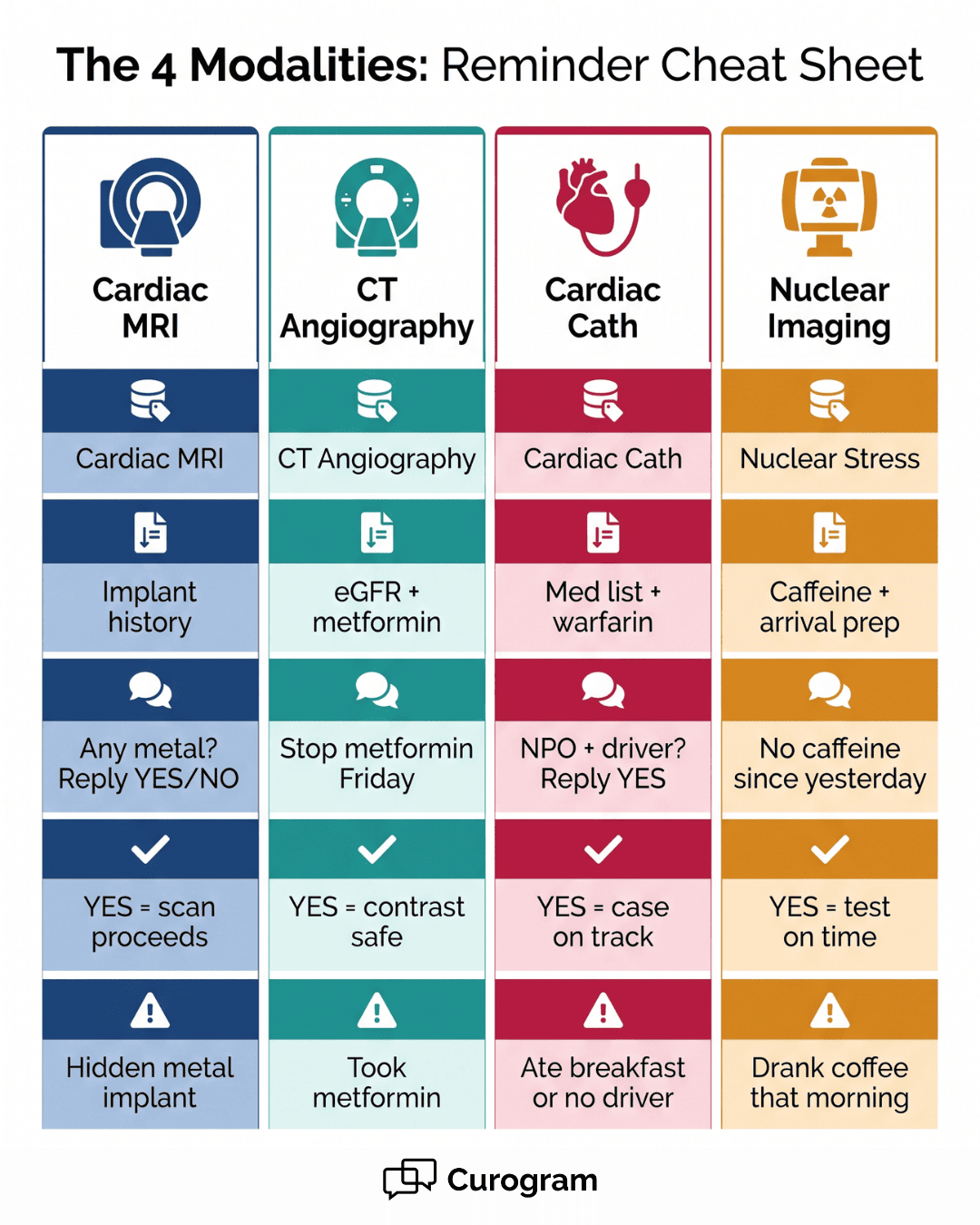
The trigger works like this: when Medstreaming logs procedure type as "Cardiac MRI," Curogram pulls the patient chart. It checks for prior pacemaker or defibrillator notes. Then it sends a reminder 48 hours out:

"Your cardiac MRI is Friday 2pm. Do NOT wear metal. Do you have a pacemaker or defibrillator? Reply YES if no metal, NO if unsure."

A YES response means the case proceeds. A NO or no reply triggers a tech call. The result: no day-of surprises and no wasted scanner time.

CT Angiography and Chest CT: Contrast Prep and Renal Function

CT angiography uses iodine contrast. That means fasting, hydration, and a metformin hold for patients on diabetes meds. If renal function is impaired, the metformin hold becomes critical.

Curogram pulls the latest creatinine or eGFR from Medstreaming lab values. If eGFR is under 30, the metformin warning gets stronger. The reminder reads:

"Your CT chest is Saturday 1pm. Fast 4 hours before. Stay hydrated Friday. If you take metformin, STOP Friday morning. Confirm by replying YES."

If the patient replies, "I'm on metformin but didn't stop," the system flags it for the radiologist before the scan. This stops a contrast injection that could lead to harm. It also stops a cancellation that would otherwise happen at check-in.

Cardiac Catheterization: NPO, Blood Thinner Hold, and Driver

Cath cases have the most prep variables. Patients must be NPO from midnight. Blood thinners need to be held on a schedule (warfarin 5 days, aspirin and clopidogrel 5–7 days). And no patient drives home for 24 hours.

A single missed step kills the case. Curogram reads the medication list in Medstreaming and builds a hold schedule per patient. Then it sends a three-way confirmation 48 hours out:

"Your cardiac cath is Saturday 2pm. NPO from Friday midnight. STOP warfarin Friday morning. STOP aspirin Friday. Have a driver arranged (you cannot drive 24h after). Reply YES to confirm all three. NO and we will call."

This is where vascular procedure prep SMS earns its keep. A YES locks in NPO, medication hold, and driver in one tap. A NO routes to a nurse for live verification.

Nuclear Imaging: Caffeine Restriction and Tracer Timing

Myocardial perfusion studies and renal scans rely on adenosine or other tracers. Caffeine blocks adenosine receptors, which can wreck the test. Patients must stop caffeine 24 hours before.

The reminder goes out 24 hours ahead:

"Your stress test is tomorrow 8am. NO CAFFEINE since yesterday. Arrive 15 minutes early for injection. Reply YES to confirm caffeine-free and arrival plan."

Timing matters even more here. The tracer is mixed for a specific window. A late patient can mean a wasted radiopharmaceutical dose, which is costly and time-bound. SMS confirmation flags this risk early.

Four-column infographic comparing Medstreaming reminder triggers for cardiac MRI, CT angiography, cardiac cath, and nuclear imaging procedures

Prep Compliance and Day-of Confidence

Lower cancellations are the headline. The deeper story is what changes inside the patient experience. When patients know what to do, they show up ready. When they have a way to ask questions, they show up calmer.

Both shifts matter for prep compliance and day-of confidence. Together, they turn an anxious schedule into a steady one.

From Generic Reminders to Procedure-Specific Confidence

A generic reminder reads like this: "Your appointment is Friday 2pm. Please arrive on time."

The patient does not learn what the procedure involves. They do not know if they should fast. They do not know which medications to skip. They walk in unprepared, and the case gets cancelled at check-in.

A procedure-specific reminder reads like this: "Your cardiac MRI is Friday 2pm. NO METAL. Wear non-metal clothing. Confirm no metal implants: YES or NO?"

Now the patient knows three things. What the procedure is. What to wear. And what to confirm. The difference is night and day.

Compliance numbers prove this out. Generic reminders sent through voicemail or PDF attachments produce prep compliance around 65%. Modality-specific SMS reminders push that figure to 85% or higher. That 20-point lift is where day-of cancellations melt away.

The reminder is not just an alert. It is a teaching tool that prepares the patient. Each line tells the patient what to do and what to confirm. There is no guesswork.

Two-Way Confirmation as Anxiety Reduction

Anxiety is one of the hidden drivers of day-of cancellations. Patients worry about the procedure. They worry about prep. They worry they got it wrong. When in doubt, many cancel.

Two-way SMS turns that anxiety into a conversation. The patient gets the reminder. They reply with a question. The clinic answers. Within minutes, the patient feels heard and informed.

Here is a typical exchange for a cardiac cath patient:

Clinic: "Your cardiac cath is Saturday 2pm. NPO from Friday midnight. STOP warfarin Friday morning. Driver arranged? Reply YES to confirm."

Patient: "Can I take my blood pressure pill in the morning?"

Clinic: "Yes, take your BP medication with a small sip of water. All other meds held."

The patient now has a clear answer. The clinic captured the question in a chart-friendly thread. And the case is on track.

Without two-way SMS, this same patient might call the office. They might not get through. They might leave a voicemail and never get a callback. By Saturday morning, they have given up and cancelled the case.

Two-way SMS prevents that spiral. It is fast, low-friction, and works on any phone. Patients who would never call the office will text. That changes the dynamic.

There is also a confidence effect for the staff. When the team can see who confirmed prep and who has not, the day-of plan becomes predictable. Cases on the morning board are not surprises. The schedule holds.

For OBL procedure cancellation reduction, this confidence loop is what compounds the gains. Better prep, fewer questions, fewer cancellations, more revenue, less stress on staff. It is a virtuous cycle once it starts.


Patient calmly reading a Medstreaming appointment reminder on their phone

How Curogram and Medstreaming Turn Procedure Data into Prep Compliance

The integration is what makes this whole system click. Medstreaming holds the procedure data. Curogram turns that data into action.

When a case is scheduled in Medstreaming, the procedure type field is the trigger. Curogram reads that field in real time. It then matches the procedure to a pre-built reminder template. A cardiac MRI maps to the metal-screening template. A CT angiography maps to the contrast and metformin template. A cath case maps to the three-way NPO, medication, and driver template.

Beyond the procedure type, Curogram also pulls patient chart data from Medstreaming. That includes the medication list, recent lab values, and prior implant history. The reminder then becomes patient-specific, not just procedure-specific. A patient on warfarin gets the warfarin hold instructions. A patient with low eGFR gets the stronger metformin warning.

All of this happens with no manual work from staff. The schedule is the trigger. The chart is the data source. The reminder is the output. SMS replies feed back into the system for staff review. Non-responders get flagged for a phone call.

The result is a closed-loop workflow. Procedure scheduled. Reminder sent. Patient confirms or escalates. Staff handles only the exceptions. The schedule fills with prepped, confirmed patients. Curogram clients see appointment confirmation rates above 75%, based on our internal data.

This is what makes the model work for facilities of any size. A 40-procedure-per-day cath lab and a 10-procedure-per-week vascular OBL both run the same automation. The volume changes, but the workflow does not. Curogram scales with you.

For teams already on Medstreaming, the integration uses the data you are already capturing. There is no double entry, no extra screen, no new training. The reminders just start flowing the moment a procedure is scheduled.

Conclusion

Day-of cancellations are not random. They follow patterns. Most are caused by prep gaps, anxiety, or simple confusion. All three are fixable with the right reminder strategy.

Modality-specific reminders close those gaps. They tell the patient exactly what their procedure needs. Cardiac MRI patients confirm no metal. CT patients confirm fasting and metformin hold. Cardiac cath patients confirm NPO, medication hold, and driver. Each message is tied to real procedure data, not a generic template.

The math is straightforward. A 40-procedure facility loses about $18,000 a day at a 15% cancellation rate. Cutting that rate in half puts $9,000 a day back on the schedule. Over a year, that adds up to millions. Atlas Medical's drop from 14.20% to 4.91%, based on our internal data, is one example of what is possible.

The deeper win is patient confidence. When patients get clear instructions and a way to ask questions, they show up ready. Staff stops chasing prep status by phone at 7am. The morning board is full of confirmed cases. The schedule holds.

For vascular OBLs and cath labs running on Medstreaming, the path is clear. Procedure data is already in the system. Patient charts already hold the medication list and lab values. The only missing piece is the automation that turns that data into smart, two-way SMS.

Curogram fills that gap. Medstreaming appointment reminders flow from the procedure schedule to the patient's phone with no manual work in between. The result is fewer cancellations, more revenue, and a calmer team.

Whether you run 10 procedures a week or 40 a day, the workflow is the same. Book a demo and see how Curogram scales with your facility and starts recovering revenue.


Frequently Asked Questions

How does Medstreaming data trigger the correct modality-specific reminder?
The procedure type field in Medstreaming acts as the trigger. Curogram reads that field, matches it to a pre-built template, and pulls patient chart data like meds and labs. The right reminder fires automatically with no staff input.
Why do generic appointment reminders fail for vascular and cardiac procedures?
Generic reminders only share time and date. They skip prep details like fasting, metal screening, or medication holds. Patients show up unprepared, and cases get cancelled at check-in. Compliance stays low without procedure-specific instructions.
How does two-way SMS reduce patient anxiety before a cardiac cath?

Patients can text questions like "Can I take my BP pill?" and get a fast, clear answer. That cuts the worry that drives last-minute cancellations. The thread also documents the exchange for the chart automatically.

What workflow changes does a small OBL need to deploy modality-specific reminders?

Almost none. Once Curogram is integrated with Medstreaming, the schedule itself triggers reminders. Staff only handles non-responders or flagged replies. A 1-2 provider lab can run the same automation as a 40-procedure facility.

How quickly can a facility see ROI from modality-specific reminders?

Most facilities see cancellation drops within the first 60 to 90 days. Atlas Medical hit 4.91% in three months from a 14.20% baseline, based on our internal data. ROI tracks with daily volume and average procedure revenue.


Fill Cancellations at Your Meditab IMS Practice | Waitlist Texting

Fill Cancellations at Your Meditab IMS Practice | Waitlist Texting

💡 Filling last-minute cancellations at a Meditab IMS practice with automated waitlist texting turns every cancelled appointment into a same-day...

Read More
Send Vascular Procedure Prep Instructions by SMS Text — No Portal

Send Vascular Procedure Prep Instructions by SMS Text — No Portal

💡 Procedure-specific prep reminders lower patient anxiety by giving clear, step-by-step instructions before the visit. With vascular patient...

Read More
Office Ally Patient Text Reminders | 75%+ Confirmation

Office Ally Patient Text Reminders | 75%+ Confirmation

💡 Office Ally patient text reminders with two-way SMS help small practices confirm more appointments. Most patients skip voicemails. Many never log...

Read More