
ROI of HIPAA-Compliant Text-to-Pay for Medstreaming Centers
 Aubreigh Lee Daculug : Jan 28, 2026, 6:00:00 AM
Discover how Curogram’s Text-to-Pay helps Medstreaming users boost revenue, reduce A/R, and enhance patient satisfaction.

A patient checks in for her MRI at 2 PM. The scan takes 45 minutes. She pays her $50 co-pay at the front desk and heads home. Two weeks later, a bill arrives for another $175. Her insurance took forever to process the claim, and now she owes the balance. She tosses the bill on her kitchen counter, meaning to deal with it later.
Sound familiar? If you run an imaging center, you see this pattern every single day.
Imaging appointments create billing headaches that linger long after the visit. Insurance claims move slowly. Patients forget appointments from weeks ago. Staff spend hours making collection calls that go straight to voicemail.
Meanwhile, healthcare has gone digital. Patients book visits on their phones, complete forms online, and view results through portals. But billing is still stuck with paper statements and phone tag.
Imaging billing is especially challenging. An MRI co-pay can easily exceed $200—enough to require planning. When bills arrive weeks later, patients question the charge, call for explanations, or ignore it altogether.
Your billing team deserves better than this endless cycle. So do your patients.
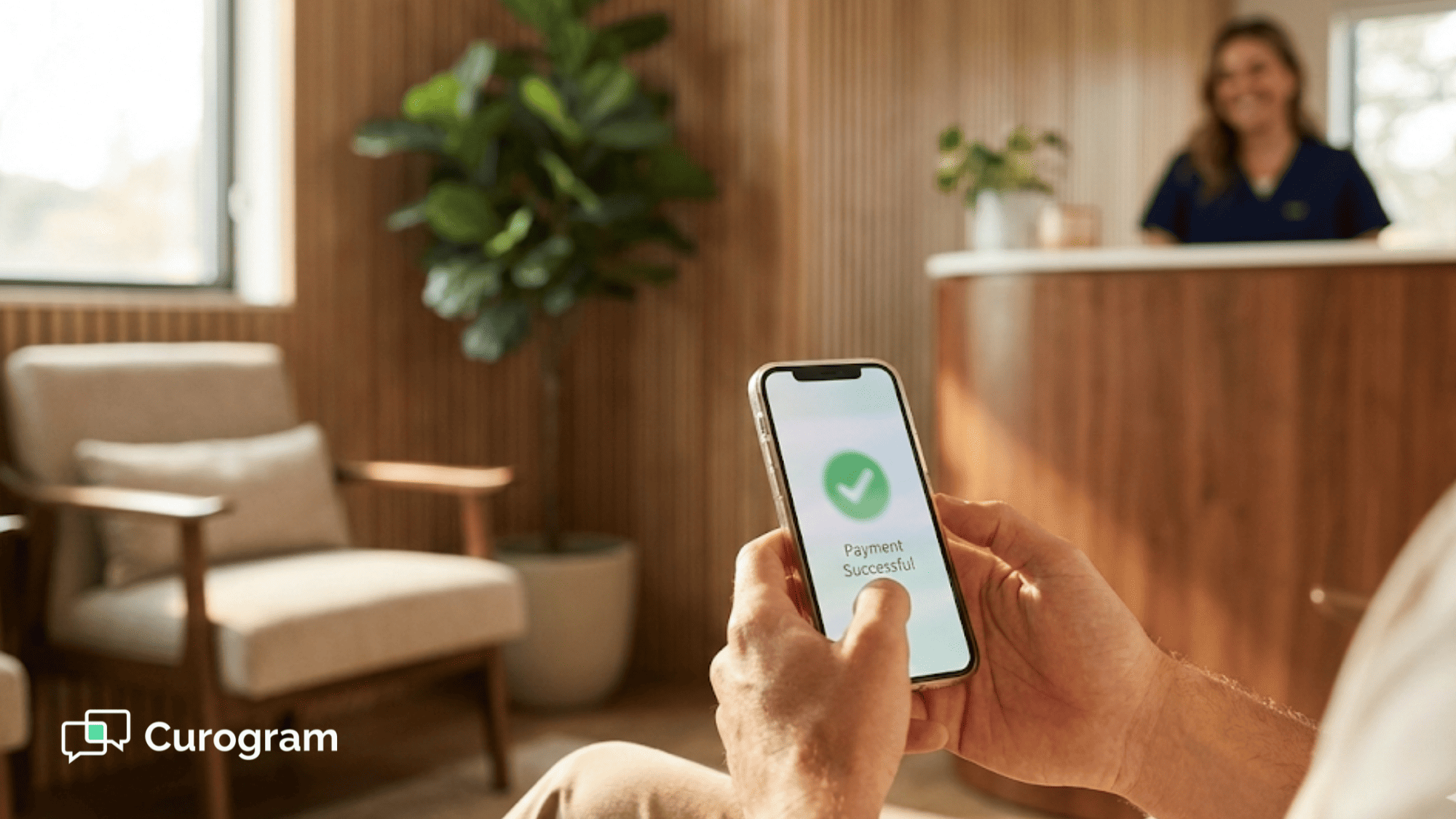
Text-to-Pay through Curogram flips the script on payment workflow automation. Instead of chasing patients weeks after their scans, you reach them instantly through the device they check 100 times a day. A simple text message. A secure payment link. Done in 60 seconds.
When Medstreaming imaging centers integrate this system, something remarkable happens. Those ignored paper bills transform into quick mobile payments. Your staff stops playing phone tag. And patients actually understand what they owe and why.
Let's look at how this works in the real world.
Running one imaging center is complex enough. Now multiply that across five or ten locations, each handling 30 to 50 scans daily. Every scan creates a billing event. Every billing event needs someone to track it, follow up on it, and eventually collect payment.
When you're processing hundreds of transactions weekly across multiple sites, the cracks in manual systems become canyons.
Here's where things get messy. A patient gets an MRI at your downtown location on Monday. Insurance processes the claim two weeks later. Now someone at your main billing office needs to send them a statement for the balance.
But which location does the patient think they owe money to? Where should they call with questions? If they had a previous scan at your suburban center, does anyone know they still owe $200 from that visit?
Information silos between locations mean your right hand doesn't know what your left hand is doing. One patient might owe balances at three different centers, but no single staff member sees the complete picture.
Your billing specialists spend hours on the phone trying to track down these payments. Let's do the math on that. Three hours daily at $20 per hour equals $60 per day. Over a year, that's more than $15,000 in labor costs for one employee just making collection calls.
Most of those calls go to voicemail anyway.
Imaging appointments hit patients harder in the wallet than regular doctor visits. A CT scan co-pay might run $150. An MRI could cost twice that. These aren't small amounts people can pay without thinking.
The problem compounds when insurance takes weeks to process claims. During that limbo period, you don't know what patients owe. They don't know what they owe. Everyone just waits.
Then the insurance finally pays their portion. You send the patient a bill for the remaining balance. But by now, it's been a month since their appointment. The scan feels like ancient history to them.
They open your bill and think, "Didn't I already pay for this?"
Post-visit balances create the most friction because patients walk out of your center thinking they're all settled up. Weeks later, surprise—another bill. Even when everything was handled correctly, it feels wrong to them.
Traditional billing moves at a glacial pace.
Each round costs money. Printing, envelopes, postage. You might spend $3 per patient across multiple mailings.
When you're sending hundreds of statements monthly, those costs pile up fast. The brutal truth? The longer a balance sits unpaid, the less likely you'll ever collect it. After six months, patients stop caring.
Many imaging centers write off 10% or more of revenue as bad debt every year.
Ask any imaging center manager about patient phone calls, and you'll hear the same complaints. "Why am I getting this bill?" "I thought my insurance covered this." "What's this charge for the radiologist?"
Imaging bills confuse patients more than almost any other medical charge. They see multiple line items—facility fees, professional fees, technical components. None of it makes intuitive sense unless you work in medical billing.
The explanation of benefits from insurance uses language only billing specialists understand. Patients try to match it up with your bill and get lost in the jargon. So they give up and set it aside, intending to call you later.
But calling during business hours means taking time off work. Days turn into weeks. Weeks turn into months. Eventually, that bill gets buried under other mail and forgotten entirely.
When you serve multiple insurance plans, the confusion multiplies. One patient pays $150 for an MRI while another pays $300 for the exact same scan. Patients see these differences and question whether you're charging fairly.
This leads to more phone calls and more delays in collecting payments Medstreaming centers desperately need to keep operations running smoothly.
Every manual step in your billing process creates friction. Friction creates delays. Delays cost you money and frustrate everyone involved.
Let's walk through what a typical collection call actually involves. Your billing specialist pulls up an account, dials the number, and waits. It rings four times. Voicemail.
They leave a message with a callback number and document the attempt in your system. Five minutes gone, zero dollars collected.
Next call. This time someone answers, but they're at work and can't talk. "Call me back tonight." Your billing office closes at 5 PM. The patient works until 6 PM. No connection possible.
Third call, maybe someone answers and has time to talk. Now the real work begins.
"Let me see if I can find that bill." Patient puts you on hold. Two minutes pass. "Okay, what did you say I owe?" They have questions about the charges. They need to find their credit card. They want to set up a payment plan.
Ten minutes later, maybe you get a payment. Maybe you don't.
When a billing specialist makes $20 hourly and spends three hours daily on these calls, you're burning through $15,000 annually per employee on collection calls alone. That doesn't count the opportunity cost of what else they could be doing with that time.
Here's an uncomfortable truth about paper billing—up to 40% of medical bills never get opened. Ever.
Patients see them mixed in with junk mail and credit card offers. They set them aside in a pile. That pile grows. Eventually, the whole stack goes in recycling without a second glance.
Even the patients with good intentions struggle with paper bills. Sure, you include a return envelope, but who has stamps anymore? They can call with a credit card, but that means finding time during your business hours.
They mean to do it. Life gets busy. It never happens.
Meanwhile, you're paying to print every statement—color printing for your logo, paper, envelopes, postage. When you send three rounds of notices for the same balance, you might spend $3 per patient before seeing a dime. Multiply that across hundreds of unpaid balances monthly.
Multi-location imaging networks struggle with standardization in ways that directly hurt collections. Visit three different locations in your imaging network, and you'll likely find three different billing approaches.
One center sends payment requests immediately after appointments. Another waits until insurance processes claims. A third batches everything monthly to save on mailing costs.
This inconsistency confuses patients who use multiple locations. After a scan at Center A, they get a text message to pay. After a scan at Center B, they get nothing for three weeks, then a paper bill.
They don't understand why your own company can't get its act together.
The lack of payment workflow automation means each location invents its own system. These systems don't talk to each other. Patient information doesn't flow between them. Your IT team maintains separate processes that should be unified.
Training becomes a nightmare—new hires at one location learn a specific workflow, then transfer to another site and start from scratch learning completely different procedures. This wastes training resources and increases errors as staff members struggle to remember which protocol applies at which location.
Watch your accounts receivable grow month after month, and you'll see the real cost of manual billing.
High A/R creates cascading problems. Cash that should be in your bank account is tied up in unpaid patient balances. You can't use that money for equipment upgrades or staff bonuses. It just sits there on paper, slowly aging into bad debt.
Some imaging centers turn to collection agencies, but agencies typically take 30% to 40% of whatever they collect. You're getting 60 cents on the dollar for balances you rightfully earned.
Plus, sending patients to collections damages relationships. Those patients rarely return for future scans.
The vicious cycle continues—staff spend time chasing old balances instead of serving current patients, service quality drops, patient satisfaction falls, and more people delay paying their bills.
Text-to-Pay sends payment requests at the right moment—after insurance is processed and while the visit is still fresh. Automated timing and follow-ups reach patients when they’re most likely to pay, directly on their phones.
Texts are opened within minutes, not days. Each message clearly shows what’s owed and why, with a one-tap link to a secure mobile payment page. Patients can pay in under a minute with no apps or accounts required.
Automation eliminates manual work and errors by pulling accurate data directly from your system. Every message is consistent, secure, and HIPAA compliant, with bank-level encryption protecting patient and payment information.
Smart timing improves collections both before and after visits. Pre-visit requests give patients time to plan for co-pays. Post-visit texts go out as soon as insurance finalizes, while the appointment is still easy to remember.
Patients have time to budget for co-pays
Funds can be moved between accounts if needed
Front-desk payment conversations are reduced
Check-in stays efficient and on schedule
No-shows decrease when patients can reschedule early
Standardized workflows create consistent billing, simpler training, and clear visibility into collections. Automated reminders keep balances from aging while maintaining a positive patient experience.
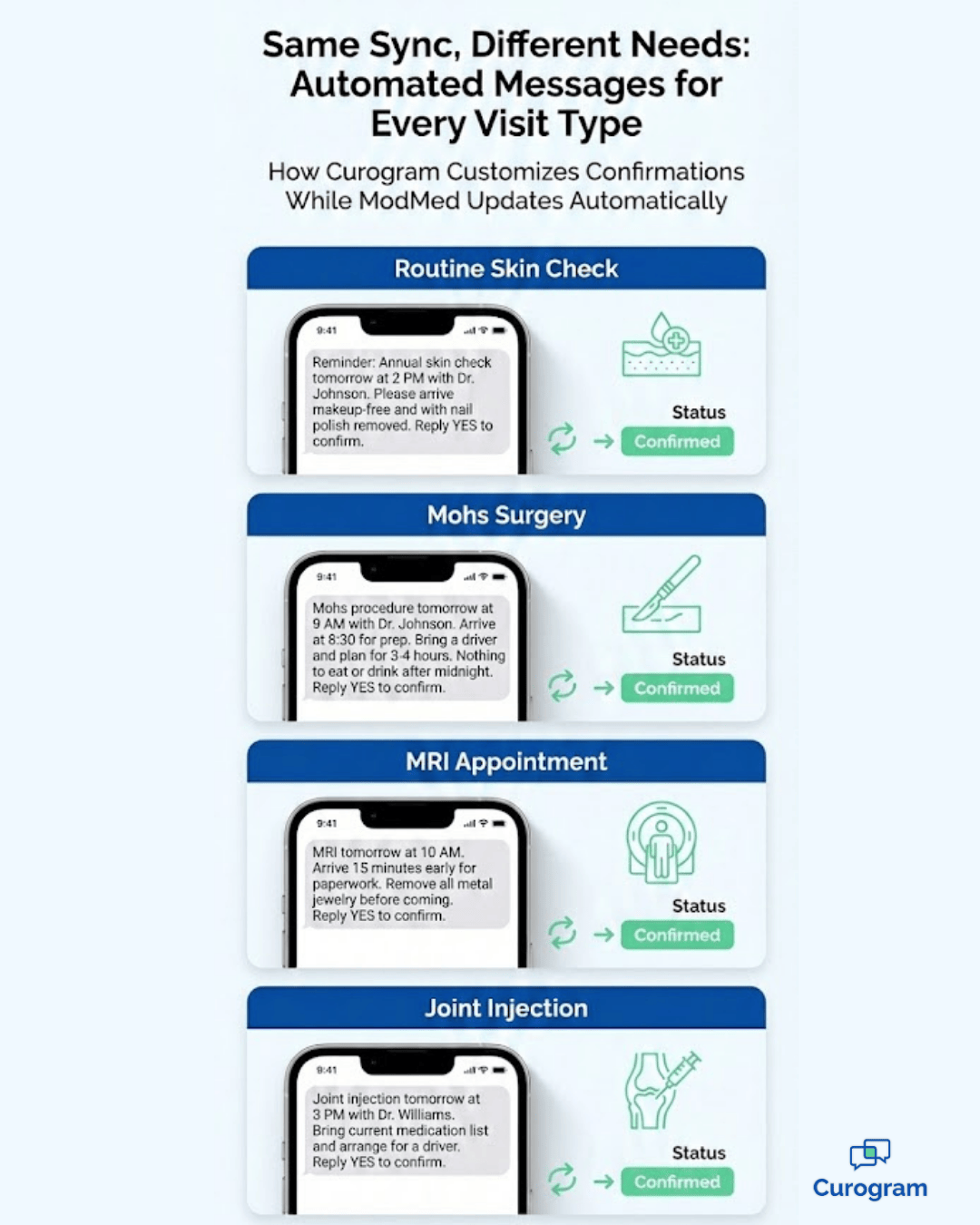
Integration sounds technical. Boring, even. But here's why it matters more than any other feature.
When your systems talk to each other automatically, your staff stops doing double work. Errors disappear. Everything just flows.
Picture a staff member scheduling an MRI in Medstreaming. They enter the appointment. They select the insurance. They add any notes.
That's it. They're done.
Behind the scenes, Curogram sees that new appointment immediately. It checks the patient's insurance details. It calculates the likely co-pay based on their plan. It sets up a billing reminder to go out the day before the appointment.
All of this happens automatically in seconds.
The triggers adapt to different imaging services. MRI appointments generate specific reminders about prep requirements and co-pay amounts. CT scans trigger different messages. X-rays follow their own pattern.
The system knows what to send based on the appointment type.
Getting the right message to the right patient sounds basic. But you'd be surprised how often this breaks down with disconnected systems. Someone updates a phone number in one system but forgets to update the other.
Messages go to disconnected numbers. Chaos ensues.
Integration keeps everything in sync automatically. Update a patient's phone number in Medstreaming, and Curogram sees the change instantly. Update an email address? Both systems reflect it immediately.
You never have to worry about old contact information causing messages to fail.
This accuracy prevents embarrassing mistakes. No more sending bills to wrong patients. No more calling disconnected numbers over and over. Every message reaches exactly who it should, exactly when it should.
Multi-location networks need smart routing. When a patient visits your downtown center, their billing reminder should mention that specific location. It should show the downtown address and phone number.
If they call with questions, they reach the staff who actually saw them.
Next month, that same patient gets a scan at your suburban location. Now their billing messages automatically update to reference the suburban center. The address changes. The contact information changes.
Everything stays current based on where they actually received care.
This location awareness builds patient confidence. They see familiar details in messages that confirm they're dealing with the right place. No confusion about which location they owe money to. No wondering if this is a mistake or a scam.
Everything checks out.
Double entry is the worst kind of busywork. Type information into System A. Now type the same information into System B. Make sure you didn't fat-finger anything. Hope the data stays in sync.
It's tedious, error-prone, and wastes incredible amounts of time.
Integration eliminates this completely. Your staff enters appointment information once in Medstreaming. Curogram picks up that data automatically and uses it for payment messages.
When patients pay through the text link, the transaction records in both systems instantly. Nobody types anything twice.
Calculate the time savings. Maybe a front desk worker saves ten minutes daily by not duplicating data. Multiply that across five staff members at ten locations.
You're saving 50 hours monthly that can go toward actual patient care instead of repetitive data entry.
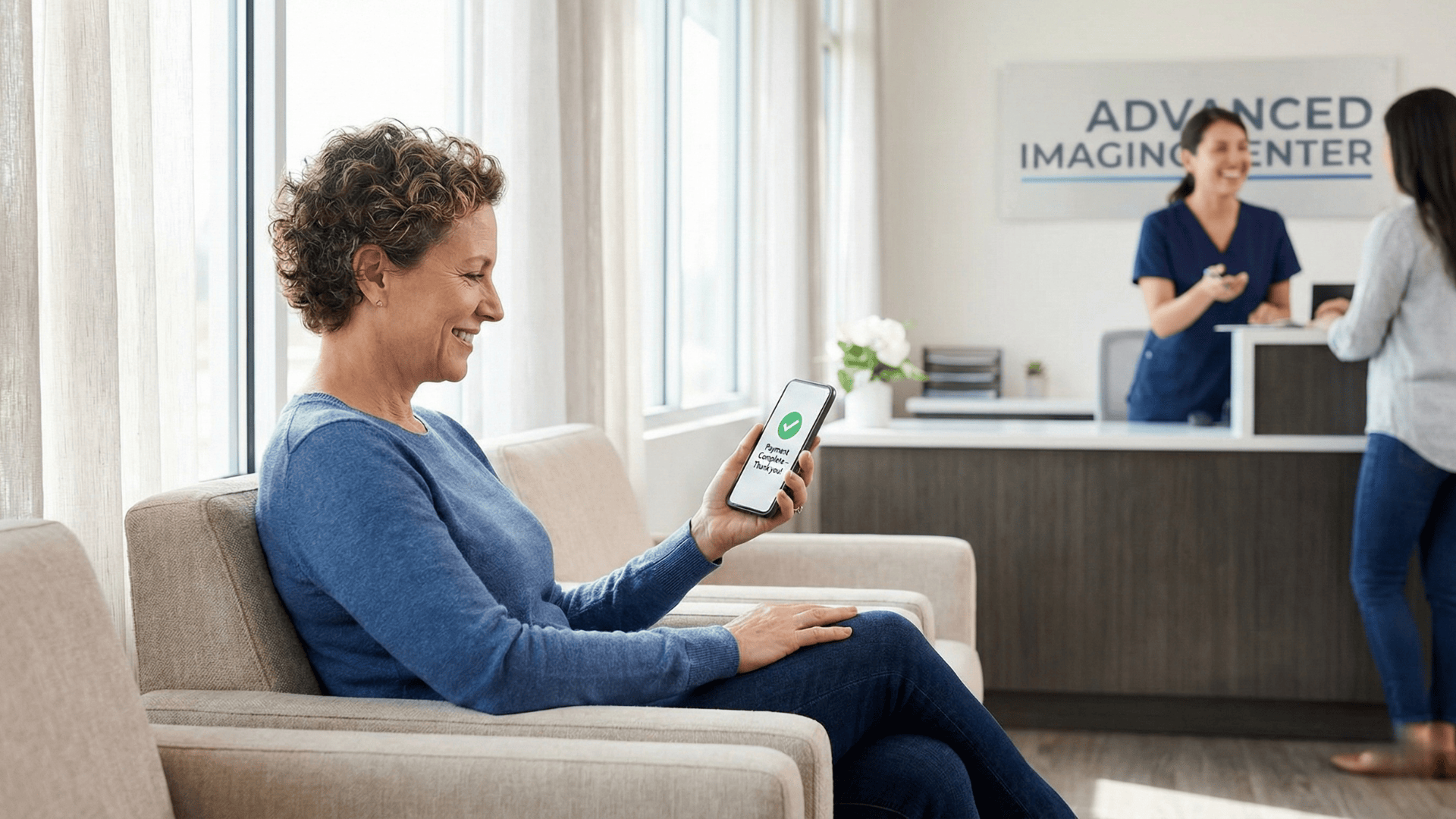
Imaging Use Cases for Text-to-Pay
Different types of scans create different billing scenarios. The system handles each one smoothly.
High-cost scans need proactive collection. The day before a scheduled MRI, the system sends a message stating the exact co-pay amount.
"Your MRI tomorrow at Downtown Imaging has a $200 co-pay. Pay now to save time at check-in."
Simple. Direct. Gives patients time to prepare.
This advance notice reduces no-shows dramatically. When patients see a co-pay they can't afford, they call to reschedule before the appointment. That's infinitely better than a last-minute cancellation or no-show that leaves an empty slot in your schedule.
Some scans require contrast material that creates additional charges. These fees might not appear until after insurance processes the claim.
Once the final amount gets calculated, Text-to-Pay sends an automatic follow-up explaining the contrast charge.
The message breaks down exactly what happened. "Your recent CT scan required contrast material. After insurance, you owe $85 for the contrast fee."
Patients understand why they owe extra money. The transparency prevents disputes.
Heart and vascular imaging often bundles multiple services. A patient might get an ultrasound, stress test, and consultation in one visit.
Instead of receiving three confusing separate bills, they get one clear message covering all services.
"Your cardiovascular diagnostic visit included three services. After insurance, your total balance is $275."
One message. One payment link. No confusion about multiple bills for the same appointment.
Complex procedures sometimes need staged billing. The system can request co-pay payment before the appointment, then follow up with the balance after insurance pays.
Each message clearly explains which portion of the total cost it represents.
"This is your pre-visit co-pay of $100." Then later: "Insurance has processed your claim. Your remaining balance is $150."
Patients never feel blindsided by unexpected charges.
Some days bring unusual patient volumes. Maybe you're running a community health screening. Maybe you extended hours for the holidays.
Whatever the reason, you might need to send hundreds of billing reminders quickly.
The system handles these surges effortlessly. It can send 500 reminders in minutes while maintaining personal touches like using patient names and referencing specific appointment details.
Your staff never stresses about keeping up with high volumes.
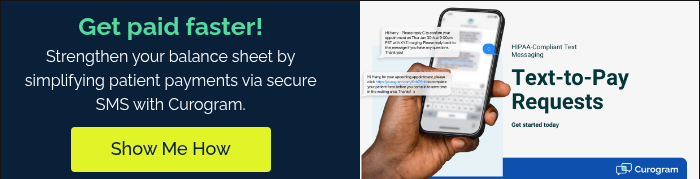
Better billing helps your imaging center. But it also transforms the experience for patients who just want to pay their bill and move on with their lives.
Patients love mobile payments. Not "they don't mind them." They actively prefer them.
Paying from a phone feels as natural as checking social media or reading news. It happens in moments of downtime throughout the day.
Lunch break at work? Pay your imaging bill. Waiting in line at the store? Done. Sitting in the carpool lane? Handled.
No need to find stamps or wait until evening to call during business hours. Payment happens whenever and wherever is convenient.
Nothing frustrates patients more than confusing bills they can't understand. Text messages eliminate that frustration.
The message states the amount owed in plain numbers. It explains what the charge covers in simple language.
"Your MRI co-pay" or "Balance after insurance" instead of billing codes and jargon.
This transparency builds trust. Patients see you're being upfront about costs. You're not hiding fees or trying to confuse them. Everything is clear and straightforward.
That trust encourages prompt payment.
Nobody enjoys dealing with medical bills. Text-to-Pay makes an unpleasant task as painless as possible.
One clear message. One simple link. Tap, enter payment info, done.
The simplicity reduces stress around an already annoying obligation. Compare that to traditional billing—find the paper bill, find a stamp, write a check, find an envelope, get to a mailbox.
Or call during business hours and wait on hold.
The friction makes people put it off indefinitely.
Professional billing systems signal competence. Patients notice when organizations use modern technology. They appreciate centers that respect their time and make financial matters easy to handle.
This positive impression influences future decisions.
Will they return to your center for their next scan? Will they recommend you to friends and family?
Modern, efficient billing helps them answer yes to both questions.
Integration sounds technical—boring, even. But it matters more than almost any other feature.
When systems talk to each other automatically, double work disappears, errors drop, and everything flows. A staff member schedules an MRI in Medstreaming, selects insurance, adds notes—and they’re done.
Behind the scenes, Curogram picks it up instantly. It checks insurance, estimates the co-pay, and schedules the right billing reminder to go out before the visit. All of this happens automatically in seconds.
Messages adjust based on exam type. MRIs trigger prep and co-pay reminders. CT scans and X-rays follow their own rules. The system knows what to send and when.
Integration also keeps patient data accurate. Update a phone number or email in Medstreaming, and Curogram reflects it immediately. No messages to disconnected numbers. No bills sent to the wrong patient.
For multi-location networks, smart routing matters. Billing reminders reference the exact location where care occurred, with the correct address and phone number. When patients call, they reach the right team. Each visit stays tied to the right center, automatically.
Most importantly, integration eliminates double entry. Staff enter information once. Payments post back to both systems instantly. No retyping. No syncing errors.
Even saving ten minutes per staff member per day adds up to dozens of hours each month—time better spent on patient care instead of repetitive data entry.
Imaging centers nationwide are discovering how Text-to-Pay transforms billing operations. The technology works reliably. The results speak for themselves.
Centers report higher collection rates within weeks of going live.
The switch to payment workflow automation doesn't require massive IT projects. Curogram integrates smoothly with Medstreaming systems you already use.
Implementation typically takes days, not months. Staff training takes even less time because the interface is so intuitive.
You see benefits immediately after launch. First automated billing reminders go out within hours. Patients start paying through text links right away.
Your staff notices the reduced workload during the first week.
Collection rates improve steadily as more patients adapt to the convenient payment method. Multi-location networks gain even more from standardized workflows.
Every center operates with the same efficient processes. Patients receive consistent service quality everywhere. Management gets unified reporting across your entire network instead of piecing together data from multiple systems.
The combination of Medstreaming and Curogram creates a powerful solution for modern imaging center billing. Automated systems handle routine tasks flawlessly. Your staff focuses on patient care instead of administrative busywork.
Patients enjoy convenient payment options that fit their busy lives.
You can't afford to keep using outdated billing methods. Competition intensifies every year. Patient expectations keep rising.
Imaging centers that embrace modern payment workflow automation position themselves for long-term success while those clinging to paper statements and phone calls fall behind.
Book your demo now to see exactly how Text-to-Pay works with your Medstreaming software.
 Aubreigh Lee Daculug : Jan 28, 2026, 6:00:00 AM
Discover how Curogram’s Text-to-Pay helps Medstreaming users boost revenue, reduce A/R, and enhance patient satisfaction.
.jpg?width=30&name=square-formal-photo%20(1).jpg) Mira Gwehn Revilla : Feb 6, 2026, 9:00:01 AM
Mira Gwehn Revilla : Feb 6, 2026, 9:00:01 AM
Elevate your patient experience. Learn how frictionless medical billing for Cerbo via Curogram’s secure SMS links makes payments easy and...
 Aubreigh Lee Daculug : Jan 9, 2026, 10:00:00 AM
Learn how GE Centricity users automate billing and reduce manual collections with Curogram’s secure Text-to-Pay integration.