Reactivate Lapsed Patients With Lytec Patient Recall Text Campaigns
💡 Lytec stores your patients but can't text them at scale. A recall layer fixes that. Lytec has no built-in way to mass-text lapsed patients. ...

10 min read
Mira Gwehn Revilla
:
June 29, 2026
Most patients do not leave a practice on purpose. They mean to come back. Then life fills up, the months slip by, and the visit fades. No one calls. No one texts. The follow-up simply never happens, and the patient is gone.
This quiet drift is a real problem for Lytec practices. Your system holds thousands of patient records. Many of those patients are overdue right now. Some need a flu shot or a wellness visit. Others need a check on a chronic condition. Lytec remembers them all. It just cannot reach out on its own.
That gap is where care slips away. A patient who skips one visit often skips the next. Screenings get missed. Chronic conditions go unchecked. The patient is not avoiding care. Friction is keeping them away.
Calling to rebook feels like a chore. People dread phone tag, hold music, and voicemail. So the call never gets made. A letter is easy to ignore. A voicemail is easy to delete.
A text is different. People read texts within minutes. They reply without thinking twice. This is the simple idea behind Lytec recall texts that let patients rebook in one reply.
Curogram sends each overdue patient a short, personal message. The patient taps back one reply to book. No app. No login. No long phone call. The reply flows into your team's inbox and your Lytec workflow.
The end result is fewer lost patients and fuller, busier days. Based on our internal data, 35% of recalled patients rebooked. That is a real shift from a database that once sat still and quiet.
This short guide shows how one-reply rebooking works for Lytec practices. You will see why a text beats a call. You will also see how to bring patients back without phone tag, letters, or guesswork.
Every Lytec practice has a hidden list. It is the group of patients who slipped away. They were not unhappy. They did not switch clinics. They just stopped coming back, one missed visit at a time.
Think about a real example. A patient sees you for a yearly check. You say, "See you next year." They nod and mean it. Then work, kids, and bills take over. The year passes. No reminder arrives, so the visit never gets booked.
This is the dormant database from the patient's view. It is not a marketing problem. It is a friction problem. The patient wants to return. The path back is just too hard.
Here is how the drift usually unfolds, step by step:
|
Stage |
What happens |
How the patient feels |
|
The intent |
Patient plans to rebook later |
"I'll call when things calm down" |
|
The silence |
No nudge from the practice |
The visit fades from mind |
|
The delay |
Months pass with no contact |
"It's been so long now" |
|
The drop-off |
Calling feels like a chore |
"I'll deal with it someday" |
|
The loss |
Care lapses for good |
The patient never returns |
Look at the pattern. At no point does the patient choose to leave. Each step is just a little more friction. Added up, that friction wins.
A patient who skips one visit often skips the next. A missed wellness check turns into a missed screening. A skipped follow-up lets a chronic issue drift. Small gaps become big ones over time.
Picture a patient with high blood pressure. She was due for a recheck in March. No one reached out, so she let it slide. By fall, she has no current reading and no refill plan. One small gap quietly became a real health risk.
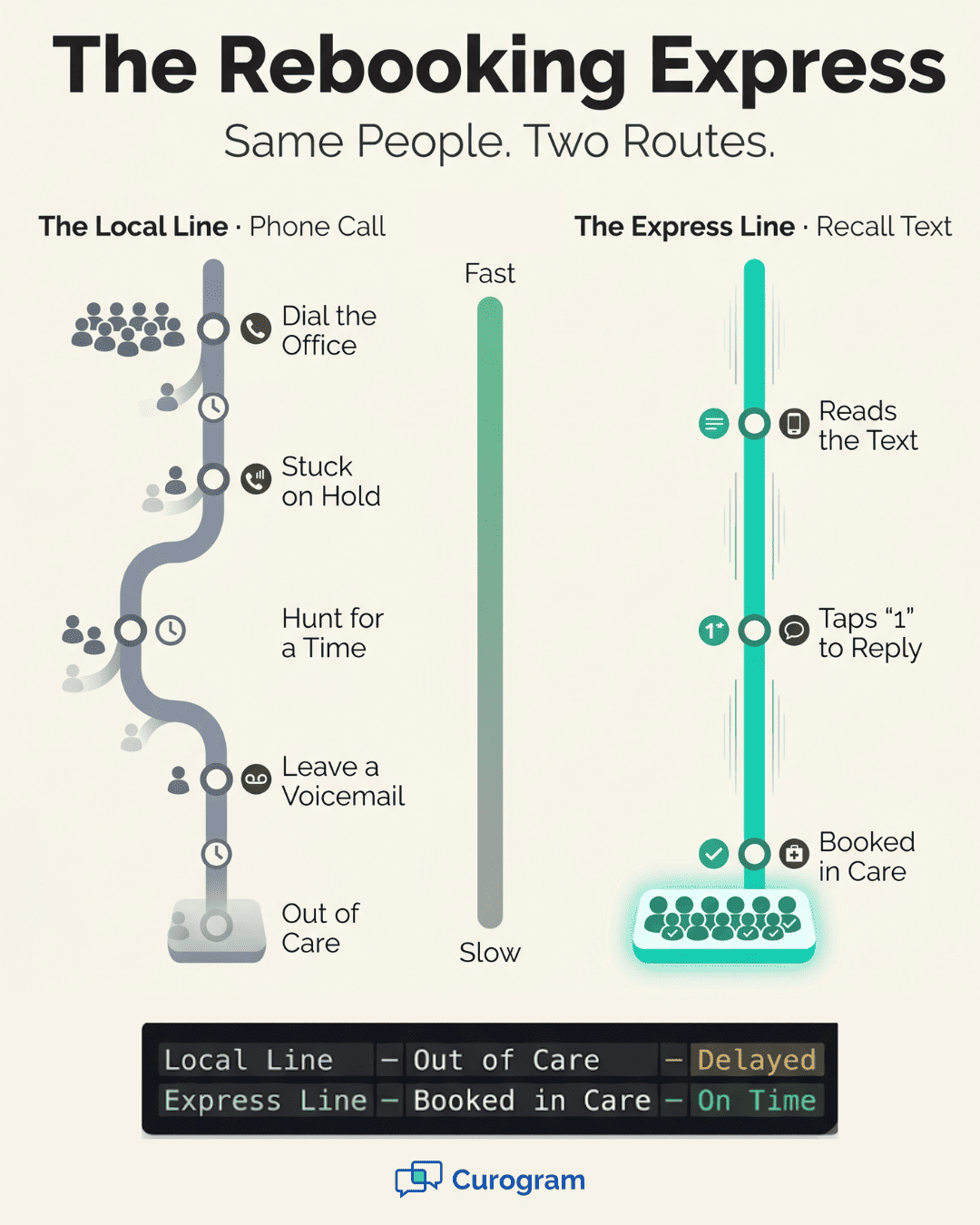
Most lapsed patients will not pick up the phone to rebook. They dread the hold music. They dread the back-and-forth on open times. They dread leaving a voicemail that no one returns. So they put it off, again and again.
Letters do not fix this either. A postcard reminder is easy to toss in the recycling. An email sinks under fifty others. Neither one asks for a quick, simple reply. Both are easy to ignore on a busy day.
The patient is left feeling forgotten. They do not know your schedule is open. They do not know you noticed they were gone. From their side, the silence feels like the door is closed.
There is no alert when a patient quietly drifts away. The schedule still looks full enough this week. So the slow leak of overdue patients goes unseen for months.
This is the heart of the problem. Your Lytec system knows exactly who is overdue. It holds the dates, the gaps, and the history. But a database cannot text. It cannot start the conversation that brings a patient back.
So the right patients sit on the list, unseen and unreached. They are not lost causes. They are people who would say yes to an easy invite. They just never got one they could answer in seconds.
That is the gap a lapsed patient text reminder is built to close. The next section shows how Curogram turns that silent list into a simple, friendly conversation.
The fix for a dormant database is not more effort. It is less friction. A patient who will not call a clinic will still answer a text. That single truth powers the whole approach.
Curogram acts as the recall engine for your Lytec practice. It reaches each overdue patient with a short, personal message. The patient does not face a phone tree. They face one easy question they can answer in seconds.
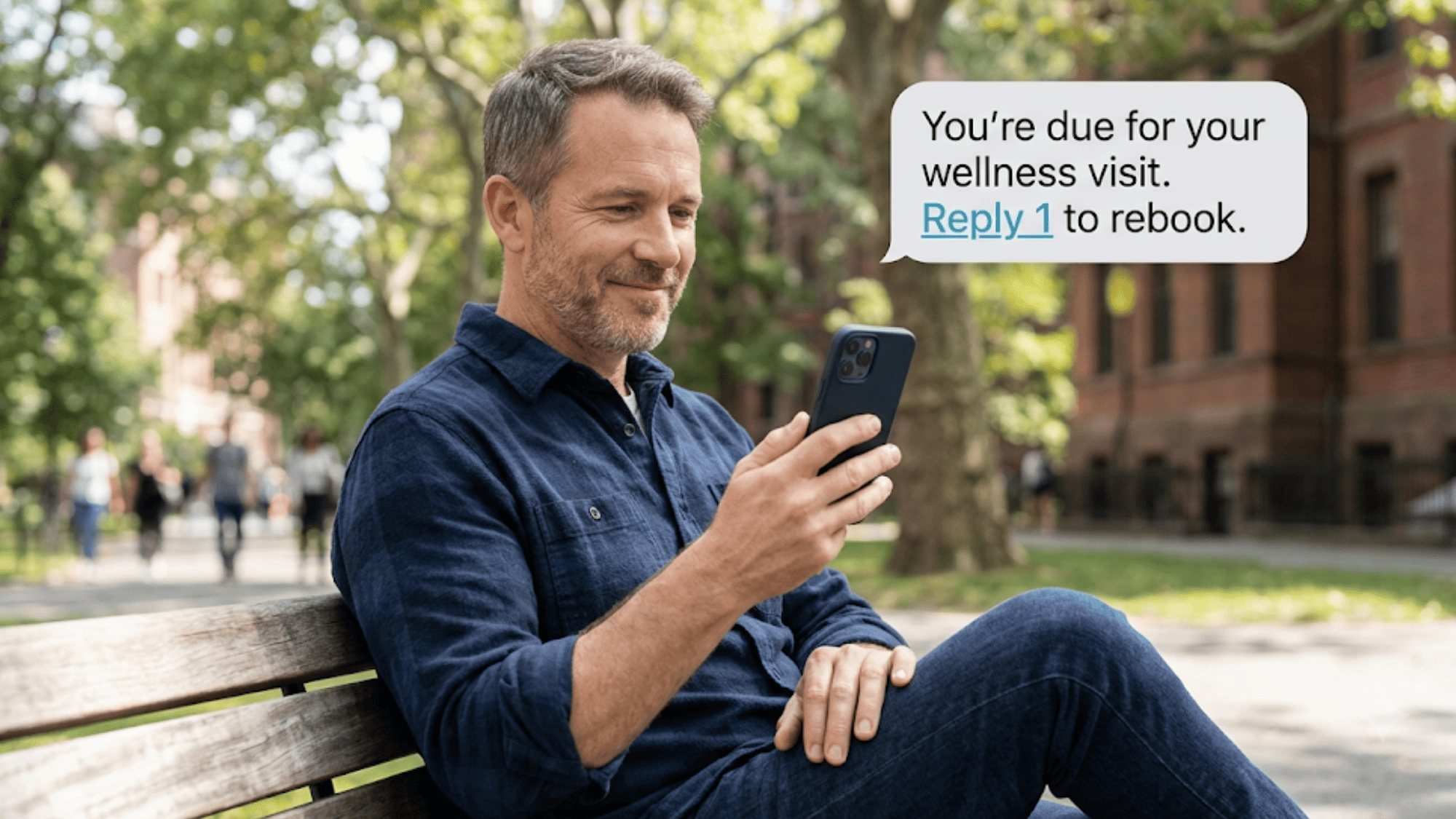
Here is what a recall text might say:
"Hi Maria, it's Lakeview Family Clinic. You're due for your yearly wellness visit. Reply 1 to book a time this month. Reply STOP to opt out."
That is it. No app. No login. No long call. The patient taps a single reply, and the path back is open. This is what lets Lytec patients rebook by text in one quick step.
You choose which patients to reach, like everyone overdue for a flu shot. You set the message and the timing. Curogram sends the texts and listens for replies. The work that once took hours of calls now runs on its own.
Timing matters as much as wording. You can send a recall right when a patient becomes overdue. You can space messages so no one feels spammed. A gentle nudge at the right moment beats a loud blast every time.
Every reply routes to one shared inbox for your team. From there, the booking flows into your Lytec workflow. Staff do not juggle a separate tool or a second list. They see the reply, confirm the time, and move on.
Think about the staff time this saves. Calling 200 lapsed patients by hand could take days. Most calls end in voicemail anyway. With recall texts, the outreach goes out at once. Your team only steps in when a patient replies and wants a slot.
This brings true one-reply rebooking to Lytec practices. The patient does the easy part. The system and your team handle the rest. No phone tag. No missed voicemails. No lost slips of paper.
The best part is who this reaches. A text works for nearly everyone. Consider the range of patients on your list:
|
Patient |
Comfort with tech |
Can they reply to a text? |
|
80-year-old on a flip phone |
Low |
Yes, texting is simple |
|
25-year-old on a smartphone |
High |
Yes, in seconds |
|
Busy parent of three |
Mixed |
Yes, between tasks |
|
Patient who hates phone calls |
Low for calls |
Yes, no call needed |
That is the every-patient fit. There is no portal that confuses older patients. There is no app that younger patients forget to open. A text meets each person on common ground.
This is why an easy patient recall works so well for Lytec clinics. It removes the steps that stop people. It asks for one reply, not a phone call or a login. It lets patients return to care by text, on their own time.
The result is a patient-friendly recall that respects how people actually live. They are busy. They skim. They reply fast or not at all. A one-tap text fits that reality far better than a call ever could.
So the recall engine does two jobs at once. It reaches the right patients with the right nudge. And it makes saying yes as easy as sending one short text back.

When you remove the friction, patients come back. Not all of them, but far more than you would expect. This is where the dormant database turns into a reactivated one. The numbers tell the story well.
Based on our internal data, 35% of patients who got an SMS recall booked an appointment within a month. At one multi-location practice, that added up to 1,240 patients seen from recall texts alone. These were not new patients. They were existing patients who had simply drifted away.
Sit with that 35% for a moment. More than one in three lapsed patients came back from a single text.
Compare that to what happens with no outreach. Most lapsed patients never rebook on their own. They wait for a nudge that never comes, and the gap just grows.
Here is the core shift in plain terms:
|
Without recall texts |
With recall texts |
|
Patient must remember to call |
Patient gets a friendly reminder |
|
Calling feels like a chore |
Replying takes seconds |
|
Most never rebook |
35% rebook within a month |
|
Slots sit empty |
Slots get filled |
|
Care lapses quietly |
Continuity returns |
The shift is simple but powerful. Returning becomes one reply, not a phone call. That small change moves patients from "someday" to "booked." And it scales across your whole overdue list at once.
Let's make the impact concrete with some example math. Say your Lytec practice has 1,000 overdue patients. The figures below are illustrative, but they show how the math can work.
|
Step |
Number |
|
Overdue patients texted |
1,000 |
|
Reactivation rate (internal data) |
35% |
|
Patients who rebook |
350 |
|
Average visit value (example) |
$150 |
|
Recovered revenue (example) |
$52,500 |
In this example, one recall round brings back 350 patients. At a sample visit value of $150, that is $52,500 in care that would have been lost. Your real numbers will differ. But the pattern holds: a higher reply rate means more patients and more filled slots.
Each rebooked visit is a real health win. A reactivated patient catches a screening they had skipped. A diabetic patient gets blood work that was months overdue. A patient with high blood pressure gets back on a steady plan.
This is the deeper value of the reactivated database. You are not just filling a calendar. You are closing care gaps that put patients at risk. Continuity of care is the real prize, and revenue follows it.
The outcome reaches your whole practice, not just the schedule. Consider the ripple effects:
Each of these adds up over a year. A few hundred reactivated patients per round is a major shift. Run recalls each quarter, and the effect compounds. Your overdue list shrinks while your schedule grows.
When you reach out, patients feel remembered. A simple "you're due for a visit" says the practice still cares. That feeling brings patients back and keeps them coming back. It turns a one-time recall into a lasting habit of care.
Compare two practices to see the gap. One sits on its overdue list and hopes patients return. The other sends a patient-friendly recall and makes returning easy.
Over a year, the second practice sees more visits, more revenue, and healthier patients. The list was the same. The outreach made the difference.

Bringing lapsed patients back into care should not take hours of valuable staff time. With SMS Recall Campaigns, it does not.
Curogram pulls your overdue Lytec patients and sends each one a personal recall text. The patient reads it, replies in seconds, and books a visit. The whole loop runs without a single phone call.
Setup is simple on your side and invisible on theirs. You pick the group to recall, like patients overdue for a wellness visit. You choose the message and the timing.
Curogram sends the texts and watches for replies. Each reply lands in one shared inbox, tied to the Lytec workflow your team already knows well.
The patient experience is the real win here. There is no app to download. There is no portal to log into. There is no password to reset. The patient just texts back, the way they text a friend. That ease is why an easy patient recall reaches Lytec patients of every age.
The messages are targeted, not generic. A patient overdue for a flu shot gets a flu-shot nudge. A patient due for a chronic check gets that reminder instead.
This is a patient-friendly recall that feels personal, not like spam. Patients can reply STOP to opt out at any time, and the flow stays HIPAA compliant.
The payoff shows up in your schedule. Based on our internal data, 35% of recalled patients rebooked, and 1,240 patients returned at a comparable practice. Slots that would otherwise sit empty get filled. Patients who would have drifted away get the care they need.
That is the heart of one-reply rebooking for Lytec practices. Curogram handles the outreach. The patient sends one reply. Your schedule fills, and continuity of care returns.
Patients rarely leave on purpose. They drift away in silence, one busy week at a time. The fix is not a harder push. The fix is simply an easier path back into care.
One reply brings them back. That is the whole idea. A short, friendly text reaches a patient where they already are. They tap back once, and they are booked. No phone tag. No hold music. No chore at all.
Lytec already does its part well. It remembers every patient and every overdue date. But a record cannot reach out on its own. Lytec remembers them. Curogram invites them back. Together, they close the loop that keeps patients in care.
The numbers back this up clearly. Based on our internal data, 35% of recalled patients rebooked. At a comparable practice, 1,240 patients returned from recall texts alone. Those are real visits, real screenings, and real clinic revenue you would have lost.
So stop letting patients drift away in silence. Every overdue record is a patient who may want to come back. They just need an easy way to say yes. A simple text gives them that way.
The shift is easy to start. You do not need to rebuild your workflow. You do not need to train patients on new tools. You only need to send the first recall and watch the replies arrive.
Fill empty slots with patients you already know. Schedule a Curogram demo to see how easy patient recall brings lapsed patients back into care.
Curogram texts each overdue patient a short, personal recall tied to your Lytec workflow. The patient replies with one tap to book. No call, no app, and no login stand in the way.
A text is easy to act on right away. Calls need a free moment and real talk. Letters are easy to toss aside. A text lets patients reply in seconds, so far more of them do.
If a patient can text, they can rebook. There is no app, portal, or password to manage. They simply reply to a message, which is why recall texts reach patients of every age.
Patients can reply STOP at any time to opt out. The whole flow runs with proper consent and stays HIPAA compliant. Opting out is as easy as the one-tap reply that books a visit.
Each recall is targeted by patient criteria, so the right reminder reaches the right person. A flu-shot patient gets a flu-shot nudge, not a random message. That focus makes the text feel helpful, not like spam.
💡 Lytec stores your patients but can't text them at scale. A recall layer fixes that. Lytec has no built-in way to mass-text lapsed patients. ...

💡 Lytec stores your lapsed patients. It cannot text them in bulk. Here is the faster way to bring them back. Curogram filters your CGM Lytec...
💡 Patient reactivation texts for lapsed CharmHealth patients work because most lapsed patients didn't choose to leave. They drifted. No one reached...