10 min read
GE Centricity Workflow Fix: Automated Appointment Reminders
Aubreigh Lee Daculug
:
Dec 31, 2025 11:00:00 AM
Table of Contents
- Staff spend less time on phone calls and patients receive scheduling reminders at the right time
- Multi-location clinics stay organized across all departments with standardized communication
- Radiology and specialty departments see patients arrive better prepared for their visits
Every clinic manager knows the morning routine. Staff arrive early to start making reminder calls. They work through lists of appointments for the day. Many patients don't answer, so staff must call again later.
This daily task takes hours away from patient care. Front desk teams spend 30-40% of their time on phone calls. Meanwhile, patients still miss appointments or arrive unprepared. The cycle continues day after day.
GE Centricity users face extra challenges with multi-location operations. Specialty clinics serve different patient needs across various departments. Radiology requires specific prep instructions. Surgery centers need detailed pre-visit guidance. Each department follows different protocols that patients must understand.
The solution lies in automated reminders GE Centricity clinics can use right away. These systems connect directly to your existing schedule. They send patient confirmation SMS messages at the perfect time. Your team gains hours of productive time each week.
Modern workflow improvements work without disrupting your current systems. Staff members don't need extensive training. Patients receive clear, helpful messages about their visits. Everyone benefits from better communication.
Think about what your staff could do with an extra 15 hours each week. They could spend more time with patients who need help. They could focus on complex cases that require attention. Your clinic could serve more people without adding staff.
This guide shows how clinics transform their operations with simple changes. You'll learn about real workflow improvements that save time and reduce stress. By the end, you'll understand exactly how to make your clinic run better.
Workflow Challenges in GE Centricity Multi-Location Clinics
Running multiple clinic locations feels like spinning plates while juggling chainsaws. Each site runs its own show with different schedules and patient flows. Your staff at Location A has no clue what's happening at Location B. Communication falls through the cracks every single day.
Let's talk about the no-show nightmare:
- Primary care loses 15% of appointments to no-shows
- Specialty visits hit 20% or higher when patients forget
- Radiology appointments reach 25% no-shows when prep instructions get lost
Do the math on a 200-appointment day. You're losing 40-50 time slots to ghosts. That's thousands of wasted hours every year while your fixed costs keep climbing.
The preparation chaos makes everything worse. Location A mails detailed instructions that arrive three days late. Location B gives verbal directions during scheduling that patients forget immediately. Location C assumes everyone remembers from last time. Guess what happens? Total confusion.
Your schedulers are drowning in reminder calls. Picture calling 50 patients before lunch. Each call eats 3-5 minutes between dialing, waiting, leaving messages, and trying again. That's over 4 hours gone for just one day's appointments.
Multi-department scheduling turns into a coordination nightmare. Patient needs labs before the specialist. Specialist requires imaging from radiology. Each step needs separate reminders and instructions. Keeping track manually? Nearly impossible.
Staff turnover pours gasoline on this fire. New employees spend weeks learning your patchwork of protocols. They mess up while learning. Meanwhile, your experienced staff babysit newbies instead of helping patients.
Every location develops its own reminder system over time. One calls 48 hours out. Another does 24 hours. The third uses random texts and calls. Patients visiting multiple locations get completely confused about what to expect.
GE Centricity handles scheduling beautifully, but it wasn't built for automated messaging. Your staff exports data to other systems or handles everything manually. More steps mean more chances for mistakes.
Here's the kicker: Patient expectations changed while you weren't looking. Everyone expects text confirmations now. They want to respond with a quick tap, not play phone tag. When you can't deliver, they get frustrated and skip appointments.
These problems don't just annoy your staff. They crush patient care quality and kill your revenue. Every no-show costs you money AND leaves a patient without needed care. Multiply that across locations and suddenly it's the new normal.
How Manual Reminder Processes Slow Down Clinic Operations
Manual reminders are the silent productivity killer hiding in plain sight. Your staff loses hours every day that could go toward actual patient care. Instead, those hours vanish into an endless loop of phone calls that accomplish almost nothing.
The morning phone rush hits like a tidal wave. Staff grab lists and start dialing while the phone system lights up with incoming calls. Patients with real questions can't get through because all your lines are busy with reminder calls. It's a disaster waiting to happen daily.
Your front desk warrior attempts 100 reminder calls weekly. Maybe 60% actually answer. The other 40% need callback attempts that multiply like rabbits. Each failed call means another task on the growing to-do list.
Voicemails create their own special hell. Staff leave detailed messages that patients delete without listening. Or they listen but forget everything five minutes later. You have zero visibility into who actually got the information they need.
Unprepared patients blow up your schedule like landmines. Someone shows up for an MRI after eating breakfast. Scan postponed. Schedule disrupted. Other patients sitting in the waiting room wondering why everything's running late. All because one person missed the fasting instructions.
Radiology gets hit hardest by this mess. CT scans need exact prep that patients must follow to the letter. Arrive unprepared? Reschedule the whole study. Now your expensive equipment sits idle while staff scramble to fill the gap.
Specialty visits face medication instruction disasters regularly. Cardiology needs specific meds taken before tests. Surgery requires stopping blood thinners days in advance. Miss these instructions and you're canceling the entire visit. Patient frustrated. Provider frustrated. Revenue gone.
The real cost isn't just the hours spent calling. It's what doesn't happen during those hours. Schedulers can't help the confused patient who needs extra guidance. They can't solve the complex multi-appointment puzzle. They're stuck on autopilot making calls that barely work.
Watch the error rate climb over time. Someone forgets to call a patient completely. Another gives incomplete instructions. A third person calls the wrong number from an outdated contact sheet. Every mistake creates more work to fix the original problem.
Documentation becomes an afterthought in the chaos. Did we reach Mrs. Johnson or leave a message? Who knows? Nobody recorded it because they were rushing to the next call. Later, when questions arise, you're flying blind.
Monday mornings turn into absolute madness. Staff need to call for the entire week ahead. Everyone feels overwhelmed trying to reach hundreds of people. Some patients don't hear from you until the day before, giving them zero time to prepare properly.
How Automated Appointment Reminders Improve Workflow Efficiency
Automated reminders GE Centricity users implement flip the script completely. The system works silently in the background while your staff actually helps patients. No more morning call marathons. No more guessing if patients got their instructions.
Reliable automated touchpoints replace the chaos of manual outreach. Patient confirmation SMS messages go out at perfect times automatically. First reminder hits 72 hours before the appointment. Second reminder arrives 24 hours out. Every message contains exactly what patients need to know.
These scheduling reminders catch people when they're paying attention. Text messages get opened 98% of the time versus 20% for emails. Most people read texts within 3 minutes of receiving them. Your important information lands right when it matters most.
Here's what standardization across locations actually delivers:
- Every radiology patient gets identical, crystal-clear prep instructions
- Specialty clinics send the same proven pre-visit guidance to everyone
- New locations automatically use tested messaging from day one
Staff build message templates once and use them forever. Setting up an MRI prep template takes 15 minutes. Then it serves thousands of patients without touching it again. Protocol changes? Update one template instead of retraining your entire team.
Communication speed jumps from days to seconds. Manual calls take 2-3 days to reach everyone. Automated systems blast messages to hundreds of patients instantly. Perfect timing for every single person.
Patient responses become stupid simple. One text reply confirms the appointment. Another keyword reschedules. Need to cancel? Quick reply handles it. You know immediately who confirmed and who needs attention.
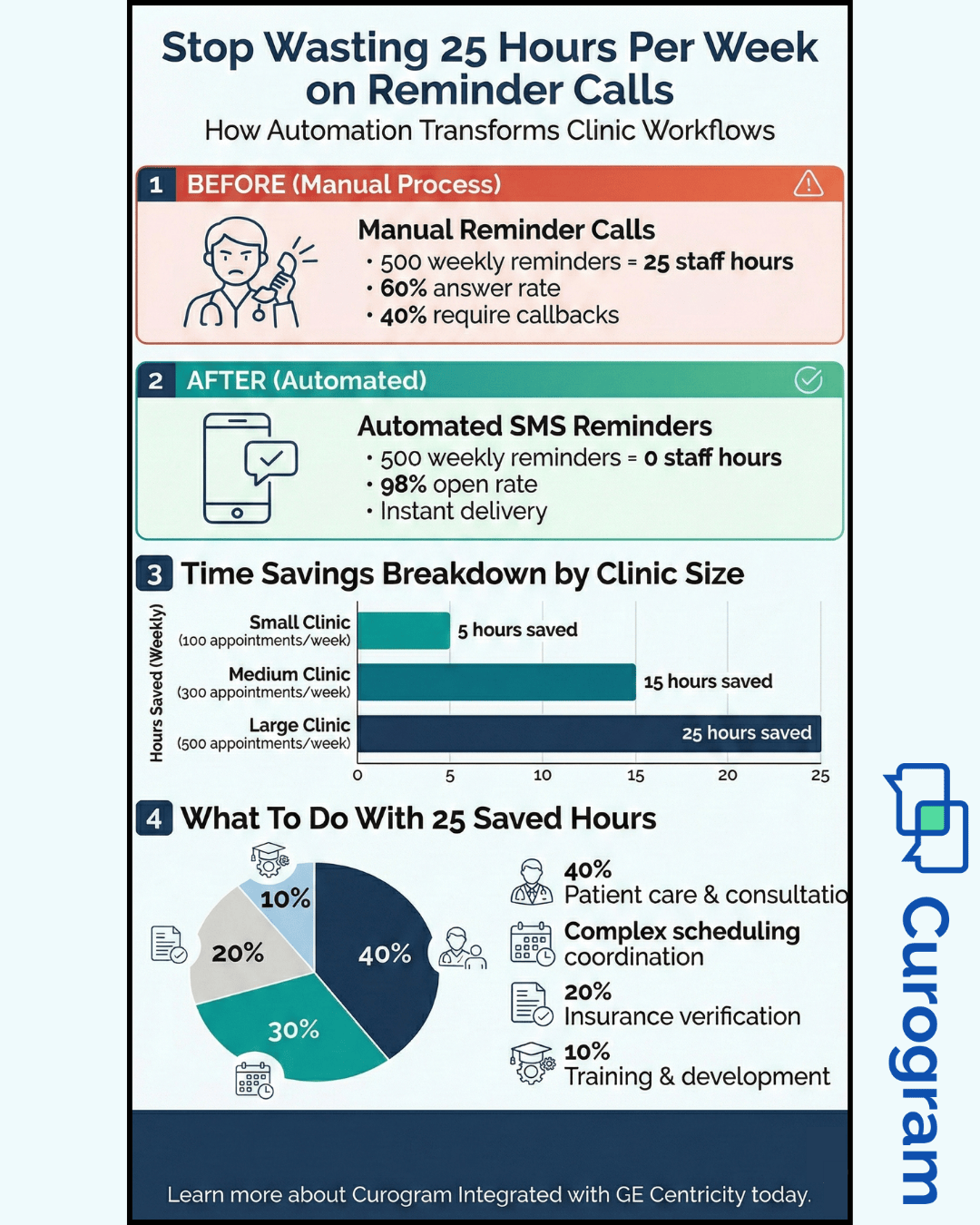
The time savings blow your mind. A clinic sending 500 weekly reminders saves roughly 25 hours of staff time. That's one full-time person doing nothing but reminder calls. Now imagine redeploying that person to work that actually matters.
Watch the compound effect across your team. Schedulers help patients instead of leaving voicemails. Front desk handles walk-ins without phone interruptions. Nurses focus on clinical care instead of administrative busywork.
Documentation happens automatically without anyone lifting a finger. The system records every message sent. It tracks confirmations and non-responses. Staff pull up this information instantly instead of digging through scattered notes.
This automatic tracking powers serious quality improvements. See which appointment types get the highest confirmation rates. Identify when patients respond most often. Use real data to make scheduling smarter.
No-show rates typically crash by 30-40% after automation kicks in. A 200-appointment clinic might see no-shows drop from 40 to 25 daily. That's 15 extra patients seen every single day without changing anything else. Multiply that across a year and watch the numbers explode.
Revenue follows naturally when no-shows disappear. Each completed appointment generates money that would've vanished. A $200 specialty visit times 15 extra daily appointments equals $3,000 recovered revenue per day. That's $60,000 monthly or more.
Patient satisfaction shoots up alongside your efficiency gains. People love helpful reminders about appointments. They appreciate clear instructions arriving at convenient times. Modern text communication shows you respect their time.
Complex cases benefit most from detailed automated messages. Procedure patients get step-by-step prep instructions. They review everything multiple times without bothering your staff. Less anxiety for them, better preparation for you.
Multilingual messaging reaches every patient in their preferred language. Create templates in Spanish, Chinese, Vietnamese, or whatever languages your community speaks. Messages automatically go out in the right language for each person. Language barriers finally stop blocking critical information.
Staff stress evaporates when repetitive work disappears. Team members report way higher job satisfaction focusing on meaningful patient interactions. Burnout drops because people feel their time actually matters. The whole workplace vibe improves.
Training new employees becomes ridiculously simple. No complex calling procedures to memorize. No department-specific protocols to learn. The system handles complexity automatically from their first day.
Scaling happens naturally as you grow. Adding a new location doesn't mean hiring more reminder staff. The automated system absorbs increased volume at zero additional cost. Growth finally becomes easier and more profitable.

GE Centricity + Curogram Workflow Synchronization
Direct use of Centricity appointment data
Integration between GE Centricity and reminder systems eliminates double data entry. The reminder platform reads appointment information directly from your existing schedule. No exports, no manual uploads, no room for transcription errors. What you schedule is what patients receive.
Patient contact information syncs automatically from your database. Phone numbers update when patients provide new information. Preferred communication methods transfer correctly. The system always uses current, accurate data.
No double entry or manual exports
Staff schedule appointments once in GE Centricity and forget about reminders. The system handles everything else automatically. Schedule changes sync in real-time so patients always receive current information. Cancellations prevent unnecessary reminders from being sent.
This seamless workflow prevents the errors that come from manual data handling. No one forgets to export a file. No one sends reminders for canceled appointments. The technology simply works in the background supporting your team.
Front Desk and Scheduling Efficiency Improvements
Front desk operations transform when automated reminders handle routine communication. Call volume drops by 40-50% in most clinics. Staff answer fewer repetitive questions about appointment times and locations. Phone lines stay open for patients who truly need personal assistance.
The change becomes obvious within the first week of implementation. Morning rush periods feel manageable instead of overwhelming. Staff have time to greet patients warmly instead of rushing between calls. The overall atmosphere becomes calmer and more professional.
Fewer follow-up calls mean schedulers can focus on complex scheduling needs. A patient requiring multiple coordinated appointments gets proper attention. Insurance questions receive thorough answers. New patients experience a welcoming introduction to the practice.
Better time allocation for high-value tasks improves the entire patient experience. Registration processes run smoothly without constant interruptions. Staff can update records and verify insurance without rushing. Quality of work increases across all front desk functions.
Curogram's platform makes this transformation possible for GE Centricity users. The system integrates seamlessly with existing workflows without requiring major changes. Staff continue using Centricity exactly as before. Behind the scenes, automated reminders GE Centricity practices need work silently and reliably.
Setup takes hours, not weeks. Most clinics go live within a few days of deciding to implement the system. Training requirements remain minimal because the platform handles complexity automatically. Your team focuses on patients while technology manages routine tasks.
How Appointment Reminders Support Predictable Throughput
Predictable daily operations become reality when patients consistently show up prepared. Clinics can schedule with confidence knowing most patients will arrive on time. Resources get used efficiently instead of sitting idle during no-show gaps.
More patients arrive prepared for their visits after receiving clear instructions. Lab work gets completed successfully on the first try. Imaging studies produce diagnostic-quality results. Specialty consultations happen without delays from missing information.
Fewer workflow disruptions mean providers stay on schedule throughout the day. A doctor starting morning clinic at 9 AM finishes on time instead of running an hour behind. This consistency reduces stress for both staff and patients. Everyone benefits from a smooth, predictable day.
Smoother daily schedules across departments create a ripple effect of efficiency. Radiology completes more studies when patients arrive prepared. Lab results come back faster when samples are collected correctly. Specialty clinics see more patients when everyone shows up ready.
Conclusion
The numbers don't lie. Automated reminders GE Centricity practices implement deliver results you can measure and bank on. Staff time savings translate directly into better patient care and happier teams. Lower no-show rates pump revenue back into your operation while maxing out resource utilization.
Multi-location clinics win biggest with standardized automated communication. Every site runs with identical high standards instead of making up their own rules. Patients get consistent care whether they visit downtown or the suburbs. You finally get clear visibility into what's actually happening across your entire organization.
The investment pays for itself so fast it'll make your head spin. Most clinics hit positive ROI within 3-6 months through recovered revenue alone. Beyond the money, staff morale shoots up and patient relationships get stronger. These softer benefits matter just as much as the hard numbers on your P&L.
Stop letting manual processes drag your practice down. Modern workflow tools plug right into your existing systems without causing chaos. Patient confirmation SMS and scheduling reminders run on autopilot. Your team reclaims hours of productive time every single week to do work that actually matters.
Book a demo to See Curogram + GE Centricity in Action.
Frequently Asked Questions
Automated reminder systems connect directly to your GE Centricity database through secure integration. The system reads appointment information automatically without requiring staff to export or manually enter data. Changes made in Centricity sync in real-time to the reminder platform. This connection ensures patients always receive accurate information about their appointments. Setup typically takes a few hours with minimal IT involvement required.
Text messages achieve a 98% open rate compared to 20% for emails and 30-40% answer rates for phone calls. People read texts within minutes of receiving them, ensuring timely delivery of important information. Texts don't interrupt patients during work or other activities like phone calls do. Patients can review preparation instructions multiple times without calling back. The convenience factor makes patients more likely to confirm and show up for appointments.
Most clinics save 20-30 hours per week by eliminating manual reminder calls. A practice sending 500 weekly reminders typically frees up one full-time equivalent position worth of labor. These hours get redirected to direct patient care and complex scheduling needs. Staff report lower stress levels and higher job satisfaction when freed from repetitive calling tasks. The time savings scale proportionally with clinic size and appointment volume.
Modern reminder systems offer multiple communication channels beyond text messages. Patients without text capability can receive automated voice calls with recorded instructions. Email reminders work for patients who prefer that method. The system checks patient preferences and contact information to choose the best channel automatically. Staff can also mark specific patients for manual outreach if needed. This flexibility ensures all patients receive reminders regardless of their technology access.
Most clinics notice improved attendance within the first two weeks of going live. No-show rates typically drop 30-40% within one month of implementation. Staff time savings become apparent immediately as phone call volume decreases. Patient satisfaction scores improve within the first quarter as communication becomes more reliable. Financial returns usually appear within 3-6 months as reduced no-shows increase completed appointments and revenue.