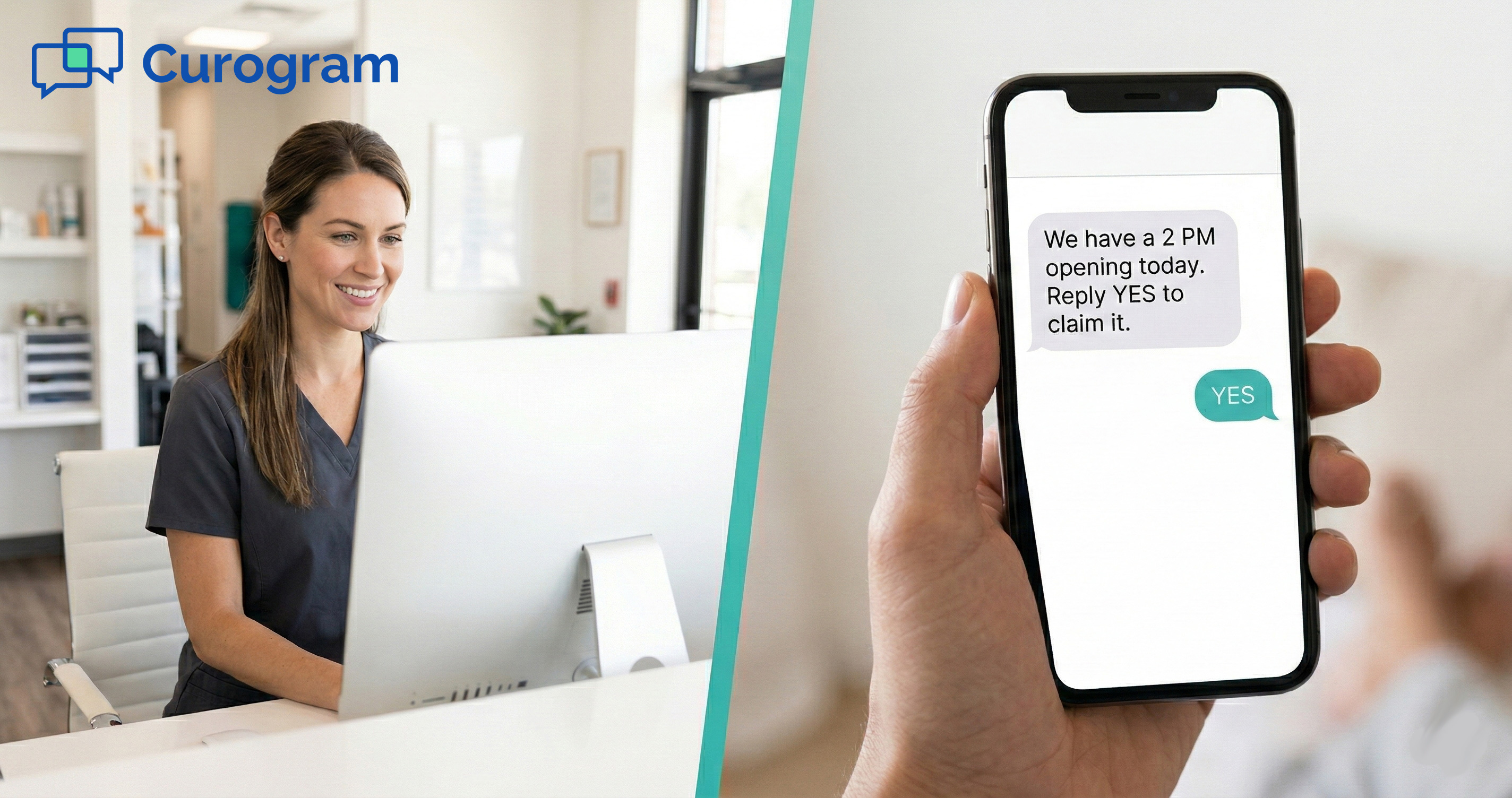
Fill Cancellations Fast: 2-Way Texting Waitlist Integration for WebPT
💡 High-volume rehab clinics lose $80–$120 or more every time a patient cancels and the slot stays empty.A 2-way texting waitlist integration for...
7 min read
Aubreigh Lee Daculug
:
March 12, 2026
It is 2:14 PM. A parent just cancelled a 4 PM therapy slot. Your front desk has less than two hours to fill it — or your clinic absorbs a $100+ loss and a child on the waitlist stays home for no reason.
This is the moment that sorts a reactive front office from a high-performing one.
The answer is not to start dialing. It is to send one well-aimed group text and let parents claim the slot. That is the core idea behind the Surgical Strike method — a fast, repeatable workflow built for the realities of pediatric therapy scheduling.
Front office leads at pediatric clinics know the cost of a cancelled slot all too well. Lost revenue.
A therapist sitting idle. A family who wanted that time but never got the call. Traditional phone-based waitlist management can eat 30 minutes or more just to reach a handful of families — and that is before anyone even says yes.
With 2-way SMS for therapy waitlists, the dynamic shifts completely. Rather than calling one family at a time, you reach several qualified families at once. The first to reply gets the slot.
Everyone else gets a quick follow-up. The whole process wraps up in under three minutes.
One of the most effective pediatric therapy scheduling hacks available today is not a complex system overhaul. It is a smarter way to use the tools already at your fingertips.
Curogram plugs directly into your Fusion Web Clinic workflow, so there is no steep learning curve and no disruption to your team's routine.
This article walks through exactly how the Surgical Strike works, why parents respond to it better than phone calls, and what it means for your schedule and your bottom line. If your team is still calling down a paper list every time a cancellation hits, read on.
Most pediatric therapy clinics still manage waitlists the same way they did 15 years ago:
A handwritten list, a desk phone, and a staff member dialing names one at a time.
It feels thorough. In practice, it is far too slow for a same-day cancellation.
Every part of the traditional process eats time you do not have. When a slot opens,
A front desk staff member has to:
While you wait for Parent A to call back, Parent B — who would have said yes immediately — never even hears about the opening.
The slot stays empty not because no one wanted it, but because the process moved too slowly to reach the right people in time.
The result is familiar to anyone who has worked a busy front desk: a therapist sitting idle for an hour, a gap in the day's billing, and a child on the waitlist who stayed home when they did not have to.
When you compare manual waitlist vs. SMS outreach side by side, the gap in speed and results is stark.
The old approach was never designed for same-day scheduling — and that gap shows every time a slot goes unfilled.
The Surgical Strike is a four-step workflow that any front desk team can run in under three minutes.
It is designed to work alongside Fusion Web Clinic — not against it — so your team does not need to learn a new system or overhaul how they manage the calendar.
They just add a faster outreach step when a slot opens up — all while maintaining HIPAA-compliant secure messaging for any patient information sent digitally.
.png?width=1080&height=1350&name=fill%20pediatric%20therapy%20cancellations%20-%20mid%20(1).png)
The moment a cancellation comes in, mark the time slot as open in the Fusion Web Clinic calendar. This is your starting gun.
The sooner you catch the opening, the more time a family has to make it in — which is why speed at this first step sets the tone for everything that follows.
Inside Fusion, pull up families currently waiting for that specific therapist or time of day. You are not blasting your entire database. You are making a targeted selection of the top 5 to 10 families who are the right fit for this specific opening.
That precision is what makes this a surgical strike and not just a mass broadcast.
Using a saved Curogram template, send one group text to those families.
Something like:
"Hi! We have a last-minute 4:00 PM opening today with [Therapist Name]. First to reply YES gets it!"
No phone calls. No voicemails. No hold music.
This is where the Fusion Web Clinic productivity gains become real — your staff just accomplished in 30 seconds what used to take half an hour.
The first YES lands in your Curogram inbox. Book that family in Fusion right away,
Then send a brief follow-up to the others:
"This slot has been filled, but we will reach out again if another opens up!" Every family feels acknowledged.
No one is left wondering. Your front desk is back to regular tasks within minutes — and the slot is filled.
.png?width=1920&height=1080&name=fill%20pediatric%20therapy%20cancellations%20-%20landscape%20(1).png)
The Surgical Strike is not just a scheduling workaround. It is an operational upgrade with measurable results.
When you look at what this method does for staff time, revenue recovery, and clinic reputation together, the case for switching becomes hard to argue against.
One well-trained front desk team member can manage the cancellation waitlist for 10 therapists in roughly the same time it previously took to handle just one.
The time savings open the door to better work across the board. Instead of spending afternoons on the phone,
Staff can focus on:
This is how you reduce front desk phone tag without adding headcount — and it is one of the fastest ways to improve staff morale at the same time.
Even a late-breaking cancellation does not have to mean a guaranteed loss. The Surgical Strike works as an insurance policy for that hour — an active, fast response that turns a would-be gap into a filled appointment.
Clinics that adopt this habit consistently report fewer unbillable therapy hours across the week.
The longer-term benefit shows up in your clinic's standing with referring pediatricians.
When children move through your waitlist faster — because cancellations get filled instead of absorbed — referring doctors take notice.
Pediatricians track which clinics serve their patients quickly and reliably, and a strong record of waitlist velocity translates directly into more referrals. In a competitive market for pediatric therapy, that kind of reputation is worth protecting.
The Surgical Strike works better for parents, not just for your staff. Once you understand what a pediatric therapy family's afternoon actually looks like, it becomes obvious why texting outperforms phone calls for same-day outreach.
At 2:30 PM, most parents of therapy-age children are in a school pickup line. They cannot take a call. But they can reply to a text in five seconds.
This is not a minor distinction — it is the single biggest reason the Surgical Strike fills slots when phone calls cannot. The medium matches the moment.
Two things drive a fast response from waitlisted families: transparency and ease.
The first-to-reply format removes the guesswork — parents know exactly how the process works, and they appreciate that fairness. There is no wondering whether the front desk called someone else first or whether their child is actually moving up the list.
For high-demand after-school "Golden Slots," that clarity builds real trust over time.
The ease factor matters just as much. Consider what a voicemail actually asks of a busy parent: listen to the message, remember a callback number, find a quiet moment, and dial back — all while managing a carpool. A text asks them to tap one word.
By removing that friction, you make it easy for a willing parent to say yes. That is what makes your clinic feel like the most considerate partner in their child's care, and that reputation keeps families coming back.
Every unfilled therapy slot is a three-way loss — for your clinic's revenue, for the child who needed that time, and for the family sitting on your waitlist. But it does not have to go that way.
With a clear process and the right tool, a 2 PM cancellation can become a filled 4 PM appointment before anyone on your team breaks a sweat.
Curogram was built by engineers who spent real time inside medical front offices — watching how staff actually work, what slows them down, and where the biggest gaps are.
The result is a platform that fits naturally into your existing Fusion Web Clinic workflow, can be learned in under 10 minutes, and starts delivering results the same day you turn it on.
The Surgical Strike is one example of what becomes possible when you give your front desk a faster communication layer.
But it is just the beginning. Curogram also supports automated appointment reminders, HIPAA-compliant secure messaging, electronic patient forms, and more — all designed to reduce phone tag, protect revenue, and make the front office experience better for staff and families alike.
Clinics using Curogram have cut phone call volume by up to 50% and reduced no-show rates by as much as 75%.
Those numbers represent real hours recovered, real revenue protected, and real children who got the care they needed on time.
Schedule a demo today and see how Curogram helps your pediatric therapy clinic fill cancellations faster, ease the load on your staff, and keep every therapist's schedule running at full capacity.
No. Curogram's unified inbox timestamps every incoming reply automatically. The first YES is easy to spot at a glance, and the booking takes only seconds. There is no sorting through a flood of messages or debating who got there first. The system handles the sequencing for you, so your team stays calm and organized even when multiple families reply at the same time.
That is exactly where it performs best. Same-day openings used to mean a near-certain empty slot because phone calls could not move fast enough. Because 98% of text messages are read within 3 minutes, the Surgical Strike is the only reliable way to fill a slot that opens just 1 to 2 hours before the appointment time. When the window is narrow, speed is everything — and this workflow is built entirely around speed.
We recommend choosing the top 5 to 10 families on your Fusion waitlist who match the therapist's specialty and the available time slot. A targeted list works better than a broad one. Families respond better when the outreach feels relevant to their child's actual needs, and keeping the list focused prevents your front desk from being overwhelmed with replies.
Yes, when used correctly. Curogram's SMS platform is designed for general notifications — appointment times, slot availability, and scheduling logistics — which do not include protected health information. The Surgical Strike message simply offers an open time slot, so there is no PHI involved. For any communication that involves clinical details, Curogram's encrypted secure messaging channel handles that separately and keeps your clinic fully covered.
That is rare, but it does happen — especially if the cancellation comes in very close to the appointment time. In that case, the Surgical Strike still saves your staff from spending 30 minutes on fruitless phone calls. Your team sends the text in seconds, waits a few minutes for responses, and if no one claims the slot, they move on without having lost significant time. No reply is still a faster outcome than a full call-down chain with no result.
💡 High-volume rehab clinics lose $80–$120 or more every time a patient cancels and the slot stays empty.A 2-way texting waitlist integration for...
💡 A 2-way texting integration for WebPT cancellations lets front desk teams fill open slots in minutes instead of hours.Rather than calling down a...
💡 The best 2-way texting integration for Fusion Web Clinic that keeps pediatric parents engaged is Curogram. It gives therapy clinics a direct SMS...