11 min read
Automated Google Reviews: Reputation Management for Elation Clinics
Mira Gwehn Revilla
:
May 23, 2026
- Sends a Google review link by text after every completed visit
- Captures patient feedback when satisfaction is at its peak
- Triggers from your Elation Health appointment data with no staff effort
- Boosts local search rank through review volume and recency
- Works for primary care, DPC, and multi-location practice groups
Here's a truth most clinic owners miss. Your Google rating does not show how good your care is. It shows who took the time to write a review. And the people who write reviews are often the ones who had a bad day.
Meanwhile, the 9 out of 10 patients who loved their visit walk out and get on with life. They never think about Google. This silent group is your biggest fan base. But your local search ranking has no idea they exist.
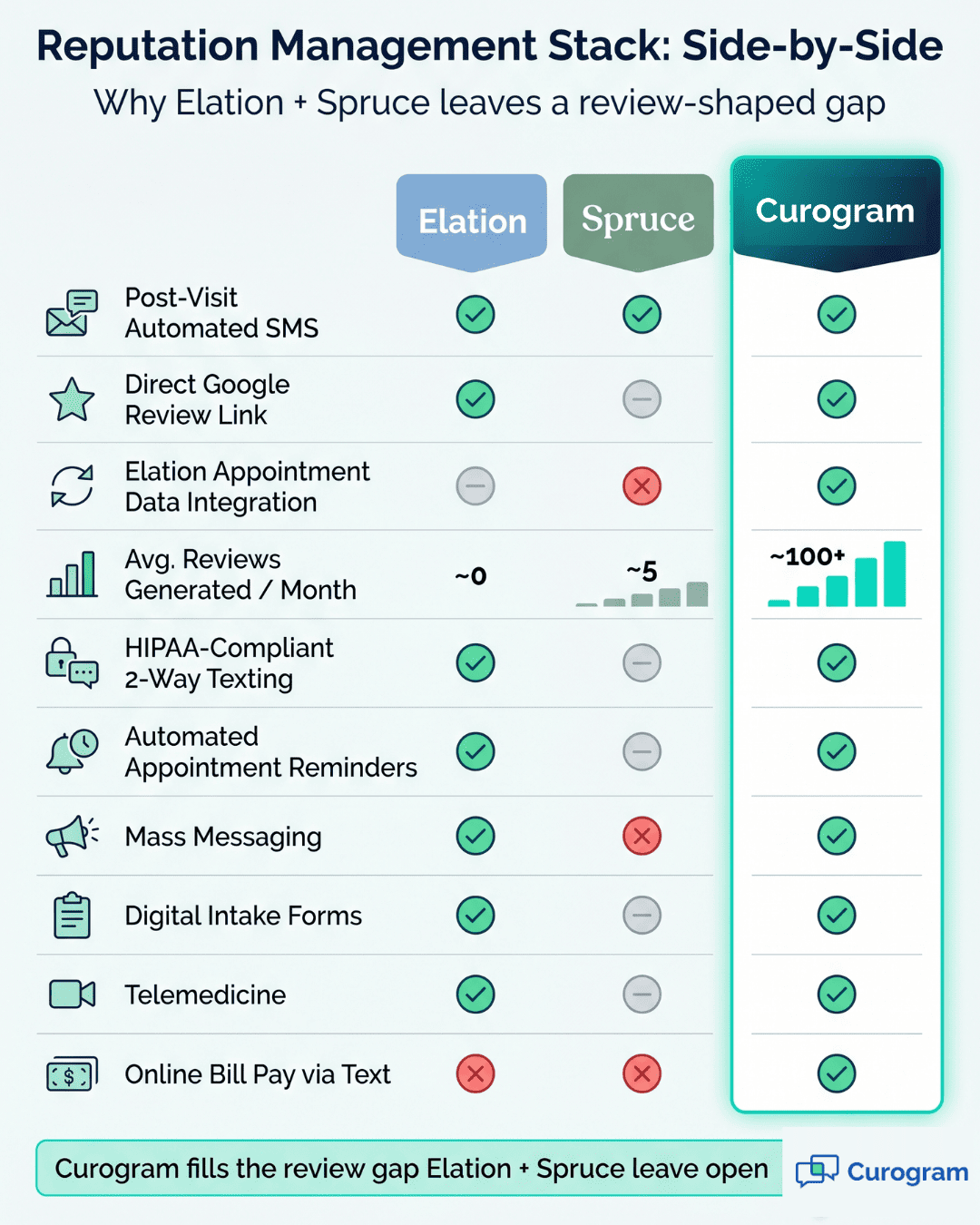
This creates a real blind spot for Elation Health practices. Elation builds strong clinical tools, but it does not solve online reputation. Neither does Spruce Health, which focuses on basic messaging. That gap costs you new patients each month — quietly and steadily.
Automated Google reviews for Elation Health clinics reputation management close that gap fast. Curogram connects to your Elation Health appointment data and works in the background. It sends a short text after each visit with a direct Google review link. Patients tap, rate, and submit — all in under a minute.
The results speak loudly. Based on our internal data, one multi-location practice gained 1,064 new 5-star reviews in just 3 months. That same group grew from 993 reviews to over 8,159 in just over a year. The math is hard to ignore.
Most happy patients will leave a 5-star review if asked at the right time. They just need a nudge — and the nudge has to come fast, before the feeling fades. That is exactly what Curogram does, one text at a time.
For primary care and DPC clinics, your Google profile is the new front door. Without a review system, that door is shaped by your critics — not your fans. This guide will show you how to flip that script.
The Villain: The Silent Majority
Every clinic has two kinds of patients. The fans, who walk out happy. And the upset ones, who leave with a frown. Only one group runs straight to Google.
That is the silent majority problem in a single line. Your happiest patients say nothing. Your loudest ones write everything. The result skews your online image in a way that does not match your real care.
The Negativity Bias Works Against You
Upset patients are 2 to 3 times more likely to leave a review on their own. Happy patients almost never do — they just go home. This is not your fault. It is human nature playing out online every day.
Think about what this means in real numbers. A clinic that gives true 4.5-star care often shows a 3.8-star rating on Google. The 90% of patients who had great visits stayed silent. The 10% with complaints went straight to Google to vent.
Your Google rating becomes a snapshot of your worst days. Not your average days. Not your best days. Just the bad ones, frozen in stars on a screen that new patients see every day.
Local Search Punishes Low Review Volume
Google's local search ranks clinics by three signals: review count, recency, and rating. A clinic with 500 reviews and a 4.7-star score beats one with 47 reviews and a 4.2-star score. Even if your care is objectively better, Google has no way to know.
This is where local SEO Elation Health matters most. The Local Pack drives most new patient calls. These are the three map results at the top of any search. If you are not in the pack, you are invisible to new patients.
A patient searching "primary care near me" sees three clinics. They call the one with the most stars and reviews. That clinic wins the new patient before you get a chance to compete.
Manual Asking Cannot Keep Up
Most clinics try to ask for reviews by hand. The front desk asks at checkout. Staff hand out review cards. Someone sends a portal message later. These efforts bring in maybe 2 to 5 reviews per month, at best.
Let's do the math. If your rival has 450 more reviews, manual asking would take 7 to 18 years to catch up. By then, the gap is even wider. Manual review work is well-meant — but the math just does not add up.
|
Method |
Reviews / month |
Time to close a 450-review gap |
|
Asking at checkout |
2–3 |
12–18 years |
|
Portal messages |
1–2 |
18+ years |
|
Review cards or signs |
1–3 |
12–37 years |
|
Automated review generation by SMS |
100+ |
4–6 months |
The fix is not more effort from your staff. It is a system that runs in the background while they focus on patients.
Low Ratings Quietly Drain Revenue
Some clinics carry Google ratings of 1.8, 2.5, or even 2.9 stars. These ratings rarely match the real care quality being given. They reflect the lack of a review system — and nothing else.
Every star below 4.5 hurts new patient flow. Patients who find a 3-star clinic just call the 4.7-star one next door. That is lost revenue every single week. And it compounds, because each missed patient is also a missed review chance.
Here's a quick example. Say you lose 5 new patients per month to a higher-rated rival. If each one is worth $1,500 in first-year value, that is $90,000 in lost yearly revenue. Not from bad care — from a quiet review presence.
The villain in your reputation story is not trolls or fake reviews. It is silence from your happiest patients. And silence has a real, growing price tag.
The Guide: The 5-Star Pipeline
Solving the silent majority problem takes two things. First, you have to ask every patient — not just the angry ones. Second, you have to ask at the moment of peak satisfaction. Curogram does both, on autopilot.
Think of Curogram as a 5-star pipeline. It starts the second a visit ends in your Elation Health system. And it finishes when a happy patient taps "submit" on their Google review. No staff effort. No paper cards. No reminders to remember.
How the Post-Visit Auto-Request Works
The flow is simple and clean. A visit gets marked as complete in Elation Health. Curogram picks up that signal right away. A text goes out to the patient with a short message and a direct Google review link.
The patient taps the link on their phone. They see your Google Business Profile review form. They pick stars, write a quick line if they want, and submit. The review is live within 60 seconds — often from the parking lot or the drive home.
This is automated review generation done right. No app to install. No login to remember. Just a text and a tap, in the same SMS thread the patient already uses for visit reminders.
Timing is what makes this work so well. Satisfaction peaks right after a visit — when the patient feels heard, helped, and on their way to feeling better. Wait an hour, and the feeling fades. Wait a day, and most patients never look back.
Why It Fits So Well With Elation Health
Elation Health is built for clinical work — charting, care plans, e-prescribing, and quality reporting. It does that part very well. What it does not do is move patient sentiment from the exam room to Google. That part is not its job.
Curogram fills the gap by hooking into your Elation Health appointment data. When a visit closes in Elation, the trigger fires in Curogram. There is no manual list to build. No staff member to remind. No follow-up email to draft.
The whole flow runs in the background. Your front desk keeps doing what they do best — caring for patients in front of them. Meanwhile, Curogram quietly turns each completed visit into a chance for a new 5-star review.
|
Without Curogram |
With Curogram |
|
Staff ask at checkout (often forget) |
Text sent automatically |
|
Patient gets home, forgets to review |
Patient reviews in the parking lot |
|
2–5 reviews per month |
100+ reviews per month |
|
Reviews skew negative |
Reviews reflect real care |
This is the kind of reputation management Elation practices need to thrive in competitive local markets. The connection to appointment data means the whole system runs with no daily upkeep from your team.

The Edge for DPC Practices
For direct primary care (DPC) practices, reviews are not just a search trick. They are a key part of how you sign up new members. A patient about to commit to a monthly fee does more research. Way more than someone booking a single visit.
That is where review depth wins. A DPC clinic with 300 fresh 5-star reviews — full of words like "personalized," "accessible," and "responsive" — beats any sales page. Prospects trust other patients. They do not trust marketing copy.
Elation Health Google reviews give your DPC practice real social proof. Each review tells a story another prospect can imagine living. That story builds trust before anyone picks up the phone.
Curogram makes that story easy to tell at scale. Each Elation visit becomes a chance to add one more honest voice to your profile. Over time, those voices form a wall of trust that no rival can easily match.
The Success: The Dominant Profile
What happens when a clinic turns on the 5-Star Pipeline? The change is not subtle. It is fast, visible, and self-reinforcing. Within weeks, the Google Business Profile starts to look like a different practice entirely.
This is where automated Google reviews for Elation Health clinics reputation management really earn their value. Not as a tool — but as a quiet engine that builds your strongest marketing asset over time.
The Metric: From 993 to 8,159 Reviews
Let's look at a real example from our data. A multi-location practice signed up with Curogram and turned on automated review generation.
The starting line: 993 total Google reviews across all locations. Within 3 months, that number jumped by 1,064 new 5-star reviews.
Based on our internal data, the practice grew from 993 reviews in August 2023 to 4,334 by May 2024. By December 2024, the total hit 8,159 — an 8x lift in about 16 months. That is the kind of curve that changes a clinic's online presence for good.
The Shift From Scarcity to Dominance
Before Curogram, the practice's profile told a half-truth. A few hundred reviews, many years old, some of them angry. New patients on Google saw an outdated picture of a clinic that was actually thriving every day.
After Curogram, the profile told the full story. Thousands of fresh 5-star reviews. Patients describing specific staff by name. Stories of short wait times, kind providers, clean exam rooms. The kind of detail that builds trust before a single phone call.
This shift has a name: review dominance. It happens when your review count is so far ahead of rivals that catching up is almost impossible. New patients see your name first. They see the most stars. They see the most recent activity. They call you.
Google's algorithm responds to this in turn. The clinic starts showing up in the Local Pack for more searches. Map listings move higher. "Best primary care in [city]" begins to surface the practice's name on page one.
This is the heart of strong local SEO Elation Health — review volume that compounds over time. Each new review pushes you higher. Each higher rank earns more clicks. Each click is a chance for a new patient to walk in the door.
The Outcome: Real New Patient Growth
More reviews mean more new patients. That link is not theoretical — it shows up in scheduled appointment volume and revenue. Clinics that hit review dominance often see 20% to 40% lifts in new patient inquiries in the first 6 months.
Three things drive this outcome. First, more search visibility means more people see your name. Second, higher star averages give patients confidence to call. Third, fresh reviews tell Google you are still active and trusted today, not five years ago.
Let's run a quick number. Say a 4-provider clinic gets 50 new patients per month. A 30% lift means 15 new patients added monthly. At $1,200 in first-year value per patient, that is $18,000 extra revenue per month — or $216,000 per year.
For DPC practices, the impact is even sharper. Membership inquiries depend heavily on trust. A prospect who reads 50 recent 5-star reviews — many describing the exact concerns they have themselves — is far more likely to book a consult call.
The Google Business Profile becomes your top-performing marketing channel. More effective than paid ads. More trusted than your homepage. More visible than any social media post. And the best part — it keeps working while you sleep.
What a Dominant Profile Looks Like
A dominant profile has four traits you can see at a glance:
- 500+ reviews (often well into the thousands for multi-location groups)
- 4.7-star or higher overall rating
- Several new reviews per week, showing recency
- Specific patient stories, not generic praise
When all four are in place, the math shifts in your favor. Even if you raise prices, even if you move offices, even if a new rival opens nearby — the profile still pulls in new patients. It becomes a moat that protects your practice.
Without automation, building this kind of profile is almost impossible. With Curogram's review system, it becomes the natural result of doing your normal clinical work. The case study practice did not change its care model. It did not hire a marketing agency. It simply let Curogram do the asking.

How Curogram Builds a Review Engine That Runs on Its Own
Curogram is more than a review tool. It is a full HIPAA-compliant patient communication platform built for outpatient clinics. The review feature lives inside the same system that handles texting, reminders, forms, payments, and telemedicine. That makes the experience seamless for both your staff and your patients.
This matters for one big reason. Most clinics already pay for too many tools. Standalone review software (Birdeye, Podium, and others) means another login, another invoice, another integration headache. Curogram folds review automation into the platform you already use for daily patient comms.
The setup takes weeks, not months. Curogram connects to your Elation Health appointment data. Visit completion triggers fire automatically. The text content is customizable — you can match your brand voice and add your practice name. Your staff does not have to learn a new workflow.
The platform is built for the front desk first. Training takes about 10 minutes. After that, the system runs in the background while your team focuses on patients who walk in the door.
Curogram also covers the rest of your messaging needs at the same time:
- 2-way HIPAA-compliant text messaging with patients
- Automated appointment reminders that cut no-shows by up to 75%
- Mass messaging for recall and reactivation campaigns
- Online intake forms and digital signature workflows
- Telemedicine for virtual visits with no extra software needed
- Online bill pay through text
This is why Curogram fits Elation Health practices better than point solutions. You get review automation, reminders, intake, and more — all in one platform, all tied to your Elation appointment data.
For practice managers, that means one vendor, one invoice, one source of truth. For your patients, it means one trusted SMS thread for everything. For your bottom line, it means more new patients without more staff hours. The numbers add up fast when every visit becomes a 5-star chance.
Conclusion: Your Best Patients Are Your Best Marketers
Your happiest patients walk out of the exam room every single day. Most of them never say a word online. Without a system, all that goodwill stays trapped in their heads. That is the silent majority problem — and it costs you new patients every month.
Automated Google reviews for Elation Health clinics reputation management is the fastest fix. Curogram sends a text after each visit — the moment patient satisfaction is at its peak. The result is a steady stream of 5-star reviews tied to real visits in your Elation Health system.
The math is clear. One multi-location practice grew from 993 reviews to over 8,159 in about a year. That is 8x review growth, all driven by automated post-visit asks.
Elation Health takes care of your clinical reputation through quality care. Curogram makes sure your online reputation matches the standard you set in person. The EHR earns the trust. The texting platform broadcasts it to every new patient on Google.
For primary care and DPC practices, this is no longer a "nice to have." It is the difference between being found and being skipped. New patients use Google like a phone book. Your reviews are your listing.
Curogram fits into the daily flow of your clinic without adding work for your team. Staff stay focused on patients. The system runs in the background. Reviews come in, one happy visit at a time.
Watch a completed Elation Health visit turn into a live Google review in under 60 seconds. Request a demo and see the full 5-Star Pipeline in action.
Frequently Asked Questions
Curogram sends review requests to every patient after a completed visit — never just the happy ones, and never with incentives like discounts. This even-handed approach meets Google's policy and standard healthcare ethics rules.
Happy patients move on quickly. They feel cared for, go home, and forget about the visit. Without a direct nudge at the right moment, the review never happens — and your profile misses their voice.
A few negatives among hundreds of positives actually builds trust. Respond publicly with empathy and a real fix. Reviewers see a responsive practice, not a perfect one — and that often matters more than 5 stars.
Most clinics see new 5-star reviews within the first week. Meaningful volume builds in 30 days. By 90 days, the Google Business Profile shows a clear shift in count, recency, and overall star rating.
Standalone tools mean a second platform, second invoice, and second integration. Curogram bundles review automation with texting, reminders, intake, payments, and telemedicine — all tied to your Elation Health appointment data in one place.