
1 min read
Automate Google Reviews via Text | Staff Workflow on Azalea Health
💡 Azalea Health practices can automate Google review collection via text by connecting Curogram's post-visit workflow to their scheduling data. ...
7 min read
Aubreigh Lee Daculug
:
August 20, 2026
Your flagship clinic has 214 Google reviews. The site you opened last spring has three.
Same clinicians. Same intake standards. Same quality of care.
One reads as established. The other reads as a question mark.
That gap is not a marketing problem. It is a growth problem with a street address. When someone searches for help in that neighborhood, they do not weigh your organization against a competitor. They weigh that one location against whatever else shows up on the map.
The map does not care what your other locations earned.
Behavioral health raises the stakes. People looking for a therapist or a treatment program are already nervous. They are not hunting for the cheapest option. They want proof that other people were treated well, and they want that proof close to home.
Here is the part that stings. Your organization earns that goodwill every day. Clients finish sessions feeling better than when they walked in. Almost none of it reaches Google, because nobody on your team has a comfortable way to ask.
Asking during a session feels wrong, and it is. So it does not happen. The gap holds, month after month, while your newest sites quietly fund a slow start.
EHRYourWay is a strong platform for behavioral health work. It runs intake, scheduling, documentation, and billing with real depth. Reputation is simply not part of its job, and that is a fair line to draw.
Which leaves the question open. How does an organization with six sites build visible trust at all six, without hiring a marketing coordinator to chase it?
This guide walks through the answer. Automated surveys after the visit. Review requests mapped to the right location.
Concerns handled privately. One clear view for leadership. No new work for the people already stretched thin.
Trust decides where someone seeks care. It also gets judged one location at a time.
Google does not rank your organization. It ranks each Google Business Profile you own. A prospective client in your east service area sees that profile, its star count, and its recent reviews. Your flagship reputation does nothing for them.
That is why 90% of new patient leads check a Google Business Profile before they open the practice website. The profile is the front door. Three reviews on it reads as unproven, even when the care behind it is excellent.
If two-way HIPAA texting already reaches these clients, the review channel is the next gap to close.
Here is the pattern most multi-site organizations find when they look.
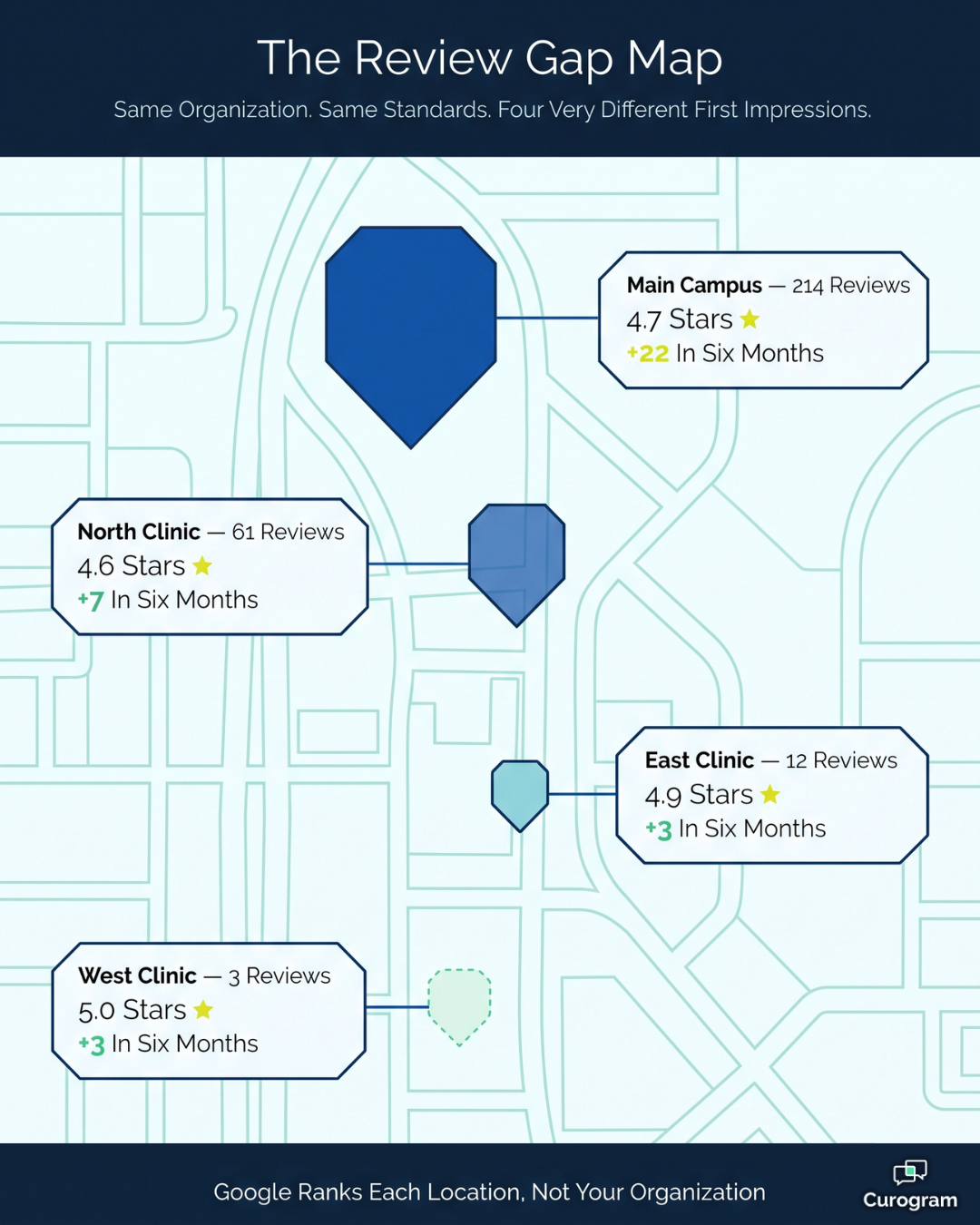
| Location | Google reviews | Average rating | New reviews in 6 months |
|---|---|---|---|
| Main campus (open 9 years) | 214 | 4.7 | 22 |
| North clinic (4 years) | 61 | 4.6 | 7 |
| East clinic (18 months) | 12 | 4.9 | 3 |
| West clinic (7 months) | 3 | 5.0 | 3 |
Same organization. Same standards. Four very different first impressions.
Now read the last column again. The newest site earned 3 reviews in half a year, while the main campus added 22 without anyone trying harder. That is not a quality difference. It is an asking difference, and it compounds every month it goes unaddressed.
The cost lands as referrals that never arrive. Local searchers pick the established name nearby, so the new site ramps slowly and the organization pays for the wait.
Worse, your own sites start competing. Referrals drift toward the profile with the strongest signal instead of the office closest to the client.
Manual fixes fail for a plain reason. Asking every client, at every site, week after week, needs someone whose only job is remembering. Front desk teams already have a job.
So the gap holds by default.
Google reviews automation for EHRYourWay behavioral health organizations is not a campaign. It is a small piece of plumbing that runs after every visit, at every site, without anyone thinking about it.
Post-visit survey automation means the request goes out on its own once a visit closes. No sticky notes. No staff member deciding who seems approachable today.
Timing matters as much as wording. BrightLocal's consumer review research finds healthcare businesses do best when they ask about three days to a week after the appointment.
Text is the channel that gets seen. SMS open rates run near 98%, far above email. For your team, that means the request gets read instead of sitting in a folder nobody checks.
The survey link is mapped to the site of the visit. A client seen at your north clinic goes to that clinic's Google profile, not the main campus listing.
This is what manual processes always get wrong. Staff share the link they happen to have, which is usually the flagship. Leadership then watches Google Business Profile reviews per site drift further apart every quarter.
Automated routing fixes it quietly. It is review generation treatment centers can rely on as they open new sites.
Not every response is a happy one, and that is useful. Clients who signal a problem are routed into a private feedback channel instead of a public form. Your team hears it first and can respond the same day.
It is private feedback routing organization leaders can act on while the fix still matters. It is also an early warning system, because complaints tend to cluster by site and by shift.
One point on policy. Everyone gets the same invitation, and nobody is blocked from posting publicly. You route the conversation, you do not gate it.
Curogram runs alongside EHRYourWay as the same layer that already handles texting, reminders, and automated review requests. Clinicians keep documenting where they always have. The reputation work happens after the visit, on the communication side.
The requests are discreet and optional by design. They never name a program, a diagnosis, or a level of care.
The message reads like a routine note from the office, which is exactly what a client in treatment needs it to look like.

The numbers move faster than most leaders expect.
One multi-location practice turned on automated post-visit surveys. In 3 months it collected 1,064 new five-star reviews. 90% of the patients who responded gave five stars.
A separate multi-site client grew from roughly 993 total reviews to 8,159.
Those figures are large. Here is a smaller one you can test against your own volume.
Assume one site finishes 350 visits a month, and treat the response rates below as conservative.
| At one site, per month | Manual asking | Automated post-visit survey |
|---|---|---|
| Clients who get asked | about 18 (5%) | 350 (100%) |
| Who leave a Google review | about 2 | about 26 |
| New reviews per site, per year | about 24 | about 312 |
| Across six sites, per year | about 144 | about 1,872 |
Read that bottom row slowly. In practice, it is the difference between a new site looking unproven for two years and looking established in one quarter.
The shift is cultural as much as technical. Every site earns its own trust on a system. Nobody waits for a marketing push that never quite arrives.
Leadership gets a straight answer too.
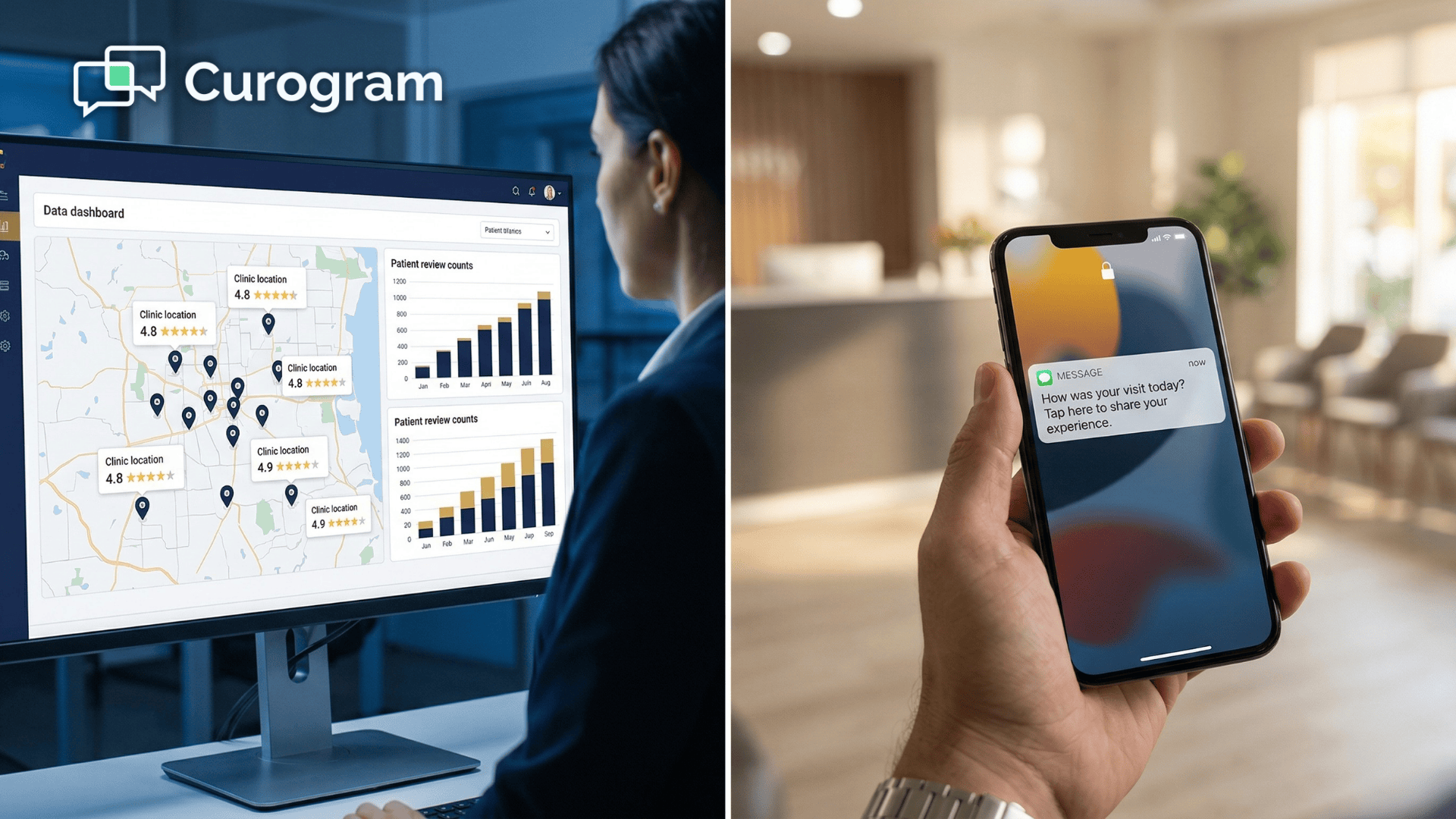
A reputation dashboard multi-site organizations can read in one screen shows volume, rating, and trend by location.
A slipping site turns up in weeks, not at the annual review.
That is multi-location reputation management behavioral health leaders can actually trust.
Pair it with the mass messaging you already send and the same client list does double duty.
The quiet win is the one nobody posts about. Concerns surface privately and get resolved. They never become the one-star review a prospective client reads late at night.
None of this requires a new department or a new hire. The work is mostly decisions, and most of them get made once during setup.
After that, the system runs without supervision.
Month one is quiet. Surveys go out, the first reviews trickle in, and your team gets comfortable seeing concerns arrive privately instead of publicly.
Month two is when your newest sites move, because they have the most room to gain. A location sitting at 3 reviews can realistically double that number within a few weeks.
By month three you have a trend line instead of anecdotes. Leadership can compare locations, spot the site that slipped, and bring a sharper question to the operations meeting.
For your team, the whole change adds up to a single habit.
Nobody asks for reviews anymore, and the reviews keep arriving anyway.
Your care is consistent across sites. The evidence of it should be too.
Right now, that evidence is uneven for a reason that has nothing to do with quality. Your best-known site had years to accumulate proof. Your newest one has had months, and no system helping it catch up.
That is fixable, and it does not require touching your clinical setup. EHRYourWay runs the organization. Curogram makes each location findable, with Google reviews automation for EHRYourWay behavioral health organizations working as a parallel layer beside the EHR you already trust.
Here is a five-minute exercise before you do anything else.
Search each of your locations on Google, the way a client would, one at a time. Write down the review count and star rating for each. The gaps will be obvious, and they are usually much wider than leadership expects.
Then ask a harder question. What is one under-reviewed site costing you in referrals every month it stays invisible? At even a handful of missed intakes per site, the annual number gets uncomfortable fast.
The system that closes that gap is not complicated. A short survey after the visit. A link mapped to the right profile.
A private path for concerns. One dashboard showing all of it by location.
Your clients already have good things to say. The only thing missing is a respectful, automatic way to ask, and a route that sends their words to the profile that needs them.
See How Curogram Works Alongside Your EHRYourWay Platform — Book a Demo. We will run a live per-site reputation audit with you, walk your Google profiles location by location, and show exactly where the review gaps sit in your network.
Yes, when it is done respectfully. Requests go out after the visit, by text, and they are optional and discreet. They never reference a diagnosis, a program, or a level of care. Clients decide what to share, or whether to share anything at all.
Each survey link is mapped to the site of the visit. A client seen at your north clinic lands on that clinic's Google profile, not the main campus listing. That single detail is what manual processes get wrong most often, and it is the reason review counts drift so far apart across a network.
It routes privately to the practice before anything public happens. That gives your team a service recovery window, usually within the same day. It also works as an early warning signal, since patterns show up by location long before they show up in your star rating.
Neither. Curogram runs as a parallel communication layer beside the EHR. Clinical documentation, scheduling, and billing stay exactly where they are. Your staff sees one extra inbox, not a new system to learn.
Most organizations see movement in the first few weeks, because the surveys go out on every completed visit from day one. The bigger change is compounding. A site adding 20 to 30 reviews a month looks materially different six months later, especially if it started near zero.
1 min read
💡 Azalea Health practices can automate Google review collection via text by connecting Curogram's post-visit workflow to their scheduling data. ...

1 min read
💡 For large NextGen Enterprise networks, Google reviews remain untapped. Neither NextGen nor Luma sends automated post-visit review texts or...
1 min read
💡 Building a reputation management workflow Meditab IMS practice automated review requests removes the front desk from the process entirely. After...