
Standardize Reminders Across Practice Fusion Offices
 Aubreigh Lee Daculug : Aug 25, 2026, 2:00:00 PM
No-show rates vary by office. Curogram runs one proven 2-way reminder sequence across every Practice Fusion location for 53% fewer no-shows.
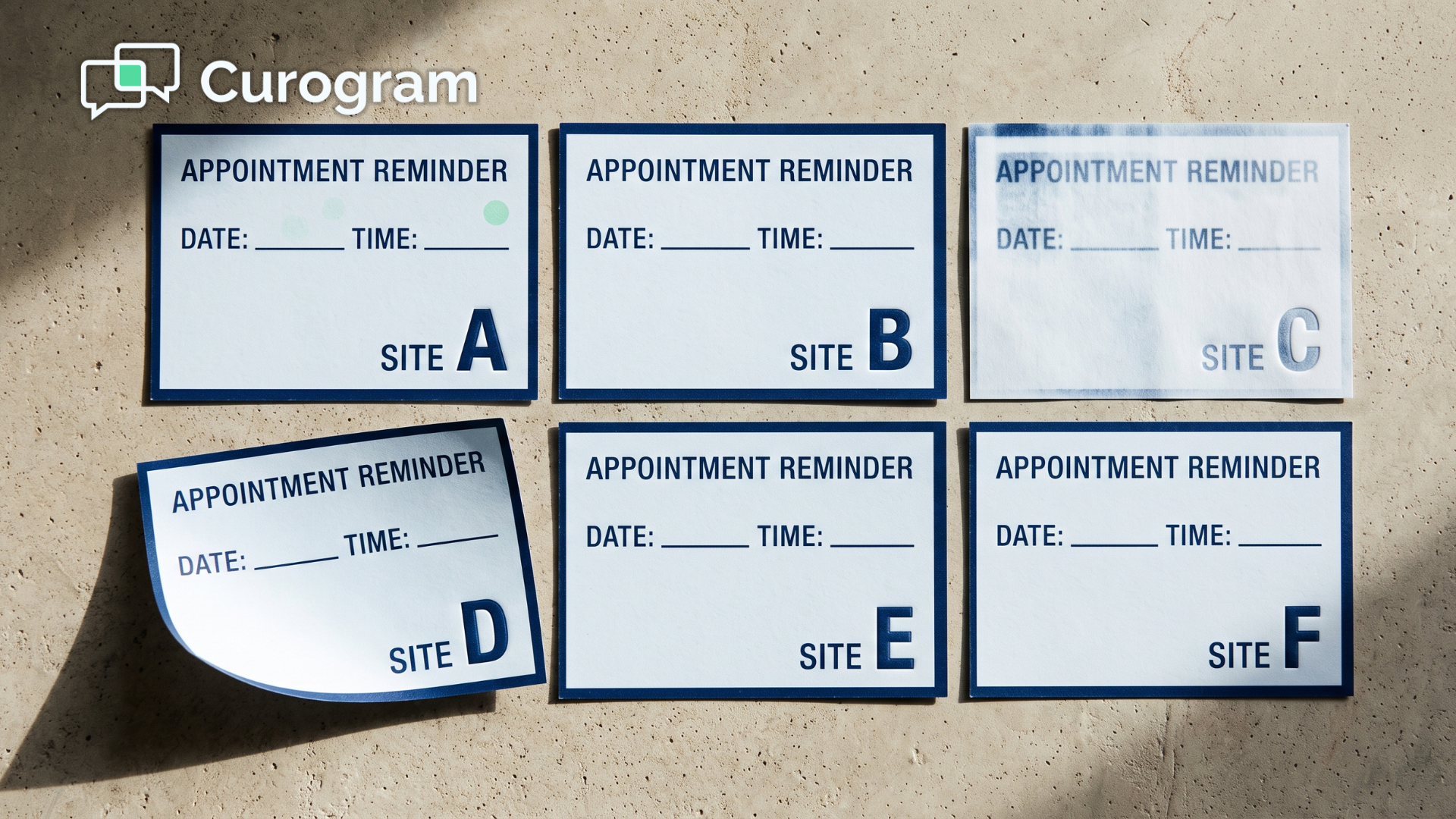
Two of your clinics look identical on paper. Same specialty mix. Same payer blend. Same patient volume, same eCW build.
One holds a 5% no-show rate. The other sits above 14%.
Nothing about the patients explains that gap, and the staff are not the problem either. The answer is buried in a settings screen nobody opens.
Somewhere along the way, each site chose its own reminder setup. One texts patients two days out, another leans on a robocall the morning of the visit, and a third had its reminders quietly break during an update that nobody caught for eight weeks.
That is the reminder patchwork. It spreads slowly, hides well, and costs real money every month.
Here is the part that stings. The gap itself proves the problem can be fixed.
If one site holds no-shows near 5%, the schedule is not the issue and the patient mix is not the issue. The reminder policy is.
Most groups answer with a memo. Leaders name a standard, send it to every practice manager, and call it settled. Within a quarter, the drift comes back. A memo has no way to enforce itself.
And the longer it runs, the more normal it looks. A 12% no-show rate stops feeling like a failure once it has been the number for three years.
You need something stronger than a policy document. You need the policy built into the system that sends the reminders.
That is what this guide covers. We will look at why eCW reminder settings drift apart, what that drift costs you in dollars and lost visits, and how one governed sequence becomes the default every site starts with.
By the end, you will know which report to pull first. You will also know what the number it gives you is worth.
eClinicalWorks lets each site set up its own reminders. That freedom made sense when your group had three offices and one manager who knew every setting by heart.
At twelve sites, it turns into a liability.
Allowing a setting is not the same as governing it. eClinicalWorks appointment reminder settings in multi-location groups get chosen once, at go-live or during an acquisition, and then sit untouched for years.
Nobody audits them. Nobody lines them up next to each other.
So the drift happens quietly. Three forces drive it, and none of them look like a problem at the time.
Acquisitions arrive with their own habits. When you bring on a practice, its reminder setup usually comes along untouched, because migrating the schedule takes priority over auditing a notification rule.
Staff turnover erases the reasoning. The manager who picked a 24-hour send window in 2019 had a reason for it. Two managers later, nobody remembers what that reason was, so nobody feels safe changing it.
Updates break things silently. A template resets or a delivery rule fails, and the reminders simply stop going out. No alarm fires, because nothing technically errored.
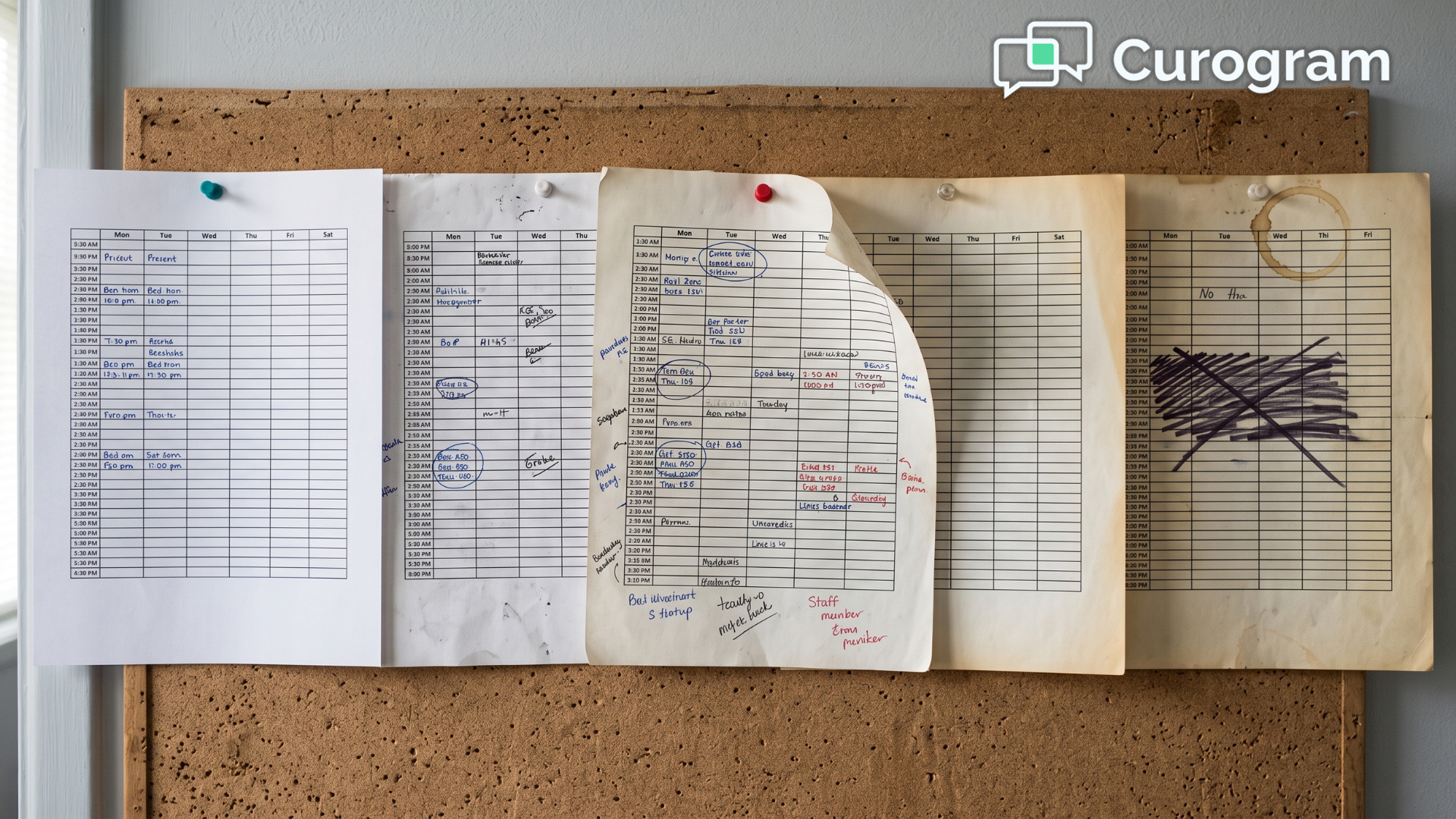
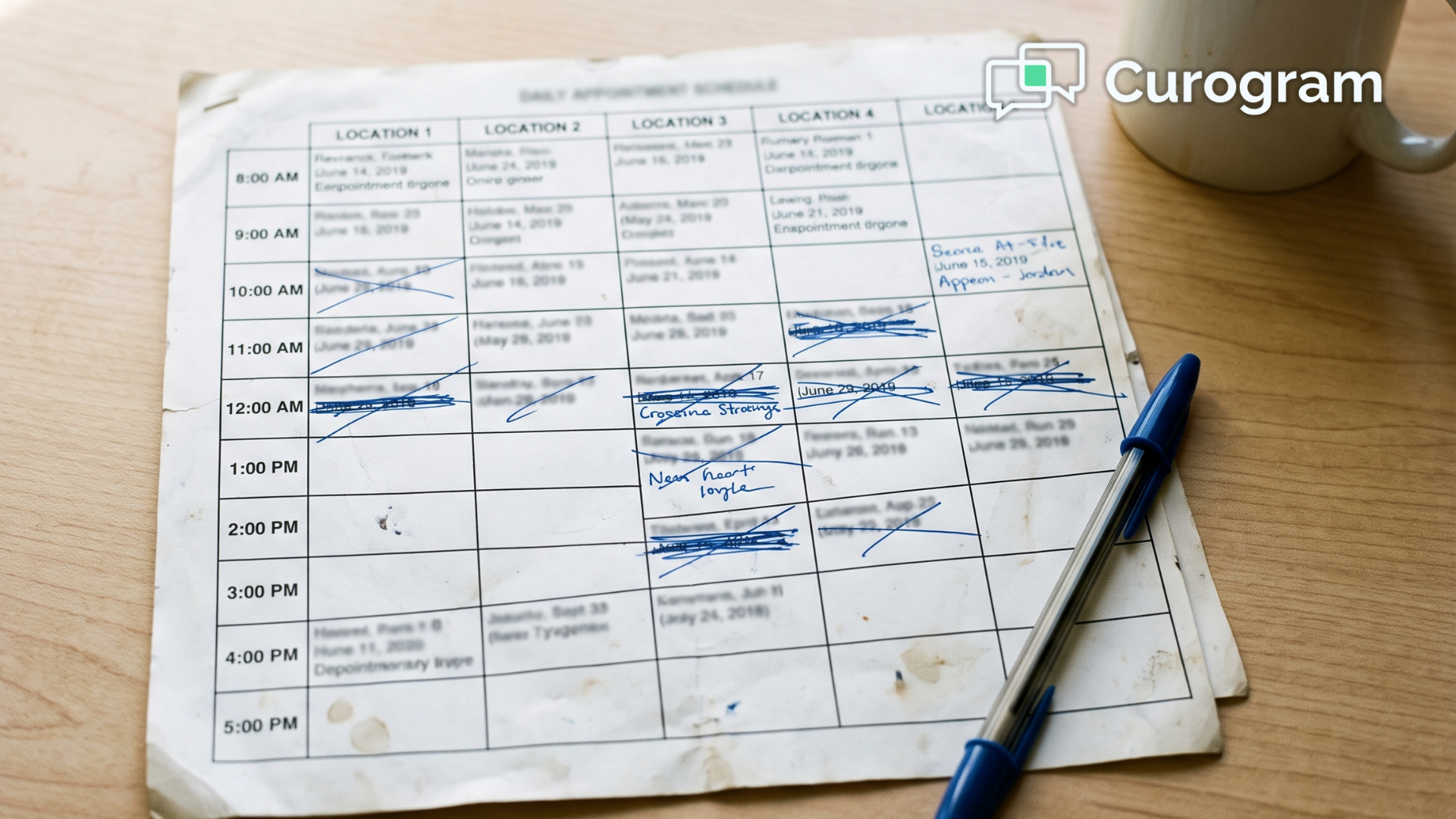
A site shifts its send time after a staffing change. Another turns off texting during a compliance question and never turns it back on. An update resets a template, and the failure makes no noise at all. Leaders find all of it during a no-show postmortem, months after the money is gone.
Here is a sample model for a six-site primary care group.
Assume 1,200 visits per site each month and $150 in average visit revenue.
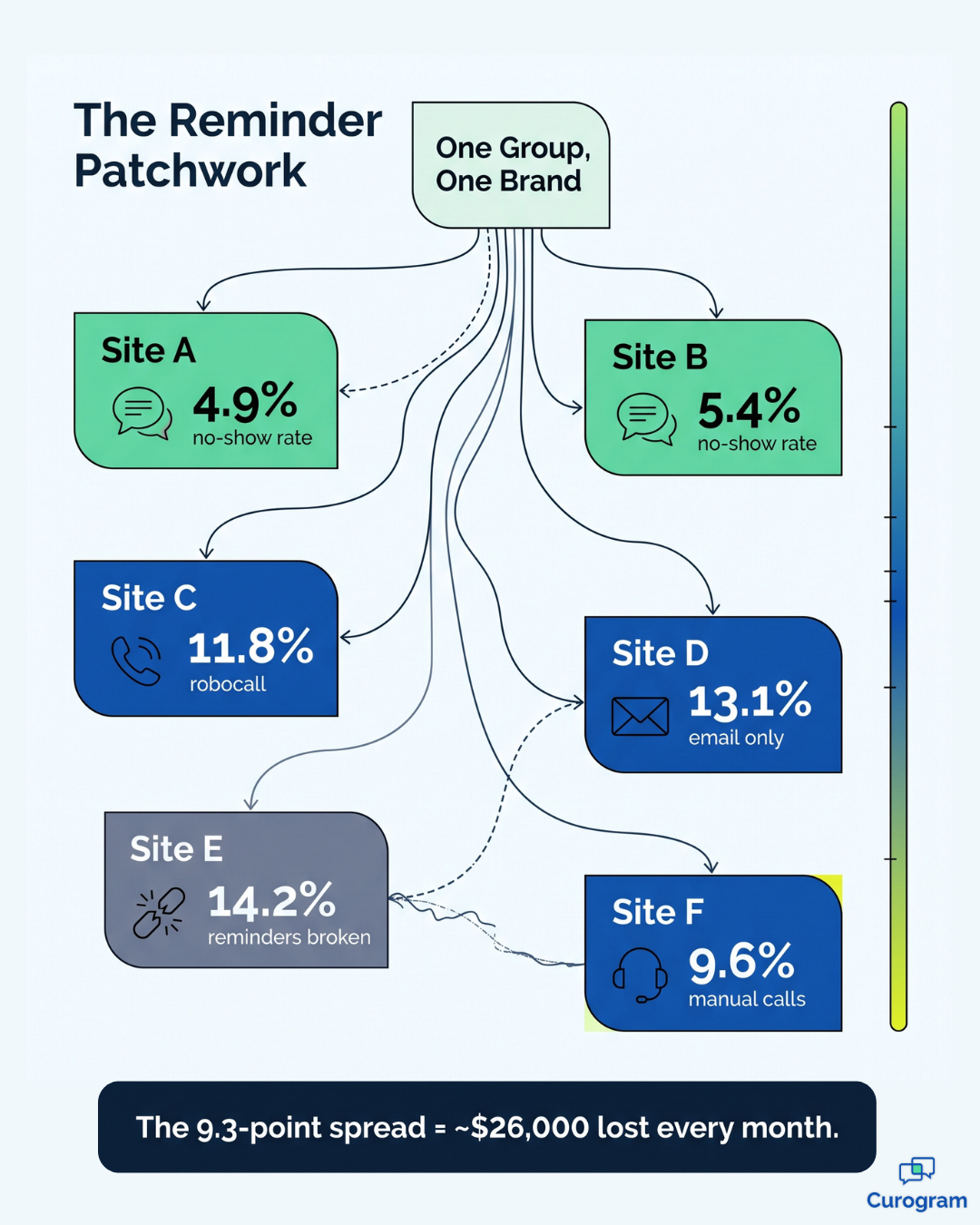
| Site | Reminder setup | No-show rate | Missed visits/month | Revenue lost/month |
|---|---|---|---|---|
| A | Text at 48 hrs, with confirm | 4.9% | 59 | $8,850 |
| B | Text at 48 hrs, with confirm | 5.4% | 65 | $9,750 |
| C | Robocall, morning of visit | 11.8% | 142 | $21,300 |
| D | Email only | 13.1% | 157 | $23,550 |
| E | Reminders broken since update | 14.2% | 170 | $25,500 |
| F | Manual staff phone calls | 9.6% | 115 | $17,250 |
These figures are illustrative. The 14.2% to 4.9% range mirrors Curogram's verified Atlas Medical Center result.
Read the spread, not the rows. Sites A and B already prove what is possible here.
If the other four matched them, the group would win back about 175 visits a month. That is roughly $26,000 each month, or $312,000 a year.
One governance fix. No new providers. No new marketing spend. No extra patients.
It helps to translate that into staff time too. Figure roughly 6 minutes of rework per no-show — the callback, the rebook, the chart cleanup. Those 175 recovered visits also hand back about 17 staff hours every month, which is most of a half-time scheduling shift.
Industry estimates often put no-show losses at $20,000 to $30,000 a month for a single practice. Your weakest site is probably sitting in that range right now.
For your team, this means eCW no-show rate variance by location is not a reporting quirk. It is a line item.
The fix is not a better memo. The fix is making the standard something every site gets by default, instead of something they are asked to remember.
That is the move from guidance to enterprise reminder governance. The proven sequence becomes the platform default, not a file in a shared drive.
Curogram sits over eClinicalWorks and owns the outbound reminder layer. Leaders define the cadence once.
That covers timing, message content, tone, and what happens when a patient does not reply.
Every site gets it on day one. A new clinic gets it the week it goes live. So does a practice you acquire next spring.
Changes travel the same way in reverse. When leadership updates the sequence — a new confirmation window, a revised rule for non-responders — that change reaches every site at once. There is no rollout email and no waiting on twelve managers to act on it.
The result is a centralized reminder cadence healthcare leaders can actually audit, because only one version of it exists.
Standards fail when they are too rigid. So the flexible parts matter as much as the locked ones.
Sites still control approved details: provider names, parking and check-in notes, language options, and prep instructions tied to that building.
What they cannot change is the timing, the compliance limits, or the core message structure. Local flavor survives. Drift does not.
A reminder that updates nothing is just a notification. The value shows up when a patient's answer changes what your schedulers see.
Curogram handles appointment confirmation write-back to the eCW schedule in real time. A patient confirms, cancels, or asks to move the visit by text. The resource schedule reflects it right away, at every site, for every scheduler.
That is what makes a network-wide reminder policy for a medical group real. The standard is not only in how messages go out. It is in how the answers come back.
That loop matters more than it first sounds. Most reminder tools text the patient and stop there, which leaves your front desk reconciling replies by hand. Every manual step is another place a confirmation quietly gets lost.
Once every site runs one sequence, the reporting turns useful. Delivery rates, confirmation rates, and no-show rates all sit in a single view, measured the same way at every address.
That is the part groups tend to underestimate. Before governance, comparing two sites is guesswork, because you are comparing two different systems. After, a gap in the numbers actually means something you can act on.
FQHCs and multi-specialty groups do not need one message for everyone. A procedure prep reminder should not read like a wellness visit nudge.
So sequences stay specialty-appropriate by service line. The governance layer keeps each service line the same across every site that offers it.
Cardiology reminders look alike at Site A and Site F. They just do not look like dermatology's.
The clearest proof comes from the benchmark itself.
Atlas Medical Center cut no-shows from 14.20% to 4.91% in three months on Curogram's standard sequence. Across Curogram clients, no-show rates run 53% below the industry average.
Here is why that matters for a group with many sites.
Atlas is not a ceiling one office might reach someday. It is the starting setup every site gets on day one.
The day-to-day work of leadership changes shape too.
| What leaders manage | Before governance | After governance |
|---|---|---|
| Reminder cadence | Chosen per site, rarely reviewed | One sequence, set centrally |
| Confirmation status | Sits in a separate inbox | Writes back to the eCW schedule |
| Comparing sites | Different systems, no baseline | Same settings, a real comparison |
| Fixing a weak site | Email the manager, hope it sticks | Update the policy once |
Three things shift once the policy is enforced instead of requested:

In practice, leaders stop managing reminders and start managing outcomes.
The question in the ops meeting changes too.
It moves from "what is Site D doing?" to "why is Site D still trailing when the setup is the same?"
That second question has an answer. The first one never did.
The instinct is to pick a cadence and push it everywhere by Monday, and that instinct is worth resisting.
The groups that succeed at standardizing appointment reminders across eClinicalWorks locations tend to start the same way, and it looks slower for about two weeks.
You cannot prove a fix without a baseline, so record each site's no-show rate, confirmation rate, and current reminder method for the last full quarter before anyone touches a template.
That snapshot does two jobs at once. It shows you where the money actually sits, and it becomes your evidence that the change worked when someone asks in six months.
Most groups try to design the perfect sequence from scratch, when there is usually a better starting point sitting inside the network already.
One of your sites is holding a low no-show rate right now. Begin with what that site does, test it against the benchmark sequence, and adjust from there.
It is faster, and it is far easier to sell internally, because the proof came from your own group rather than a vendor deck.
Start with your two weakest sites, which have the most ground to make up, so the numbers move quickly and give you a visible early win to point at.
Once those hold, extend to the rest and lock the cadence at the platform level. That last step is the one groups skip, and skipping it is exactly how the patchwork grows back.
No-show variance between sites looks like a technology problem. It usually is not. It is a governance problem wearing a technology costume.
Your eCW build is not broken, and your staff are not slacking. Ten sites are simply running ten uncoordinated reminder systems, and the results show it.
Here is the split worth holding onto.
eClinicalWorks is built to run your schedule. Curogram is built to run their confirmations — set centrally, delivered locally, written back the moment a patient replies.
That is the piece a memo can never deliver. Policy without enforcement drifts back within a quarter, every time.
So start with the number. Pull no-show rates by site for last quarter and line them up. Do not average them. The average hides the whole story.
Look at the gap between your best site and your weakest one.
That gap is your upside, and you can measure it in dollars. In the model above, a nine-point spread across four weak sites was worth more than $300,000 a year.
Run the same math on your own volume and average visit revenue. The number will likely be bigger than you expect.
Then ask a harder question. If your strongest site already proves the target is reachable, what is stopping the rest from hitting it?
Usually, nothing but the lack of a shared standard.
Schedule a demo and we will design your network-standard reminder sequence together, mapped to your service lines. We will also show the write-back running live against an eCW test schedule.
 Aubreigh Lee Daculug : Aug 25, 2026, 2:00:00 PM
No-show rates vary by office. Curogram runs one proven 2-way reminder sequence across every Practice Fusion location for 53% fewer no-shows.
 Aubreigh Lee Daculug : May 21, 2026, 3:00:00 PM
Klara’s confirmations fall short. Curogram’s automated reminders reduced no-shows from 14.2% to 4.9% for specialty practices using Modmed. Book a...
 Aubreigh Lee Daculug : Sep 1, 2026, 2:00:00 PM
No-shows drain $20K–$30K monthly per office. This owner’s playbook standardizes two-way reminders across Practice Fusion sites, 53% below-average...