
6 min read
Helping Patients Choose Your eClinicalWorks Locations on Google
Jo Galvez
:
September 9, 2026
AI tools now influence 36% of patients searching for a provider, ahead of Google search results and physician referrals. Both audiences read the same four signals, which are rating, review count, recency, and whether anybody replied.
A satellite holding 12 reviews from two years ago gives a patient and a summarizer the same thin answer. Curogram keeps each site current by turning real eCW visits at that address into fresh reviews.
Most location marketing assumes a patient looks at your profile, forms an impression, and decides. That assumption is getting less true every year.
AI tools were cited as a top influence by patients who searched for a new doctor, ahead of Google search results. Patients also trust the AI Overview the most, before organic links and the local map pack.
None of that changes what gets read. It changes who is doing the reading. Your rating, your review count, the newest review date, and whether anyone replied are now raw material. A patient can act on the summary built from them without ever opening your listing.
None of that makes the map pack irrelevant. It does mean the map pack now sits beneath a summary built from the same four fields, read by someone who may never scroll past it.
Which puts a specific kind of pressure on a satellite clinic. Thin, old evidence used to produce a weak impression. Now it produces a weak summary, delivered with more authority than the profile it came from.
The Villain: The Stale First Impression
A health system reputation does not travel. Patients research a location, and the network’s overall standing never reaches the results page for one suburb.
Nobody searches for your health system
A family moving into the suburb searches for care near their new address. Your flagship’s 2,300 reviews sit on a different profile, attached to a different address, eleven miles away. They are not part of this comparison and never will be.
Eleven locations means eleven of these comparisons running at once, in eleven neighborhoods, against a different competitor in each. Your strongest profile is a spectator in ten of them.
That satellite competes on its own evidence. Patients read reviews before booking a doctor with the habits they bring to every other local decision. They scan the newest entries and judge the rest by those.
Two years old reads as closed
Review recency and patient trust are linked for reasons that have nothing to do with your clinicians.
Ownership changes. Providers move on. Hours get cut. A profile that has gone silent for two years gives a stranger no way to rule any of that out.
So they treat silence as a signal. The Google Business Profile first impression a clinic makes is doing more work each year, not less.
Now something else is reading it too
A summarizer working from 12 reviews written two years ago has almost nothing to summarize. It cannot say the wait times are short, because nobody recently said so. It cannot describe the pediatric team, because none of the twelve mention them.
What it can do is answer accurately and briefly, and brief answers about your satellite are not what wins a near me search healthcare decision. The competitor with 400 recent reviews gives the same system far more to work with.
Accuracy is not the problem here. A summary drawn from twelve old entries will be perfectly accurate and completely forgettable.
|
Surface on a Google results page |
Share of patients who trust it most |
|---|---|
|
AI Overview |
37% |
|
Organic links |
20% |
|
Local map pack |
13% |
|
Sponsored ads |
7% |

The Guide: The Network Reputation Desk
Evidence has to arrive at the pace the care does, at every address. Across eleven sites running different volumes, that means the supply keys off each location’s own schedule.
How each location stays current
Post-Visit Review Requests reach the patient while the visit is still fresh. Curogram connects with eCW, reads appointment activity per facility, and sends to the patient seen at that address. The link opens that location’s profile, two taps from a text.
Volume tracks the schedule. A site running 1,900 completed visits a month generates requests at that rate, and a slower site generates fewer. Each profile’s review stream ends up matching real patient flow at that address, in volume and in voice. Curogram is HIPAA-compliant and SOC 2 Type II certified, and the request carries no PHI.
Why the writing sounds like your patients
No script goes out, and no survey runs first. Every patient receives the same request once a visit closes, with nothing standing between them and the Google link. Whatever they write is what appears, which is also what Google’s policy requires.
That detail is what a family is hunting for, and it is what a summarizer has to work from. Somebody on the same plan. A parent managing the same condition. Anyone who mentions parking at Northgate by name.
Volume is what makes any of that reliable. One well-written review is an anecdote. Forty from the same address inside a quarter is a pattern a reader can act on.
Much of what patients praise turns out to be logistics: the reminder that landed, the short wait, the message answered before lunch. Centralized reminder governance sits upstream of a surprising share of it.
Replies are read twice
Replies get read by every patient who arrives later. One practice administrator quoted in that report makes the second point. Those public replies are also ingested by AI systems building the summary for the next person who asks.
Per-location responding stays workable from one dashboard, and a safe reply names the location, thanks the reviewer, and confirms nothing about their care.
The Success: The Profile That Says We’re Excellent, Currently
Total review count is a poor measure here. What matters is how much usable evidence each location can offer whoever is reading.
1,064 reviews, every one recent and local
Based on our internal data, one multi-location group generated 1,064 new 5-star reviews in 3 months, with 90% of responding patients leaving five stars. Each was written by somebody who had been to a specific site, about that site.
Because requests fired continuously off completed visits rather than in a campaign burst, no profile in the group went quiet long enough to look abandoned.
What a summary actually has to work with
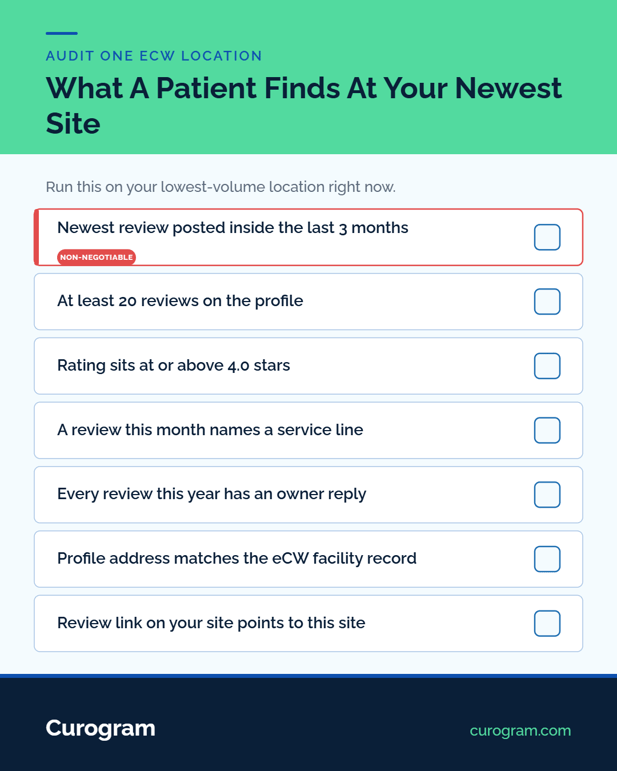
Evidence depth is easier to see when you count what is usable rather than what exists. Below is the same audit run against one satellite and one flagship in the same network.
|
Usable evidence |
Satellite |
Flagship |
|---|---|---|
|
Total reviews |
12 |
2,300 |
|
Written in the last 3 months |
0 |
180 |
|
Naming a specific service line |
1 |
340 |
|
Carrying an owner reply |
0 |
2,300 |
Illustrative audit of two locations in one network. Both are real profiles of the same organization.
That satellite is barely reviewed rather than badly reviewed, and the four rows show why a patient and a summarizer both come away with nothing specific to repeat.
Run the same audit across all eleven sites, and the ranking looks nothing like the one leadership reviews, because a rating average says nothing about depth.
One month of requests at a site that size fills the second row. A quarter fills the third. Local clinic online presence patients can actually use is built out of those rows, not out of a better description or more photos.
What changes in the neighborhood
Run the same search twelve weeks later, and the satellite reads differently in every channel at once. Its listing shows a current date. A summary now has recent, specific language to draw on. And the comparison the family was going to lose has two credible sides.
New patient acquisition on Google Maps still depends on that comparison, and the care behind it never changed. What changed is how much of it the neighborhood can see. The network view of the same work is in managing Google reviews for multiple eClinicalWorks locations.
Conclusion: Let the Neighborhood See What Patients Experience
Check the date on the most recent review at each of your locations. That date tells you how old your first impression is in that neighborhood, and it is the one reputation number that decays without anyone touching it.
eCW holds the record of the care delivered at every facility, visit by visit. The public account of that care lives on profiles no EHR touches. Increasingly it gets read secondhand, through a summary the patient trusts more than your listing.
We would argue the satellites deserve the request volume first, and by some distance. They have the least evidence, the most room, and the neighborhoods the network spent the most to enter. The flagship will be fine without the help.
Book a demo, and we will show you what one busy Tuesday at a single location produces on that location’s profile over the week that follows.
Frequently Asked Questions
Every request follows a completed appointment at that specific site, with no incentives and no filtering applied first. The concrete detail patients include is what a reader recognizes as authentic rather than manufactured.
A summary can only repeat what the reviews say. Twelve old entries give it nothing specific about your service lines, so the answer a patient receives about your site stays vague and forgettable.
Once per completed visit, and no reminder chases it afterward. Opt-outs take effect immediately and permanently across all eleven profiles, so anyone who declines stays off every future send at every site.
Every later reader sees them, and so does anything summarizing your profile.
The recency signal clears within a week of requests starting. Depth takes about a quarter, depending on visit volume, before the profile carries enough specific language to compete on detail.