

6 min read
Win the 'Near Me' Search at Every New Practice Fusion Location
Jo Galvez
:
September 9, 2026
Based on our internal data, about 90% of new patient leads land on the profile first. They read the date on the newest review about as closely as they read the star average.
A profile whose newest review is a year old reads as a practice that may have declined or closed. Curogram keeps each office current by turning real visits at that address into a steady stream of fresh reviews.
18% of consumers are swayed only by a review written in the last seven days. 74% want something from the last three months. Those are BrightLocal’s 2026 numbers, drawn from a panel of 1,002 US adults.
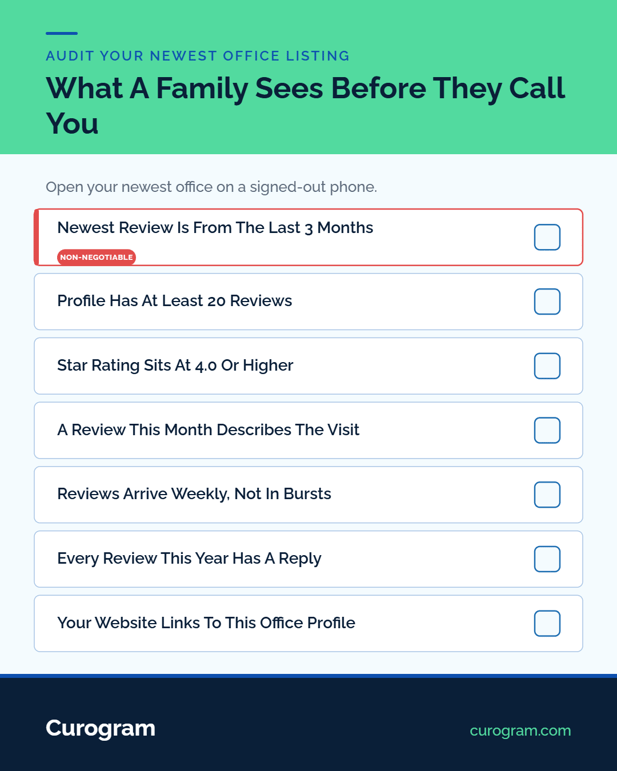
Now check the date on your newest office’s most recent Google review, from a phone that is not signed into the practice account. If it reads eleven months ago, that office fails the recency bar for three-quarters of the families searching its neighborhood. The quality of the reviews themselves does not enter into it.
Families research an office, not a group. Your founding location’s 600 reviews sit on a separate profile at a separate address, and they never surface in results for the suburb you expanded into.
Each new office competes with whatever evidence it has of its own, which is usually a handful of reviews and a date.
That combination reads as risk. Recency is the cue a stranger uses to judge whether a business is still the business those reviews describe.
Staff turn over. Practices get sold. A profile that has gone quiet for a year gives a family no way to rule any of that out.
That office did not open cheaply. Lease, buildout, a provider, a front desk, signage, all of it aimed at one neighborhood. Then the single surface that neighborhood checks first goes unmanaged for two years.
What moves this is a steady supply of recent evidence at every address you operate. Everything below is how each office produces its own.
The Villain: The Stale First Impression
Care quality is invisible on a search results page. What shows is a count, a star average, and a date. The date does more work than most owners expect.
The 90-second comparison
A family new to the suburb has two options open in two tabs. Yours reads 4.6, 41 reviews, latest one from last March. The other reads 4.4, 88 reviews, latest one from Tuesday. Your average is higher, and your physicians are better.
They book the other one. Patients read reviews before booking a doctor the way anyone reads reviews, scanning for the newest first and stopping when the top of the list looks old.
Why an old review reads as risk
Review recency and patient trust are linked for a reason that has nothing to do with your practice. Ownership changes. Providers leave. A clinic that was excellent in 2024 could have turned over its whole front office since.
A stranger cannot check any of that, so the date becomes the proxy. BrightLocal put 74% of consumers on reviews from the last three months, and 32% on the last two weeks, up from 20% a year earlier. That bar rose in a single year.
|
How old the newest review is |
What share of consumers still counts it as current |
|---|---|
|
Last 7 days |
18% are swayed only by reviews this fresh |
|
Last 2 weeks |
32% look for reviews this recent, up from 20% |
|
Last 3 months |
74% look for reviews inside this window |
BrightLocal Local Consumer Review Survey 2026, panel of 1,002 US adults.
The new office no-reviews problem
A new location starts with nothing on both axes at once. The count is low, and there is no history for anything to be recent within. The Google profile first impression a clinic makes in month three is close to a blank page with an address on it.
Left alone, it gets worse before it gets better. The few reviews that arrive by accident in year one become the stale ones in year two, and the date on the newest keeps drifting backward while the neighborhood keeps searching.
Total count is the wrong thing to watch here. An office can add nine reviews in a year and still show a newest date of five months ago, because nine spread across twelve months leaves gaps everywhere. A family lands in whichever gap they happen to arrive in.

The Guide: The Network Reputation Desk
Evidence has to arrive at the same rate the care does. Across three offices running different volumes, that means the supply keys off each office’s own schedule rather than a group-wide campaign.
How each profile stays current
Post-Visit Review Requests reach the patient while the visit is still fresh. Curogram connects with Practice Fusion, reads appointment activity per facility, and sends the request to the patient seen at that address. The link opens that office’s Google profile, two taps from a text message.
Volume follows the schedule. An office running 780 completed visits a month produces requests at that rate, and a slower location produces fewer.
Each profile’s review stream ends up mirroring the real patient flow at that address, which is what makes it read as authentic to the family reading it. The group-level view of all of this sits in managing Google reviews for multiple Practice Fusion offices.
Why the reviews sound like your patients
Nothing is scripted, and nothing is screened. Requests go to every patient after every completed visit, with no sentiment survey beforehand, which is what Google’s policy requires.
Whatever comes back is what that patient decided to write. Curogram is HIPAA-compliant and SOC 2 Type II certified, and the request carries no PHI.
A family scanning your Westgate profile is looking for someone like them. A parent of a four-year-old. Somebody on the same plan. Anyone who mentions the parking.
Much of what families end up praising is logistics: the reminder that arrived, the wait that did not happen, the text answered in four minutes. Centralized reminder governance sits upstream of most of it.
Responses are the other half of the first impression
A reply under a review is read by everyone who arrives after it. This influences what prospective patients will think of your practice.
Per-office responding stays workable from one dashboard, and the rule holds at every location. A reply thanks the reviewer and names the office. It confirms nothing about who they are, what they had, or when they came in.
The Success: The Profile That Says 'Excellent, Currently'
Review count takes a quarter to matter. The date on the newest review changes within a week, and it is the fastest-moving trust signal a young office has.
1,064 reviews, every one of them recent and local
Based on our internal data, one multi-location group generated 1,064 new 5-star reviews in 3 months, with 90% of responding patients leaving five stars.
Each was written by somebody who had just been to a specific office, about that office. Roughly a dozen a day across the group is what continuous requesting looks like from the outside.
Recency came along as a byproduct. Requests fired continuously off completed visits instead of in a campaign burst, so no profile in the group went quiet for more than a few days.
What twelve weeks looks like at one office
Take the location from the comparison above: 41 reviews, a 4.6, newest review from last March. Below is what the profile shows once requests start firing off its own schedule.
|
Week |
New reviews |
Total |
Newest review reads |
|---|---|---|---|
|
Start |
0 |
41 |
11 months ago |
|
Week 1 |
4 |
45 |
3 days ago |
|
Week 4 |
17 |
58 |
Yesterday |
|
Week 12 |
48 |
89 |
Today |
Illustrative twelve weeks at one office, modeled from a steady visit-triggered request rate.
Week 1 is the row that matters. Four reviews barely move the total and do nothing to the average. They also carry the office past the three-month recency bar that 74% of searchers apply, which is the gate it had been failing.
Week 4 does the same thing at scale. 17 new reviews lift the total by 41% while leaving the rating roughly where it was, because incoming reviews cluster near the profile’s existing average.
Everything after that is accumulation. By week 12 the count reads established, and the newest date still reads today, because the requests never stopped.
What the family sees at the end
Run a near me search for family practice in that suburb twelve weeks later and the entry reads differently. 4.6, 89 reviews, most recent one today. The 90-second comparison now resolves the other way.
New patient acquisition on Google Maps runs on exactly that comparison. Nothing about the office itself changed in those twelve weeks: same physicians, same protocols, same parking.
The whole difference in the search result comes from evidence that was always being earned and never collected.
Conclusion: Let Each Neighborhood See the Care
Look at each office’s most recent review. That date is the age of your first impression in that neighborhood. Put it on one line of the monthly report, per office. It takes a minute to gather, and it is the only reputation number that moves backward on its own.
Practice Fusion holds the record of the care you gave, visit by visit, at every facility you have opened. The public account of that care lives somewhere else, on profiles no EHR touches. Closing the distance is a matter of routing, timing, and doing it at every address rather than the busiest one.
We would argue the newest office deserves the request volume first. It has the most room to move, the least evidence to show, and the neighborhood you spent the most to enter. Your founding location will be fine.
Book a demo and watch one busy day at a single office turn into a week of fresh reviews on that office’s own profile.
Frequently Asked Questions
A strong average across 41 reviews still fails the three-month test that 74% of consumers apply. A new office has no history to look current within, so the date moves faster than the rating.
Every request goes to a patient after a completed appointment at that office, with no incentives and no filtering. The specific detail in the writing is what a reading family recognizes as real.
Once, after a completed visit, with no follow-up chase behind it. Opt-outs apply immediately and permanently across the group, so a patient who declines is never asked again at any office.
Every later reader sees them. A provider responding increases their trust. A reply is public evidence somebody is paying attention.
Recency clears within a week of requests starting. Review count takes roughly a quarter, depending on visit volume at that address, before the office reads as established beside nearby competitors.