

7 min read

Managing Google Reviews for Multiple eClinicalWorks Locations

Managing Google Reviews for Multiple eClinicalWorks Locations
💡Managing Google reviews for multiple eClinicalWorks locations means treating every site’s Google Business Profile as managed infrastructure rather than a marketing afterthought. Post-visit review requests trigger from real eCW appointment activity at each facility.

Monitoring and response run per location from one dashboard, and ratings reach leadership as a KPI with a visible floor. eCW records which facility every appointment belongs to. The listings themselves sit outside the EHR, so a routing layer has to read that field and send each patient to the right profile.

Curogram adds that layer for multi-specialty groups and primary care networks. Based on our internal data, one multi-location practice generated 1,064 new 5-star reviews in 3 months, with volume reaching the sites that held the least.


Eleven locations means eleven Google Business Profiles, eleven review counts, and eleven separate verdicts a patient can reach without ever calling you. Leadership tends to track one number across all of them.

A network average of 4.6 can sit comfortably on top of four sites below 4.0. The arithmetic allows it because review volume concentrates at the flagships, and a weighted average follows the volume.

Patients apply their gate per location. BrightLocal surveyed 1,002 US adults in 2026 and found 68% now require a minimum of 4 stars, against 55% a year earlier. Not one of those patients saw your network average. They saw a single profile, for a single address, in one suburb.

Multi-location Google Business Profile healthcare work has an org-chart problem before it has a software problem. Reviews arrive where someone happens to care, which is almost always the flagship. Everywhere else the review column sits unmanaged while marketing buys ads pointed at the same ZIP codes.

An 11-site group competes in eleven local markets at once, against a different set of rivals in each one. The flagship’s reputation is a spectator in ten of them.

The number worth managing is the floor. Everything below is how to raise it, location by location.

The Villain: Invisible Location

Care is standardized across the network. Evidence of that care is not, and the gap falls along the same line every time. The oldest and busiest sites hold nearly all of it.

Eleven profiles, one organization

Inside eCW, the network is one organization. Every appointment carries a facility. Providers and rooms map to facilities under Schedule, then Resources, and a regional manager can filter the Resource Schedule down to their own sites. Google has none of that structure.

Each address is a separate entity with its own reviews, its own rating, and its own local ranking. eCW will not cross-reference locations for you either. Book a patient at the wrong site, and it shows as a no-show at one facility and a walk-in at another.

Google is less forgiving. Reviews attach to the profile the patient opened, and they never move.

What the satellite loses that nobody logs

A parent searches for a pediatrician near an address three miles from your newest site. Your satellite appears with 12 reviews and a 3.6. The urgent care two blocks down appears with 400 reviews and a 4.5. The parent taps the urgent care.

None of that reaches your intake team. No call came in. No form was abandoned. The site runs under plan, and the meeting about it turns into a conversation about referral patterns and paid search spend.

Paid search covers part of the gap at a cost per acquisition. The review column sitting under that ad costs nothing and stays unmanaged for another quarter.

The gate keeps rising

Rating thresholds have moved twice in two years. 68% of consumers now set a 4-star minimum, against 55% the year before. Another 47% will not consider a business holding fewer than 20 reviews, a count several of your satellites have never reached.

Rating band

Locations

Share of network reviews

4.5 and above

3

82%

4.0 to 4.4

4

13%

Below 4.0

4

5%

Illustrative distribution across an 11-site network whose blended average reads 4.6.

4 of 11 sites fail the threshold three-quarters of searching patients apply, and between them they hold 5% of the network’s reviews. Local SEO for medical group locations is decided in that bottom row.

Math of how a 4.6-star network avarage is built in a multi-location medical network

The Guide: The Network Reputation Desk

Reputation needs an owner at two levels in a network. Somebody accountable per site, and somebody reading the roll-up. Both views have to come off one request engine or they will disagree.

What the network reputation desk runs

Curogram operates as the network reputation desk on top of eCW. Automated Review Requests fire when a visit completes, and each request inherits the facility the appointment was booked into.

A patient seen at Northgate receives the Northgate profile link, and a patient seen downtown receives the downtown one. No list is uploaded and no campaign gets scheduled.

Results land in a per-location rating dashboard a medical group can actually staff against, showing count, average, recency, and response status for all eleven profiles. A regional manager opens their four sites.

Leadership opens the roll-up with the floor sitting next to the average. eCW automated review requests without that second view produce volume nobody can allocate.

The facility field is the routing key

Curogram connects with eCW and reads appointment activity per facility. That single field decides which Google profile the patient lands on, which makes facility hygiene a reputation problem as much as a billing one.

Groups that skip this step end up with one review link on a network-wide template. Every patient from every site lands on the flagship, so the satellites stay at 12 reviews while the flagship adds another 300.

The mechanics of automating review requests across eClinicalWorks locations come down to that mapping being right. Curogram is HIPAA-compliant and SOC 2 Type II certified, and the request carries no PHI.

Who owns the number, and who approves the reply

A review response workflow across a network answers two questions before anything else. Who drafts the reply, and who is cleared to publish it.

A central desk holding both keeps voice steady across eleven profiles. Some groups prefer regional managers drafting into an approval step, which buys local accuracy instead.

Curogram supports either arrangement from the same dashboard, and inbound feedback lands in the shared inbox behind the multi-location command center.

The publishing rule stays fixed under both models. Name the location, thank the reviewer, and stop there. Nothing published should let a reader confirm the person was ever a patient.

For the reporting cut beside volume and payer mix, enterprise analytics and location benchmarking carries the same per-location view.

The Success: Every Office Findable, Every Office Chosen

Volume follows visits once the trigger moves off a person. What changes at network scale is where that volume lands.

1,064 reviews in a quarter, weighted toward the sites that needed them

Based on our internal data, one multi-location practice generated 1,064 new 5-star reviews in 3 months, with 90% of responding patients leaving five stars. Requests fired per visit and routed per facility, so each site produced in proportion to its own schedule.

A flagship adds to an already large base and barely moves. A satellite adding the same absolute number moves its rating and its count enormously, because it started near zero.

Reputation management in enterprise healthcare compounds fastest at the bottom of the distribution.

Sequencing matters more than budget here. A network with a fixed monthly request volume wins more searches by aiming it at the bottom four sites than by spreading it evenly across eleven.

The average that hides the floor

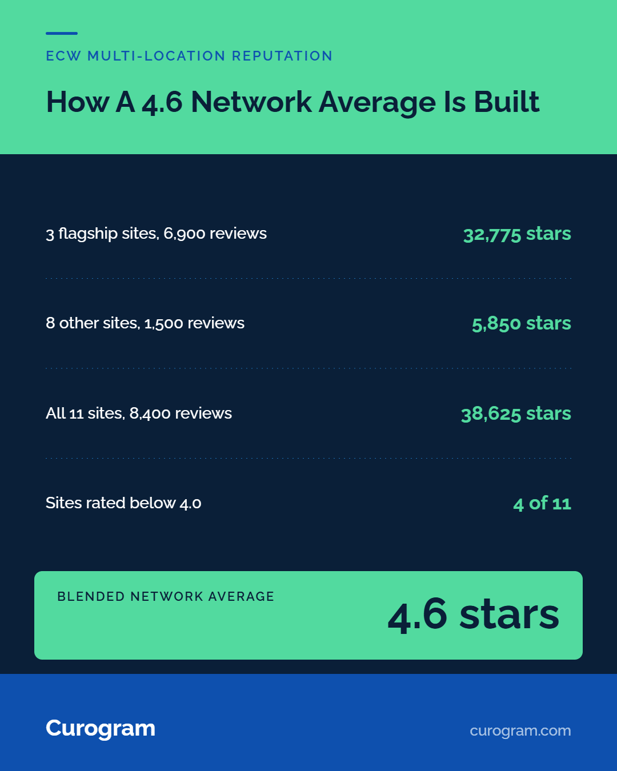
Run the arithmetic on the illustrative network above and the trap shows itself. 8,400 reviews sit across eleven sites. Three flagships hold 6,900 of them at an average of 4.75, and the remaining eight sites share 1,500 at an average of 3.9.

Weight those together and the network reads 4.6. Leadership sees a healthy number. Four sites are below 4.0 inside it.

Line on the operating review

Network roll-up

Weakest location

Reviews

8,400

12

Rating

4.6

3.6

Newest review

Today

22 months ago

Share of network reviews

100%

0.1%

Illustrative. Both columns are true at the same time, which is the reason a single blended average cannot run a network.

The correction is smaller than it looks. 12 reviews at 3.6 is 43.2 total stars, so 22 five-star reviews puts that site at 4.5. The network average does not visibly move.

What a floor-first quarter changes

22 reviews is roughly a month of requests at a site running 1,900 completed visits. Four locations below 4.0 become four locations above it inside a quarter, and the 20-review count threshold falls not long after.

Those satellites then surface in the local pack for the neighborhoods they were opened to serve. What happens once a family reaches the comparison is covered in helping patients choose your eClinicalWorks locations on Google.

Conclusion: Put Reputation on the Dashboard

Google your three lowest-volume locations tonight, on a device that has never been signed into a practice account. That is the entire first impression for every patient in those neighborhoods.

eCW runs the clinical and financial operation across every facility in the network, at a scale few systems match. The listings those facilities get found through sit outside it, and no EHR claims them. What connects a completed visit to a public piece of proof is routing and timing.

Put four lines on the monthly operating review, broken out per location: review count, rating, newest review date, and response rate. Sort ascending. The sites at the top have the most room to move, and they are usually the ones the network spent the most to open.

Watch whether the same names stay there month after month. A site that never moves has a routing problem rather than a care problem.

Book a demo and we will rank all eleven profiles by the gap between them, then project 90-day volume for the bottom four from your own eCW visit counts.


Frequently Asked Questions

How do we keep review requests compliant across every location?

Send to every patient after every completed visit, with no sentiment screening first. Google’s Maps content policy bans gating, incentives, staff review quotas, and on-premises pressure. Curogram requests stay ungated at all sites.

How should a network decide who responds to reviews?

Match it to how tone is governed elsewhere. Central desks hold voice consistent across profiles, while regional managers add local accuracy. Approval routing covers the middle, provided no reply confirms a patient relationship.

Why does a healthy network average still leave locations invisible?

A weighted average follows review volume, and volume concentrates at flagships. Several sites can sit below 4.0 while the roll-up reads 4.6, because those sites hold a very small share of the total.

How quickly can a weak satellite clear the rating threshold patients apply?

Faster than most leaders expect, because a small base moves fast. A site holding 12 reviews at 3.6 reaches 4.5 after 22 five-star reviews, which is about one month of requests at moderate visit volume.

Why prioritize satellites ahead of flagship locations?

Marginal value per review is far higher on a small base. The same review that lifts a satellite from 3.6 to 4.5 is invisible on a profile holding 2,300, so floor-first sequencing wins more searches per request sent.