
 Jo Galvez
Patients told at checkout that texts are coming, who see the same line on the appointment card, and whose first message arrives from their practice’s own local number, adopt almost immediately.
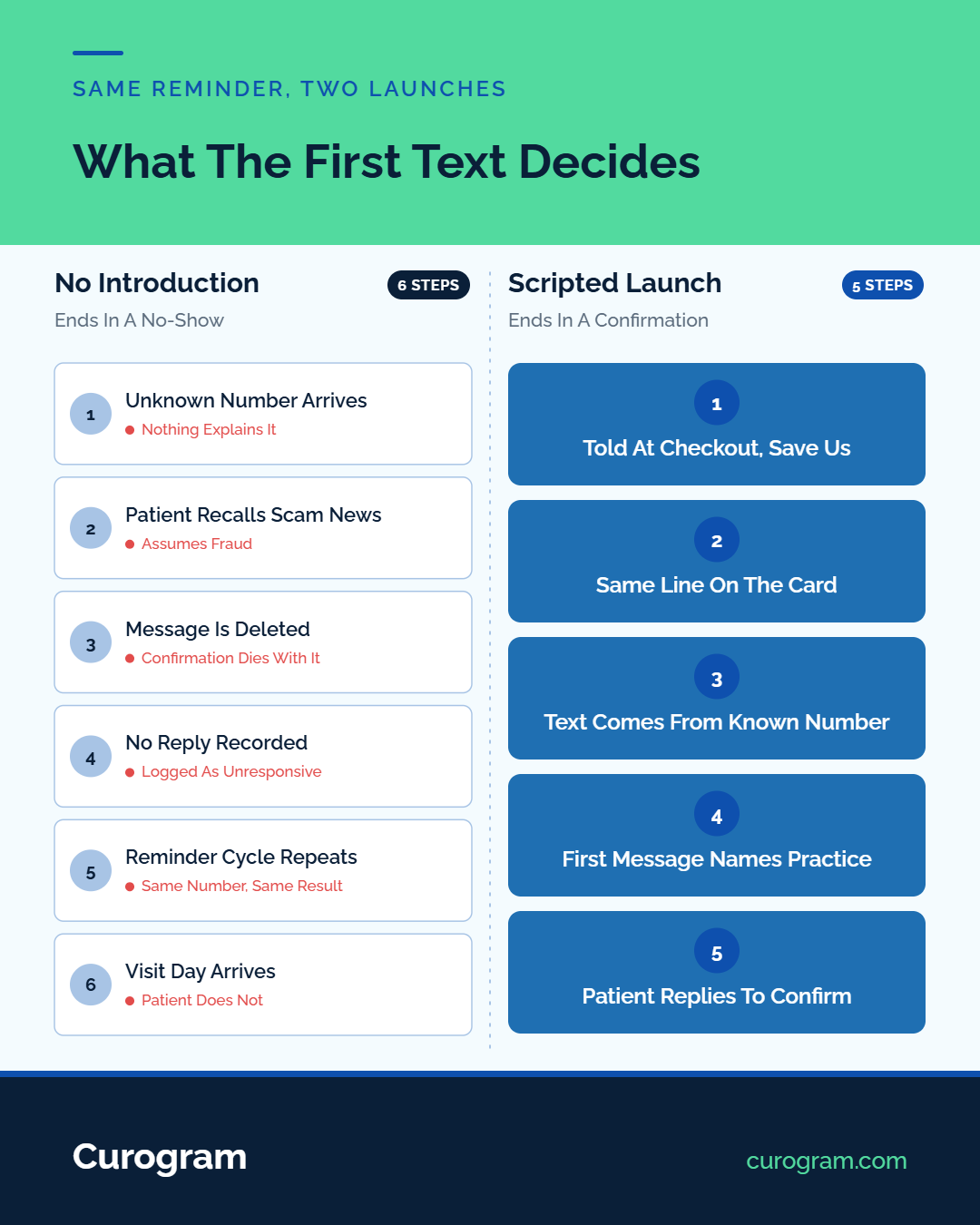
Texting is already how they live. Patients who simply start receiving messages from an unexplained number delete them, and the confirmations inside them die too.
The villain is the unannounced change, and it is entirely preventable with a launch script every location repeats.
Done well, groups cross a 75% confirmation rate within the first reminder cycles, per Curogram client data from clinical settings. Patients were never the barrier. The introduction was.
Americans reported $470 million in losses to text scams in 2024, more than five times the 2020 figure, according to the FTC’s April 2025 data spotlight. Fake fraud alerts rank among the top five types.
Your patients read that news. Then an unfamiliar number texts them “Reply Y to confirm.”
They delete it. The practice logs an unresponsive patient and, a week later, a no-show. Nothing about that sequence was a technology problem.
Practice emails do not fix this, because patients do not read practice emails. A channel change has to be announced inside the moments patients actually attend to: the checkout conversation, the front desk, the appointment card in their hand, and the first message itself.
Our position on patient onboarding for a new channel is simple and testable. Adoption is close to automatic when the first impression is designed, and close to hopeless when it is accidental.
The difference is roughly one sentence, said out loud at checkout, by every location, for one month.
The Villain: The Unannounced Change
The Week After A Scam Story Runs
A local news segment covers text fraud on a Tuesday. On Thursday, your patient gets a message from a number she has never seen, asking her to reply Y.
She does what she has been told to do. She deletes it and does not reply. Her behavior was correct in every way except this once.
Early Ignored Texts Train Everyone Wrong
The first weeks set the pattern in both directions. Patients learn that messages from this number can be ignored. Staff learn that texting does not work here.
Response rates start low and stay low, and the initiative takes the blame for a problem created in its first 48 hours.
Trust Does Not Recover On Its Own
A patient who classified your number as suspicious does not revisit that judgment. There is no second first message.
That location now runs a channel patients would have liked, at a response rate that will read as evidence against texting for as long as anyone looks at it.
The Cheapest Fix In The Rollout
Every other part of a go-live costs configuration time. The patient introduction costs one sentence at checkout and a line on the appointment card.
Skipping it is the most expensive saving in the whole deployment.
The Guide: The Rollout Playbook
A Scripted, Multi-Touch Introduction
Introducing text communication to patients at DrChrono practices runs the same way at every location, in the same order. Checkout script, appointment card line, front desk signage, then the first message.
Multi-touch matters because no single touch reaches everyone. A patient who missed the checkout line sees the card. A patient who tossed the card recognizes the number.
Consent Rides On Visits Already Happening
|
Moment |
What is captured |
Where it is recorded |
|---|---|---|
|
Intake paperwork |
Mobile number, consent to text |
Patient record |
|
Check-in confirmation |
Number verified aloud, corrections made |
Patient record |
|
Checkout script |
Verbal notice that texting starts |
Launch log for the location |
|
First message |
Opt-out instruction included |
Consent and opt-out record |
Patient consent for a texting launch does not need a separate campaign. It attaches to visits that are already on the schedule.
The First Message Introduces Itself
Message one names the practice before it asks for anything. It also says what will be texted, how to reply, and how to stop.
Those three facts turn an unknown number into a service being offered. Announcing texting to patients works when the announcement arrives inside the thing being announced.
Curogram Highlight: The Recognized First Text
The Recognized First Text is the whole anti-scam design, and it rests on two decisions made before launch day.
First, messages come from each location’s existing local number. Patients have been calling that number for years, and many have it saved. Recognition happens before a single word is read.
Second, the opening message introduces the practice by name and states its purpose before it asks for anything.
“This is Midtown Medical. We text appointment reminders now. Reply C to confirm, STOP to opt out.” That is the entire first text.
Clear expectations do the rest. Patients are told what will be texted, how to reply, and how to stop, which makes the channel feel offered rather than imposed. A launch script exists to produce one reaction at the moment of the first message: “good, they text now.”

The Success: Trusted From Message One
Adoption Arrives In The First Cycles
A well-introduced launch crosses the 75% confirmation benchmark within its first reminder cycles, per Curogram client data from clinical settings. Covina Arthritic Clinic sustains more than 1,100 confirmed appointments a month.
Speed here is diagnostic. When adoption is immediate, trust was designed in. When it crawls, the introduction is usually what went missing.
What Patients Do From Week One
They confirm by reply. They ask a question and get an answer. They reschedule without calling during work hours.
None of that is advanced behavior. Patients already do all three with their pharmacy and their dentist, which is why the first text from a practice reaction tends to be relief rather than curiosity.
The Sentence Front Desks Start Hearing
Staff report a recurring comment after a good launch: I wish every business did this.
Patient adoption of text reminders is not something a practice has to build. It has to be permitted, and permission is granted the moment the first message is recognizable.
Conclusion: Launch the Channel Like You Mean It
Patient adoption of texting is close to automatic when the first impression is designed. It is close to impossible when the first impression is an unexplained number.
DrChrono holds your record of consent and contact. Curogram delivers their first hello from a number they already trust.
Write your checkout sentence now. Something close to “we text now, from this number, save it.” Make saying it a habit at every location for the full launch month, and put the same line on the appointment card so the front desk has backup.
Book a demo to see the patient launch kit. First-text scripts, signage, and the consent flow, ready to localize per site.
Frequently Asked Questions