
 Aubreigh Lee Daculug

A profile whose last review is a year old creates a "Stale First Impression." Patients read it as a warning and book somewhere else.
Curogram connects to DrChrono visit activity and sends each patient a timely review request for the exact location they visited. One multi-location group gained 1,064 new five-star reviews in just 3 months.
Eleven months.
That could be the age of the newest review on one of your locations. You may not know which location it is, but your prospective patients do, because they see that date long before they ever meet your front desk.
Most patients read reviews before booking, and they rarely research your organization as a whole. They evaluate the one clinic that appears when they search on their phone. For a newer or smaller site, that listing is often thin, quiet, and out of date.
It's the Google profile first impression practice owners rarely check. Your flagship might have hundreds of glowing reviews, yet none of them appear when someone across town searches for care close to home.
So the patient sees a respectable star rating, followed by a date from last fall. Right beside it sits a competing clinic with a review from last Tuesday, with photos. The choice takes less time than a cup of coffee.
That's the real problem. Your care didn't slip. Your visible proof did.
Helping patients choose your DrChrono locations on Google means closing the distance between the quality inside each clinic and the story on its public profile. DrChrono handles your charts, scheduling, and billing effectively, but it wasn't designed to keep a consistent flow of fresh reviews moving at every address.
This matters most for elective and aesthetic services, where patients compare providers the way they'd evaluate a major purchase. They want recent, believable proof from people like them, at the exact address they'll drive to.
In this guide, you'll learn why outdated profiles quietly push patients toward competitors and how Curogram keeps every location's reviews current. You'll also see how one multi-location group earned 1,064 five-star reviews in just 3 months.
Finally, you'll get a five-minute check to run today.
When Your Newest Location Looks Like It's Closing
Patients Search a Place, Not a Brand
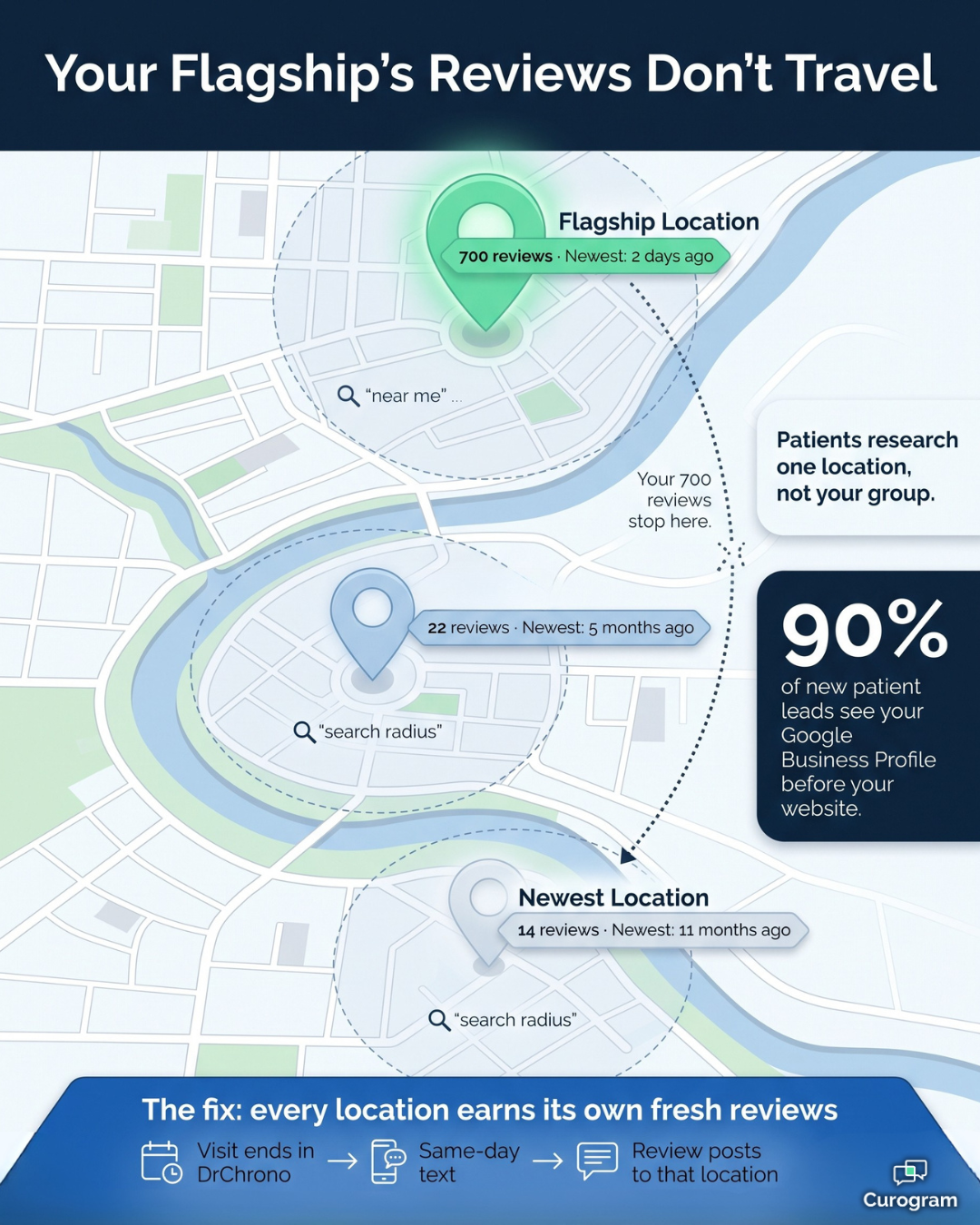
When a patient types "dermatologist near me," Google doesn't show your whole group. It shows one location, with its own stars, its own photos, and its own reviews.
That's the challenge for growing practices. Your original clinic may have 700 reviews collected over a decade, while your newest site two miles away has only 14, and the most recent one appeared before the holidays.
The patient never sees the 700. They only see the 14, and they make their decision based on that limited evidence.
The Ninety-Second Decision
Consider how a near me search decision actually unfolds. A patient wants a consultation, opens Google Maps, and finds two clinics within a short drive.
Your clinic has the stronger providers and the better track record. However, its newest review is almost a year old, while the other clinic shows a review from last Tuesday, complete with a photo of a smiling patient.
The patient taps "Book" on the competitor. The entire process takes about ninety seconds, and your team never learns that you were even considered.
Why Old Reviews Feel Risky
A stale profile doesn't just look quiet. It creates doubt. Patients start to wonder whether the clinic lost staff, whether the doctor left, or whether the location is about to close.
This is review recency trust at work. After the star rating, the review date is often the next detail patients examine, because a recent review confirms that the practice is open, fully staffed, and still delivering good care.
Elective service review shopping makes this effect even stronger. Someone weighing a cosmetic treatment or a costly procedure reads review after review, and a gap of several months can end the search entirely.
What It Costs a Growing Group
Here's an illustrative example.
Suppose a new location loses just 8 consultations a month to a competitor with fresher reviews.
If each consultation is worth $400 on average (a sample figure, not an industry benchmark), that's $3,200 a month. Over a full year, the total reaches $38,400 in missed revenue from a single site.
In practice, the location you opened to grow the group ends up competing for patients with excellent care but invisible proof.
How Curogram Keeps Every Location's Profile Alive
Curogram works like a network reputation desk for your whole group.
Its job is simple: keep the proof flowing at the same pace as the care, at every address you run.
Here's how the process works from visit to review:
- A real visit wraps up in DrChrono. Curogram uses that visit activity as the starting point, so each request is tied to an actual appointment.
- The patient gets a text while the visit is fresh. Timing matters. A request sent the same day catches the patient while the experience is still top of mind.
- Two taps open the right Google profile. The link goes to the exact location the patient visited, not a generic group page.
- The review posts to that location. Each clinic builds its own stream of recent, local feedback.
Texting is the right channel for this. Curogram's case studies show a 98% open rate for SMS, which means your request actually gets seen instead of buried in an inbox.
Real Visits, Real Voices
Because every request starts with a real DrChrono visit, each location's review flow mirrors its actual patient volume. A busy site earns more reviews. A quieter site earns fewer. Nothing is padded or faked.
That authenticity matters to Google and to patients. Curogram doesn't offer incentives or screen out unhappy patients before they can post. Everyone who visits gets the same honest invite.
Smooth logistics also help. Patients often praise the small things, like a clear reminder or a short wait, so strong reminder workflows across your locations tend to show up in the reviews that follow.
What Prospective Patients Get
For someone doing research, this is exactly what they want. They find recent, real accounts from people like them, about the exact clinic they plan to visit.
For your team, it means less chasing. Nobody has to remember to ask for reviews at the front desk, and each location manager can see and respond to feedback from one dashboard.
To see how this fits into a full reputation plan, read our guide to managing Google reviews for multiple DrChrono locations.
The Profile That Says "Excellent, Right Now"
One multi-location practice was struggling with patient feedback and its online reputation. After adding Curogram's automated post-visit review requests, the group earned 1,064 new five-star reviews in just 3 months.
That works out to about 355 new reviews a month, or roughly 12 every day across the group. Each one is recent, local, and written in a real patient's voice.
Here's what that shift looks like at the location level:
| What patients see | Stale profile | Living profile |
|---|---|---|
| Newest review | 11 months ago | 2 days ago |
| Review volume | A handful, mostly old | A steady weekly flow |
| Photos and details | Few or none | Recent patient stories |
| What it signals | "Maybe declining" | "Busy and trusted" |
| Patient's next move | Keeps scrolling | Books a visit |
This table uses sample values to show the pattern, not data from a single clinic.
The biggest change isn't the number. It's what each profile does for you. A stale listing waits to be found. A living one works as that location's best marketer, around the clock.
Steady, local reviews also drive the kind of patient acquisition Google Maps was built to reward.

Here's an illustrative split:
If a group like this ran five locations, each would average about 71 new reviews a month.
And the benefit carries into the visit itself. Patients arrive already reassured because they chose you on evidence. The relationship starts with confidence instead of doubt.
Keep Each Location's Profile Working Between Visits
Fresh reviews do the heavy lifting, but they work best on a profile that looks cared for. A few simple habits help every location turn new reviews into new bookings.
Start with these basics at each address:
- Reply to reviews within a few days. A short, warm thank-you shows prospective patients that real people are paying attention.
- Keep every reply free of health details. Never confirm that someone is a patient or mention a visit, treatment, or condition, even when the reviewer does.
- Update hours, photos, and services each season. A profile with last year's holiday hours sends the same "stale" signal as an old review.
- Check each location's newest review date once a month. Treat any site that goes quiet for more than a few weeks as an early warning.
That's a lot to track across five or ten profiles. Curogram brings each location's reviews into one dashboard, so managers can see what's new and reply from one place instead of logging in to every profile separately.
Here's an illustrative example of the time involved.
If a group with six locations spends 20 minutes per site each week checking and replying across separate logins, that's 2 hours a week, or about 104 hours a year.
If one dashboard cut that time in half (a sample figure), your team would get roughly 52 hours back for patients.
Show Every Neighborhood the Care It Already Gets
Your locations earn patient trust every single day. Their Google profiles should reflect that trust every week.
Right now, there may be a gap between the two. The care inside your newest clinic might be excellent, but if its profile went quiet months ago, patients searching nearby have no way of knowing.
That gap isn't a quality problem. It's a visibility problem, and it's one you can fix.
Here's the central idea.
DrChrono is designed for your record of care, while Curogram is designed for your patients' public story about that care. You need both working together at every address.
Start with a quick check today. Open Google Maps, search for each of your locations individually, scroll to the most recent review, and write down the date.
That date represents the age of your first impression in that neighborhood. If it's more than a few weeks old, prospective patients are quietly comparing you to competitors who appear more current and more active.
Now consider what changes when every appointment can lead to a fresh review. A busy Tuesday at one clinic becomes a week of new, honest feedback on its profile. Your quieter locations stop looking stale, and your flagship keeps its advantage.
Your team doesn't carry extra work, either. Requests go out automatically, connected to real visits, and each location's reviews stay organized in one place for easy responses.
Curogram helps multi-location DrChrono practices keep every profile as active as the care behind it. It's a straightforward way to ensure each neighborhood sees your practice the way your current patients already experience it.
Ready to see how it works? Schedule a Demo, and we'll show you how one busy day at a single location can become a steady stream of fresh reviews. Then check that date again next month.
Frequently Asked Questions