10 min read

Win the 'Near Me' Search at Every Network Location

Win the 'Near Me' Search at Every Network Location
💡 Helping patients choose your athenahealth locations on Google comes down to one thing: what each location's own profile shows. Patients compare two map pins. The pin with newer reviews usually gets the call.
  • Based on our internal data, 90% of new patient leads see your Google profile before your website.
  • Each location has its own profile, so a flagship's 800 reviews never appear on a satellite's listing.
  • A newest review from two years ago can make a patient wonder if the clinic has changed hands or is closing.
  • A short text after each real athenaOne visit gives every location a steady flow of new, local reviews.
  • One multi-location group earned 1,064 new five-star reviews in 3 months with Curogram.
Keep each location's newest review recent, and the side-by-side check starts to favor you.

Nine out of 10 new patient leads look at a Google Business Profile before they ever reach a practice website, based on our internal data. For a network with 12 locations, that means 12 separate profiles. Google judges each one alone, and so do patients.

This is where network brands lose people without seeing it happen. Your flagship may have 800 reviews and a brand campaign that runs all over town.

None of that appears when a parent in a newer suburb searches "pediatrician near me." What they see is your satellite clinic with 31 reviews and a newest review from two winters ago.

Our position: helping patients choose your athenahealth locations on Google is a location-by-location job, and review dates decide more bookings than most networks think. Patients read reviews before booking. After the star rating, the next thing they check is how old those reviews are.

A stale profile sends a message the clinic never meant to send. Patients wonder if the doctor they read about left, or if the place changed owners. By the time they'd find out, they've already tapped the next pin.

The fix sits inside visits you already have. Each location sees real patients every day, and many of them would describe the visit in public if someone asked at the right time.

A short text a few hours after checkout, with a link to that exact location's profile, is enough to get the ask out the door.

That ask has to go to every patient, though. Google's review rules bar clinics from inviting only happy patients, and a network that gets caught doing it risks losing reviews at every location at once.

Patients Research One Pin at a Time

Search "family doctor near me" and Google shows a map with three pins. Under each pin sits a star rating, a review count, the hours, and a snippet from a recent review. Each pin is its own Google Business Profile, and each profile holds only its own reviews.

Networks feel this most. Their downtown flagship might have 800 reviews built over ten years. The satellite that opened in 2023 across town starts at zero, and none of the flagship's reviews carry over.

In athenaOne, that satellite is one department in a shared setup, with the same templates, providers, and billing rules as the rest of the group.

On Google, it's a stranger. Your satellite location online presence is whatever that one profile shows, and for many networks, that's a thin list of old reviews and a stock photo of the building.

A 90-Second Choice

Take a family that just moved to a new suburb and needs a pediatrician. The parent opens Google Maps and sees two clinics, 1.4 miles apart. Side by side, the two profiles look like this (illustrative):

What the Parent Sees

Your Satellite

The Other Clinic

Star rating

4.6

4.5

Total reviews

38

112

Newest review

23 months ago

6 days ago

Owner replies

None in 2 years

Most reviews


Your clinic has the higher rating and a network name people know. The parent still taps the other pin, reads two recent reviews about short waits, and books online.

The near me search healthcare decision took about 90 seconds, and your physician bios never got a single view. Moments like this make up most of the new patient acquisition Google Maps sends a satellite's way.

The Date Is the Second Thing Patients Check

After the stars, patients look at the date. A 4.6 rating built in 2023 says little about who's working the front desk today. Call it the review recency patient trust check, and most people run it in a few seconds.

Google shows the age of each review right under the reviewer's name: "2 years ago," "a week ago." A patient who sees "2 years ago" at the top of the list starts asking questions the profile can't answer. They wonder whether the doctor retired, or whether anyone will pick up the phone.

Google's own help page on local ranking lists review count and review score as part of how it judges a business's prominence. So a quiet profile can slip down the map pack, and then the patient never sees it at all.

A clinic group runs a Google profile first impression network whether it plans to or not: every pin is a front door, and each one is judged on its own evidence.

Why Satellites Go Quiet

Satellite profiles usually go quiet one skipped ask at a time.

At a two-person front desk, the review request is the first task to drop. Three patients need to reschedule, a prior auth is stuck, and the phone won't stop. Asking a patient to "leave us a review" at the checkout window feels awkward anyway, so staff stop doing it.

Meanwhile, the marketing team watches the flagship's profile because that's the one leadership searches. No one runs a weekly report that shows which location's newest review is the oldest. The gap grows for months before anyone looks.

What It Costs, in Plain Math

Say one satellite loses 3 new patients a week to the pin next door (illustrative). Over a year, that adds up to about 150 new patients. If each new patient brings 3 visits in their first year, that's 450 visits the location never sees.

Those numbers are made up for this example, so run your own. Pull new-patient counts by department from athenaOne for the last quarter. Rank your locations from busiest to quietest, then check the date on each one's newest Google review.

If a location with slow new-patient growth also has the oldest review date, start there. It's the clearest case of a profile holding back a location that has the staff and schedule to grow.

The Network Reputation Desk

A review program for a network needs three working parts: an ask that goes out after every real visit, a link that lands on the right location, and one place to watch all the profiles at once.

We call that setup the Network Reputation Desk. Curogram runs it so the evidence on each profile keeps pace with the care inside each building.

From Checkout to Review in Two Taps

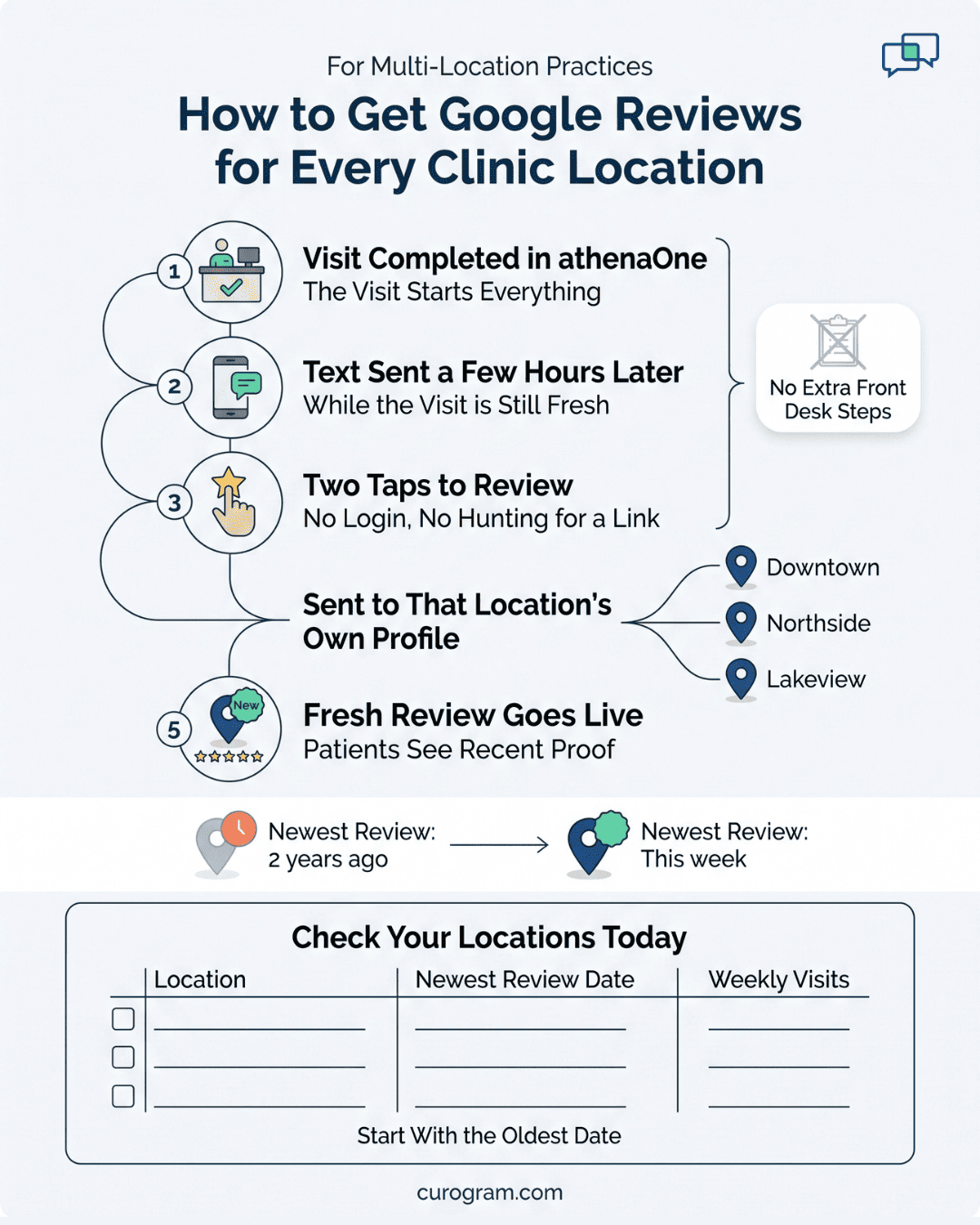
The ask goes out by text a short while after the visit ends. Patients get a message like this one:

"Hi Maria, thanks for visiting Lakeside Family Medicine in Plano today. How was your visit? Tap here to share a quick review: [link]. Reply STOP to opt out."

The first tap opens a short rating screen. The second opens Google's review box for the Plano location itself. From there, the patient writes as much or as little as they want.

Timing matters here. A text a few hours after the visit reaches the patient while they still remember the nurse's name and how long they waited. A batch email three weeks later arrives after those details have faded.

Requests That Follow Real Visits

Curogram works with athenahealth, so review requests key off real visit activity in athenaOne. When a visit is completed at a given department, that patient becomes eligible for a request tied to that department's Google profile.

This keeps each location's review stream in line with its actual patient flow. A location that sees 140 patients a week gets more requests than one that sees 40.

The reviews that come back use the patients' own words about that building, that parking lot, and that front desk team.

Every patient gets the same ask. Curogram doesn't route happy patients to Google and unhappy ones somewhere else.

Google's review policy bars businesses from selectively asking only happy customers for reviews, and the FTC's 2024 rule on fake reviews added federal teeth to review honesty. An all-patient ask is the only version we'd put a network's name behind.

Five-step flow of a post-visit text that routes each patient's Google review to the right practice location

What a Prospective Patient Gets

A parent comparing pins wants three things from a profile: recent reviews, from people like them, about the exact place they're thinking of visiting. Visit-driven requests supply all three.

A review that reads "In and out in 25 minutes, and Dr. Reyes walked my son through his X-ray" (illustrative) does more for a new family than any ad.

It names a provider, a wait time, and a kind of care. It's also dated last Thursday, which answers the recency question before the patient asks it.

Local detail carries weight with new families. Reviews of a suburban satellite tend to mention easy parking, weekend hours, or a short drive from a school.

Those are the details a new-to-town family is searching for, and they only show up when that location's own patients are asked.

One Dashboard for Every Location

A network manager needs every location in one view: new reviews this week, current star rating, and replies still waiting. Curogram shows those numbers per location. When one satellite's weekly count drops from 8 to 1, someone can call that site manager the same week.

That drop usually has a plain cause. A new front desk hire may be skipping the step that marks visits complete, or a provider may be out for two weeks.

Because requests follow completed visits, a gap in reviews often points to a gap in the schedule or the workflow, and the dashboard makes it visible early.

Replies need care. A reply should thank the patient and invite them to call, and it should never confirm they're a patient or mention care details.

Manasa Health Center paid OCR a $30,000 settlement after its Google review replies disclosed patient information. Short, generic, warm replies are the safe standard.

The Profile That Says Excellent, Currently

Based on our internal data, 90% of the practice's patients left five-star reviews, which added up to 1,064 new five-star reviews in 3 months. That's roughly 350 new reviews a month across the group, or about 80 a week.

Each one came from a real patient, about a real visit, at a specific location, and each one was recent when a prospective patient read it.

A Worked Example: One Satellite, Eight Weeks

The numbers below are illustrative. Use them as a model, then swap in your own visit counts.

Start with a satellite that has 38 reviews and a newest review that's 23 months old. It completes 110 visits a week in athenaOne. Assume about 6% of patients leave a Google review after the text, or roughly 6 reviews a week.

Week

Total Reviews

Newest Review

0

38

23 months ago

1

44

1 day ago

4

62

1 day ago

8

86

1 day ago


Week 1 brings the biggest shift. That "23 months ago" at the top of the list is gone within days, and the profile now reads like an active clinic.

By week 8, the review count has more than doubled, and a parent comparing pins sees a steady run of recent visits.

Our setup steps for that satellite would run in this order:

  1. Confirm the department in athenaOne maps to the right Google Business Profile.
  2. Set the request to send a few hours after the visit is completed.
  3. Write the text with the location's name, so patients know which clinic they're reviewing.
  4. Turn on replies from the dashboard, with a short, PHI-free reply template.
  5. Check the location's newest review date every Monday.

What Honest Asks Do to the Star Rating

Some networks worry that asking every patient will drag the rating down. The math says otherwise for most clinics that deliver good care.

Go back to the satellite above: 38 reviews at 4.6 stars, or about 175 total stars. Over eight weeks it adds 48 reviews. If 90% are five stars, in line with the group in our case file, and the other 10% average three stars, those 48 reviews add about 230 stars (illustrative).


Reviews

Total Stars

Average

Before

38

175

4.6

Added in 8 weeks

48

230

4.8

After

86

405

4.7


The rating climbs from 4.6 to 4.7 even with some three-star reviews in the mix. Those mid-range reviews help too. In our view, a wall of perfect scores can look staged, and a few honest notes about a long wait make the five-star reviews easier to believe.


Curogram Highlight: Post-Visit Review Requests for Every athenahealth Location

Post-Visit Review Requests send each patient a short text after a completed visit, with a link to the Google profile for the location where they were seen.

Curogram connects with athenaOne, so requests key off real visit activity at each department. No one at the front desk has to remember to ask.

For a multi-location group, the feature covers five jobs:

  • Location matching, so a patient seen in Plano reviews the Plano profile, and a patient seen downtown reviews the downtown profile.
  • Timing, with the text going out a few hours after the visit, while details like wait time and provider names are still fresh.
  • Every patient gets the same ask, with no screening of happy versus unhappy patients before the Google link appears.
  • STOP replies take effect right away, and patients who opt out stop getting requests.
  • A per-location view of new reviews, star ratings, and replies waiting, so a quiet satellite is easy to spot.

Based on our internal data, one multi-location practice using this approach earned 1,064 new five-star reviews in 3 months, with 90% of its patients leaving five stars.

The feature sits inside Curogram's HIPAA-compliant patient texting. The same number that sends appointment reminders and handles two-way messages also sends the review ask.

Patients see a sender they already know from their reminder texts, which makes the link feel safe to tap.

Nothing new lands on the front desk. Staff check patients out in athenaOne the way they do now, and the request goes out on its own.

Conclusion: Let Each Neighborhood See the Care

Your locations earn patient trust every day. Their Google profiles should show that trust on a weekly basis.

athenaOne holds your record of the care. The Google profile holds the patient's public account of it, and that account is what a new family reads before calling.

When the newest entry is two years old, a new family is reading about a front desk team that may have turned over twice since.

So start with one check. Open Google Maps, search each of your locations by name, and look at the date on the newest review. That date is the age of your first impression in that neighborhood.

Write each one down next to that location's weekly visit count from athenaOne, and you'll see the gap between how busy a location is and how busy it looks.

Most networks find at least one satellite where the numbers don't match. It's usually a location with a full schedule, good providers, and a profile that went quiet after the last office manager left.

Book a demo with Curogram and we'll show you how a busy Tuesday at one location turns into a week of fresh, honest reviews on that location's profile.


Frequently Asked Questions

How does Curogram make sure reviews come from real patients?

Requests only go out after a completed visit in athenaOne, so every person who gets a link was seen at that location. Curogram doesn't offer incentives, write reviews, or filter who gets asked. Each patient receives the same short text, and whatever they choose to write goes straight to Google. That's why the review count at each location tracks its real patient volume.

How often will a patient get a review request, and how do they stop them?

Patients get one request tied to a visit, sent a few hours after checkout. There's no string of follow-ups. A patient who doesn't want to review can ignore the text, and replying STOP ends future requests right away. We think one well-timed ask respects patients more than a monthly email blast.

Why should each location reply to its own Google reviews?

Replies show a prospective patient that someone at that location reads feedback and cares about it. They also keep a satellite's profile looking active between new reviews. Keep replies short and never confirm that the reviewer is a patient or mention care details. Manasa Health Center paid a $30,000 OCR settlement after its review replies disclosed patient information.

How recent should a location's newest Google review be?

We'd aim for a newest review under two weeks old at any location that sees patients every weekday. Past a month, the profile starts to look slow next to active competitors. Past a year, patients start asking whether the clinic is still open. A location running visit-based requests usually posts new reviews within days, so the date takes care of itself.

How can a network decide which athenahealth location to fix first?

List every location with three numbers: weekly completed visits from athenaOne, total Google reviews, and the date of the newest review. Sort by the newest review date, oldest first. The location with high visit volume and an old review date is your first target, because it has plenty of real patients to ask and the most bookings to win back.