
Text Your DrChrono Practice — No OnPatient Login
 Jo Galvez : Oct 12, 2026, 8:00:00 AM
Patients shouldn’t need an OnPatient login to ask a quick question. Curogram makes every DrChrono location’s number textable.
Interruptions cost more than the seconds they take. Gloria Mark, Daniela Gudith and Ulrich Klocke measured this at CHI 2008. Interrupted workers actually finished tasks faster, in about 20.3 minutes against a 22.8-minute baseline.
heir self-reported stress rose from 6.92 to 9.46, and frustration from 4.73 to 6.63, on a 20-point scale. People absorb interruptions by speeding up and paying for it internally.
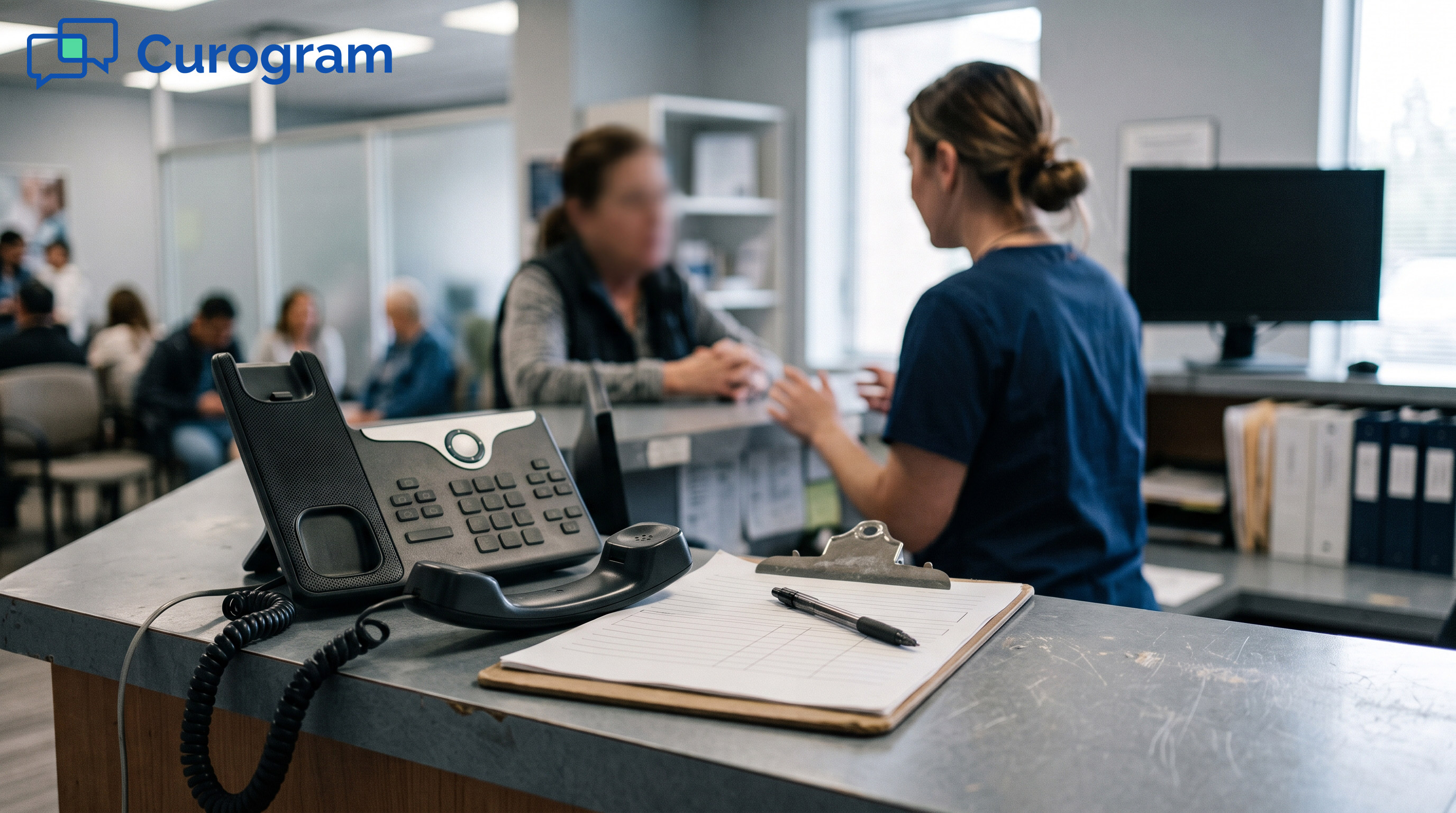
Now put that on a front desk taking 80+ calls a day.
Most of those calls carry ten seconds of content. “Which location is my Thursday visit at?” “Did my referral go through?” “Do I stop the blood thinner before Friday?”
Every one of them still costs a full call: authenticate, open DrChrono, answer, document, hang up, then turn back to the patient at the counter who’s now repeating herself.
Practice leaders rank the load the same way. In an MGMA Stat poll fielded 10 March 2026 with 294 responses, 45% named eligibility and prior authorization the most time-consuming phone work, and 31% named scheduling. Both are list work that happens to arrive by phone, one caller at a time, in whatever order the phone decides.
Our position: the front desk interruption cost is the real line item, and it never shows up in a staffing model. You can measure calls answered. You can’t easily measure the check-in that took four minutes instead of two because the phone rang twice during it.
Routine call deflection to text fixes the arithmetic at every site at once. The phone keeps the calls that need a voice.
DrChrono took the friction out of everything behind the desk. Charting, claims, and scheduling all moved.
Out front, the phone is still the only door, so a ten-second question and a genuine clinical concern arrive through the same channel at the same cost.
|
Phone task named most time-consuming |
Share of practice leaders |
Deflects to text? |
|---|---|---|
|
Eligibility and prior authorization |
45% |
Status updates yes, payer calls no |
|
Scheduling and rescheduling |
31% |
Yes |
|
Intake |
9% |
Yes |
|
Prescription refills |
6% |
Yes |
|
Other |
9% |
Varies |
Source: MGMA Stat, 10 March 2026, 294 responses.
Eighty calls per location per day, five days a week. A three-site group is absorbing roughly 1,200 calls a week across its front desks. Staff time on routine questions doesn’t accumulate in any report, so it never gets budgeted. It gets covered by whoever is standing there.
One unanswered call becomes two. A patient calls at 11, nobody picks up, she leaves a voicemail. Someone returns it at 3, she’s in a meeting, so she calls back at 4:30 as the desk is closing.
Phone tag in a multi-location group compounds because the callback often comes from a site the patient didn’t call, so she doesn’t recognize the number and lets it ring.
Turnover in front-office roles is expensive and slow to fix. Your most capable staffer spends her day as human hold music, and the CHI 2008 numbers describe exactly what that feels like from the inside. Abandoned callers, meanwhile, don’t complain. They reschedule somewhere else.
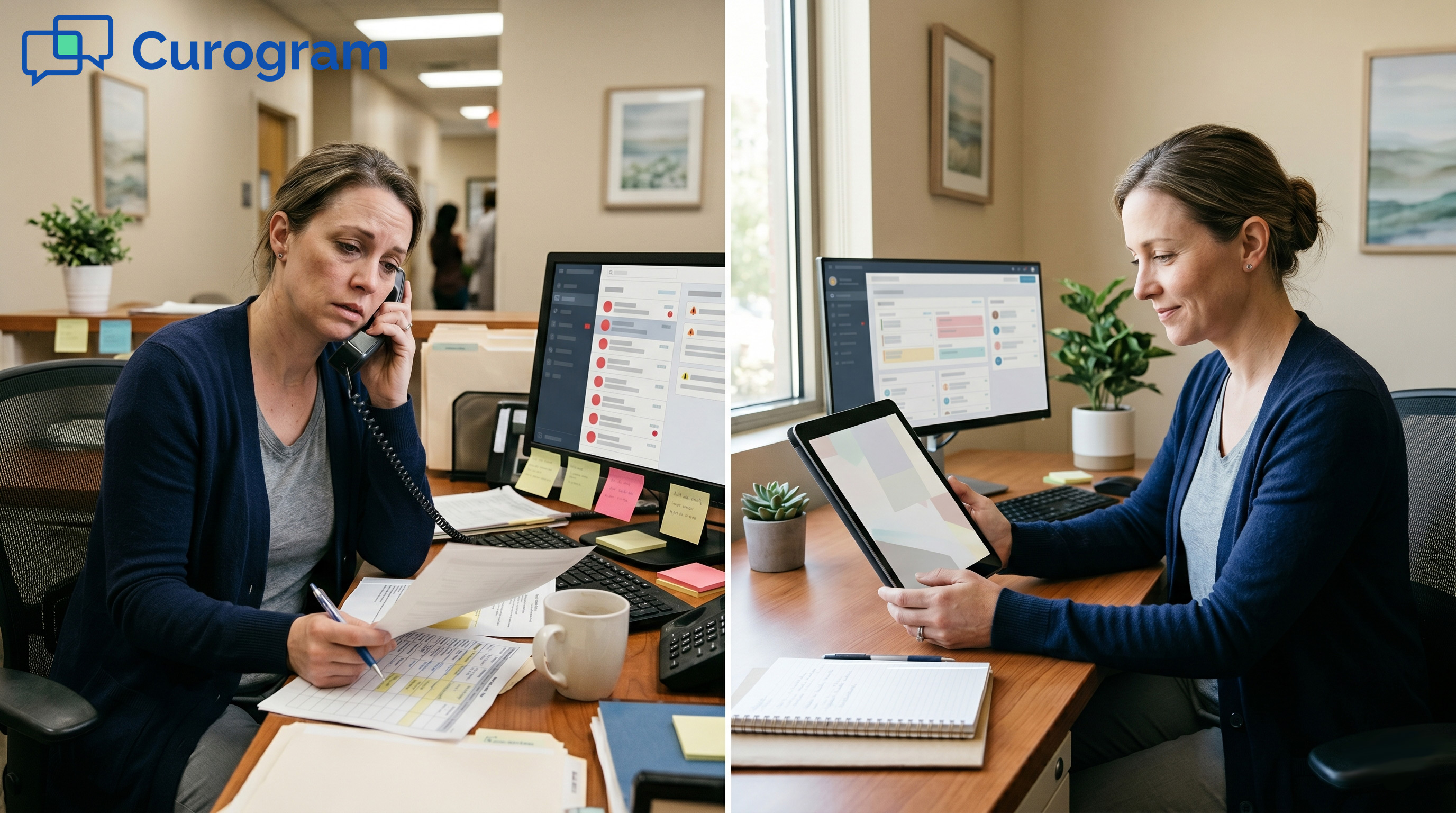
Curogram converts the routine layer into text threads that any authorized staffer at any location can claim, answer, and close. Nothing is on hold.
Nobody is interrupted mid-check-in, because a thread waits politely while a call does not. Work becomes asynchronous and prioritized, which is how every other queue in the practice already runs.
Rank your top 20 inbound questions and each one gets a one-tap answer. Parking and entrance directions. Fasting instructions. Referral status. Balance questions.
Templated replies for common questions keep tone and accuracy consistent across every site, which matters more in a group than in a single office, because patients compare locations without meaning to.
Billing texts land with billing. Scheduling texts land with scheduling. Clinical questions route to a nurse queue. To reduce phone calls at the DrChrono front desk in a lasting way, the desk has to stop being the switchboard for questions it was never going to answer itself.
2-Way Texting gives every location a compliant, routed inbox behind its existing local number, and templated replies are what turn that inbox into deflection rather than another channel to monitor.
Build the template library from one week of real call logs, not from guesses. Each template holds the answer plus any location-specific detail, so the Westside parking instructions never go to a Midtown patient. Staff can edit a template before sending, which keeps the thread human when the situation isn’t standard.
Deflection metrics roll up per location: threads handled, median first response time, and estimated calls avoided. Phone systems report call counts and hold times.
Neither tells a manager which site is absorbing the most routine work, and that comparison is usually the first thing leadership acts on.
One condition: a template only stays accurate if someone owns it. Assign a single reviewer per location and revisit the library quarterly, or the parking instructions will outlive the parking lot.

Appointment confirmation is the single biggest routine call category in most groups, and Curogram clients confirm more than 75% of appointments by text, per our internal data.
Deleting that category outright changes the shape of the day before any other template is written.
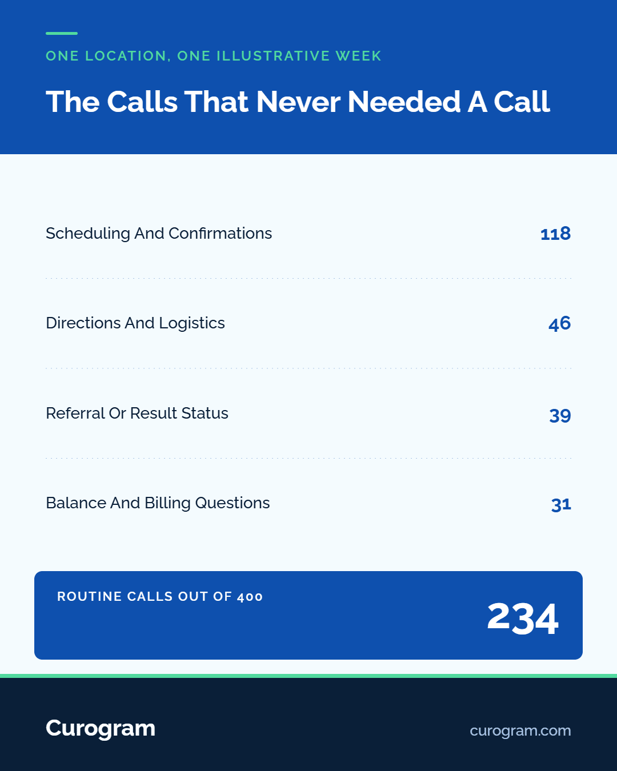
Start with one site’s Monday-to-Friday call log. Say it shows 400 calls, and tagging them by reason puts 118 in scheduling and confirmations, 46 in directions and logistics, 39 in referral or result status, and 31 in balance questions.
That’s 234 calls, illustrative but typical of the mix we see. Load templates for those four categories in the first week. Route billing to billing.
What remains on the phone are clinical concerns, complex insurance calls, and patients who prefer to talk. That is roughly 40% of the original volume, and the 40% that deserves a person.
Hold times fall because fewer people are queued. Interruptions fall because the routine work now waits in a list. The measurable change managers notice first is that check-in stops running long, and the patient standing at the counter gets a full sentence of attention.
Most call volume in a growing group is routine, and routine belongs in a queue that doesn’t ring. DrChrono holds your schedule and your chart. Curogram holds their quick questions, which leaves the phone free for the calls that need a voice.
Pull one week of call logs and tag each call by reason. The routine share is your deflection opportunity, quantified per location, and it’s usually larger than the front desk expects.
Schedule a consultation and bring that tagged log. We’ll model your deflection rate and the staffing impact location by location, then build the first template set from your own top 20 questions.
 Jo Galvez : Oct 12, 2026, 8:00:00 AM
Patients shouldn’t need an OnPatient login to ask a quick question. Curogram makes every DrChrono location’s number textable.
 Jo Galvez : May 22, 2026, 11:00:00 AM
Opus EHR front desk staff spend 80+ minutes daily on confirmation calls. Curogram's two-way texting cuts call volume by 50%. See the workflow...
 Jo Galvez : Oct 5, 2026, 8:00:01 AM
DrChrono practices run on iPads, but patient messages still die in per-location voicemail. Curogram unifies texting into one HIPAA-compliant...