
 Jo Galvez
Curogram makes every location’s number textable while the conversation syncs securely into the DrChrono chart.
What gets in the way is the portal detour: assuming a patient wondering which office her Thursday visit is at should recover a password to find out. OnPatient stays the right home for records, results, and intake forms.
Curogram covers the quick back-and-forth portals were never designed for. In a Sinch Engage survey of 1,000 U.S. patients fielded 4–7 December 2025, 90% preferred text for healthcare communication against 55% for patient portals.
A patient books a Thursday follow-up at the group’s Westside office. Two weeks later she can’t remember whether she was told Westside or Midtown. She calls the main line.
The recording suggests the portal for non-urgent questions. She doesn’t have the password, decides she’ll figure it out Thursday, and drives to Midtown.
The appointment was at Westside. The slot dies, and so does the next available slot she could have taken. That entire failure was a ten-second question.
Login walls filter people out, and they filter out precisely the patients a modern practice works hardest to attract.
Our position is straightforward. A group running on iPads, selling a modern experience at every touchpoint, shouldn’t make texting the one thing patients can’t do.
OnPatient portal alternative messaging puts the ten-second questions on the channel patients already use for the pharmacy, the school, and the car dealership.
The practice with the best charting software in the building is often the only business in that patient’s phone that can’t text back.
Why a Login Kills a Ten-Second Question
Signup Friction Priced for the Wrong Job
OnPatient handles records, results, forms, and scheduling well, and it does require an account.
Signup runs through an email invite from the practice, registration, and password creation. That’s a sensible amount of friction for downloading a lab result. It’s an absurd amount for confirming an address.
|
What the patient needs |
Better channel |
Why |
|---|---|---|
|
Download a visit summary or lab report |
OnPatient |
Full history, permanent record |
|
Complete intake paperwork before a visit |
OnPatient |
Structured forms feed the chart |
|
Confirm which office Thursday’s visit is at |
Text |
One question, one-minute answer |
|
Ask whether to fast before a blood draw |
Text |
Needs an answer tonight, not a login |
|
Say she’s running 15 minutes late |
Text |
One line, time-sensitive |
Every Wall Has a Drop-Off Rate
Some patients push through the reset-password flow. Most weigh a ten-second question against three minutes of effort and drop it. The question doesn’t disappear; it turns into a wrong turn on Thursday, a missed prep instruction, or a call at 4:55 pm when the desk is closing.
The Gap Patients Talk About
Patient experience in a multi-location group is judged at the seams, not at the center. The exam room can be excellent while the front door reads as unreachable.
That mismatch is what shows up in reviews, and it’s specific: people write about not being able to reach anyone, rarely about the EHR.
Unfamiliar Numbers Get Ignored
When a callback finally comes, it often comes from a site the patient didn’t call. She doesn’t recognize the number and lets it ring.
Familiar caller ID earns trust, and a group that answers from four rotating numbers spends that trust every day without noticing.
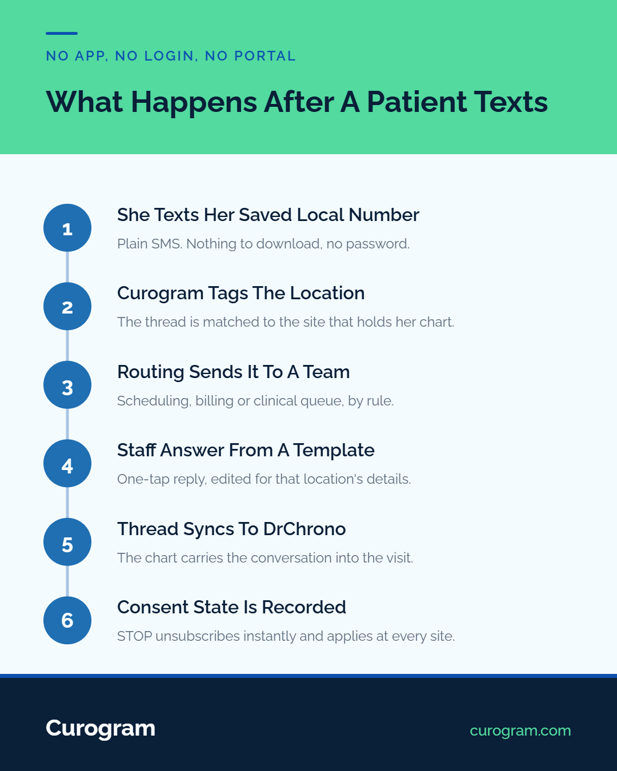
Answering From the Number Already in Their Phone
No Download, No Account, No Invite
Curogram text-enables each location’s existing local line, so patients text the local practice number they’ve been calling for years. Nothing to download, no account, no invite email.
On the patient’s side, it’s plain SMS in the same thread as their sister and their pharmacy. On the practice side it’s a secure, routed, permission-scoped inbox.
A Quick Question at the Clinic With No Login
Someone asking about parking, entrance doors, or whether to bring a referral gets an answer without authenticating into anything.
To text the practice a directions or appointment question, a patient types it and hits send. Staff answer from a templated library, edit for the specific site, and close the thread.
Context Follows the Patient Into the Room
Threads sync to the DrChrono chart, so the care team sees what the patient asked before the visit. The medical assistant who reads “she asked twice about fasting” handles the draw differently than one walking in cold.
Curogram Highlight: No-App 2-Way Texting
No-App 2-Way Texting removes every step between a patient’s question and a staff answer. Plain SMS on their side. A HIPAA-compliant, SOC 2 Type II certified platform on yours, with a signed BAA behind it.
Consent and opt-out handling runs automatically. Replying STOP unsubscribes instantly and the record is retained for compliance, so a patient who prefers phone calls loses nothing by saying so once.
That opt-out state travels across locations, which matters when a group shares a patient population between sites.
Content rules keep the channel appropriate. Routine logistics stay in text where they’re convenient, and anything requiring a full record or sensitive detail moves to OnPatient or a secure link. Staff sees that guidance inside the thread rather than in a training document nobody reopens.
Worth naming plainly: this works only if the patient’s mobile number in DrChrono is current. Groups that clean stale numbers during check-in for two weeks before launch see noticeably better reach in the first month.

What Patients Do When They Can Just Text
Patients Who Can Ask, Show Up
Across our client base, no-show rates run 53% below the practices we benchmark against, and Atlas Medical Center went from 14.20% to 4.91% in three months.
Patients who can resolve a doubt at 8 pm arrive on Thursday, at the right building. SMS recall campaigns show the same pattern from the other direction: 35% of one multi-location group’s lapsed patients booked within a month of a text, 1,240 visits from recall messages alone.
The Same Thursday, Rerun
She texts the number saved in her phone at 8:01 pm. Curogram tags the thread to the location that owns her chart, routes it to scheduling.
A staffer on the evening queue replies at 8:03 with the address and the parking entrance. She arrives Thursday at Westside. Total staff time spent: under a minute, none of it on hold.
What the Front Desk Stops Saying
“We can’t receive texts” is a sentence that costs a group more than it looks like it should. Removing it changes the tenor of the first interaction of the day.
It’s the change patients mention without prompting, usually in the same review where they name the receptionist.
Conclusion: Meet Patients in Their Messages App
Patients already know how to text, and they’ve told researchers they’d prefer it by a wide margin. OnPatient is where their records live. Curogram is where their conversations happen, with DrChrono as the system of record behind both.
Ask each front desk how many times this week they said the practice can’t receive texts. That number is your real accessibility score, and it’s fixable this quarter at every location.
Book a demo and text-enable your busiest location first. Patients find it on their own within days, usually by replying to a reminder, and the rest of the group follows the same configuration.
Frequently Asked Questions