6 min read
Text Your athenahealth Practice — No App Login Needed
Aubreigh Lee Daculug
:
September 24, 2026
Curogram makes every athenahealth location textable, and each conversation stays secure and tied to the patient record.
The barrier is "The App Wall" — the idea that a patient wondering "should I fast before this lab draw?" must install an app, reset a password, and file a portal message into a queue.
athenaPatient still handles records, results, and self-scheduling. Curogram handles the fast, human back-and-forth. Practices using it see no-show rates 53% below the industry average.
Somewhere in your network right now, a patient has a ten-second question and no easy way to ask it.
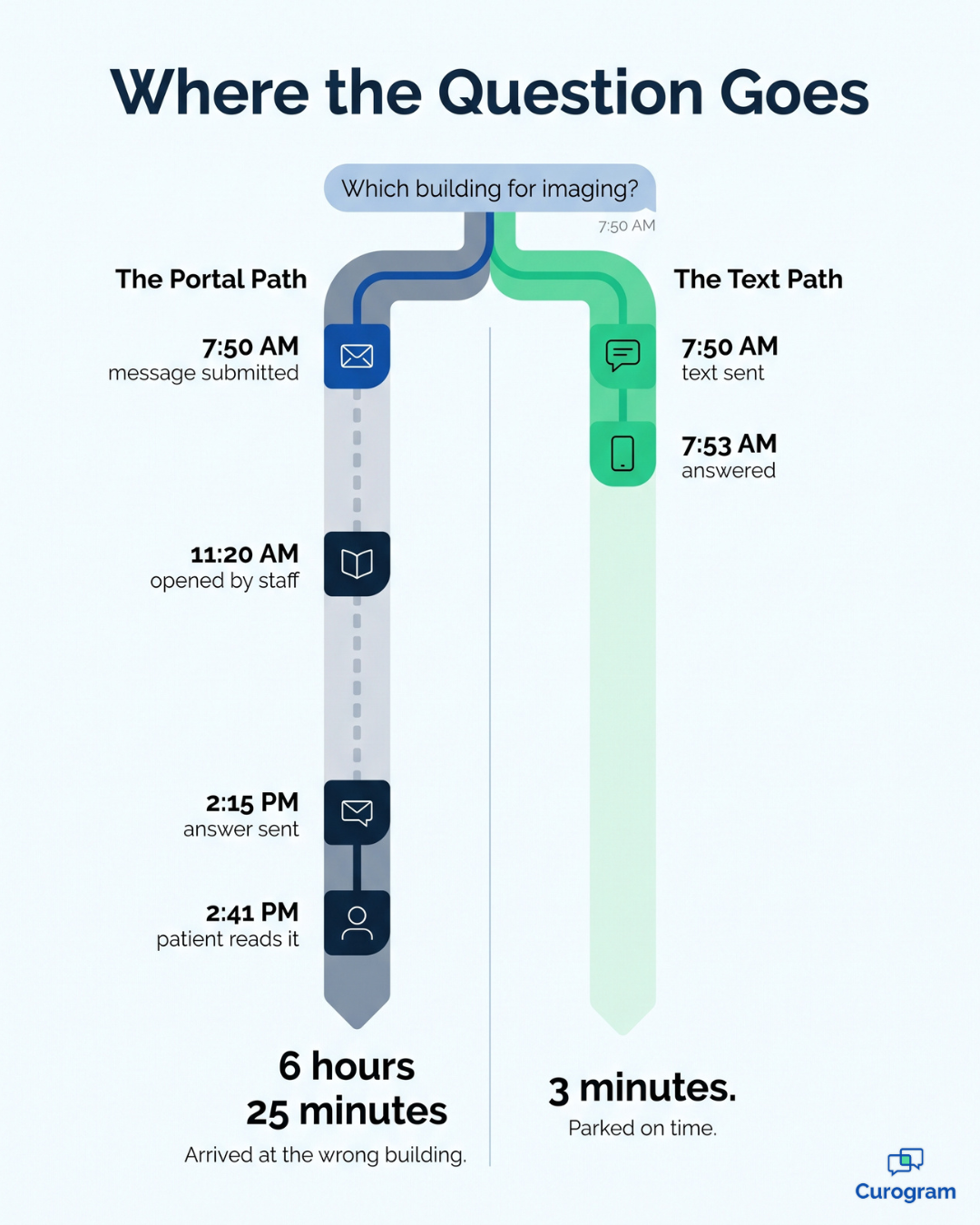
She isn't trying to schedule surgery. She wants to know whether her imaging appointment is at the main campus or the specialty building across the street. The website is vague, the phone tree offers six options, and the recorded voice suggests she download an app.
She doesn't download it.
Instead she guesses, drives to the wrong building, and arrives at her 8:00 am appointment twenty minutes late. Your schedule absorbs the delay, three other patients feel it, and nobody documents the cause — because the cause was a question that never got asked.
Now multiply that by every single location.
This is the quiet arithmetic of a large athenahealth network. athenaOne manages the record beautifully, and athenaPatient gives patients a genuine home for results, statements, and self-scheduling.
But the moment a patient has something small and urgent to ask, the system requires her to become a registered user first — install, log in, verify, submit — and wait for a reply that lands in a queue.
Small questions rarely survive that process. They get abandoned, or they become phone calls your front desk can't answer fast enough.
There's a simpler alternative, and patients have been using it with everyone else in their lives for fifteen years. They text.
Texting your athenahealth practice without the athenaPatient app sounds like a workaround. It isn't. Done right, it becomes a secure, HIPAA-compliant channel that runs on each location's own local number, routes to the appropriate department, and records the exchange in the patient record.
No application. No login. No case number.
Below, we'll examine what the app wall genuinely costs, how a network-wide texting layer eliminates that friction, and what changes once patients can simply reply.
Why the App Wall Quietly Turns Patients Away
athenaPatient performs its job well. Records, lab results, statements, self-scheduling — all of it lives in one place, and patients who use it get real value.
The problem isn't the app. The problem is what the app is being asked to carry.
A portal message is a ticket, not a conversation
When a patient sends a portal message, she isn't actually talking to anyone. She's filing something. It enters a queue, waits for a staff member to open it, and comes back hours later — sometimes not until the following business day.
That's fine for a records request. It's useless for "which entrance should I use?"
The mismatch surfaces as frustration on both sides. Patients feel ignored, and staff feel buried under messages that could have been resolved in nine words.
Every login screen filters your patient panel
Here's the consequence that's easy to overlook at scale.
A login wall doesn't slow patients down evenly — it eliminates some of them completely.
Older patients who never signed up. Patients who signed up once and forgot the password. Parents coordinating a child's care from a different phone. Anyone standing in a parking lot with one bar of signal and two minutes available.
At one clinic, that's a handful of people every week. Across a large network, it becomes a structural gap in who can reach you at all. Patient experience at an enterprise network is built from moments exactly this small, and app-only messaging quietly decides which patients get to have them.
The result is a reputation problem that reads identically under every location: easy to bill, difficult to talk to. Reviewers rarely mention that the portal was slow. They write that nobody ever responded.

One Local Number Per Location, Backed by Your Whole Network
The fix isn't another app. It's making the number patients already have work in both directions.
Curogram text-enables each location's existing local number — the one printed on the appointment card and saved in the patient's contacts. Patients text local practice numbers the same way they'd text a friend.
On your side, those messages land in a secure, HIPAA-compliant inbox that routes by location and department.
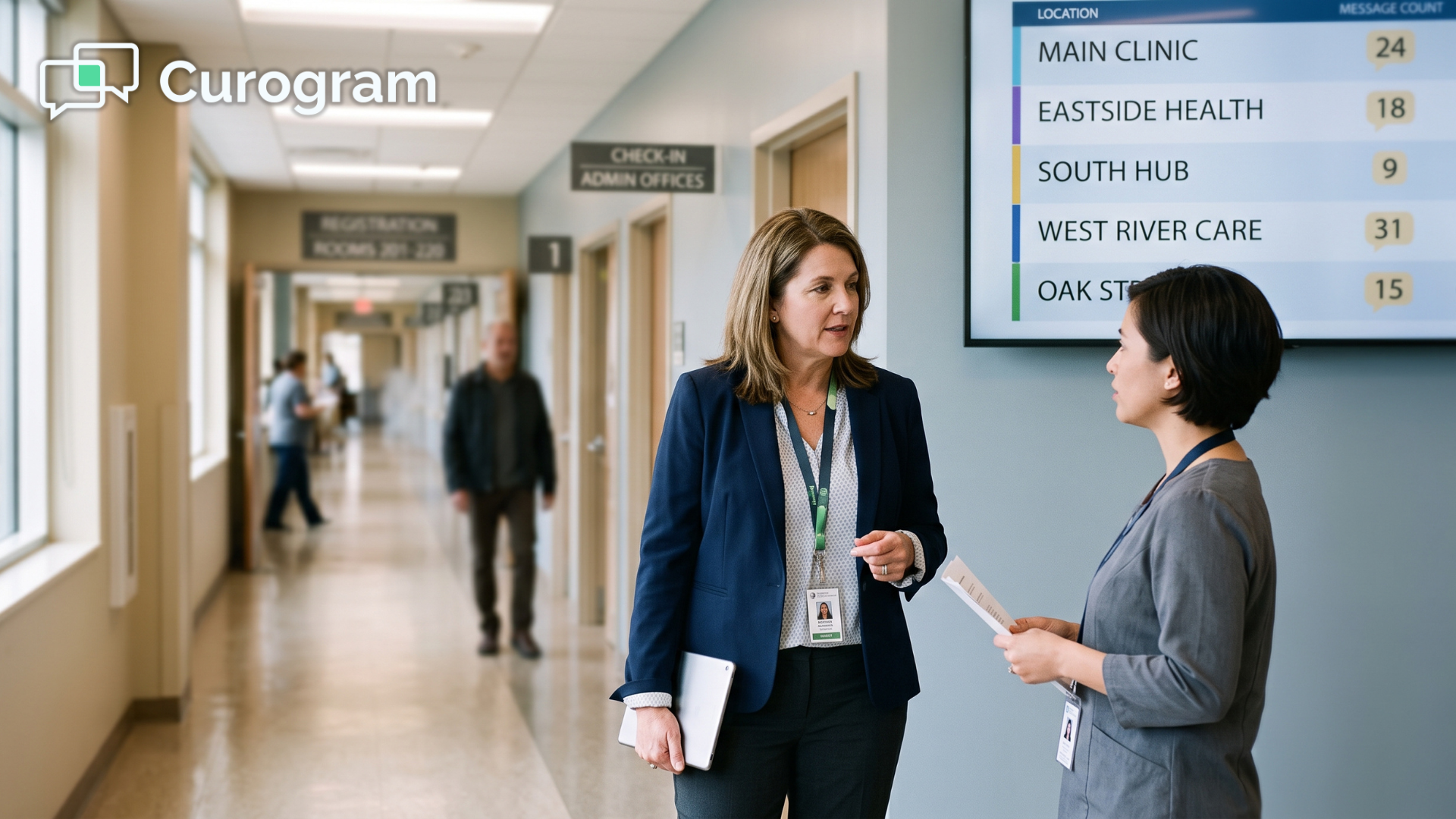
Think of it as a switchboard for the whole network.
That's the whole idea behind no portal login patient messaging: the patient does nothing new, and your team gets more structure, not less.
| What the patient does | What your network gets |
|---|---|
| Texts the local number already in her phone | A message tagged to the right location and department |
| Sends plain SMS — no app, no password, no case number | A secure, HIPAA-compliant thread with consent and opt-out handled |
| Gets a reply in minutes from whoever is free | Coverage across sites, so no single front desk is a bottleneck |
| Never repeats her history | Conversation history tied to the patient record for the next visit |
Two things make this work better than it sounds.
First, the number is familiar. Messages come from a local area code the patient recognizes, which carries the same familiar caller ID trust that makes someone pick up when their doctor's office calls. Unknown short codes get ignored. Local numbers get read.
Second, the load spreads. Because threads route by department instead of sitting with one receptionist, a staffed location can cover a slammed one. That's why replies arrive in minutes rather than by end of day.
None of this competes with athenaPatient. Treat it as an athenaPatient app alternative for quick questions only — the ten-second exchanges that were never worth a login.
Records, results, and self-scheduling stay exactly where they are, and athenaOne stays your system of record behind both.
What Actually Changes When Your Network Texts Back
The shift is smaller than a platform rollout and much bigger than it appears on paper.
Here's what moves first.
- Questions actually get asked. Patients text the practice for directions, an appointment question, or a quick preparation check instead of guessing. Curogram practices see no-show rates fall to 53% below the industry average, because patients who can ask questions are the patients who show up — at the correct building, on time.
- Messages actually get read. Text messages achieve a 98% open rate, compared with portal messages that sit unopened for days. Appointment confirmation rates climb past 75% when patients can respond with a single word.
- Phones get noticeably quieter. Practices using two-way texting report call volume dropping by roughly 50%, which returns about 30% more front desk capacity to the patients standing directly in front of them.
Numbers like these stay abstract until you size them for a real network. Here's an illustrative example — not Curogram data, simply arithmetic you can repeat using your own volumes.
Suppose you operate 8 locations, each fielding 250 inbound calls daily. That's 2,000 telephone calls every day. Reduce that by half and you've eliminated 1,000 calls daily, or roughly 260,000 calls annually.
At an average of three minutes per call, that's about 13,000 staff hours returned each year — the equivalent of six full-time schedulers, without hiring anyone.
What that means in practice: your front desk stops triaging the telephone and starts managing the schedule. And the patient who once circled the campus searching for imaging now texts at 7:50 am and has her answer before she finishes parking.
One sentence changes how the entire organization feels to its patients. Not "download the app or keep holding." Simply: "text us."
Give Patients One Less App to Download
Patients already know how to text. They do it with their pharmacy, their dentist, their child's school, and their airline. The only organization where it still feels impossible is the health system holding their medical chart.
That gap is no longer a technology problem. It's a decision.
athenaPatient is where patients go for their records and results. Curogram is where they go for their conversations. athenaOne remains the system of record behind both, and nothing about your configuration has to change for patients to start receiving answers in minutes.
Here's a quick assessment you can run this week.
Ask your front desk teams how many times a day they say some version of "sorry, we can't receive text messages." Then ask what happens to those patients afterward. Usually the answer is a voicemail nobody returns, or complete silence.
You can end that this quarter, at every location in your network.
Texting your athenahealth practice without the athenaPatient app isn't a workaround or an unmanaged shadow channel. It's the same local number you've always published, finally operating in both directions — with consent tracking, opt-out handling, department routing, and a documented record of every conversation.
Start with a single site. Text-enable your busiest location first and observe what happens over two weeks. Patients discover it independently, usually within days, because many of them are already texting that number into a void and wondering why nobody responds.
Then expand across the remaining locations one at a time, without disturbing a single athenaOne workflow or retraining your clinical staff.
Your patients are holding their phones right now. Most of them are one tap away from your front desk. Some have a question they've quietly decided not to ask.
Schedule a demo and see what your network looks like when they finally ask it anyway.
Frequently Asked Questions
Yes, for the kinds of questions patients actually text about. Curogram manages consent, opt-outs, and content rules, so routine logistics stay convenient while sensitive details move to a secure channel when needed. The platform is built for HIPAA compliance, and every conversation is logged and tied to the patient record.
No. They do different jobs. athenaPatient stays the home for records, results, statements, and self-scheduling. Curogram handles the fast conversational messaging that was never worth a login in the first place.
Yes. Replying STOP unsubscribes them instantly, and Curogram keeps the opt-out record for compliance. Patients who prefer phone calls or the app lose nothing — every other channel keeps working exactly as it does today.
Each location keeps its own familiar local number, and every one of them becomes textable. Behind the scenes, messages route to the right team by location and department, so your network can share coverage without patients ever seeing a central switchboard.
Most networks start with one high-volume site and expand from there. Because you're text-enabling numbers you already own rather than migrating systems, there's no change to athenaOne workflows and no new app for patients to install — which is why adoption tends to happen on its own.