Easy Copay Collection: DrChrono Patient Payment Links by Text
💡 DrChrono practices can now let patients pay a medical bill by text using a secure payment link sent to their mobile phone, making copay and...
11 min read
Mira Gwehn Revilla
:
April 23, 2026
Your Dolphin dashboard tells the story. Thirty active patients owe money. The total sits above $50,000. Your front desk has been working the phones for weeks.
Most calls go to voicemail. Some patients promise to mail a check. Only a few actually do. The AR aging report keeps growing week after week.
This is the quiet problem inside orthodontic billing. Treatment plans run 18 to 30 months, and cards expire during that window. Auto-pay fails without warning. By the time anyone notices, three payments have already been missed.
Dolphin Management tracks every dollar. But Dolphin can't text a payment link to a patient. Collection falls back to phone calls and paper statements. Patients ignore both channels.
Curogram closes that gap. With Dolphin orthodontic text-to-pay, your team sends a secure payment link by SMS. The patient taps the link on their mobile phone and enters card details right there. The balance clears in 30 seconds.
No voicemail. No portal login. No mailed statement. Just a tap, and the payment posts.
The same link also fixes an expired card. Patients enter new card info on the secure page. That clears the current overdue bill and keeps future auto-pay from failing. One text solves two problems.
For a practice with 200 active payment plans, the numbers move fast. If 15% have failed cards, that's $54,000 at risk in a single cycle. Phone-based collection recovers about 35% of that. Text-to-pay pushes the rate past 70%.
In this guide, you'll see how the SMS payment link works day to day. You'll see how it fits next to Dolphin's financial module. And you'll see the numbers behind the shift from chasing balances to collecting them.
Dolphin tracks every dollar you're owed. Curogram makes sure it lands in the bank.
On paper, orthodontic billing looks clean: present the treatment plan, split the cost, and run auto-pay each month. But the reality of long payment plans creates a collection problem paper can't describe. Every month, some of what Dolphin tracks as billable quietly slips into write-off territory.
Orthodontic care is uniquely expensive and uniquely long. A $6,200 case split over 24 months creates 24 separate charges. Each charge is another chance for something to fail.
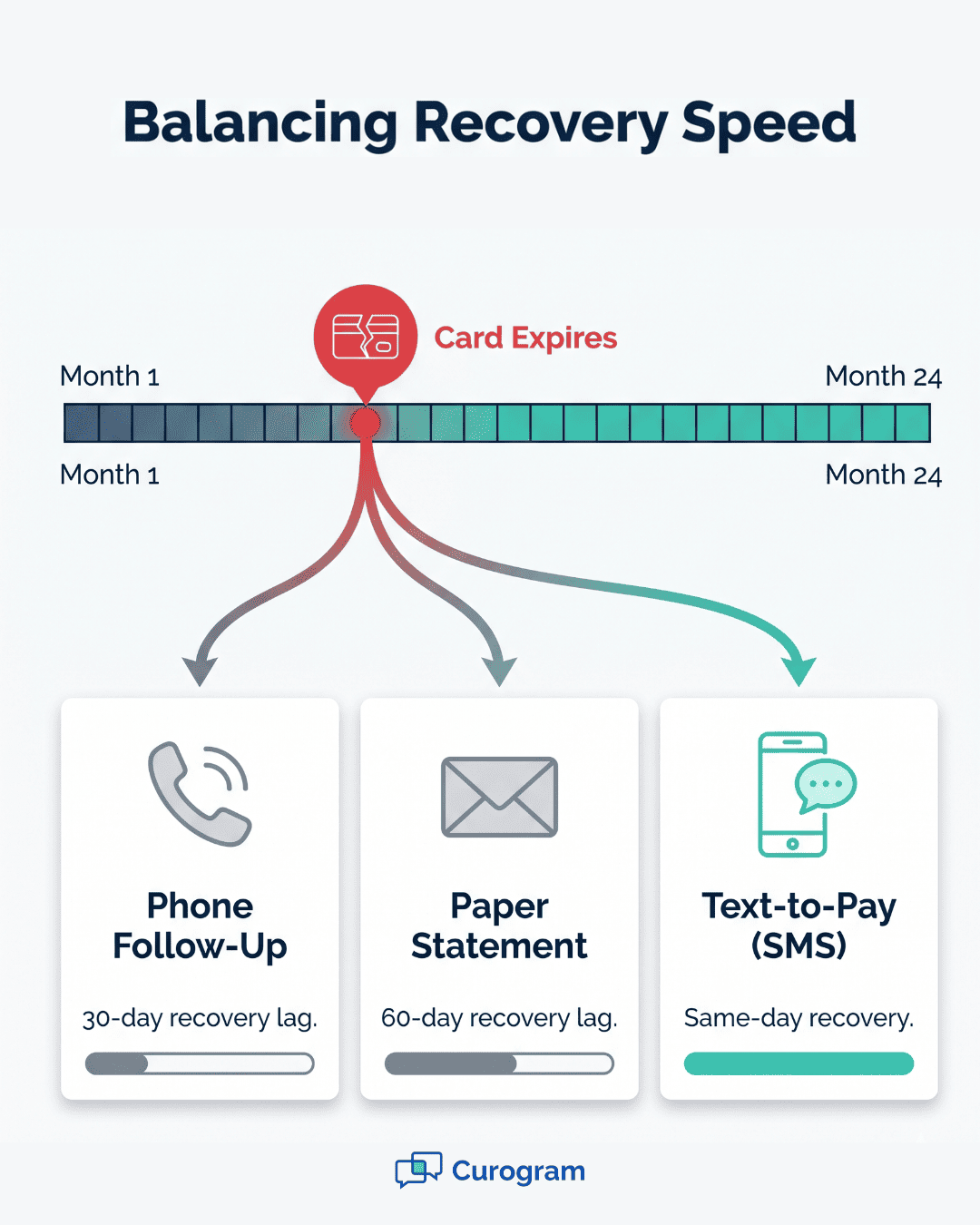
Credit cards expire every three to four years. A two-year plan will almost always hit an expiration date mid-treatment. Auto-pay then fails silently, and no one is notified in real time.
The patient doesn't know the charge bounced. The practice doesn't notice until the next billing cycle — or the cycle after that. By then, two or three payments are missed. That's $600 to $900 stuck on a single account.
Now multiply by 15% of your active cases. For a practice with 200 active plans, 30 patients are affected at any given moment. That works out to around $54,000 in delayed revenue.
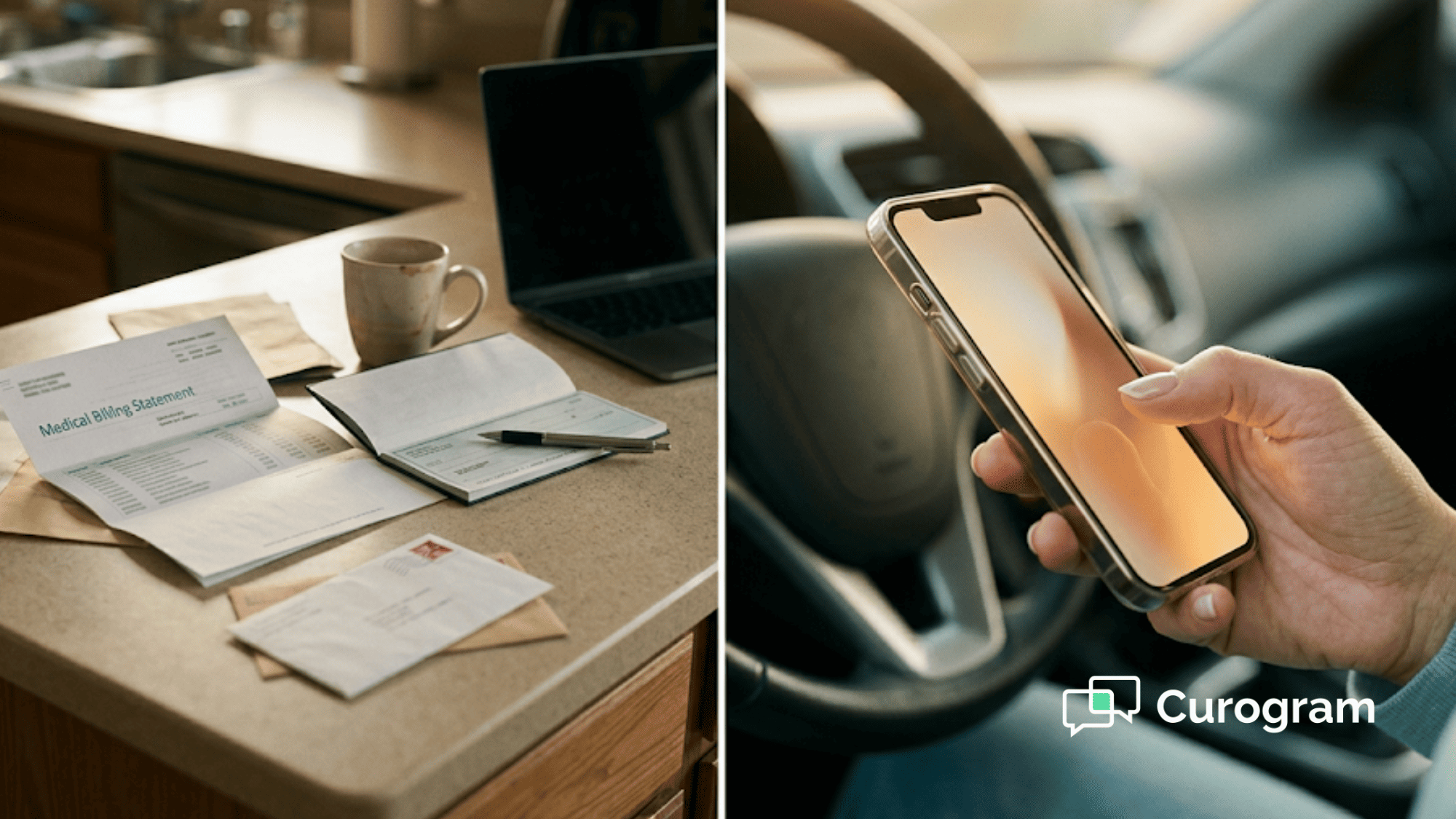
When auto-pay fails, most practices mail a paper statement. It lands in a mailbox full of ads and junk mail. Even patients who mean to pay may not open it for days — or ever.
Paper statement response rates in healthcare hover between 5% and 15%. Printing and mailing each one costs $5 to $10. Three attempts to collect a $300 installment can burn 5% to 10% of the balance in overhead.
That's before the patient pays a cent. Many never will. The paper bill just doesn't break through the noise anymore.
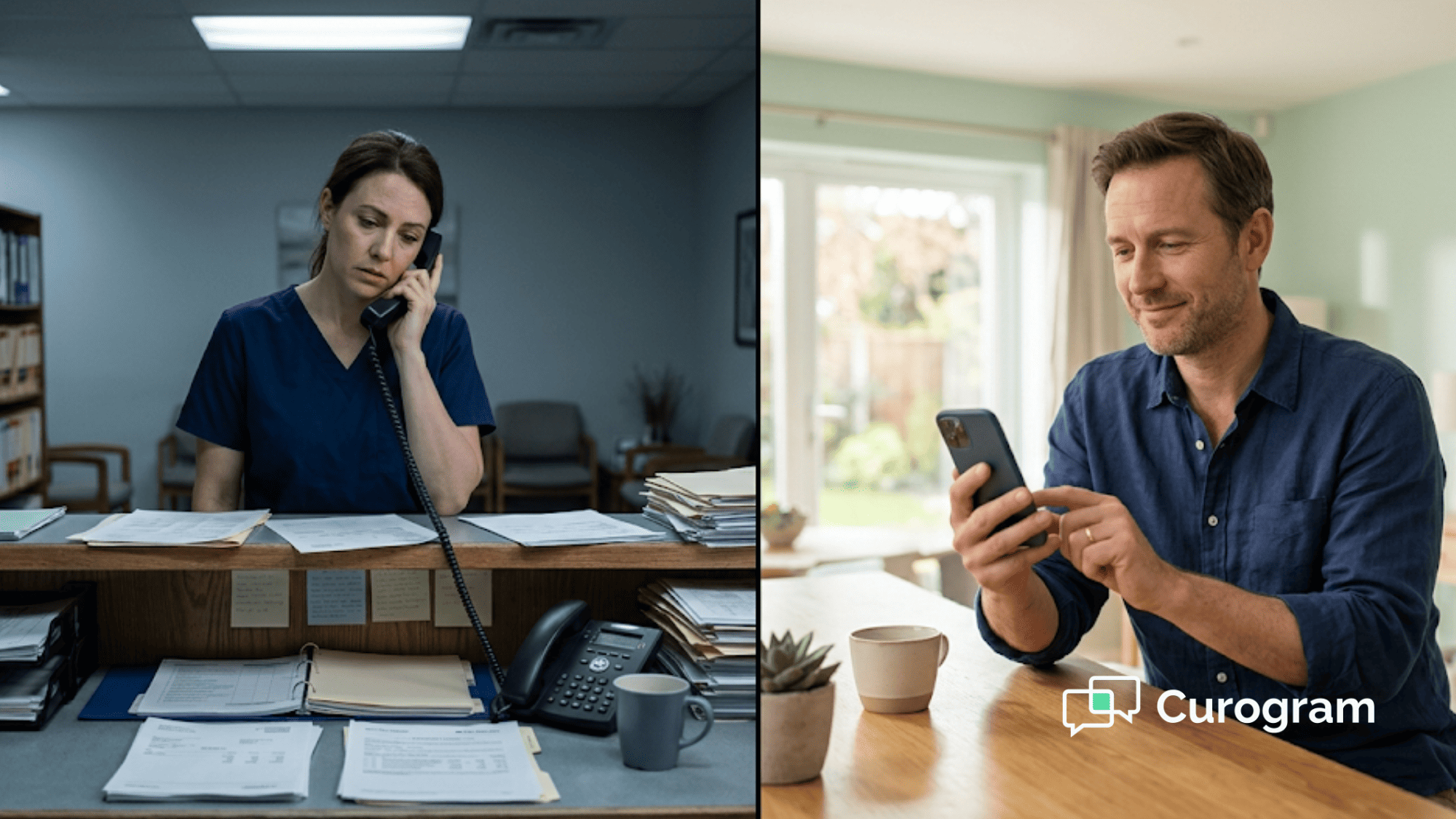
Your front desk spends hours each week calling about overdue balances. Most calls land in voicemail. Patients don't return calls from numbers they don't recognize.
Worse, they often dodge calls from numbers they do know. They sense the call is about money. Your treatment coordinator — the person who should be booking new consultations — is stuck leaving voicemails for balance collection.
The human cost is real. Morale drops when staff feel like debt collectors instead of care providers. Turnover in the front office often traces back to this kind of work.
In orthodontics, AR aging hurts more than in most fields. Long treatment cycles mean missed payments stack up over months. A 30-day balance becomes 60, then 90, then 120.
With each step, the chance of collection drops. Balances aged over 90 days carry less than a 50% recovery rate. For a practice sitting on $54,000 in at-risk AR from expired cards, each month of delay costs thousands in write-offs.
These are losses a simple text could have prevented. The tool is missing, not the will to collect.
Here's how this shows up inside the office. You open the AR aging report in Dolphin. You see exactly who owes what — $54,000 across 30 patients.
Your front desk manager has been calling for weeks. She's reached eight patients. Five promised to mail a check. Only two did.
The other 22 stay silent. You're looking at a possible $30,000 write-off this quarter. The cause isn't bad patients or a weak practice. The cause is a broken collection channel.
Every orthodontic owner knows this feeling. You built a strong practice. You deliver great care. But long orthodontic payment plans mean constant chasing of expired cards and failed auto-pay, month after month.
Curogram's Two-Tap Payment Channel fills what Dolphin Management's financial module leaves open. Dolphin tracks the treatment contract, the payment plan, the ledger, and the insurance side. Curogram handles the one thing Dolphin can't — texting a secure payment link straight to the patient's mobile phone.
When auto-pay fails, a card expires, or a monthly installment is due, your team sends a text. The patient gets a short message on their phone:
"Hi [Name], your orthodontic payment of $300 is due. Tap here to pay securely: [link]."
The patient taps the link and opens a secure HIPAA-compliant page. They enter card details. The payment posts and syncs back to the balance. Total time: about 30 seconds.
No phone call. No portal login. No paper statement. Just a tap, and the balance clears.
The Payment Link Generator lets your front desk or billing team send a link in seconds. Pick the patient. Enter the amount or pull it straight from the outstanding balance. Send the text.
Each link is unique to that patient and that transaction. It's single-use, encrypted, and compliant. There's no risk of a payment landing on the wrong ledger or a link being shared and misused.
For expired cards, the payment page also includes an option to update the card on file. That means one text does two things at once. It clears the current overdue balance, and it prevents future auto-pay from failing on the next installment.
The patient taps once, enters a new card, and their orthodontic payment plan keeps running on schedule.

Some weeks, you don't have five overdue patients. You have fifty. Calling each one would eat days of staff time.
Curogram's broadcast feature lets you send personalized payment links to the full list at once. Filter patients by overdue balance. Write a short payment message. Send.
Fifty overdue patients get individual payment links in about five minutes. Each message carries the patient's own balance and a unique, secure link. This is what a week of phone work looks like on autopilot.
Your front desk spends five minutes on a task that used to take five days. And the response rate climbs because SMS cuts through where voicemail and paper mail don't.
General dentists collect at time of service for most procedures. An orthodontic practice collects $250 to $400 per month for 18 to 30 months per patient. That's a very different billing model.
Multiply one patient by 200 active cases. Your practice processes 200 payments per month. Each one is open to card expiration, bank changes, or simple patient forgetfulness.
Text-to-pay automates the collection touchpoint for every one of those 200 payments. The system catches failures the moment they happen — not weeks later when the statement returns unpaid. That shift changes the whole rhythm of balance collection inside the office.
Text-to-pay doesn't replace Dolphin's financial module. Dolphin still manages the contract, the ledger, the insurance, and the long-term accounting. Curogram adds the missing communication layer — the fast, mobile-first channel your patients already use every day.
It also doesn't require a full platform switch. You don't need a bundled system like Weave at $300 to $500+ per month just to get a payment link working. Curogram layers on top of Dolphin. It focuses on what Dolphin doesn't do well: reaching the patient on their phone and closing the balance today.
The best way to see the value is in the math. For an orthodontic practice with 200 active payment plans and 15% hitting card failures in a given cycle, that's 30 patients with overdue balances. With an average balance of $1,800, the at-risk AR reaches $54,000 in a single cycle.
That number doesn't need to be a write-off. It just needs the right channel.
Phone-based collection on that $54,000 typically recovers around 35%. That's $18,900 brought back. The remaining $35,100 either rolls into deeper aging buckets or gets written off.
Text-to-pay changes the math. Based on our internal research, SMS payment link outreach recovers 70% or more of at-risk AR. On the same $54,000 pool, that's $37,800+ collected in the same cycle.
The incremental gain is $18,900+ per collection cycle over phone-based outreach. Run four cycles a year, and that's $75,600 in revenue your practice was already owed — just moved out of write-off and into the bank.
Picture the old routine. Forty overdue patients on the list. One team member on the phone from 9 to 5. Forty calls made. Six conversations had. Two payments secured. Eight voicemails left. Twenty-four ignored calls.
Now picture the new routine. Forty overdue patients on the list. One team member opens Curogram. Forty personalized payment links sent in five minutes. By the end of the day, fifteen are paid.
The front desk stops being a collection agency. It goes back to being a patient experience center. The treatment coordinator stops chasing old balances and starts booking new cases. That shift compounds over quarters.
It's the first Monday of the month. The billing coordinator opens the Dolphin AR aging report. Twenty-eight patients have overdue balances. The total is $47,200.
She opens Curogram, selects those 28 patients, and sends personalized payment links. By Tuesday morning, nine patients have paid — $14,400 collected. By Friday, sixteen patients have paid — $27,800 collected.
She sends a quick follow-up text to the remaining twelve:
"Hi [Name], we noticed your payment of $[amount] is still outstanding. Tap here to pay securely: [link]. Reply if you have any questions about your account."
By the following Wednesday, six more have paid. Total collected: $38,200 of $47,200. That's an 81% collection rate in 10 days.
Last quarter, the same AR took eight weeks of phone calls to collect just $16,500. This cycle, it took 10 days and almost no phone time to collect more than double. The aging report is shrinking. The phone is quiet. The revenue is in the bank.
Three things make SMS outperform the older channels:
Reach - Over 95% of text messages are opened, and most within three minutes. A paper statement can sit for a week. A voicemail might never get played.
Friction - Phone payments require a live conversation, card details read aloud, and a receipt mailed later. A paper bill requires a check, a stamp, and a trip to the mailbox. A payment link needs a tap.
Context - The patient sees their exact balance, pays from the same phone that's on their nightstand, and doesn't need to find an account number or a login. The easier the path, the higher the completion rate.
The gain isn't just one recovered balance. It's the balance collection discipline that comes with catching failures in week one instead of week eight.
When the system texts the patient the moment auto-pay fails, the patient updates the card right away. The next monthly installment runs cleanly. The one after that runs cleanly too. A problem that used to stretch across six missed payments gets solved in a single message thread.
Over a 24-month plan, that can be the difference between collecting 100% of the contract and writing off 5% to 10% at the end.
Ask any billing coordinator what changed, and they'll point to two things. The phone queue gets shorter. And the "I never got a statement" conversation disappears.
Patients can't claim they didn't know. The text is in their phone. The link is saved in their messages. Most pay within a day because it's genuinely easy.
Some of the wins don't show up on the AR aging report. Patients stay in treatment longer because the payment friction is lower. Fewer patients freeze mid-case over a billing dispute. Reviews trend higher because paying is painless.
Those are the second-order effects of an SMS payment channel — harder to count, but easy to feel when you walk into the office and the front desk isn't holding a phone to their ear.
The AR aging report is the scoreboard. The story behind it is a quieter, faster, more professional practice.

How Curogram Turns a Missed Auto-Pay Into a 30-Second Fix
Curogram was built around one idea: the fastest channel to reach a patient is the one already in their pocket. For Dolphin orthodontic practices, that channel is SMS, and the clearest use case is text-to-pay.
Here's how the flow works inside the office. Dolphin shows a failed auto-pay on a 24-month orthodontic payment plan. Your billing coordinator opens Curogram. She selects the patient, confirms the balance, and clicks send.
Within seconds, the patient's mobile phone lights up with a short text. The message carries a unique, secure, single-use payment link. The patient taps it, sees their name and their balance, and chooses one of two actions: pay the overdue amount, or update the expired card and pay in the same step.
Because Curogram is HIPAA-compliant and PCI-DSS aligned, the text itself never exposes sensitive information. The payment page is encrypted. The card data never touches your office systems. Everything routes through compliant payment infrastructure.
What makes the tool different from a bundled platform is focus. Curogram doesn't ask you to rip out Dolphin or pay for features you already have. It layers on top of Dolphin and does three things extremely well: 2-way HIPAA-compliant texting, automated SMS reminders, and text-to-pay with broadcast capability.
Based on our internal research, practices that adopt SMS-based collection see major gains. Curogram reduces phone call volume by as much as 50%, lifts staff productivity by 30% or more, and shortens time-to-collect on patient AR balances.
For an orthodontic practice juggling 200 active payment plans, those gains translate directly into thousands of dollars recovered each quarter — without new software, new training, or a bundle you don't need.
Dolphin's financial module is built for the complexity of orthodontic billing. It handles the treatment contracts. It manages the ledger. It runs the payment plan schedule. It works with insurance.
What it doesn't do is reach the patient when something goes wrong. When a card expires on month eight of a 24-month plan, Dolphin can flag the problem on a report. It can't text the patient a payment link. That last step has always fallen back to phone calls and paper statements — the two channels patients respond to the least.
That's the gap Curogram closes. A secure SMS payment link goes out the moment auto-pay fails or a balance ages. The patient taps, updates a card if needed, and clears the balance in 30 seconds.
The math works at every size of practice. Twenty overdue patients become twenty quick payments. Fifty become a five-minute broadcast. Two hundred payment plans stay current because failures get caught in week one, not week eight.
The shift inside the office is just as real. Your front desk stops being a collection agency. Your treatment coordinator stops leaving voicemails. Morale lifts. Turnover drops. The aging report gets smaller every week.
And you don't need a $300 to $500+ monthly bundle to get there. Curogram layers on top of Dolphin and focuses on what Dolphin doesn't do well — reaching the patient on their phone.
Keep Dolphin as your financial backbone and layer text-to-pay on top — no rip-and-replace, no bundled platform. Request a demo to see Curogram working alongside Dolphin in a real orthodontic workflow.
General dentists collect at time of service for most visits. Orthodontists run 18 to 30 month payment plans, processing hundreds of monthly charges. That long window creates constant card expirations and auto-pay failures. SMS collection catches each failure in days, not months.
You can send personalized payment links to your full overdue list in a single campaign. Whether it's 5, 50, or 500 patients, each gets their own balance and a unique, secure link. A task that took a full week by phone now runs in about five minutes.
Based on our internal research, practices typically recover 70%+ of at-risk AR through SMS payment links, compared to around 35% with phone calls. For a practice with $54,000 in overdue balances, that's roughly $18,900+ in added recovery per cycle, with far fewer staff hours spent on calls.
💡 DrChrono practices can now let patients pay a medical bill by text using a secure payment link sent to their mobile phone, making copay and...
💡 Paying your Cloud 9 orthodontic balance via text takes under 30 seconds. When your child's practice uses Curogram, a secure payment link arrives...
💡 Patient payments for Opus EHR are faster and easier with Curogram's text-to-pay platform. Billing teams send secure payment links by text to...