14 min read
Simplify Patient Payments for Opus EHR with Text-to-Pay
Mira Gwehn Revilla
:
February 12, 2026
- Collect co-pays, fees, and balances through mobile patient payments for rehab
- Use text-to-pay for behavioral health to replace paper bills and phone calls
- Cut days in A/R and reduce A/R for SUD facilities with same-day collections
- Keep all payment data synced within Opus EHR financial workflows
- Stay HIPAA and PCI-DSS compliant with every single payment
Picture this. A family just got a loved one into a 30-day rehab program. Emotions are high. The last thing they want is to dig through mail for a paper bill, call the front desk, and read off a credit card number over the phone.
Now, flip it around. Your billing team has 40 open balances. Half the phone numbers go to voicemail. The rest lead to stiff, awkward calls that feel more like debt collection than patient support. Meanwhile, days in A/R keep climbing.
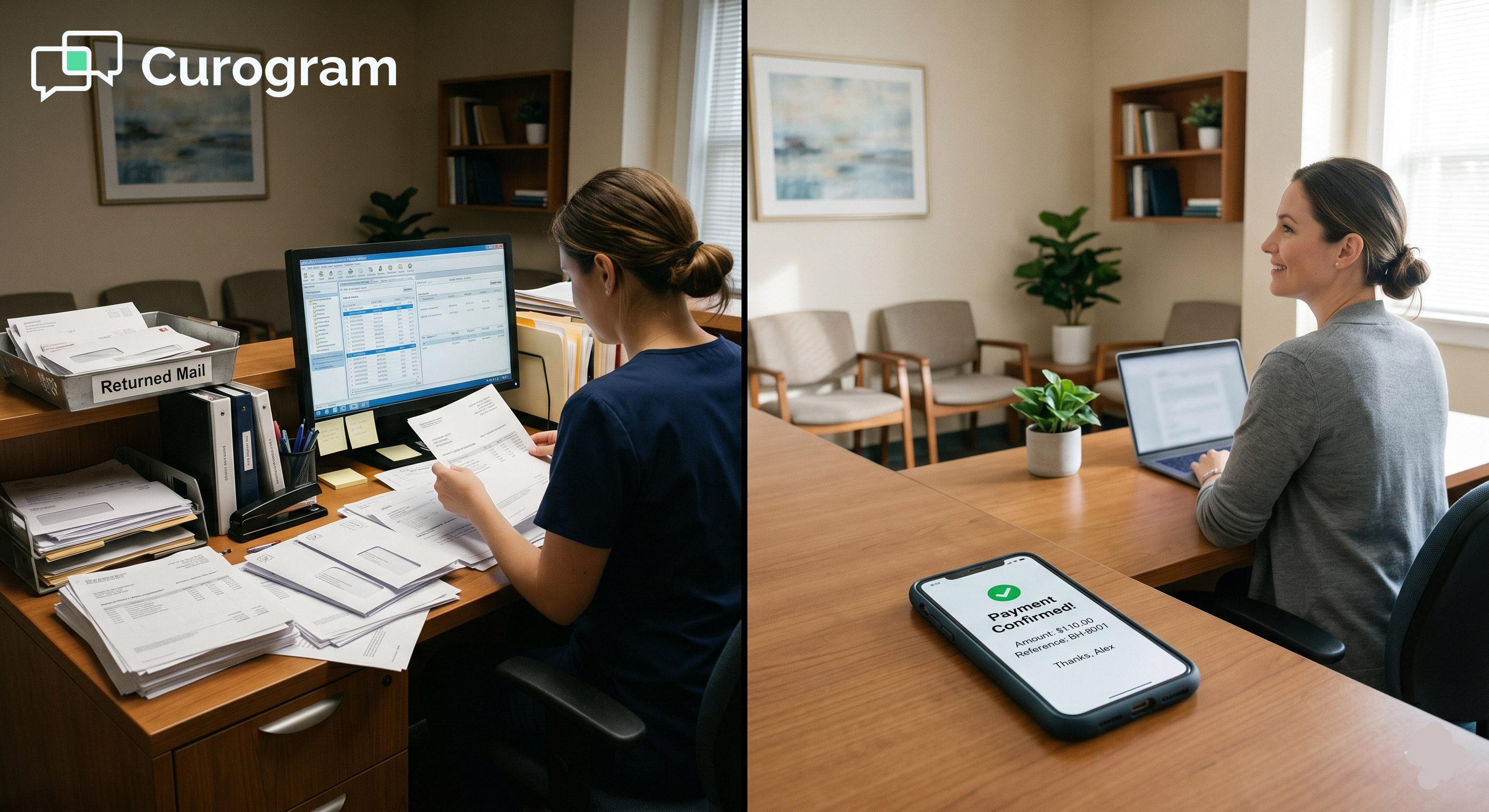
This is the reality for most rehab and behavioral health centers that still rely on old-school billing. Paper statements pile up. Payments trickle in. Cash flow stalls at the worst time.
There is a better way. Patient payments for Opus EHR through Curogram's text-to-pay platform let your billing office send a secure payment link straight to a phone.
The patient or their family member taps the link, pays in seconds, and the record updates right inside Opus. No portal login. No stamps. No chasing.
For treatment centers running on Opus EHR, this kind of addiction treatment billing automation is not a luxury. It is a lifeline. It keeps revenue moving so your clinical team can stay focused on what matters most: helping people get better.
In this guide, we break down why the old billing model fails rehab centers, how text-to-pay for behavioral health works step by step, and the real return on investment you can expect. We also cover the security and compliance features that keep every payment safe and audit-ready.
If your center still prints and mails statements, this article will show you how much time and money you are leaving on the table.
The "A/R Lag" Villain: Why Traditional Billing Fails Rehab Facilities
Most treatment centers know their billing process is slow. But few realize just how much that slowness costs them each month. The gap between service and payment, often called the A/R lag, is one of the biggest drains on revenue for SUD and behavioral health programs.
Let's look at why the old model breaks down at every step:
The Paper Statement Graveyard
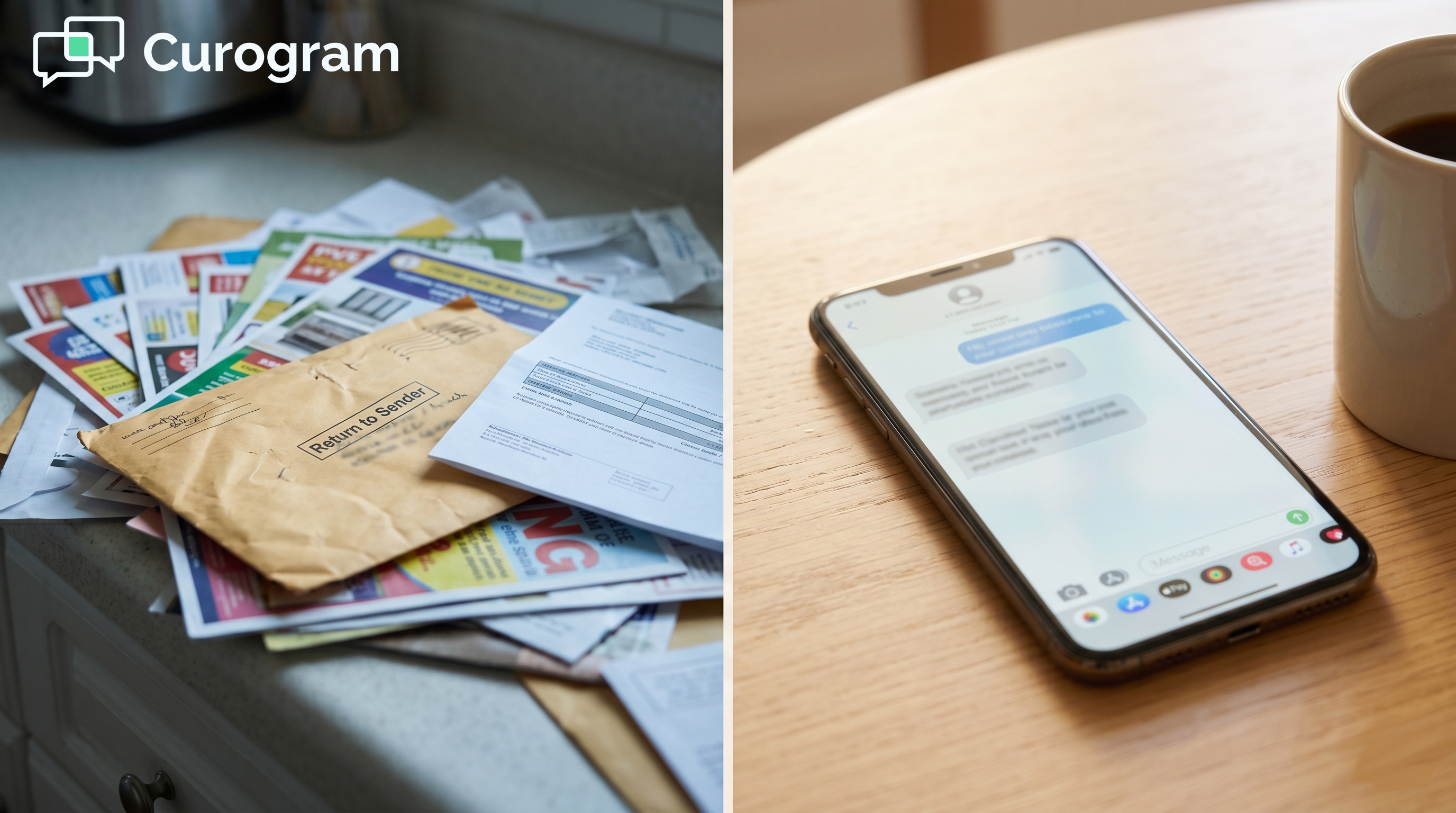
Think about what happens when a paper bill hits a mailbox. A family is in the middle of a recovery crisis. The parent or spouse at home is managing visits, insurance calls, and daily stress. A white envelope from a treatment center is easy to ignore, lose, or set aside.
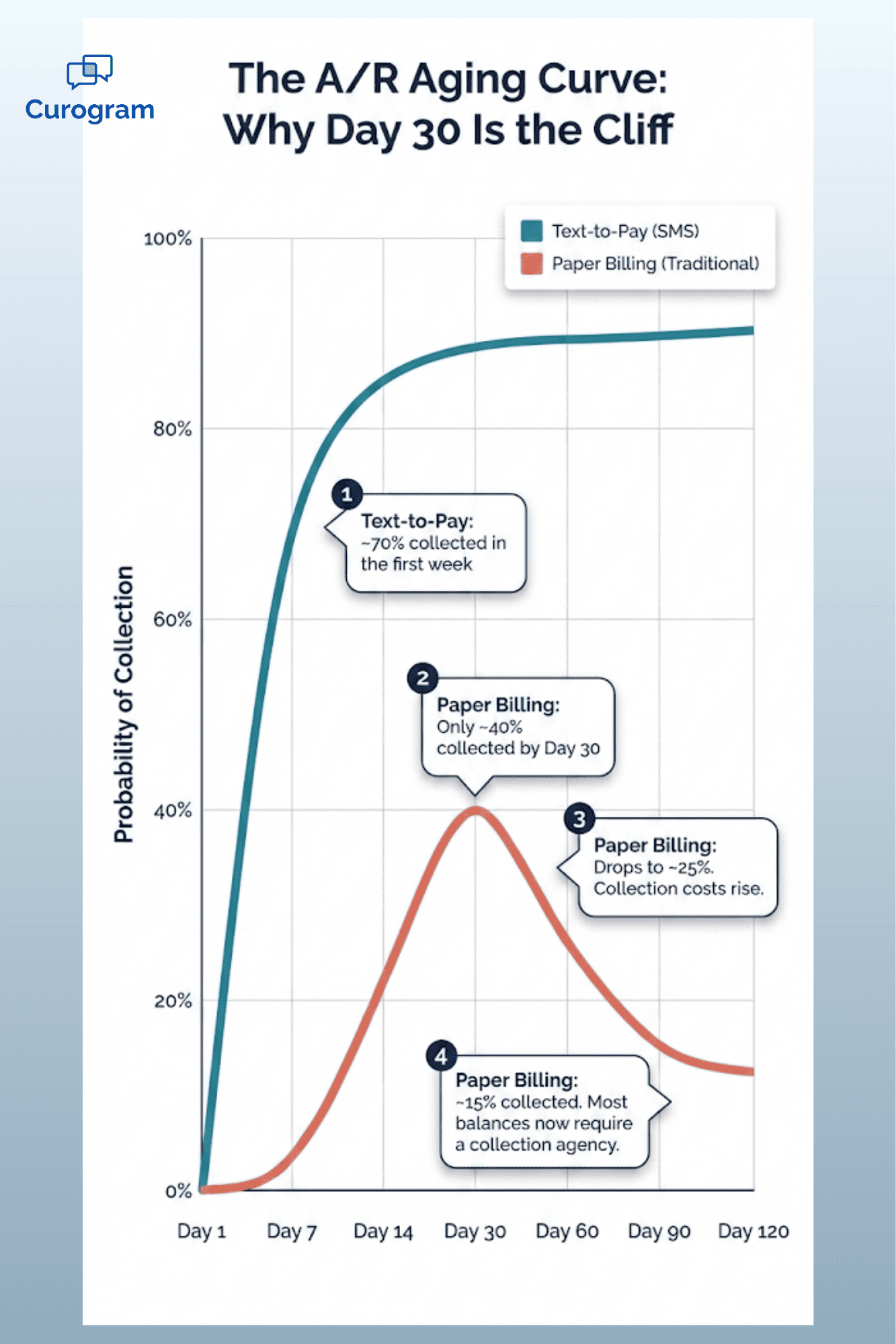
The chance of collecting on a paper bill drops fast after 30 days. By the 90-day mark, many balances become nearly uncollectable without outside help from a collection agency. That agency takes a large cut, sometimes 25% to 40% of the balance.
For a center with 50 open accounts at $500 each, that is $25,000 at risk. If even half of those accounts age past 90 days, the center could lose $5,000 or more to agency fees alone. Multiply that over a year, and the cost is staggering.
Paper bills also cost money to send. Between printing, envelopes, and postage, a single statement run can cost $1 to $2 per bill. A center mailing 200 statements a month spends up to $4,800 a year just on paper no one opens.
The Phone Collection Friction
When paper fails, most billing teams pick up the phone. But calling a patient or family member to ask for money is not like calling to confirm an appointment. It feels personal. It feels aggressive. And it can damage the trust your clinical team worked hard to build.
Staff members dread these calls. Many put them off or rush through them. The result is low contact rates and even lower payment rates. A billing clerk might spend a full morning on the phone and collect on only one or two accounts.
There is also a timing problem. If your billing team works 9 to 5, they are calling during work hours. The guarantor, often a working parent, is busy and unlikely to answer. Voicemails go unreturned. Callbacks create phone tag that drags on for weeks.
This cycle burns staff hours that could go toward higher-value tasks. When you factor in the average hourly cost of a billing employee, each uncollected call costs your center real dollars in labor alone.
The Complex Guarantor Workflow
Behavioral health billing has a wrinkle that most medical offices do not deal with: the person paying the bill is often not the person in treatment. In residential rehab, the guarantor is usually a parent, spouse, or other family member living somewhere else.
Traditional billing systems are built around the patient. They send the bill to the patient's address, call the patient's phone, and post charges to the patient's account.
But the patient may be in a 30-day or 60-day program with limited phone access. They are not the one writing the check.
Getting a payment link to the right person, at the right time, on the right device is the core challenge. Paper and phone calls are not up to the task. Opus EHR financial workflows need a faster, smarter bridge between the billing office and the guarantor's phone.
This is where the entire model needs to shift. The billing process should meet families where they already are: on their phones, ready to act with a single tap. That shift is exactly what text-to-pay for behavioral health was built to solve.
Modernizing the Financial Experience: The Text-to-Pay Workflow
Fixing the A/R problem does not require a full system overhaul. It takes one smart addition to your existing Opus EHR setup: a text-to-pay link powered by Curogram.
Here is how the workflow runs from start to finish, and why each step matters:
One-Click Mobile Payments
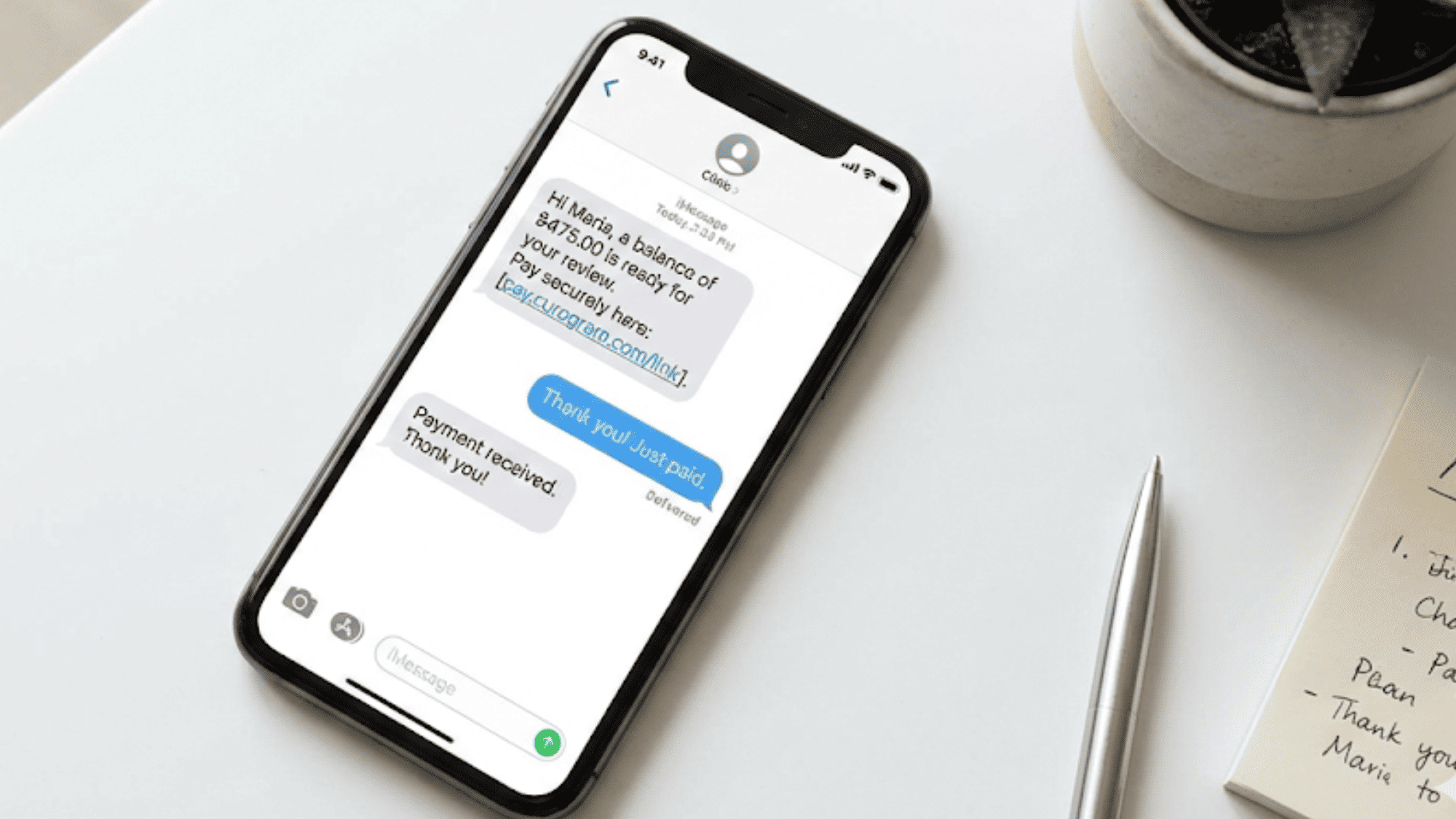
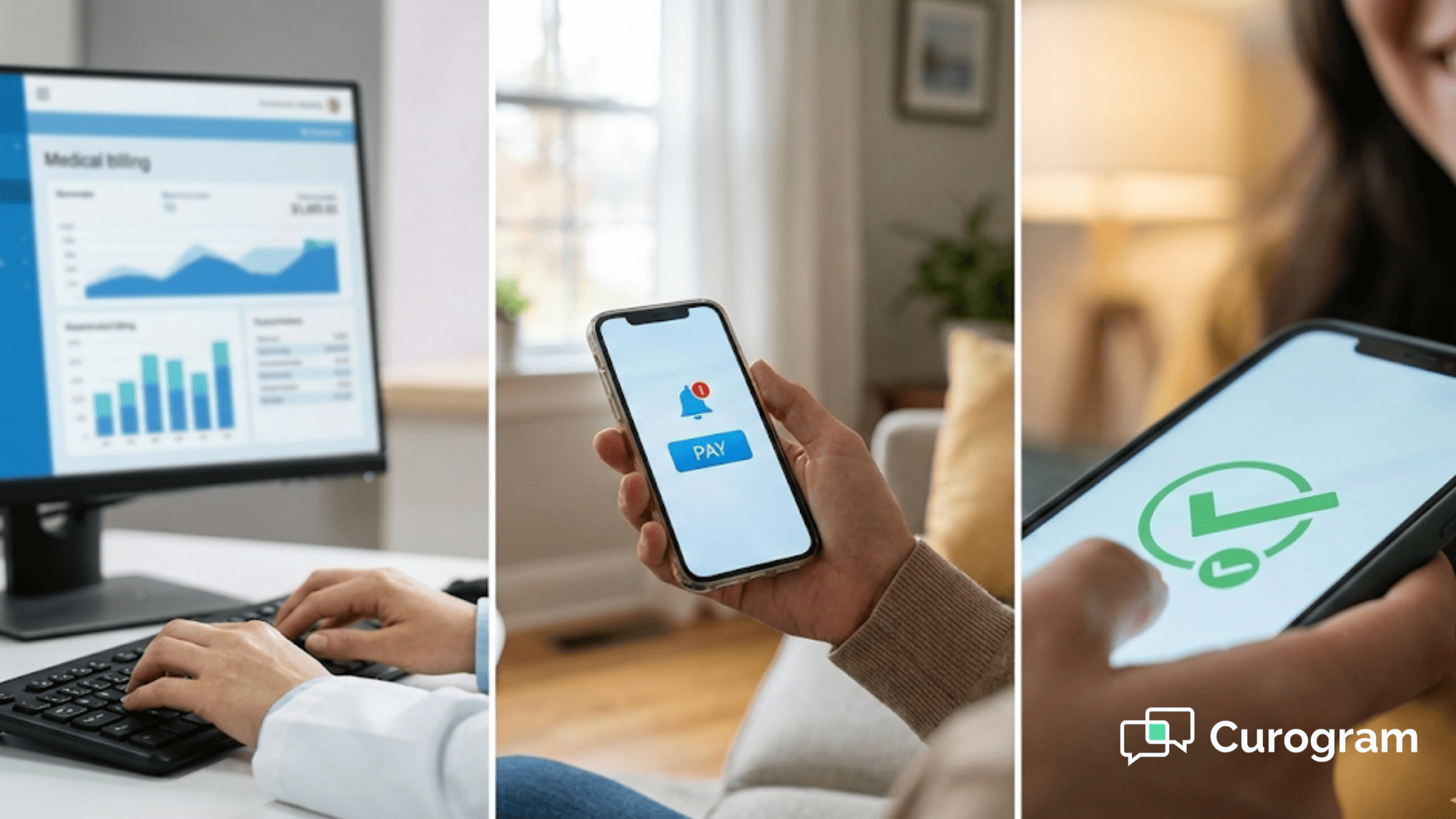
When a balance is ready to collect, your billing team opens Curogram and sends a secure payment link by text. The message goes straight to the patient's or guarantor's phone. No app download. No portal login. No long URLs to type in.
The person receiving the text taps the link and lands on a simple, mobile-friendly payment page. From there, they can pay with Apple Pay, Google Pay, or a saved credit card. The whole process takes less than 60 seconds.
Compare that to the traditional process. A paper bill takes 3 to 5 days to arrive. The family has to find the bill, write a check or call in a card number, and mail it back.
Even if they pay right away, you are looking at 7 to 10 days before the funds clear. Mobile patient payments for rehab cut that timeline from days to minutes.
|
For example: Say, a facility sends out 100 text payment links on a Monday morning. If even 30% of those are paid within 24 hours, that is 30 balances settled before the week is half over. With paper, those same 30 payments might take 30 to 60 days. |
Targeted Guarantor Messaging
One of the biggest wins of this system is how it handles guarantors. In Opus EHR, the guarantor is often listed as a separate contact, not the patient. Curogram lets your team select that specific guarantor and text the payment link right to them.
This matters because in rehab settings, the patient may not have phone access. Or the patient may be a young adult whose parent is the one paying. Sending the bill to the patient's number does nothing if the patient cannot act on it.
With Curogram, the billing clerk pulls up the account, picks the guarantor, and sends the link. The parent or spouse gets a clear, polite text that says a balance is due, along with a secure link to pay it. There is no confusion about who the message is for or what it is about.
This targeted approach also keeps things private. The text does not include treatment details. It simply provides a link, keeping the interaction HIPAA-safe and respectful.
Automated Payment Nudges
What happens when someone does not pay after the first text? Curogram lets you set up gentle follow-up messages that go out on a schedule.
These are not threatening collection notices. They are friendly nudges that remind the family a balance is still open.
|
For instance: You can set a reminder to go out 3 days after the first text, then again at 7 days, and a final one at 14 days. Each message is brief and warm, something like "Just a reminder that your balance is ready for payment. Tap here to pay securely." |
This kind of addiction treatment billing automation removes the manual follow-up from your staff's plate. No one has to remember which accounts need a second call. No one has to write a note in a spreadsheet. The system handles it quietly in the background.
The result is higher collection rates with less effort. Families see the reminder as a helpful tap on the shoulder, not a demand letter. That keeps the relationship supportive, which matters in a space where trust and care are everything.
When you combine one-click mobile payments, smart guarantor targeting, and automated follow-ups, you have a system that does the heavy lifting your paper-and-phone process never could.

Operational and Financial ROI for Opus Users
Text-to-pay sounds good on paper. But what does it actually do for your bottom line? Let's walk through the three big areas where Opus EHR users see real, trackable returns:
Reduction in Days in A/R
Days in A/R is one of the most watched numbers in any billing office. It tells you how long, on average, it takes to collect a payment after services are provided. For many behavioral health centers, that number sits between 45 and 90 days, and sometimes higher for private-pay accounts.
When you make it easy to pay, that number drops fast. A text payment link reaches the guarantor in seconds. If they pay within 24 hours, that balance goes from "open" to "settled" in a single day. Compare that to a paper bill cycle that can stretch 30 to 60 days or more.
|
Let's put some rough numbers to it: Say, your center has $200,000 in open patient balances at any given time. If your average days in A/R is 60, that money is tied up for two full months before it reaches your bank account. Now imagine cutting that average to 20 days. You just freed up roughly $133,000 in cash that would have been stuck in the pipeline. |
That cash can go toward hiring, equipment, marketing, or simply keeping the lights on. For SUD centers that run on tight margins, this kind of speed matters.
The faster you collect, the less you rely on credit lines or delayed vendor payments. Facilities that reduce A/R for SUD facilities through text-to-pay gain a real edge in day-to-day cash flow.
|
Here is another way to think about it: Every day a balance sits unpaid costs your center money. Staff time is spent tracking it. Follow-up calls are made. The older the balance gets, the less likely it is to be paid in full. Moving that payment forward by even 10 days across all accounts has a compound effect on your revenue cycle. |

Lower Billing Overhead
Billing is not free. Every statement you print, stuff, and mail costs money. Every phone call your team makes takes time. Every returned check or failed card charge creates extra work.
|
Let's break down what a typical center spends on manual billing each month: Printing and postage for 200 statements runs about $400. Staff labor for phone follow-ups, say 2 hours a day at $20 per hour, costs roughly $880 per month. Add in returned mail handling, payment posting, and data entry, and you are easily looking at $1,500 to $2,000 a month in billing overhead alone. |
Text-to-pay cuts most of that out. There are no envelopes. No stamps. No time spent on hold. The payment link goes out in a few clicks, and the payment comes back tagged and ready for posting.
Your billing staff can then spend their time on higher-value work. They can focus on insurance claims, denial follow-ups, or financial counseling with families. Instead of chasing $200 co-pays, they are working on $10,000 insurance claims that need attention.
This shift is not just about saving money. It is about putting your team's time where it has the most impact. When your staff is freed from manual statement runs, they can work on the parts of the revenue cycle that require human judgment and skill.
For centers with lean billing teams of one or two people, this matters even more. Those staff members cannot afford to burn half their week on tasks a text link can handle in seconds. Opus EHR financial workflows become far more effective when the routine work is taken off the plate.
Improved Reconciliation
One of the hidden costs of paper billing is the mess it creates on the back end. Payments come in by check, over the phone, or through a portal.
Each one has to be matched to the right account, the right date of service, and the right payer. Mistakes happen, and when they do, they take time to fix.
With Curogram's text-to-pay, every payment is logged the moment it happens. The system records who paid, how much, when, and which balance it applies to. That data flows back into the Opus environment, so your billing team can see it right away.
This means less time spent on manual payment posting. It also means fewer mismatches between what the bank shows and what the EHR shows. At the end of the month, your books are cleaner. At the end of the year, your audit is smoother.
|
For example: Imagine a guarantor pays a $750 balance through the text link on a Tuesday. By the time your billing clerk opens the dashboard on Wednesday morning, the payment is already posted. The account shows a zero balance. There is no need to call the bank, check a lockbox, or dig through a stack of checks. |
This kind of real-time tracking also helps with reporting. You can pull a report at any time to see how much was collected today, this week, or this month.
You can spot trends, like which day of the week gets the most payments, or which accounts need a second nudge. That data drives smarter decisions about when and how to send your payment links.
Clean data also matters when it comes to audits and reviews. Behavioral health centers face regular reviews from payers, state agencies, and accrediting bodies.
Having a clear, time-stamped record of every payment makes those reviews easier to pass. Instead of pulling together paper trails and manual logs, you hand over a clean digital report.
Putting It All Together
The ROI of text-to-pay is not a single number. It is a combination of faster collections, lower costs, and cleaner records that compound over time. For an Opus EHR user, these gains show up in every part of the billing cycle.
|
Consider a mid-sized rehab center: Say, the facility has 80 beds and $150,000 in monthly patient balances. If text-to-pay cuts their average days in A/R from 55 to 20, saves $1,500 a month in overhead, and shaves 5 hours a week off manual posting, the annual impact adds up to tens of thousands of dollars in recovered revenue and saved labor. |
That is money that stays in the center, supports the mission, and keeps the focus on client care rather than on chasing payments.
Security and Compliance in Patient Payments
Handling payments in behavioral health is not like running a retail checkout. The data is sensitive. The rules are strict. And the stakes of a breach go far beyond a fine.
Families trust your center with their loved one's care and their personal financial data. That trust has to be protected at every step.
PCI-DSS Level 1 Security
Curogram uses PCI-DSS Level 1 security, the highest standard in the payment card industry. This means credit card data is never stored on your facility's local servers or inside Opus EHR. Instead, the data is handled by secure, certified payment processors.
Why does this matter? If your center stores card numbers on a local machine or spreadsheet, you are a target for data theft.
A single breach could cost hundreds of thousands of dollars in fines and legal fees, not to mention the damage to your reputation. PCI-DSS Level 1 removes that risk by keeping card data off your property entirely.
HIPAA-Compliant Invoicing
Every payment link sent through Curogram is encrypted. The text message itself does not include any clinical details, the nature of the treatment, or a diagnosis. It simply provides a secure link to pay a balance.
This is critical in behavioral health. A text that mentions substance use treatment or a mental health program could violate HIPAA if seen by the wrong person. Curogram's links are clean and neutral, protecting the patient's privacy while still getting the bill paid.
Audit-Ready Reporting
Every payment made through the system is tracked with a full digital trail. The log includes the payer's name, the amount, the date, the time, and the method of payment. This makes it easy for your billing team to pull reports for internal reviews or outside audits.
When a state agency or accrediting body asks for payment records, you can hand over a clear, digital report in minutes. No digging through file cabinets. No piecing together spreadsheets. It is all in one place, clean and ready to go.
Frictionless Payments, Focused Healing
The billing office and the clinical team may sit in different parts of the building, but they share the same goal: keeping the center running so clients can heal. When payments come in on time, the center has the resources to hire better staff, upgrade programs, and keep beds full.
Mobile patient payments for rehab through Curogram remove the friction that slows everything down. No more awkward money conversations that put distance between your team and the families you serve.
When a parent can pay their child's treatment balance with a single tap on their phone, the whole experience feels different. It feels modern. It feels respectful. It tells the family that your center cares about their time and their dignity, not just their wallet.
And when your billing clerk can clear 20 accounts before lunch without picking up the phone, they have the rest of the day to focus on complex claims, insurance follow-ups, and the work that actually needs a human touch.
This is what it looks like when financial workflows support the mission instead of dragging it down. Every payment collected through text-to-pay is one less barrier between your center and the care it was built to provide.
Why Treatment Centers Choose Curogram as Their All-in-One Platform
Curogram is the most advanced and HIPAA-compliant patient texting platform on the market. Built to work with almost any EHR, including Opus, it automates front-desk tasks, streamlines patient and family communication, and drives real revenue results.
Text-to-pay is one of Curogram's most impactful features. It increases patient balance conversions, which directly strengthens your center's balance sheet. But it is not the only thing Curogram does.
Curogram also offers two-way texting that replaces phone calls with faster, more efficient SMS conversations. This alone can cut phone call volume by up to 50% and boost staff output by more than 30%. For a billing office already stretched thin, that kind of gain is hard to ignore.
-
Automated appointment reminders help reduce no-shows by up to 75%, which means more filled slots and more revenue per day.
-
Online patient forms let clients fill out paperwork on their phones before they walk in, cutting wait times and paper costs.
-
Automated survey requests drive five-star Google reviews, building your center's online presence and attracting new referrals.
The platform integrates directly with Opus EHR, so there is no double data entry. Information flows one way from the EHR into Curogram, keeping your records clean and your team focused.
Staff training takes as little as 10 minutes. The interface works just like regular texting, so your team can start using it right away with almost no learning curve.
For behavioral health and addiction treatment centers that need to move fast, save money, and give families a better experience, Curogram is the one-stop-shop communications platform that ties it all together.
Conclusion
The way your center handles billing says a lot about how it values people. Paper statements and phone calls might have worked a decade ago, but families today expect something faster and simpler. They expect to pay from their phone, just like they do for everything else.
Patient payments for Opus EHR through Curogram give your billing team the tools to meet that expectation. The balance is settled, the record is updated, and everyone moves on.
The benefits reach beyond speed. You lower your billing costs. You reduce A/R for SUD facilities that have watched unpaid balances grow for months.
You give your staff hours back each week. And you protect every transaction with PCI-DSS Level 1 security and HIPAA-compliant invoicing.
Most importantly, you keep the focus where it belongs: on client care. When the financial side of your operation runs smoothly, your clinical team can do its best work without worrying about whether the center can make payroll next month.
If your center is still printing bills, making collection calls, and watching balances age past 90 days, it is time to make a change. Text-to-pay for behavioral health is not just a nice upgrade. It is the kind of shift that changes how your center operates every single day.
Schedule a 10-Minute Demo today to see how patient payments for Opus EHR can modernize your revenue cycle and provide a better financial experience for your families.
Provide a better financial experience for families. Schedule a quick demo with us to see how patient payments for Opus EHR can modernize your revenue cycle.
Frequently Asked Questions
While about 98% of people in the U.S. now use mobile devices, the system can also send secure email links. This ensures you can reach every payer in your base, even if they prefer email over text.
Automated nudges are brief, warm reminders sent on a set schedule. They feel like helpful texts, not collection calls. This keeps the relationship supportive while still moving balances toward payment without staff having to make awkward phone calls.
Curogram uses PCI-DSS Level 1 security, so credit card data never touches your local servers or EHR. Payment links are encrypted, and text messages contain no clinical details, keeping every transaction HIPAA-compliant and audit-ready.