11 min read

How to Boost Opus EHR ROI for Patient Payments with SMS

How to Boost Opus EHR ROI for Patient Payments with SMS
💡 Behavioral health centers lose revenue when small patient balances go unpaid. Curogram's Text-to-Pay feature helps solve this by working with Opus EHR.
  • Sends secure SMS payment links to patients and guarantors in seconds
  • Cuts the cost of chasing co-pays and small balances to near zero
  • Helps reduce A/R days for addiction treatment centers
  • Recaptures revenue that paper billing leaves on the table
  • Works for balances of any size, from $20 co-pays to $10,000 deposits
By pairing Curogram with Opus EHR billing workflows, facilities can speed up cash flow and stop writing off money they've already earned.

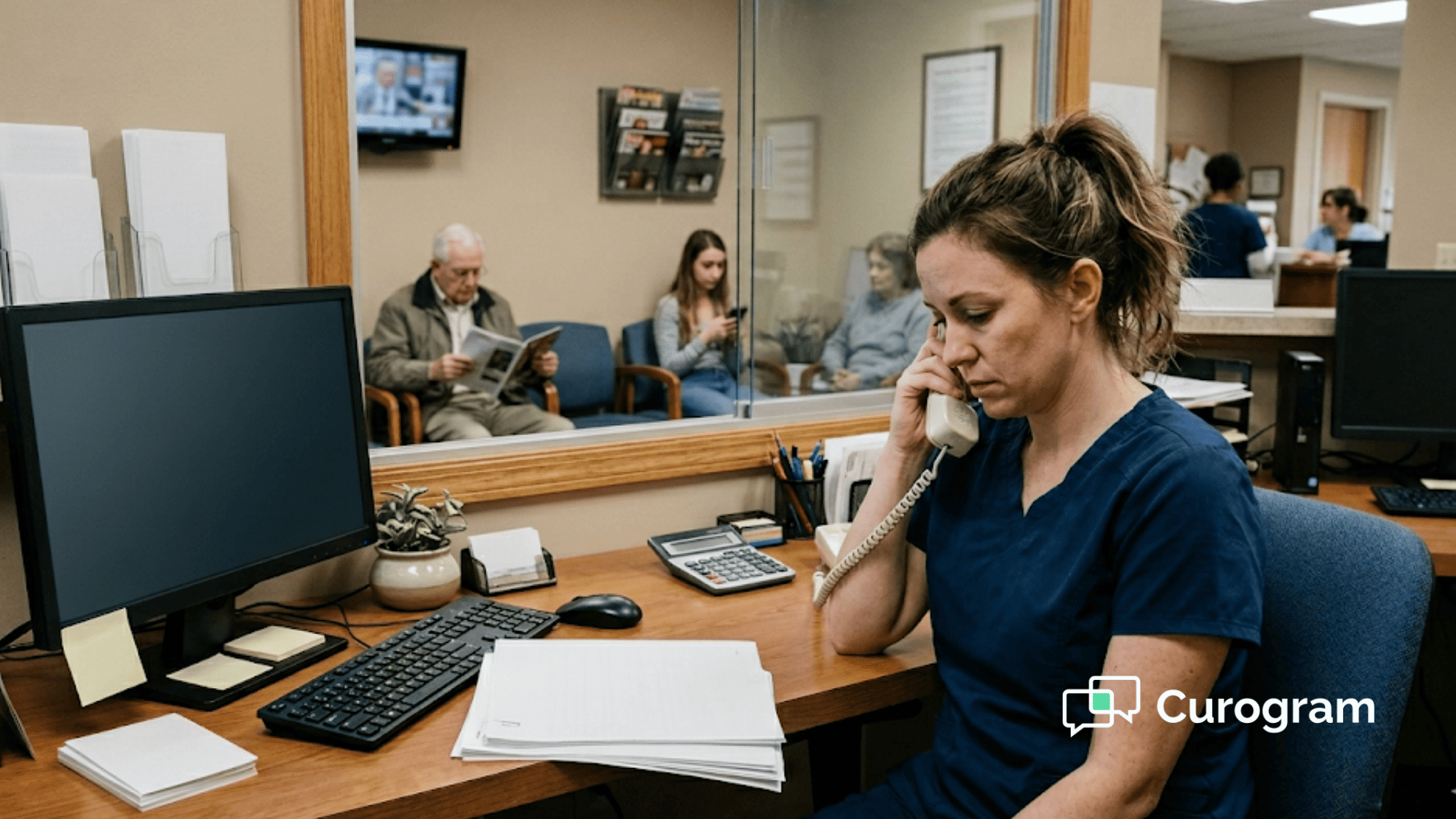
Your billing team just spent two hours calling patients about $50 co-pays. Only three picked up the phone. One agreed to pay. That math doesn't work for any treatment center.

Behavioral health centers can boost their Opus EHR ROI for patient payments by swapping manual billing for SMS Text-to-Pay links. When accounts receivable ages past 60 or 90 days, most facilities write those balances off. The admin cost of chasing them is just too high. Curogram changes that equation.

With Curogram, your billing team sends secure payment links straight to a patient's phone. No more stuffing envelopes. No more leaving voicemails that never get returned. The payment prompt lands right where the patient is already looking — their text messages.

This means a faster revenue cycle and fewer lost dollars. It also means a real path to behavioral health revenue recapture that doesn't require more staff or more hours. For centers running on Opus EHR, the gap between "billed" and "collected" can shrink fast.

As a result, there are fewer write-offs, shorter A/R aging, and a billing team that spends time on high-value work instead of phone tag. In the substance use disorder space, where margins are already tight, every dollar matters.

This article breaks down why small balances go unpaid, how to recapture them, and how to measure the return on SMS-based billing. If you're a CFO, billing manager, or executive director at a treatment center, this is your playbook.

The "Cost of Collection" Villain: Why Small Balances Go Unpaid

There's a silent problem eating into your revenue. It's not denied claims or low rates. It's the small balances — the co-pays, the leftover charges after insurance pays its share.

They sit in your A/R aging report for months, then quietly get written off. Why? Because the cost of collecting them is higher than the balance itself.

Let's look at how this plays out in the real world:

The Manual Outreach Deficit

Consider this situation:

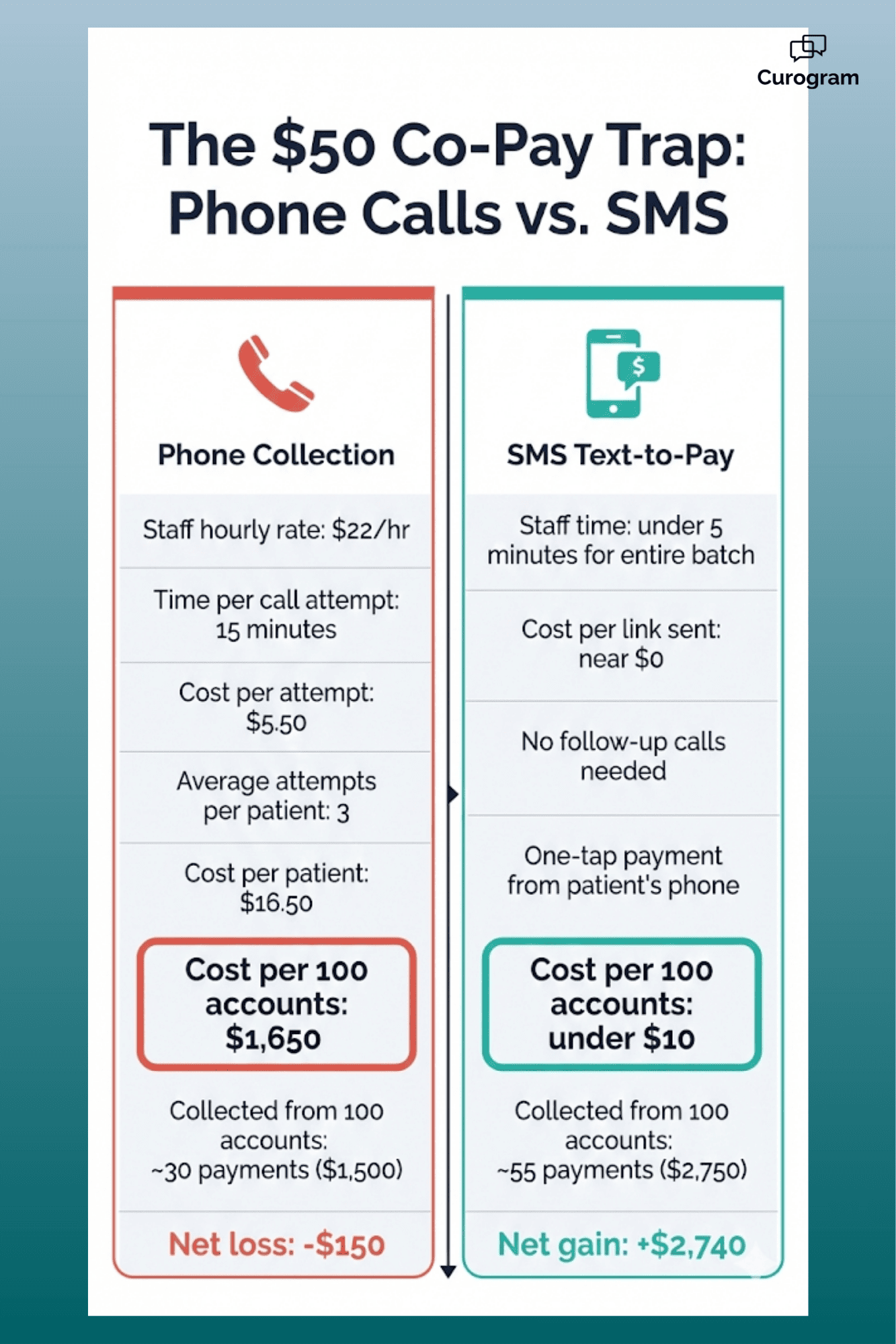
Say, a biller earns $22 per hour. It takes them about 15 minutes to pull up a patient account, find the phone number, make the call, and log the outcome.

That's roughly $5.50 in labor for one call. If the patient doesn't answer — which happens most of the time — your biller has to try again. Two or three attempts later, you've spent $15 chasing a $50 co-pay.

Now, multiply that across 200 open balances. You're looking at over $3,000 in labor just to make calls.


Many of those calls won't even connect. The ones that do may not result in payment. This is the core breakdown in healthcare collection efficiency for most treatment centers.

For a facility running Opus EHR billing workflows, the data is right there. The balances are clear. The issue isn't knowing who owes — it's the cost and effort to actually reach them.

The Statement Decay Rate

Speed matters more than most billing teams realize. Each month a balance sits unpaid, the chance of ever collecting it drops by about 10–15%.

A balance that's 30 days old has a strong chance of being paid. At 90 days, that chance has been cut in half. At 120 days, it's nearly gone.

This is why behavioral health revenue recapture has to happen fast. Waiting for the next billing cycle, or hoping a second paper statement works, burns time you don't have. Every week of delay costs real money.

Think of it this way:

If your facility has $80,000 in patient balances over 60 days, and you're only collecting 30% of that, you're losing $56,000. A faster outreach method wouldn't just save time. It would save that revenue.


The "Lost in the Mail" Myth

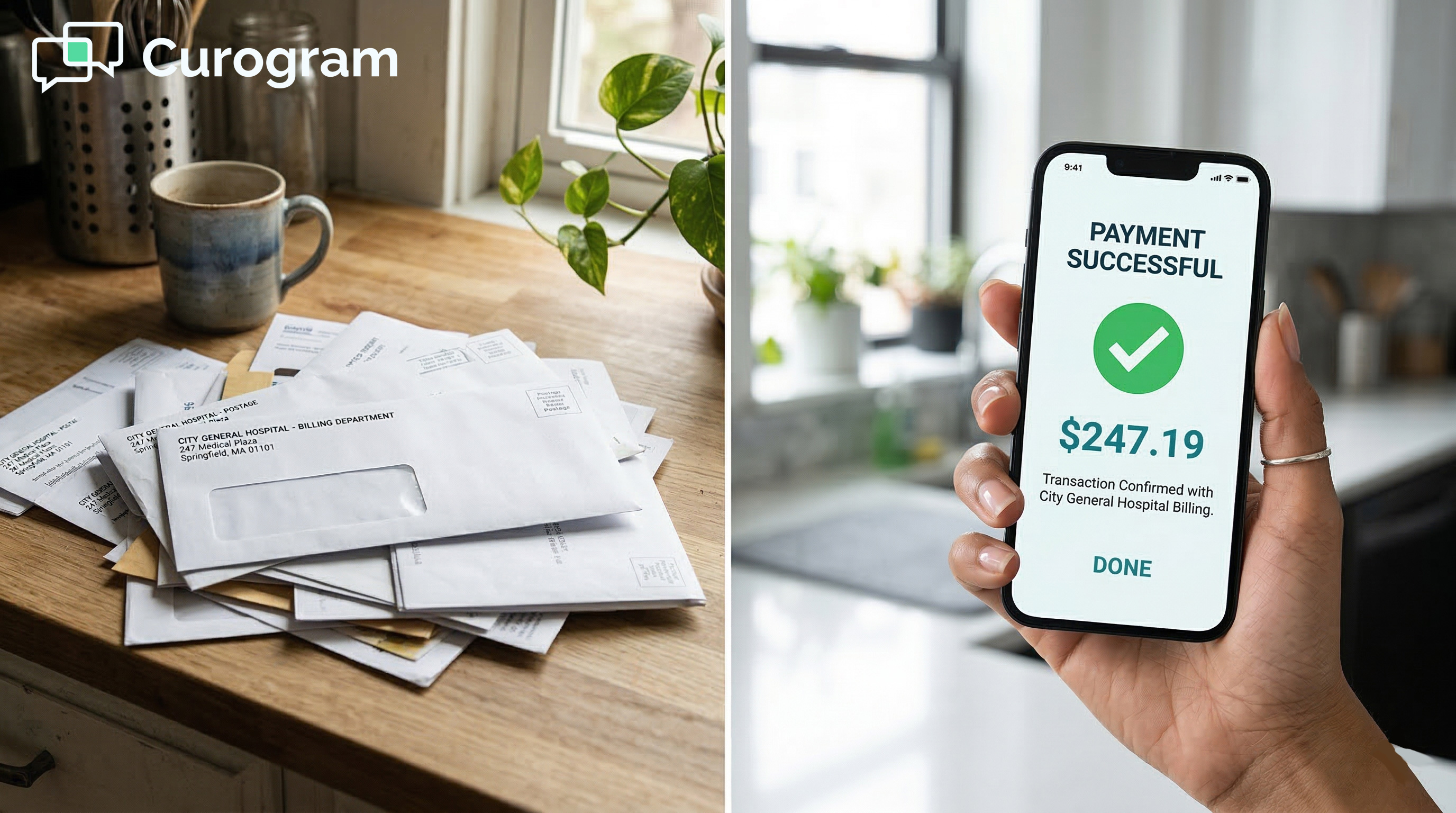
Here's the truth about paper statements in 2026. Most patients aren't ignoring their bills on purpose. They just never see them. Paper mail gets lost, tossed, or buried under junk mail. For younger patients and families, a paper bill feels like a relic from another era.

The modern patient lives on their phone. They pay rent through an app. They split dinner tabs with a text. If a medical bill doesn't show up on their phone, it might as well not exist.

This is why SMS medical billing ROI is so strong. When you meet patients where they already are — on their phones — you remove the biggest barrier to payment. It's not that they don't want to pay. It's that you haven't made it easy enough.

Treatment centers that rely only on paper are leaving revenue on the table. In the substance use disorder space, where patients may be in transitional housing or moving between addresses, mail delivery is even less reliable. A text message reaches them no matter where they are.

The labor cost of chasing a $50 co-pay by phone often exceeds the balance itself. After two or three failed call attempts, most billing teams move on, and the balance ages until it's written off.

Strategies for Rapid Revenue Recapture

Knowing the problem is half the battle. The other half is acting on it with the right tools and the right timing. Here are three strategies that turn slow-moving patient balances into active cash flow:

Bulk SMS Billing Runs

Picture this: It's the first Monday of the month. Your billing team normally prints 500 paper statements. That means folding, stuffing envelopes, applying postage, and walking them to the mail room. The whole process takes two to three days and costs your facility hundreds in supplies and labor.

With Curogram, that same billing team sends 500 secure payment links in under five minutes. They pull the A/R report from Opus EHR, filter for open patient balances, and send a bulk SMS run.

Each patient gets a text with a secure link to view and pay their balance. No waiting two weeks for the mail to arrive and another two weeks for a check to come back. The payment link is live the second the text lands on the patient's phone.

This is what makes Opus EHR billing workflows so much more powerful when paired with Curogram. The data lives in Opus. The action happens through Curogram. Together, they turn a week-long admin task into a five-minute job.

Targeting the "High-Intent" Window

Timing changes everything in billing. When a patient finishes a session, a program, or a residential stay, they feel the value of the care they received. That's the moment to ask for payment.

If you wait 30 days to send a bill, that feeling fades. The patient may have moved on. The guarantor may have other bills stacked up. The connection between the care and the cost gets weaker every day.

The smart move is to send a payment link right after discharge or right after a key session. Think of it as a "thank you" text with a payment option built in. The patient or family member sees it while the experience is still fresh. They're far more likely to tap the link and pay.

This is not about being pushy. It's about being timely. Most patients expect a bill. They just want it to be easy to pay.

Guarantor-Specific Collections

In residential treatment, the patient often has no income. They may be in early recovery with no job and no access to funds. But a parent, spouse, or other guarantor signed on to cover the cost. The bill should go to that person.

Curogram lets your billing team send the payment link to the guarantor, not just the patient. This is a crucial difference. If the bill only goes to someone who can't pay, it sits and ages. If it goes to the person with the means to pay, it gets handled.

For example:

Say, a 24-year-old completes a 30-day residential program. Their mother is the guarantor. She has a $1,200 balance after insurance. Sending that link to the patient's phone does nothing. Sending it to the mother's phone — with a clear breakdown and a one-tap payment option — gets the job done.


This simple change in workflow can reduce A/R days for addiction treatment in a big way. You're no longer billing the wrong person and waiting for nothing to happen.

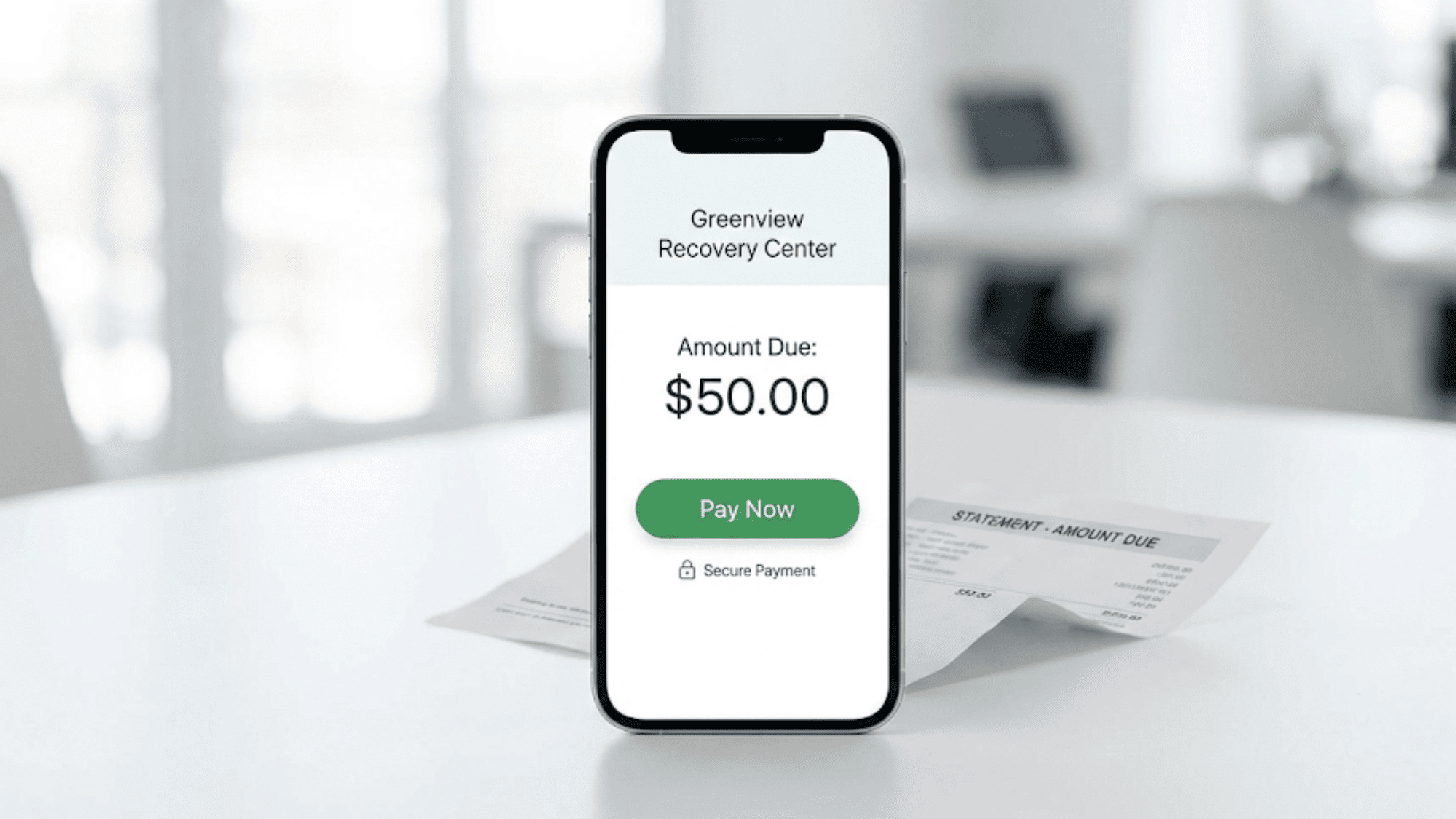
Close-up of a mobile payment screen with pay now button next to a paper statement on a desk

Measuring the ROI of SMS Payments

You can't manage what you don't measure. If you're going to invest in SMS-based billing through Curogram, you need a clear way to track the return. Here are three key areas to watch, along with how to calculate the impact:

Reduction in Days Sales Outstanding (DSO)

Days Sales Outstanding is a simple measure. It tells you how many days, on average, it takes to collect payment after a service is billed. The lower the number, the faster your cash comes in.

Most treatment centers that rely on paper billing see DSO numbers between 45 and 90 days for patient balances. That means you're waiting one to three months after care is delivered to get paid. During that time, the balance is at risk of going stale.

When you switch to SMS payment links through Curogram, that window shrinks fast. Most facilities see a 50% drop in DSO for patient-owed balances.

Here's a simple way to track it:

Take your current average DSO for patient payments. Say it's 72 days. After 90 days of using Curogram's Text-to-Pay, measure it again. If it drops to 36 days, that's 36 fewer days your money is sitting in limbo. That's 36 more days of cash in your bank account.

For a facility billing $200,000 per month in patient balances, cutting DSO from 72 to 36 days means roughly $200,000 in cash that arrives a full month sooner. That's real money you can use for payroll, supplies, or growth.


This is one of the clearest ways to see the Opus EHR ROI for patient payments in action. The data is already in your system. You just need to compare before and after.

Labor Savings

Your billing staff's time is one of your biggest expenses. Every minute they spend on low-value tasks — like stuffing envelopes or sitting on hold — is a minute they're not spending on high-value work like insurance follow-ups or claim appeals.

Here's a quick way to estimate your labor savings:

List the tasks Curogram replaces, then estimate the time each one takes per week.

Printing and mailing paper statements might take 8 hours per week. Manual credit card entry over the phone after a patient calls back could take 5 hours.

Follow-up calls to patients with open balances might eat up 10 hours. That's 23 hours per week spent on tasks that SMS billing handles in minutes.

At $22 per hour, that's about $506 per week in labor. Over a year, that's over $26,000. For many small to mid-size facilities, that's close to a full part-time salary. You could redirect that time to revenue-driving work. Or you could reduce overtime costs that strain your budget.


The bottom line is simple: Curogram doesn't just collect more money. It frees up the people who were trying to collect it the hard way.

Recaptured Bad Debt

This is where the real magic happens. Every treatment center has a bucket of "old" balances — accounts that are 60, 90, or 120+ days past due. Most of these have been touched once or twice by the billing team, with no result. Many are on the verge of being written off.

Now, imagine sending a one-click payment link to every one of those accounts in a single bulk run. No phone call. No letter. Just a clear text message with a secure link.

Here's how to track the impact:

Pull your current A/R aging report from Opus EHR. Filter for all patient balances over 60 days. Note the total dollar amount. Then, send a Curogram SMS billing run to that entire list. After 30 days, check the report again and see how much was paid.


Many facilities are surprised by the results. Balances that sat untouched for months suddenly get paid — not because the patient didn't want to pay, but because no one had made it easy enough before.

For example:

Let's say your facility has $120,000 in patient balances over 60 days old. You send a bulk SMS run and collect 25% of that within 30 days. That's $30,000 in revenue you would have written off. Over a year, running these catch-up campaigns monthly, the numbers add up fast.


This is the core of behavioral health revenue recapture. It's not about finding new revenue. It's about collecting the revenue you've already earned.

To tie it all together, here's a simple way to build your ROI case:

  1. Add up three numbers: the value of your DSO reduction (cash coming in faster), your labor savings (less time on manual tasks), and your recaptured bad debt (old balances now paid).

  2. Compare that total to the cost of Curogram. For most facilities, the return is clear within the first 90 days.

Tracking SMS medical billing ROI doesn't need to be complex. Use the reports you already have in Opus EHR. Compare one quarter to the next. The numbers will speak for themselves.

Turn Your A/R into Active Cash Flow

Your A/R report is not just a list of what's owed. It's a map of where your money is sitting. Every line on that report is revenue your team earned but hasn't collected yet. The question is: how long will you let it sit there.

With Curogram and Opus EHR, you have the tools to turn those numbers into payments. Bulk SMS runs, timed outreach, and guarantor-level billing put you in control of the collection process.

You don't need to hire more staff. You don't need to work longer hours. You just need a smarter path from "billed" to "paid."

The facilities that thrive aren't the ones billing the most. They're the ones collecting the most.

When healthcare collection efficiency goes up, everything else follows — better cash flow, lower stress, and a billing team that can focus on what matters.


How Curogram Bridges the Gap Between Billing and Collecting


Curogram is a HIPAA-compliant patient texting platform that plugs into your existing Opus EHR setup. It doesn't replace your billing system. It makes it faster and more effective.

Your billing team pulls the A/R report from Opus. They select the accounts they want to target — past-due balances, recent discharges, guarantor accounts, or any other group.

Then, they send a bulk SMS run with secure payment links. Each patient or guarantor gets a text with a link to view their balance and pay on the spot.

The payment is secure, the link is HIPAA-compliant, and the whole process takes minutes instead of days. There's no app to download, no portal to log into, and no phone call to make. The patient just taps the link and pays.

Curogram also supports two-way texting. If a patient has a question about their balance, they can reply to the text and your team can respond in real time. This cuts down on billing-related phone calls and gives patients a simple way to resolve issues.

For treatment centers running Opus EHR, Curogram acts as the missing piece between having the billing data and actually collecting on it. It turns your A/R from a static report into an active revenue tool.

Conclusion

Every dollar that sits in your A/R report is a dollar your team earned but hasn't collected. In the behavioral health space, where margins are tight and patient balances are often small, those dollars add up fast.

The old way of collecting — paper statements, phone calls, and manual follow-ups — costs too much and takes too long. By the time a bill reaches a patient through the mail, the window for payment has already started to close.

Curogram flips that model. Paired with Opus EHR, it gives your billing team the power to reach every patient and guarantor with a secure payment link in seconds.

No more phone tag. No more lost mail. No more writing off balances because the cost of chasing them was too high.

The results show up in your numbers: fewer A/R days, lower labor costs, and revenue that was once written off now flowing back into your facility. That's the Opus EHR ROI for patient payments in practice — not theory, but actual dollars collected.

If your facility is ready to stop leaving money on the table, the next step is simple. Schedule a 10-Minute Demo today to see how Curogram can transform your billing workflow and strengthen your bottom line.

Ready to stop leaving money on the table? Book a demo today to see how Curogram can transform your billing workflow and strengthen your bottom line.


Frequently Asked Questions

Can we send links for past-due balances?
Yes. You can filter your Opus A/R report by balance age and send a "catch-up" link to all patients with an open balance over a set number of days. For instance, you could target all accounts over 60 days in a single bulk run. 
Is there a limit to the payment amount?
No. The secure links handle any amount. Whether it's a $20 co-pay or a $10,000 private-pay deposit, the system works the same way. The patient or guarantor taps the link, sees the balance, and pays — all from their phone.
How does this impact our billing staff's daily routine?

It shifts their focus in a big way. Instead of spending hours on the phone chasing payments, they move to higher-value work. That means more time on insurance follow-ups, claim appeals, and payment posting.

How does guarantor billing work through Curogram?

Your billing team sends the payment link to the guarantor's phone number rather than the patient's. This is critical in residential care, where the patient may not have income but the guarantor does.

Why do small patient balances get written off so often in behavioral health?

The labor cost of chasing a $50 co-pay by phone often exceeds the balance itself. After two or three failed call attempts, most billing teams move on, and the balance ages until it's written off.


Simplify Patient Payments for Opus EHR with Text-to-Pay

Simplify Patient Payments for Opus EHR with Text-to-Pay

💡 Patient payments for Opus EHR are faster and easier with Curogram's text-to-pay platform. Billing teams send secure payment links by text to...

Read More
The Cost of Paper Statements | Save $2k/Month in Prime Clinical

The Cost of Paper Statements | Save $2k/Month in Prime Clinical

💡 If you want to reduce patient statement costs in your Prime Clinical practice, the fastest path is switching from printed mail to digital...

Read More
Text-to-Pay ROI for StreamlineMD Radiology, Vascular, and IR Practices

Text-to-Pay ROI for StreamlineMD Radiology, Vascular, and IR Practices

💡 StreamlineMD practices often struggle with slow payments, aging balances, and rising billing costs. Text-to-pay changes how imaging centers...

Read More