Collect CureMD Balances by Text With Secure SMS Payment Links
💡 Text-to-pay collects the CureMD balances that age while patients put off paying. A CureMD text-to-pay patient billing SMS payment link sends a...
10 min read
Mira Gwehn Revilla
:
July 11, 2026
On the first of the month, billing runs the statement batch. Print, fold, stuff, meter the postage, drop it at the mailbox. Then everyone waits. Most of those envelopes land on a kitchen counter, and the balance sits there for weeks.
That mailed statement is the slowest, priciest part of collecting money a CureMD practice has already earned.
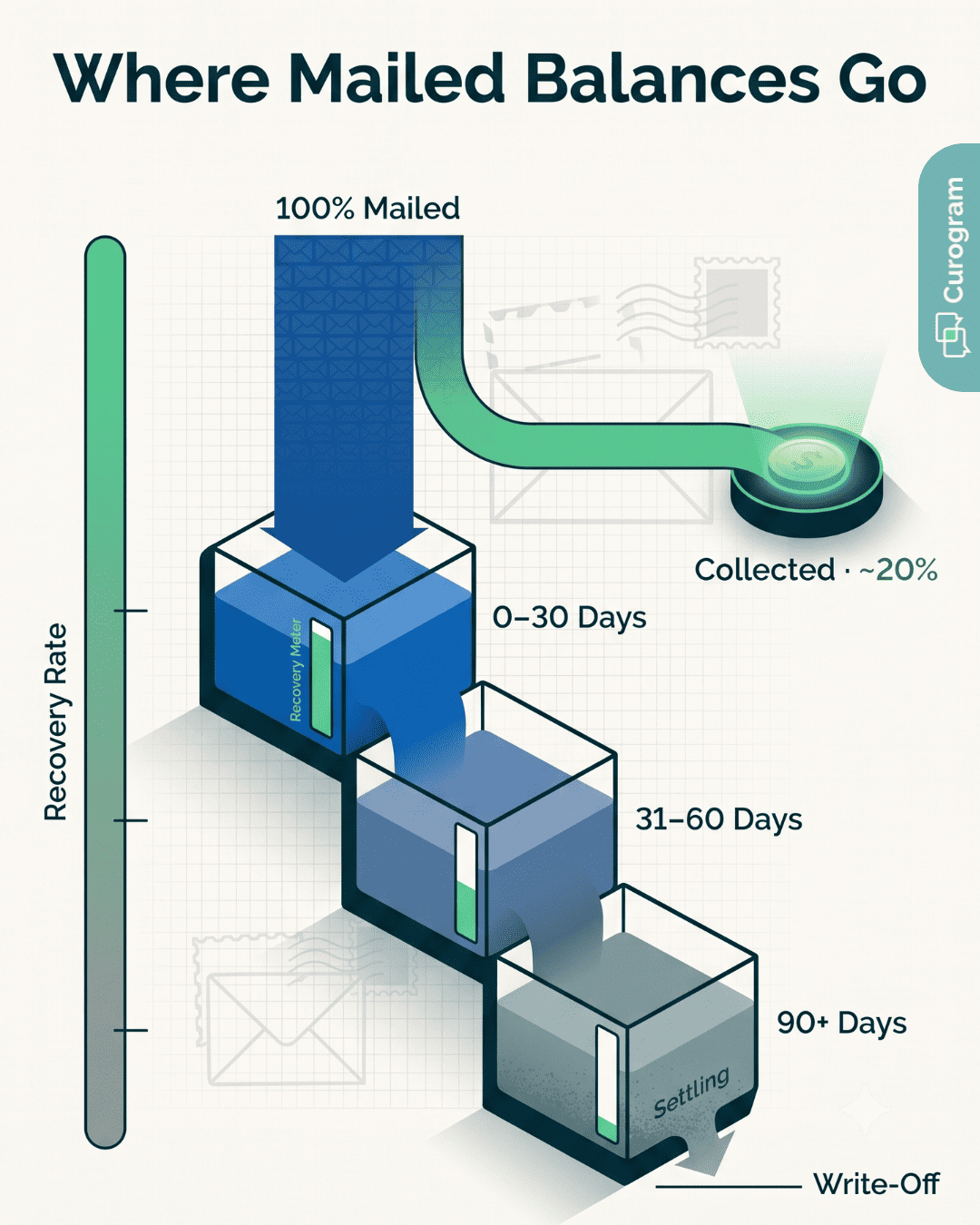
A typical statement run pulls in about 20% of what it bills, and it can cost $800 to $1,000 a month once you add paper, postage, and the mailing service. Most of it just ages. Billing re-sends at 30 days, then starts calling at 60.
CureMD patient balance collection without paper statements means sending patients a secure payment link by text, so they pay in two taps instead of hunting for a portal password or a stamp.
The balance clears the same day it posts, and the statement run shrinks to a fraction of what it was. High-deductible plans make this urgent, because the patient's share of each bill is bigger than it used to be.
CureMD still does the billing and the RCM. What changes is the last step, the part where money actually reaches the practice.
Instead of a mailed bill that mostly ages, billing sends a text patients open and pay, and the front desk stops fielding password-reset calls all afternoon.
This piece walks through where statements cost you, how a two-tap link fits your current CureMD workflow, and what the billing desk stops doing once the mailing loop is gone.
When a visit closes and a patient owes money, CureMD gives billing two main ways to collect: point the patient to the portal, or mail a statement. Both sound reasonable. Both stall.
The portal asks the patient to remember a login they set up months ago. Most don't. They call the front desk for a password reset, or they give up and wait for paper. So the statement becomes the real collection tool by default, and that's where the cost starts.
Every portal password reset is also a phone call your front desk has to take, on top of everything else in the queue. Mailing is the fallback for balances the portal never catches, and it's the slowest path you have.
Watch the CureMD billing staff collections workflow on statement day. Someone pulls the batch, prints it, folds each page, stuffs envelopes, and meters postage, or hands the file to a mailing service that charges per piece. Then the waiting starts.
A patient gets the envelope, sets it by the mail pile, and means to deal with it later. Two weeks pass. Billing re-sends at 30 days. At 60, someone picks up the phone and starts calling.
Each of those touches costs staff time, and none of them makes the balance easier to pay.
A mailing service often charges 75 cents to a dollar per piece once printing, envelope, and postage are bundled, so a batch of a few hundred statements is real money before a single balance comes back.
The loop looks like this:
Wait
Re-send
Call
Repeat, for money the practice already earned
A single balance can take three or four touches before it clears, if it clears at all.
A statement run that collects roughly 20% is common, and the math is unkind. You pay to mail 100% of the bills and collect a fifth of the value
The rest becomes CureMD aged AR patient balances that drift into 60- and 90-day buckets, where they get harder to collect every week.
|
Statement run, monthly |
Typical figure |
|
Statement + postage + service cost |
$800–$1,000 |
|
Share of billed value collected |
~20% |
|
Balances left aging |
~80% |
|
Follow-up touches per balance |
2–3 (re-send, call) |
Those cost ranges reflect the typical statement economics the industry cites, not Curogram internal data.
The pattern holds across practices: you spend the most on the balances least likely to pay. A first-class stamp alone runs most of a dollar, and that's before paper, toner, envelopes, and the labor to assemble each piece.
Statement collection doesn't stay inside billing. When a patient can't log into the portal, the call lands at the front desk, which now has to verify identity and reset a password before anyone can pay a dime. When a statement arrives with a question, that call lands up front too.
So the cost isn't only postage. It's a receptionist walking a patient through a portal reset while three people wait to check in, and a biller working a call list instead of the accounts that need real judgment. Every one of those interruptions is time the practice pays for and never bills.
Aged patient AR isn't bad debt yet, but every mailing cycle nudges it closer. A balance sitting past 90 days collects at a fraction of the rate of a fresh one, so the longer the statement loop runs, the less you recover.
High-deductible plans stretch this further, since patient responsibility is a larger slice of each bill than it was a decade ago.
Billing ends up spending its best hours on the accounts least likely to pay, one envelope and one voicemail at a time. That's payroll spent to collect a shrinking share of money the practice booked weeks ago.
The balance was earned in the exam room; the mailing loop just makes it slow and costly to bring home.

Replace the envelope with a text. When a balance posts, billing sends the patient a secure payment link. They tap it, see the amount owed, enter a card, and confirm. Two taps, no login.
There's no portal password to reset and no stamp to find. That page shows what they owe and takes the payment, then marks the balance paid. The text itself carries no clinical detail, just a short note and the link, so nothing sensitive travels in the message.
Compare the two paths on a $180 balance. A mailed route asks the patient to open an envelope, find a checkbook or a portal login, and take an action at a desk. The text route asks them to tap while they're already holding the phone.
Billing chooses when the link fires. Send it the moment a balance posts in CureMD, so the ask reaches the patient while the visit is fresh. Or hold it for a scheduled follow-up a few days out.
For accounts a patient skips the first time, you can automate patient payment reminders in CureMD practices with a second and third text on a set cadence, so the nudge goes out without anyone re-printing a statement
This is the CureMD text payment follow-up your billing team never had: a link, then a gentle reminder, then another, all automatic.
Most patients already read and answer practice texts. Based on our internal data, Curogram sees an average appointment confirmation rate above 75%, so a payment link rides a channel patients already open.
Patients get a short text from a number they recognize as the practice, with one line and a link. No account number to decode, no envelope to open. Tapping the link opens a page with the practice name, the amount owed, and a card field.
They enter a card and confirm. The page shows a receipt, and they're done in under a minute. No app to download, no account to create, nothing to remember for next time.
For a patient who's been ignoring a paper statement for three weeks, that lower bar is often the whole difference between paid and aging.
This isn't a billing-system swap. CureMD keeps doing the coding, claims, and RCM it already does. The text link is the collection channel added to the end, so nothing about your CureMD setup has to change.
A balance posts in CureMD, a link goes out by text, the patient pays, and the payment gets recorded against the account.
Your billing staff keeps working in the system they know, minus the print run and most of the calls. There's no rip-and-replace and no second billing platform to learn.
Specialty practices feel this most. A dermatology or ortho balance after a high-deductible plan can run into the hundreds, and a mailed statement for that amount often sits the longest.
A patient who'd never mail a check will tap a link for the same balance while they're standing in line for coffee.
Frictionless payment lifts collections without more dunning. You send fewer letters and make fewer calls, and still bring in more, because the easy path and the paid path are finally the same path.
Once text-to-pay is carrying balances, the argument to stop mailing patient statements at a CureMD practice writes itself.
You keep a small paper fallback for the few patients who need it, and you reduce statement costs at your CureMD practice by cutting the volume you print, stuff, and mail every month.
Fewer envelopes, less postage, and a shorter follow-up list, with the bulk of collections moving to a channel that costs a text to send.
Retiring the run isn't about a prettier statement; it's about sending far fewer of them. A monthly batch that collects about 20% at $800 to $1,000 shrinks to a small fallback pile, while the bulk of balances clear by text within days of posting.
|
Statement run |
Text-to-pay |
|
|
Time to first payment |
Weeks |
Same day to a few days |
|
Cost to reach the patient |
Print + postage + service |
One text |
|
Patient action needed |
Find portal login or mail a check |
Tap a link, enter a card |
|
Staff follow-up |
Re-send, then call |
Automated reminder text |
Balances that used to age for 60 days now often clear the week they post. That's the shift from a statement treadmill to a collected balance, and it shows up in the AR aging report within a month or two.
Follow one $180 balance through both paths:
On the statement route, the charge posts Tuesday, waits for the first-of-month batch, gets printed and mailed, and lands in a mailbox a week later. It sits. Billing re-sends at 30 days and calls at 60. Best case, it clears in six or seven weeks.
On the text route, the same charge posts Tuesday afternoon. A payment link texts out within the hour. The patient taps it that evening from the couch, enters a card, and pays. By Wednesday morning, the payment is recorded and the balance is closed.
One charge, one text, no envelope, no call. That gap between the two timelines, multiplied across a month of balances, is what moves the AR aging report.
Billing stops running the print-stuff-mail loop for most balances. Reminders go out on their own, so the follow-up list gets shorter.
Staff hours that went to statement day and collection calls move to work that actually needs a person, like tricky insurance follow-up or setting up payment plans.
A biller who used to spend a full morning on statement day gets that time back for accounts that need a human, like an insurance appeal or a payment-plan setup.
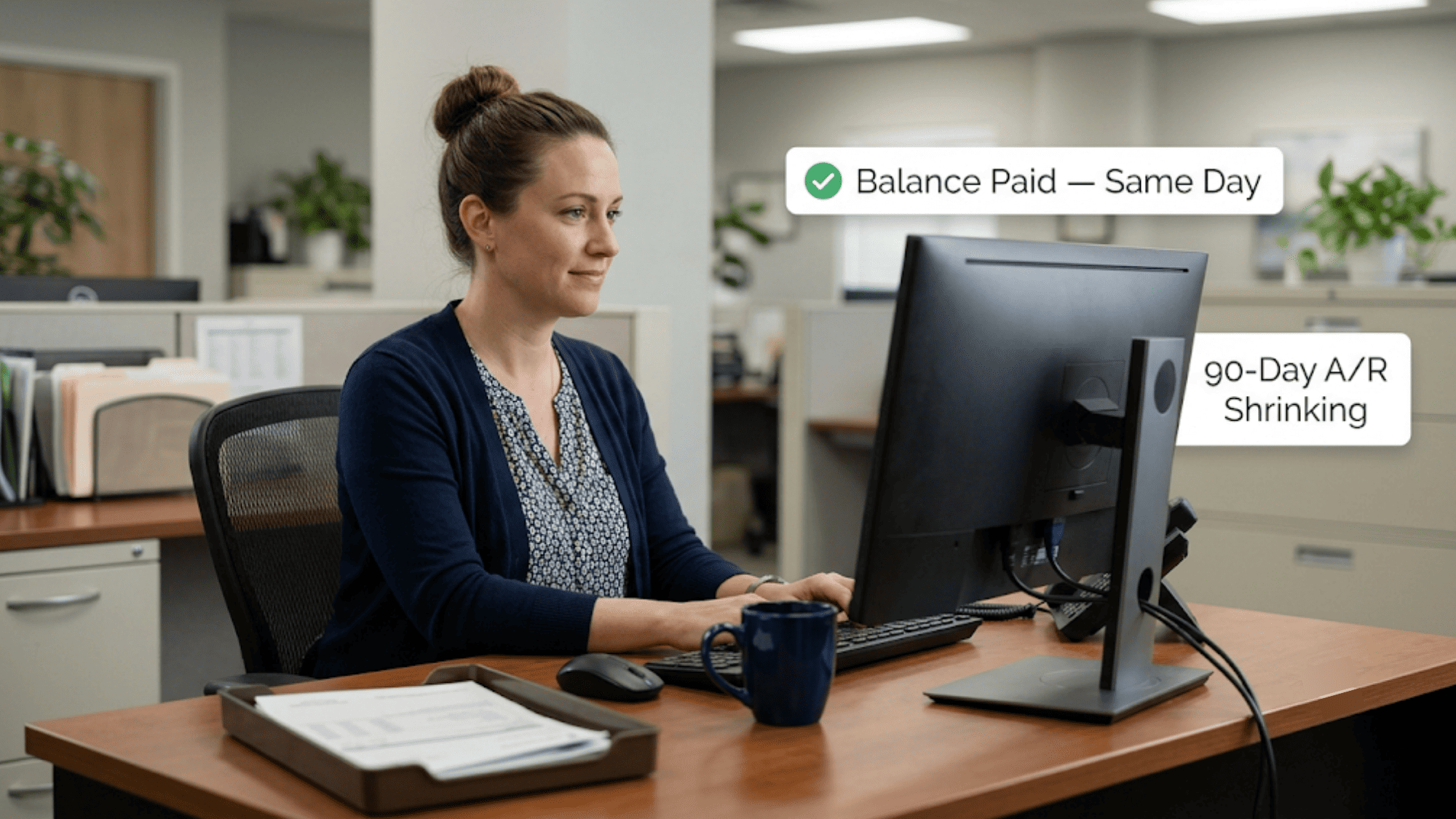
Cash flow speeds up too. Money that used to sit in 60- and 90-day AR buckets starts landing the same week the visit closes, which changes what the month's deposits look like. Fewer balances slide into 90-day territory, so less revenue slips toward write-off.
Speed changes the shape of the AR aging report. When most balances clear within days, the 60- and 90-day columns thin out, and less revenue drifts toward write-off.
Money the practice earned this month tends to arrive this month, instead of trickling in over a quarter.
That timing matters for a practice meeting payroll and rent on a schedule. Faster, more predictable patient collections mean fewer surprises in the deposit total and less cash tied up in balances you've already earned.
The reduced statement volume shows up on the expense side at the same time, so both halves of the ledger move the right way.
You won't send zero statements. A handful of patients still need paper, and that's fine. The difference is scale: instead of mailing the whole batch, you mail the exception.
That's how the $800-to-$1,000 monthly cost drops, while collections rise, because most balances now clear on the channel patients actually use.
Paper becomes the rare exception instead of the standing routine, and the print run stops eating a morning every month.
The same shift also works earlier in the visit. Catching the copay at the front desk keeps balances from ever reaching a statement in the first place, which shrinks the mailing pile even further.
If you want a sense of the dollars in play, calculate your potential amount in A/R recovery before a single balance ages.

Text-to-Pay is the collection channel that replaces the statement run for CureMD practices. When a balance posts, billing sends the patient a secure payment link by text. The patient taps it, sees the amount, enters a card, and pays, all without a portal login or a mailed page.
That payment page runs through a secure, PCI-conscious checkout, and every text stays HIPAA-compliant under a signed BAA, so billing can send links without exposing protected health information.
For balances a patient skips the first time, you can schedule an automated follow-up text a few days later, so no one re-prints a statement to nudge a single account.
It works alongside your existing CureMD billing and RCM, not in place of it. CureMD keeps the coding and claims; Curogram carries the patient payment by text.
A balance posts, a link goes out, the patient pays, and the payment is recorded, with far less paper in between.
Patients respond to this channel because they already use it. Based on our internal data, Curogram clients see an average appointment confirmation rate above 75%, and no-show rates 53% below the industry average, both driven by the same two-way texting a payment link rides on. A patient who confirms a visit by text will pay a balance by text.
For specialty billing teams carrying larger high-deductible balances, that's the difference between a statement that ages 60 days and a payment that lands the week it posts.
You mail fewer statements, make fewer collection calls, and collect more of what the practice already earned.
The statement run is an expensive way to collect a fraction of what you're owed. You pay to mail every balance and collect about a fifth, while the rest ages into 60- and 90-day AR that only gets harder to recover.
For most CureMD practices, that's the single slowest, costliest step left in the revenue cycle. Trade the statement run for a text your patients will actually pay.
CureMD is built for the billing, the coding, claims, and RCM that turn a visit into a charge. Collecting the patient's share is a different job, and a mailed statement does it badly. A secure text link does it in two taps, the same day the balance posts.
Your billing team gets its statement day back. Postage drops, the follow-up call list shrinks, and cash that used to sit in aging AR starts landing the week the visit closes. Patients pay from a channel they already read, on the phone that's always in their hand.
Give your billing desk its statement day back for good. Schedule a CureMD integration demo and see how text-to-pay clears balances the same day they post.
Payments run on a secure, PCI-conscious page, and Curogram's texting is HIPAA-compliant under a signed BAA. The message carries no clinical detail, just a short note and the payment link itself.
It complements them as the patient-payment channel. CureMD keeps the coding, claims, and RCM it already handles, while Curogram sends the text link that collects the patient's share and records the payment.
The dropped statement costs and faster collections typically more than cover it. You collect more of each balance, sooner, with far less postage and follow-up, and most patient payments arrive within days.
They tap the link in the text, see the amount owed, enter a card, and confirm. No password reset, no account to create, and no app to download, so most finish in under a minute.
A paper statement asks the patient to open an envelope, find a checkbook or portal login, and act at a desk. Most set it aside, so a typical run collects only about 20% while the rest ages.
💡 Text-to-pay collects the CureMD balances that age while patients put off paying. A CureMD text-to-pay patient billing SMS payment link sends a...
💡 DrChrono text-to-pay patient billing lets practices collect copays, balances, and past-due amounts through a single SMS payment link — no portal...
💡 Text-to-pay patient billing for Modmed specialty practices lets you send a secure SMS payment link right after a visit. Patients tap, pay, and...