
Digital Intake Forms for eKyros Centers
💡 Digital intake forms for eKyros centers let patients complete sensitive medical history privately on their phones before appointments. This...
7 min read
Aubreigh Lee Daculug
:
March 2, 2026
Your front desk staff didn't go into healthcare to spend half the morning squinting at someone else's handwriting.
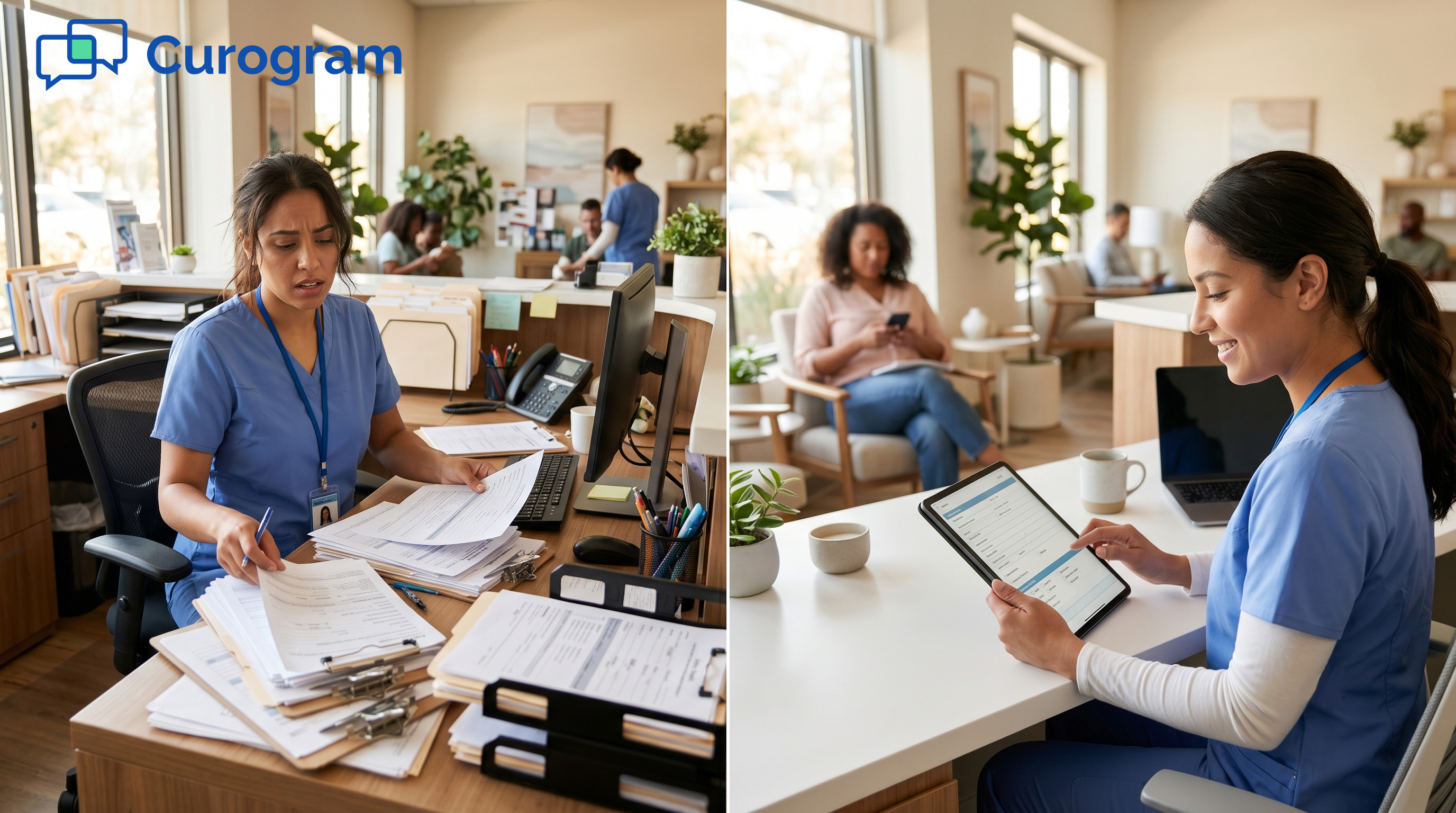
But that's exactly what happens when a new patient walks in with a 15-page intake form filled out in pencil. Someone has to read it, decode it, and type every answer into CharmHealth — one field at a time. That someone is your staff.
And while they’re doing that, the phone is ringing. A patient is waiting to check in. Another needs to reschedule. The backlog builds quietly. Ten minutes here. Fifteen minutes there.
By noon, your team is already behind — not because they’re inefficient, but because they’re buried in manual data entry that shouldn’t exist in the first place.
It's not just slow. It's risky. A misread allergy or skipped medication field isn't a clerical inconvenience — it's a clinical concern.
And when you're running an integrative or functional medicine practice, your intake forms are even longer than average. The amount of information your team manages before a patient is even seen is significant.
There’s also the patient experience to consider. Sitting in a waiting room filling out repetitive paperwork — especially after completing similar forms at previous offices — doesn’t feel modern or thoughtful. It feels outdated. Patients notice when a practice runs on clipboards.
And in a healthcare landscape where convenience matters, small friction points can shape overall perception.
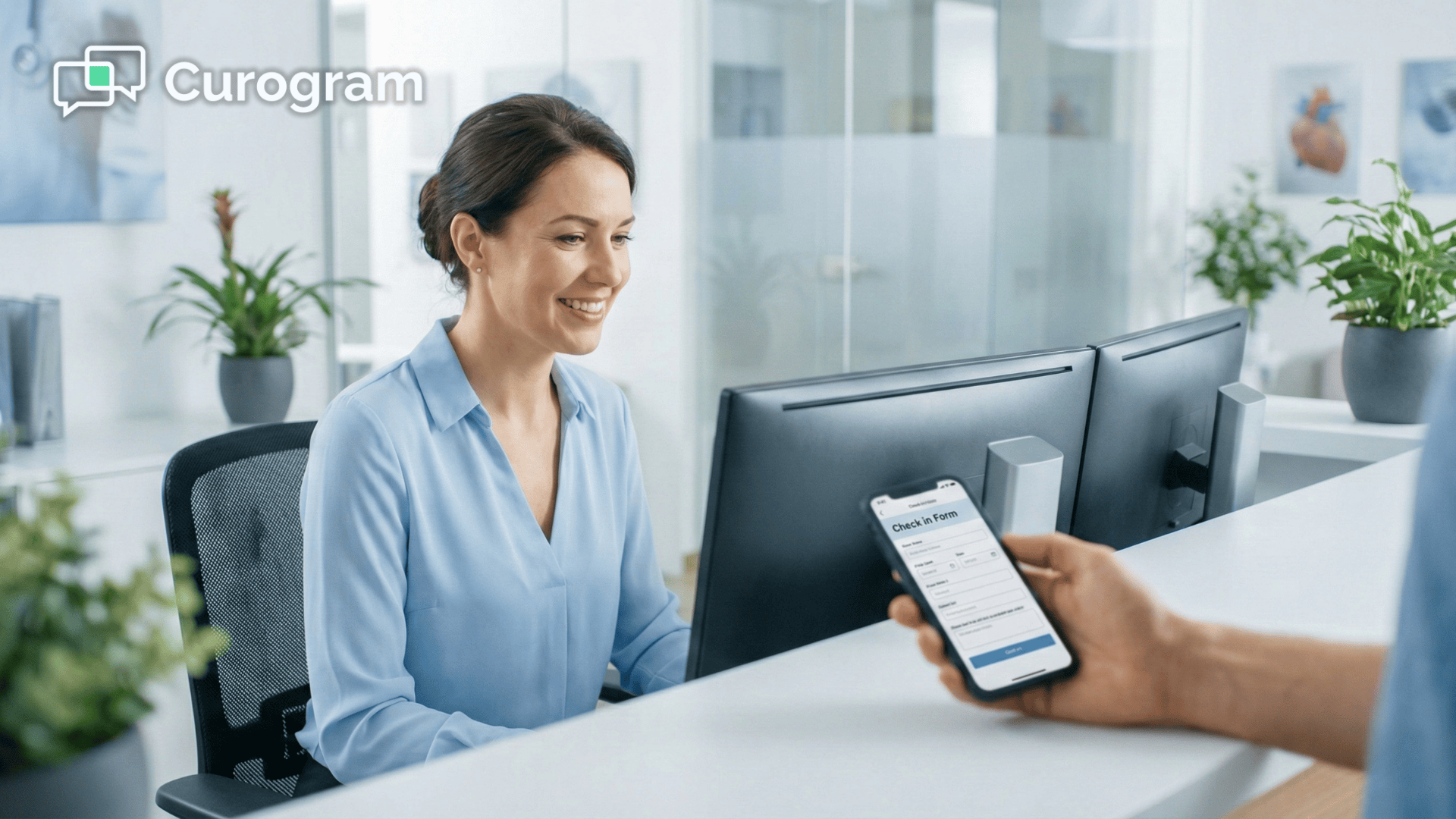
There’s a better way to handle this. Curogram's CharmHealth digital forms integration lets patients fill out their intake questionnaires on their own phones before the visit. When they hit submit, the data goes directly into their chart.
Staff review instead of retype. The provider walks in prepared. And the handwriting problem disappears entirely.
Instead of acting as transcriptionists, your front desk becomes what they were hired to be: patient coordinators, problem-solvers, and the welcoming face of your practice. Time shifts from paperwork to people. Errors decrease. Stress drops. The day flows more smoothly — for everyone involved.
This article walks you through how the process works, why it matters for practices like yours, and what your team gets back when you hand the typing over to the patient.
Integrative medicine practices collect a lot of information. A standard intake form might run 10 to 20 pages — covering health history, lifestyle habits, supplements, medications, stress levels, and more. That depth of data is what makes your care model work.
But it also creates a serious administrative burden that most practices have simply accepted as unavoidable.
The assumption is that someone on staff will handle it. And they do — every single day, for every single new patient.
What rarely gets examined is how much of that work is genuinely necessary and how much of it exists purely because the process was never designed to be efficient in the first place.
The patient fills out the form once. Then your staff reads it and enters it into CharmHealth — again. That second pass is what we call the transcription tax: the same work, done twice, by two different people.
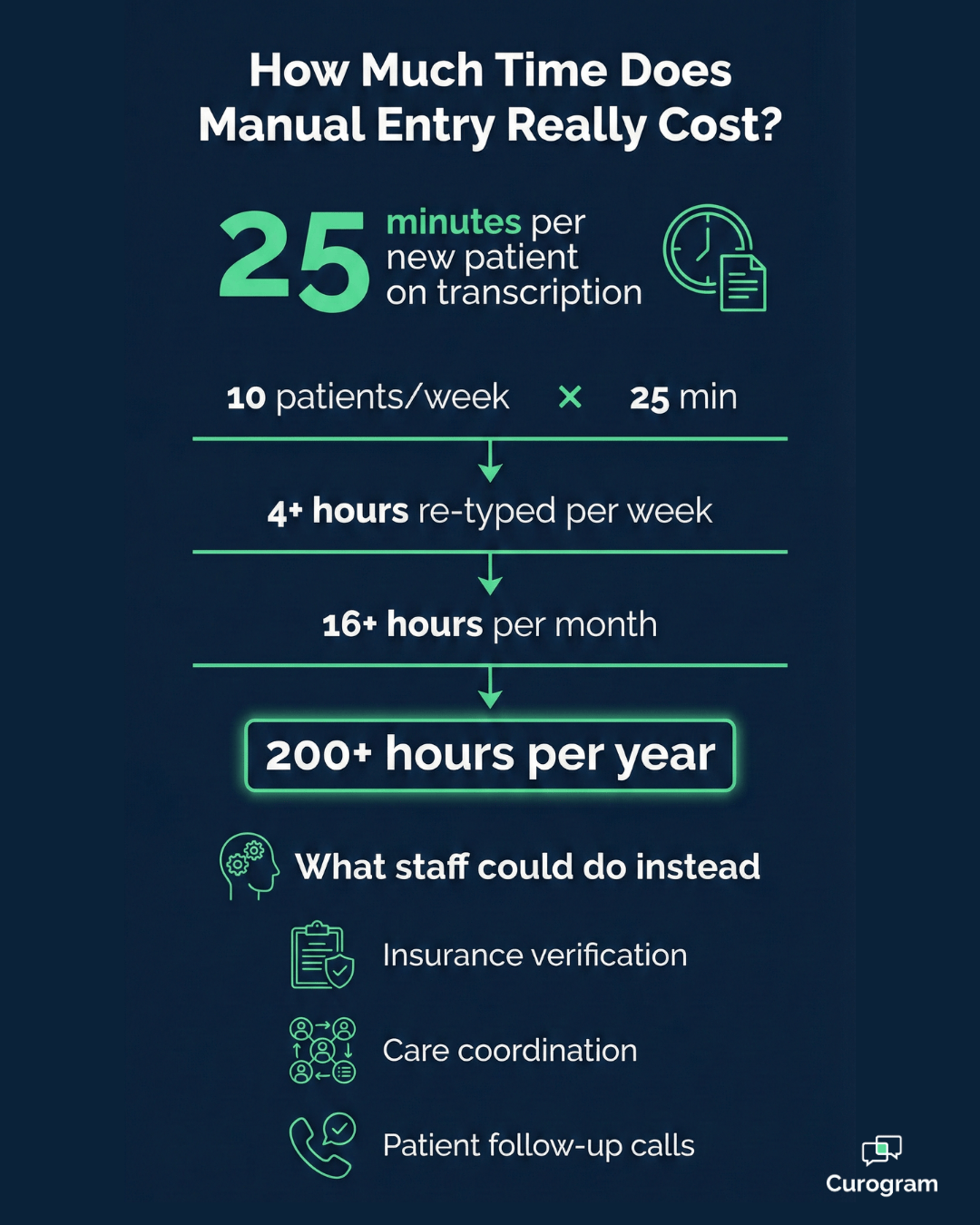
For every new patient block on your schedule, your team loses 20 to 30 minutes to an entirely redundant task.
Multiply that across a busy week and the numbers become hard to ignore. If your practice sees 10 new patients a week and each intake takes 25 minutes to transcribe, that's over four hours of staff time spent on pure data re-entry.
Those hours aren't going toward patient care, phone follow-ups, or insurance verification. They're going toward copying information that already exists on a piece of paper sitting right next to the keyboard.
Now add the handwriting factor. Not everyone writes clearly, and the consequences of misreading aren't minor. Consider what's at stake when a staff member has to guess between
Similar-looking words on a medical form:
Avoiding handwriting errors shouldn't require extra effort or special attention. It should be built into the process. Right now, for most practices, it isn't.
The result is predictable: staff dread the new patient block, accuracy depends on how good someone's eyesight is that morning, and your team spends its best hours doing the one thing they should never have to do — guessing.
This is data entry drudgery in its most concrete form, and it quietly undermines your data integrity while costing your practice time, energy, and accuracy every single day.

The idea is simple: let the patient be the data entry clerk. Instead of printing a form, handing it over at the front desk, and later re-typing every answer into CharmHealth, your staff sends a secure text message with a link.
The patient opens it on their phone, completes the form before the visit, and hits submit. That's the entire process on their end.
From a workflow standpoint, this is a significant shift. Your team no longer spends time on intake transcription at all. The effort moves upstream — to the patient, before the appointment — which means your staff arrives at the visit with a chart that's already populated and ready to review.
When the patient submits the form, Curogram's smart sync feature handles the rest. The completed data is instantly formatted and attached to the patient's profile in CharmHealth — either as a PDF or in discrete fields, depending on your setup.
There's no waiting, no manual upload, and no extra step for your team.
The integration is designed to work quietly in the background. Staff don't need to check a separate inbox or remember to pull the form into the chart.
By the time the patient checks in, the data is already there. That reliability is what makes the system genuinely useful rather than just technically possible.
Standard texting tools weren't designed with functional medicine in mind. Curogram forms are.
They support the kinds of fields your intake questionnaires actually require:
A clipboard can't do any of that. A mobile-friendly digital form does all of it — and the automated patient history collection happens quietly in the background before your patient steps through the door.
Your staff doesn't need to learn a complicated new system, either. Sending a form is as straightforward as sending a text message. The whole point is to reduce front desk administrative work, not replace one burden with another. Once the workflow is set up, it runs on its own.
Typed data is always legible. That might sound like a small win, but the downstream effects are significant — and they highlight one of the most practical electronic records benefits for busy practices.
When patients enter their own health information — allergies, medications, past diagnoses, and current concerns — there's nothing to decode.
What they typed is exactly what appears in the chart. Zero transcription errors, by design.
This kind of accuracy matters more in integrative medicine than in almost any other specialty. Your intake process is built around gathering detailed, nuanced information about a patient's full health picture.
When that information is collected digitally and synced directly to CharmHealth, nothing gets filtered through a third party's interpretation of someone else's handwriting.
This changes the nature of your staff's role in a meaningful way. Instead of typing, they're reviewing. The task becomes checking that required fields are complete and flagging anything that needs follow-up — not transcribing line by line from a paper form.
That's a faster process, a less stressful one, and a more appropriate use of your team's attention.
It also creates a natural quality-control step. When staff review a digitally submitted form, they're looking at complete, readable data.
Anything missing is obvious. Anything unusual stands out immediately.
That's a much better position to be in than trying to catch errors while simultaneously trying to read and type at the same time.
The benefit doesn't stop at the front desk. When a form is submitted before the appointment, the chart is populated and ready. The provider can review the intake data, identify key concerns, and plan the conversation — before the patient even checks in.
Instead of reading through a form while the patient watches and waits, the visit can start with real dialogue.
For integrative practices managing complex, multi-page patient histories, this kind of preparation is hard to overstate. The provider isn't catching up during the appointment — they're already ahead of it. The information is accurate, it's in the right place, and it's there on time.
That's what a well-run intake process looks like, and it starts with eliminating the step that never should have existed in the first place.
Can we use our existing PDF forms?
Yes — you don't need to rebuild anything from scratch. Curogram takes your existing intake questions and converts them into a mobile-friendly digital format. Every clinical nuance in your current forms is preserved.
Patients get a clean, easy-to-use experience on their phone, and your team keeps the same structure you've always relied on.
What happens if a patient forgets to sign?
Digital forms include required fields that prevent submission until every mandatory item is complete. If your form requires a signature, the patient cannot hit submit until it's added.
This means 100% signature compliance on every form — no more chasing patients down after the fact or discovering a missing signature at the time of the visit.
Does this work for insurance cards?
It does. Curogram forms can include an image upload field where patients take a photo of their insurance card and photo ID directly from their phone.
Those images sync to the patient's chart in CharmHealth alongside the rest of the form data. It eliminates one more manual step for your staff and speeds up the check-in process considerably.
Your front desk team handles insurance verification, patient check-in, scheduling, phone calls, and a dozen other responsibilities before noon. Re-typing handwritten forms isn't a good use of that skill set. It's a bottleneck dressed up as routine.
Digital forms aren't just a modern convenience. They're accurate in a way that handwritten forms simply can't match. When patients enter their own data, legibility is guaranteed. When that data syncs directly to CharmHealth, nothing gets lost in translation. The result is a cleaner chart, a faster workflow, and a staff team that can spend their energy where it actually matters.
This is exactly what Curogram is built to do. It eliminates manual data entry for CharmHealth intake forms by shifting the input responsibility to the patient — the one person who knows their own history best. Your team reviews. Your provider prepares. Your patients show up to a visit that's already off to a strong start.
Shedule a demo with Curogram today. Watch how a form goes from an SMS link on a patient's phone to a completed entry in their CharmHealth chart — in seconds.
💡 Digital intake forms for eKyros centers let patients complete sensitive medical history privately on their phones before appointments. This...
💡 Automating data entry for eKyros clinics removes the need to type handwritten patient forms by hand. With Curogram's digital intake workflow,...
💡 Patient recall and mass messaging for CharmHealth lets medical practices reach dormant patients through text instead of email. By connecting...