
Fix OncoEMR Oncology Staff Telehealth Workflow With Text Link Setup
💡 Telehealth shouldn't add work to your nursing staff's plate. With Curogram, oncology patients join video visits by tapping one text link. Here's...
Your front desk just confirmed a patient by text. Now the video visit starts. So a staff member closes the messaging window, opens a separate telehealth tool, logs in again, and joins the call.
After the visit, they switch back to take payment.
Three tools. One appointment. Every single time.
That is the quiet drain inside a lot of CharmHealth practices. Virtual care was supposed to make the day simpler. Instead, it added one more window to keep open and one more login to remember.
It sounds small. It adds up fast.
Here is the part that stings.
Your team isn't slow or careless. The work is just split across separate systems that were never designed to talk to each other. Every toggle is a few wasted seconds, a small mental reset, and a tiny chance for an important detail to slip through.
Now multiply that friction by every provider, every visit, every day of the week.
The good news is that none of this is permanent. The tools created the problem, so the tools can take it away. A consolidated telemedicine workflow for CharmHealth practices fixes the underlying cause, not just the symptoms your staff feel.
The idea behind it is refreshingly simple. You run the video visit from the same dashboard you already use to send reminders and collect payments.
No separate tool to open. No extra login to remember. No spare module sitting off to the side for someone to maintain, patch, and update.
In this guide, we'll cover why the extra login quietly costs far more than it appears to, what a true single-platform visit looks like in practice, and the real numbers behind consolidation.
You'll also see how practices keep CharmHealth exactly as it is for the clinical chart. Let's start with the hidden cost.
CharmHealth delivers video visits through a separate plugin. So running virtual care means stepping out of the messaging-and-scheduling flow your team uses for everything else. The chart stays put, but the visit lives somewhere else entirely.
Here is how it plays out in real time. Switch to the telehealth tool to start the visit. Switch back to text the patient a form. Switch again to collect payment.
That is a mid-day tool shuffle for a single appointment. Run it across every provider's schedule and the lost minutes pile up quietly.
Per-provider fees and separate logins affect you in two distinct ways. There is the line item, which represents the add-on price itself. Then there is the hidden cost: more setup, more training, and one more system that can break.
Virtual care should simplify the day. Too often, it just adds another tab. The point of telemedicine without a separate login is to put that time back where it belongs.

Curogram is the all-in-one platform, which means the visit runs in the same place as reminders, forms, payments, and reviews.
The feature that makes this work is multi-user telemedicine, launched right from the dashboard your staff already open. There is no second system to sign into.
That one dashboard handles the moments that used to demand three separate tools:
Each of those steps once meant its own login and its own tab. Now they share a single screen, so the work moves in a straight line instead of bouncing between disconnected windows.

Here is the difference side by side.
| Step in the visit | Separate telehealth add-on | One Curogram platform |
|---|---|---|
| Send the reminder | Messaging tool | Same dashboard |
| Start the video visit | Telehealth login | Same dashboard |
| Collect the payment | Billing tool | Same dashboard |
| Maintain it | Several systems | One system, one bill |
Curogram works alongside CharmHealth, so you drop the standalone telehealth add-on without disrupting the EHR.
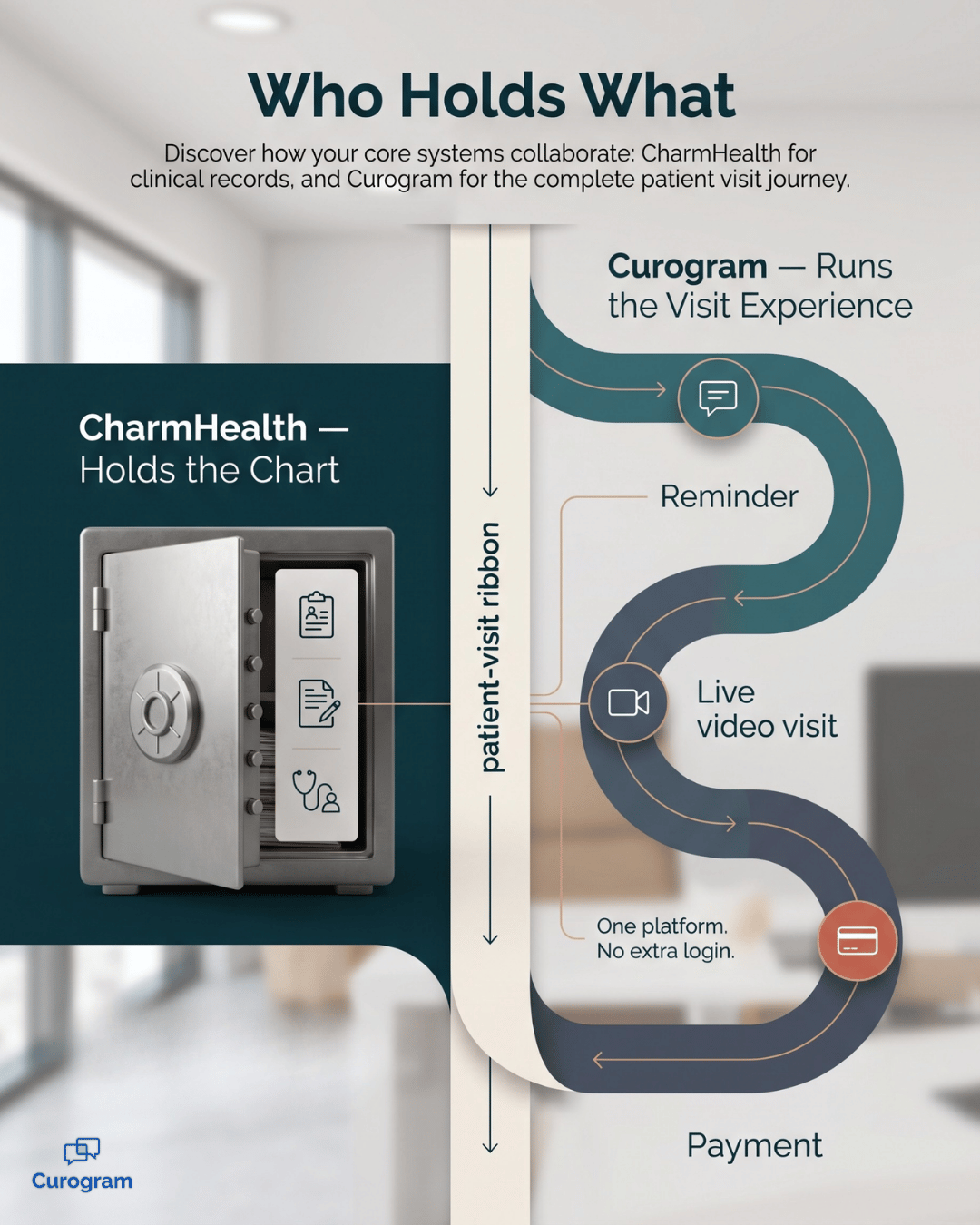
When practices consolidate telehealth, CharmHealth keeps holding the chart while Curogram runs the visit around it.
For a 1–20-provider team, this is an all-in-one engagement platform CharmHealth offices can run for the whole patient journey. It is one platform where video visits, reminders, and payments share a single screen.
That is the CharmTeleHealth alternative workflow in a nutshell.
To reduce add-on tools, CharmHealth practices simply move the visit into software they already use, instead of bolting on one more login.
The math is where this gets concrete. Eliminating the $20/provider/month telehealth add-on and folding the visit into a platform built for under-10-minute onboarding removes both the cost and the tool sprawl at once.
Here is a sample for a five-provider office, just to show the shape of it.
$20/provider/month telehealth = $100/month $100/month = $1,200/year for that one add-on $305+/month is where many practices land once add-ons stack up
For your team, that means the savings are not theoretical. Folding the visit into one platform cuts a recurring line item and most of the overhead around it.
Over a full year, that is real money you can point to.
The bigger shift is what staff actually feel. The whole visit lifecycle now lives in one place, from the reminder to the call to the payment. That is the one-platform practice in action.
In practice, the outcome is reliable and uneventful in the best possible way. Your team runs reminders, the visit, and payment without switching tools.
The practice maintains one system instead of several, and there is nothing extra to keep patched and current.
Consolidating telehealth does one thing really well. It ends the extra-login shuffle without changing how CharmHealth runs clinically. Your chart stays exactly where it is.
Think of it as a clean split of duties.
CharmHealth holds the record. Curogram runs the visit experience around it — the reminder, the video call, the payment — all in one place.
That shift sounds minor on paper. In daily practice, it changes the entire rhythm of the front desk. Your team stops hunting around for the right tab. They stop logging in twice just to handle one appointment.
And the savings here are real, not theoretical. Dropping a recurring per-provider add-on and folding the visit into one platform trims both the fee and the overhead that surrounds it. For a busy office running dozens of visits a week, that genuinely adds up across the year.
Here is the bigger point worth sitting with.
Every extra tool you remove is one less thing to train new hires on, troubleshoot, and pay for. Simpler isn't just nicer for your staff. Simpler is measurably cheaper and far harder to break.
You don't need to rebuild anything to get there. CharmHealth keeps doing what it does best. Curogram simply brings the visit into the workflow your front desk already lives in.
So stop maintaining a separate telehealth tool just to start a video call. Bring the whole visit, from reminder to payment, into the platform you already use every day.
The fastest way to see it is to watch it run on your own setup. Schedule a Demo, and we'll show a visit launching right beside your reminders and payments. One platform usually costs less than the add-ons it replaces.
No. Curogram gives you a single-platform alternative, so you can retire the standalone telehealth add-on while CharmHealth keeps handling the clinical record. Nothing about the chart changes.
No. Video visits launch from the same Curogram dashboard your team uses for messaging, reminders, and payments. Onboarding is designed to take under 10 minutes, so the learning curve is short.
Instead of paying $20/provider/month for telehealth on top of other add-ons that push spending toward $305+/month, the visit is included in one platform. So consolidation lowers your total spend rather than adding to it.
No. Curogram runs alongside CharmHealth, not on top of it. CharmHealth continues to hold the clinical record, and you simply move the visit experience into one shared workflow.
It fits practices from a single provider up to a 20-provider group. One platform for the whole patient journey means the same simple setup whether you run one schedule or twenty.
💡 Telehealth shouldn't add work to your nursing staff's plate. With Curogram, oncology patients join video visits by tapping one text link. Here's...
💡 Cerbo has no built-in video visits. Curogram adds them to the same text thread your patients already use. HIPAA-compliant video visits launch...
💡 Curogram's NextGen telemedicine workflow powered by Schedule-Triggered Video Launch lets clinicians initiate HIPAA-compliant video visits...