Automated Appointment Reminders for Cerbo: Protect Your Clinical Time
💡 Automated appointment reminders for Cerbo help functional medicine practices protect high-value clinical time and reduce no-shows. Sends 2-way...

12 min read
Mira Gwehn Revilla
:
Updated on January 27, 2026
Your front desk team starts each morning with a long list of patients to call. By noon, half of those calls went to voicemail. The rest sparked a game of phone tag that eats up hours of their day.
This scene plays out daily in functional medicine clinics across the country. Staff spend 2 to 3 hours calling patients who rarely pick up. The goal is simple: confirm who will show up. Yet the process feels anything but simple.
For boutique practices, this grind hits harder. Your team wears many hats. They track labs, prep for complex visits, and greet patients with warmth. But when they're tied to the phone, those high-touch tasks suffer.
The good news is, there's a better way. A Cerbo appointment reminder workflow can take this task off your plate. By linking Curogram to your MD-HQ scheduler, you create a system that works without constant human input.
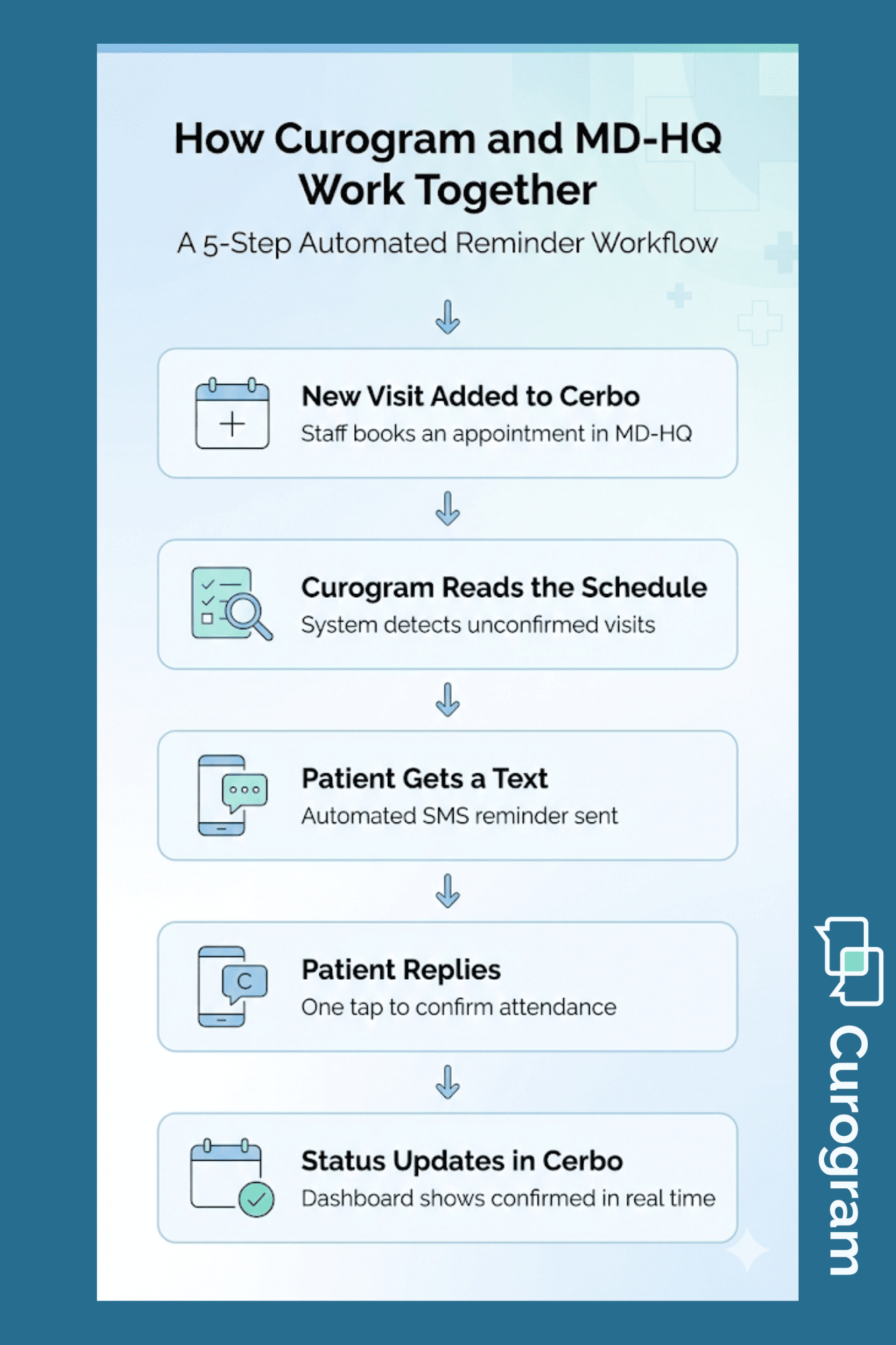
Here's how it works: The system sends 2-way SMS reminders to patients with pending visits. Patients tap once to confirm. That response flows back to Cerbo in real time. Your dashboard updates, and no one had to dial a single number.
This approach does more than save time. It helps reduce clinic admin by giving your staff room to breathe. Instead of chasing down answers, they can focus on the care that sets your practice apart.
In this guide, we'll show you why manual calls drain your team. We'll walk through how MD-HQ schedule automation works with Curogram.
Let's put an end to the phone tag cycle.
Every call your staff makes is a gamble. Will the patient pick up? Will they return the voicemail? Or will the cycle drag on until the day of the visit?
For Cerbo boutique clinics, this gamble plays out dozens of times each day. The result is a drain on time, focus, and morale.
Think about a typical day at your front desk. Your staff member pulls up the list of patients due for a visit in the next two days. There might be 30 names on that list. They start calling.
The first call goes to voicemail. So does the second. By the tenth call, they've left eight messages and reached two people. That's 20 minutes gone with little to show for it.
Now, multiply that by the callbacks that trickle in throughout the day. Each one breaks their focus. They might be in the middle of pulling lab results or helping a patient at the window. The phone rings, and they have to shift gears.
This pattern eats up 2 to 3 hours daily in most practices. For a team of two or three, that's a huge chunk of the workday spent on a task that yields spotty results.
Confirmation calls don't just take time. They break the flow of other work. Each switch between tasks costs mental energy.
Picture your patient care lead prepping charts for tomorrow's complex visits. The phone rings. They answer, mark a confirmation, and try to get back to the chart. But now they've lost their place. They spend a few minutes finding their focus again.
Across a full day, these small breaks add up. Studies on task switching show that even brief breaks can cut work output by a large margin. For a small clinic where every hour counts, this cost is real.
Your team didn't train to make calls all day. They trained to support patients through care plans, track supplement orders, and answer questions about protocols. When phones eat their time, those skills go to waste.
Manual calls create another problem: stale data. When a staff member gets a confirmation by phone, what happens next? Often, they jot a note or make a mental mark. Hours might pass before they update the chart.
During that gap, your provider lacks a clear view of the day's schedule. They don't know who confirmed and who's still pending. This makes it hard to plan for the flow of visits.
In functional medicine, this matters even more. Long consults require prep time. If a slot might be empty, your team could have used that hour for another patient. But without clear data, they can't make that call.
The lag also affects your ability to fill gaps. If a patient cancels at the last minute, you have no lead time to reach out to your waitlist. The slot stays empty, and revenue walks out the door.
These pain points share a common thread: they stem from a process that relies on human effort at every step. Each call, each note, and each update depends on your staff.
Functional medicine confirmations deserve a smarter approach. When you automate the routine parts, you free your team to do what they do best. They can focus on patient education, care follow-up, and the personal touches that keep patients loyal.
The solution starts with removing the phone from the equation. In the next section, we'll look at how Curogram connects to Cerbo to create a hands-free system that keeps your schedule full without the grind.
Manual calls put your staff in a reactive loop. They wait for answers, chase down responses, and update records by hand. The result is a system that depends on constant effort.
A Cerbo appointment reminder workflow flips this script. It puts the work on autopilot so your team can step back.
The system starts by watching your Cerbo schedule. It looks for visits that haven't been confirmed yet. Only those patients receive a reminder.
This matters for patient trust. No one wants three texts about the same visit. Over-messaging can annoy patients and train them to ignore your texts. A smart system avoids this trap.
Here's an example. Say you have 25 patients on tomorrow's schedule. Ten already confirmed when they booked online. The system ignores those ten. It sends reminders to the 15 who haven't responded yet.
This targeted approach keeps your outreach clean. Patients only hear from you when there's a reason. And your staff never has to sort through a list to figure out who needs a call.
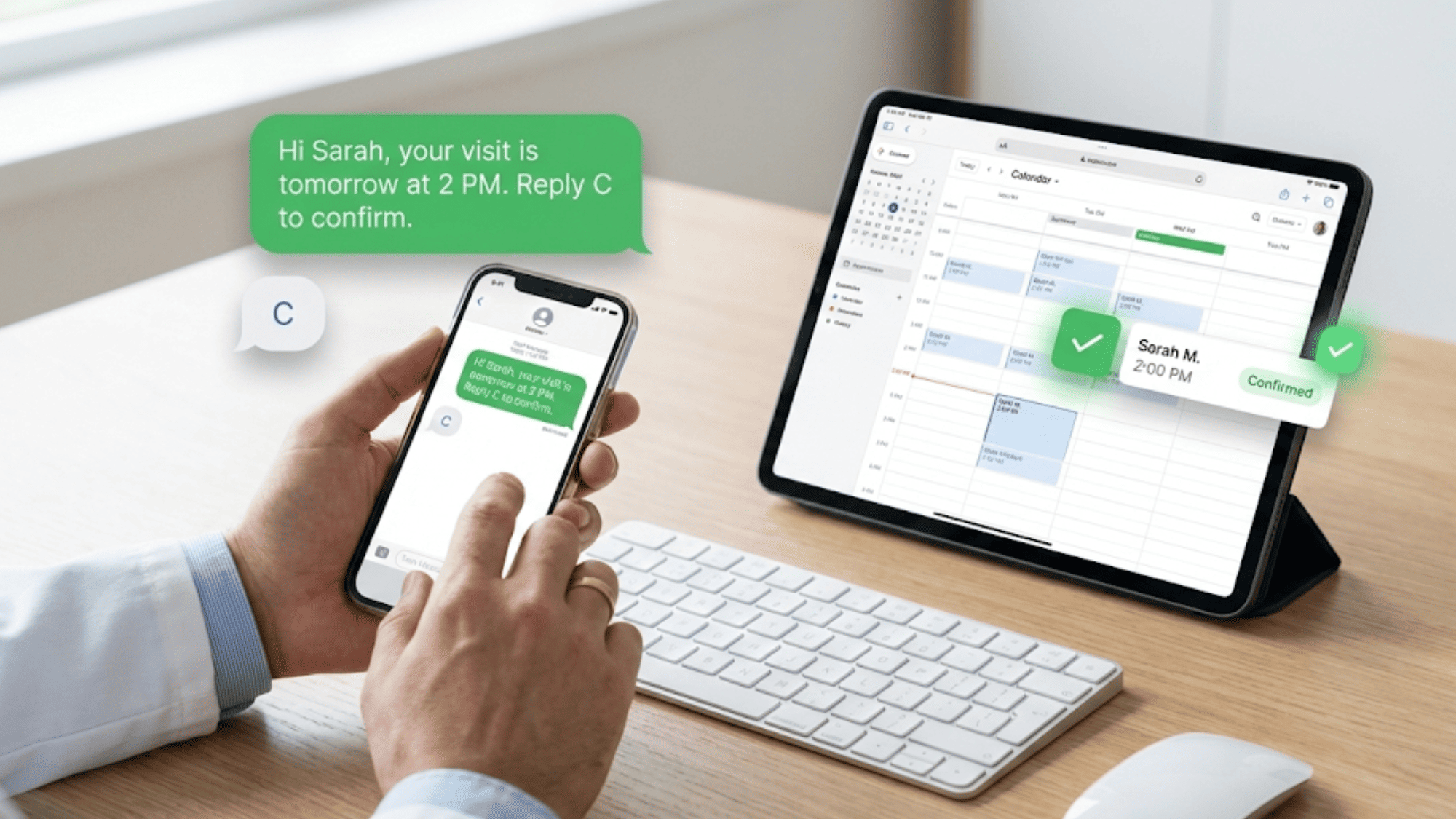
The real magic happens when patients reply. A 2-way SMS lets them confirm by sending a simple "C" or by tapping a link in the message.
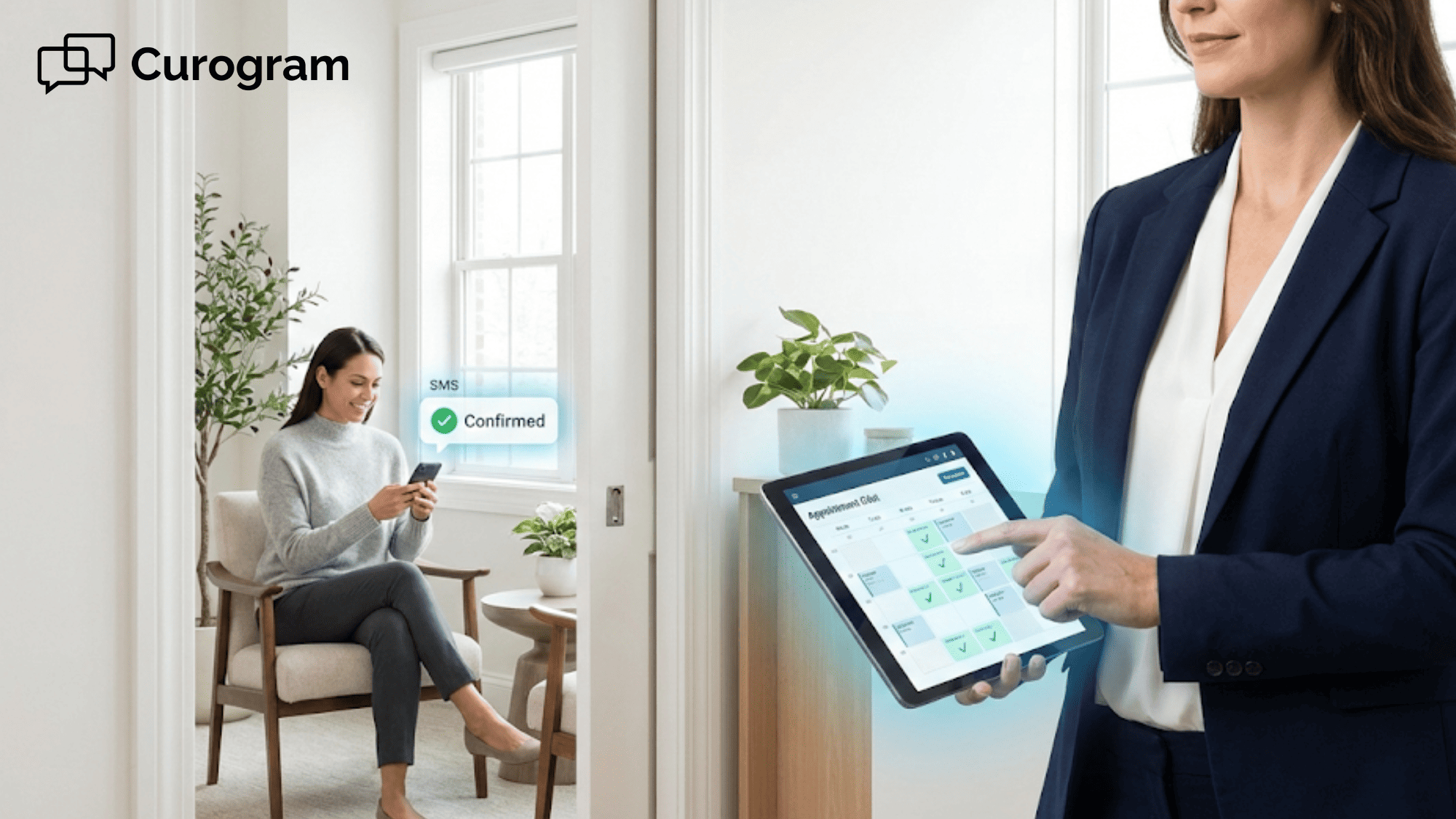
Once they respond, the status field in MD-HQ changes on its own. Your team sees a "Confirmed" mark in Cerbo without lifting a finger. There's no need to check the phone, log into another system, or type a note.
This MD-HQ schedule automation removes the data lag we talked about earlier. The moment a patient confirms, everyone in your clinic knows. Your provider sees a clear view of the day. Your front desk can move on to other tasks.
Think about what this means for a busy morning. Instead of checking voicemails and making return calls, your staff opens Cerbo and sees the truth at a glance. That clarity lets them plan with confidence.
Functional medicine visits aren't all the same. A 15-minute follow-up call is different from a 90-minute new patient intake. The stakes of a missed appointment vary by visit type.
The system lets you set reminder timing based on visit length or type. For long-form consults, you might send a "Save the Date" message 7 days out. Then, you follow up with a "Final Confirmation" 48 hours before the visit.
This two-touch approach works well for high-value slots. These are the visits that take the most prep and bring the most revenue. By giving patients two chances to confirm, you protect those slots from last-minute gaps.
For shorter visits, a single reminder 24 hours out might be enough. You can tailor the timing to match the needs of each visit type. This keeps your outreach relevant and avoids reminder fatigue.
Some clinics worry that new tools will disrupt their flow. Curogram was built to fit into your current setup. It connects to the Cerbo API, which means it reads your schedule data without forcing you to change how you work.
You don't need to enter data twice. You don't need to learn a new dashboard for basic tasks. The system runs in the background while you keep using Cerbo the way you always have.
For a boutique practice where time is tight, this ease of setup is key. Training takes minutes, not hours. And the return on that small investment shows up fast in the form of fewer calls and cleaner data.
In the next section, we'll explore how this freed-up time can shift your staff toward the work that really moves your practice forward.

Saving time is only half the story. The real win comes from how your team uses those extra hours.
When confirmation calls disappear, your staff gains room to do work that matters. They can track labs, guide patients through protocols, and create the personal touch that defines boutique care.
Let's put some numbers to this. Say your practice saves 10 hours per week on confirmation calls. That's 40 hours per month, or about one full-time week of labor.
Now, think about what your team could do with that time. Here are a few high-value tasks that often get pushed aside.
Lab result tracking is a big one. Functional medicine relies on detailed blood panels, stool tests, and other labs. Results come in at different times from different labs. Someone needs to log them, flag anything out of range, and alert the provider.
With extra hours, your staff can stay on top of this flow. They catch results faster, which means patients get feedback sooner. This improves outcomes and builds trust.
Patient education is another area that benefits. Many functional medicine protocols involve supplements, diet changes, or lifestyle shifts. Patients often have questions. They want to know how to time their doses or what foods to avoid.
When your staff has breathing room, they can answer these questions with care. They can send follow-up texts with tips or links to helpful guides. This kind of support keeps patients on track and reduces drop-off.
Care coordination rounds out the list. Complex cases may involve outside specialists, pharmacies, or other providers. Your team can spend time making sure all the pieces connect. This reduces gaps in care and keeps patients from falling through the cracks.
One of the biggest costs of a missed appointment is the empty slot. In a boutique practice, each open hour represents lost revenue. For high-value consults, that loss can run into the hundreds of dollars.
Manual confirmation calls often come too late to fix this. By the time you learn a patient won't show, the slot sits empty. You don't have time to reach out to someone else.
With SMS-based functional medicine confirmations, you get answers earlier. The 48-hour reminder window gives you a buffer. If a patient cancels, your team has time to act.
Here's how the waitlist process might work:
You keep a list of patients who want an earlier slot. When a cancel comes in, your staff texts the next person on the list. If they can't make it, you move to the next name.
This back-and-forth happens fast over text. A phone call might take 5 minutes per patient. A text exchange takes 30 seconds. In the time it would take to call two people, you can text ten.
The result is fewer empty slots and more revenue. Your schedule stays full even when plans change. And your patients on the waitlist get seen sooner, which keeps them happy.
Boutique patients expect a premium experience. They chose your practice for personalized care, not long hold times or phone tag.
SMS fits this expectation. It's quick, private, and respects the patient's time. They can reply from a meeting, a grocery line, or the couch. No need to step away for a phone call.
This convenience signals that your practice values their time. It sets a tone that carries through the rest of their care. They see you as modern, efficient, and easy to work with.
Text reminders also reduce the stress of remembering an appointment. Life gets busy. A text the day before serves as a gentle nudge that keeps the visit top of mind. Patients appreciate this help, even if they don't say it out loud.
For practices that focus on whole-person care, this attention to experience matters. It shows that you think about the small details, not just the clinical ones.
Let's walk through a sample week to see how this plays out:
Monday morning, your front desk opens Cerbo. They see 24 patients on the schedule for Tuesday and Wednesday. Of those, 18 have already confirmed via text. Six are still pending.
Instead of calling all 24, they review the six pending names.
By mid-morning, three have confirmed via text. The other three haven't replied. Your team sends a quick follow-up text to those three.
By end of day, two more confirm. One cancels. Your team texts the waitlist and fills the slot within an hour.
Compare this to the traditional way: Your staff would have spent 2 hours calling all 24 patients. Half would have gone to voicemail. Callbacks would have trickled in through the day, each one breaking their focus.
Instead, they spent about 20 minutes on confirmations. The rest of their time went to lab tracking, patient questions, and prep for complex visits.
This shift adds up over weeks and months. It's not just about doing less work. It's about doing better work.

Most practice owners didn't hire front desk staff to be callers. They hired them to be patient-facing coordinators. They wanted people who could make patients feel welcome and supported.
When confirmations eat up half the day, that goal falls short. Your team spends more time talking to machines than talking to patients. Their real skills go unused.
A Cerbo appointment reminder workflow restores the balance. It lets your staff do the job they were hired to do. And it lets your practice deliver the care that sets it apart.
The shift also helps with retention. Staff who feel useful and engaged stick around longer. Turnover is costly, both in dollars and in lost knowledge. When you reduce clinic admin, you create a better workplace for everyone.
The phone has been a staple of medical practice for decades. But that doesn't mean it's the best tool for every job.
Confirmation calls are a prime example. They take hours, break focus, and often yield incomplete data. For a boutique practice built on personal care, this grind pulls resources away from what matters most.
A smarter system lets technology handle the routine parts. Your team steps in only when a human touch adds value. The rest happens on its own.
This shift doesn't just save time. It changes the feel of your front desk. Staff are calmer. The pace is steadier. Patients get responses faster.
The data also stays clean. When confirmations update in real time, everyone knows the state of the schedule. Providers can plan. Coordinators can prep. No one is left guessing.
For clinics focused on functional medicine, this clarity is essential. Complex cases require prep time. High-value visits deserve protection. A reliable schedule makes both possible.
The choice isn't about adding more to your plate. It's about removing a task that no longer fits. Let the system handle the calls so your team can handle the care.
How Curogram Fits Into Your Existing Workflow
Curogram was built with clinics like yours in mind. The platform offers HIPAA-compliant 2-way texting that fits right into your current workflow.
The system integrates with almost any EMR, including the MD-HQ scheduler that functional medicine practices rely on. You don't have to switch platforms or learn a new way of working.
Setup takes minutes. Staff training can be done in as little as 10 minutes. And once it's running, the system works in the background without needing daily upkeep.
The benefits go beyond appointment reminders. Curogram can help you reduce phone call volume by up to 50%. That frees your team to focus on the tasks that drive patient outcomes and practice growth.
Practices that use the platform also see lower no-show rates. Some report drops of up to 75%. When patients confirm via text, they're more likely to keep the visit. And when they cancel, you hear about it fast enough to fill the slot.
The platform also supports other front desk tasks. You can send electronic patient forms, collect payments via text, and request Google reviews without any extra work from your staff.
For practices that want to reduce clinic admin, Curogram acts like an extra team member. It handles the repetitive work so your people can do the high-touch work that patients value.
The confirmation call is a relic of a time before texting. It made sense when phones were the only option. Today, it's a bottleneck that costs your team hours each week.
Boutique practices can't afford that loss. Your staff already juggles labs, patient questions, and care coordination. Adding a call list to their plate pulls them away from work that matters.
A Cerbo appointment reminder workflow changes the equation. It moves the routine task to a system that never gets tired. Your team gets back the hours they need to support patients the way you intended.
The shift also improves the patient experience. Texts are fast, private, and easy to answer. Patients feel respected when you don't ask them to play phone tag. This sets a positive tone before they even walk through the door.
For clinics built around functional medicine, these gains matter. Long consults require prep. High-value visits need protection. A reliable schedule makes both possible.
Curogram makes this vision real. It connects to MD-HQ, reads your schedule, and sends reminders on its own. Patient responses flow back in real time. Your dashboard stays current, and your staff stays focused on care.
The setup is simple. Training is quick. And the return on time invested shows up within the first week. If your front desk is tired of voicemails and callbacks, it's time for a change.
Let the system handle the routine so your team can handle the care. Book a demo today to see how Cerbo Health automated patient confirmations can give your team their time back and keep your schedule full.
No. The setup connects directly to your Cerbo API. This means the system pulls data from your existing schedule without asking you to change how you work. Training takes about 10 minutes. Most teams feel comfortable within the first day. Support is also available if questions come up down the road.
Curogram checks your Cerbo schedule for visits marked as unconfirmed. It only sends reminders to those patients, so you avoid duplicate messages and keep outreach clean and targeted.
You can set unique timing rules for each visit type in Cerbo. For long consults, send a 7-day and 48-hour reminder. For short follow-ups, a single 24-hour text may be enough.
💡 Automated appointment reminders for Cerbo help functional medicine practices protect high-value clinical time and reduce no-shows. Sends 2-way...

💡 Cerbo Health digital intake forms through Curogram let clinics collect patient data before visits. This ends the clipboard logjam that slows down...
💡 Telehealth for Cerbo through Curogram helps integrative and functional medicine practices grow their reach with ease. Send secure video visit...