Automated Appointment Reminders for Cerbo: Protect Your Clinical Time
💡 Automated appointment reminders for Cerbo help functional medicine practices protect high-value clinical time and reduce no-shows. Sends 2-way...
11 min read
Mira Gwehn Revilla
:
February 18, 2026
Every empty chair in your exam room is money walking out the door. For medical practices that run on CollaborateMD, a single no-show might seem small.
But add up three missed visits a day, and you could lose well over $100,000 a year. That is not a billing error. It is a revenue leak, and it happens quietly.
Here is the problem: CollaborateMD does a great job managing your billing. But billing only works when there is a visit to bill.
If the patient never shows up, your staff did all the prep work for nothing. The chart is ready. The room is clean. The provider is free. And the slot stays empty.
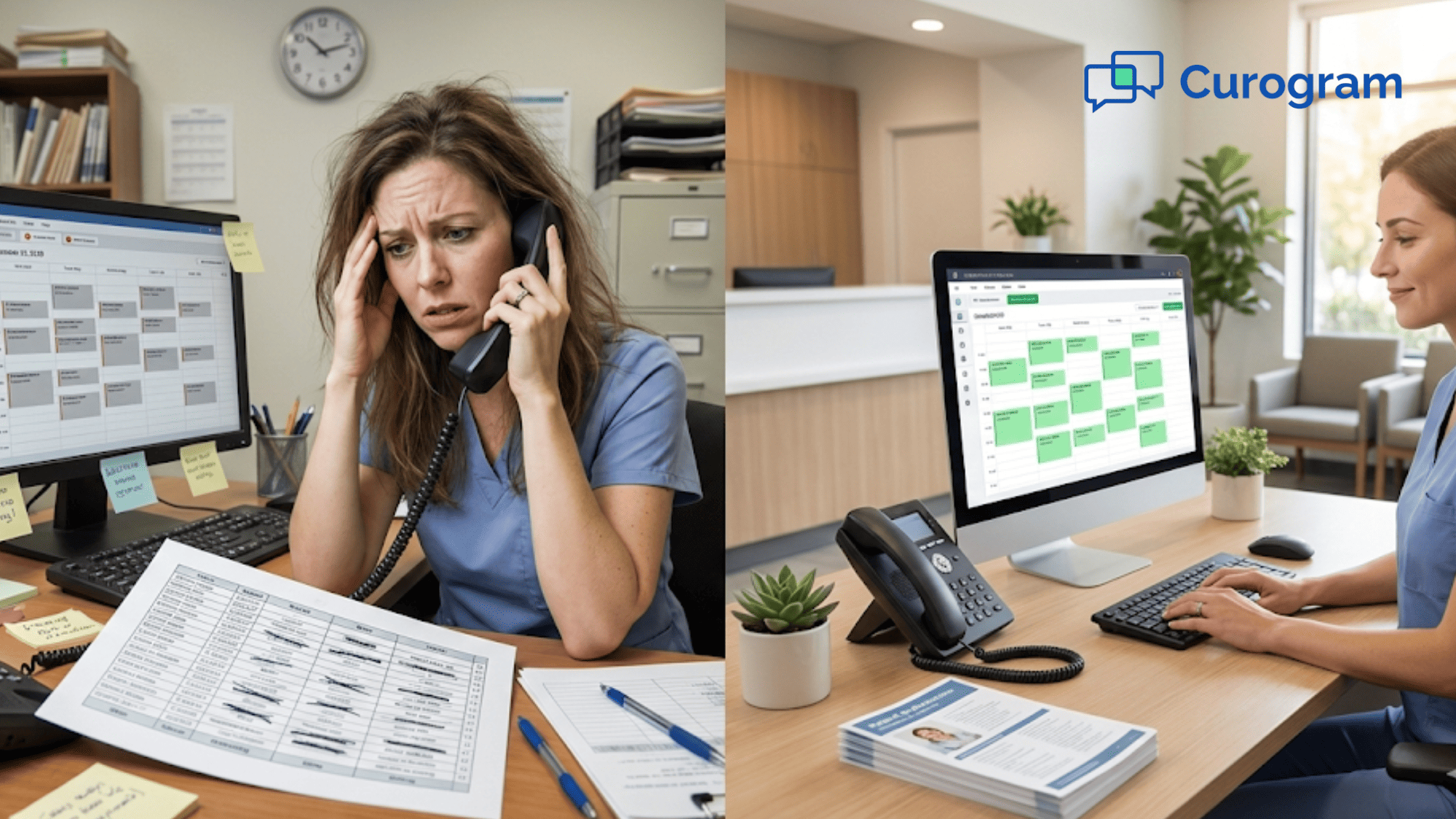
Most practices try to fix this with phone calls. A front desk team member prints the day's schedule and starts dialing. Fifty calls. Sixty calls. Most go to voicemail. By the end, only a handful of patients have confirmed. And the rest? You just have to hope they show up.
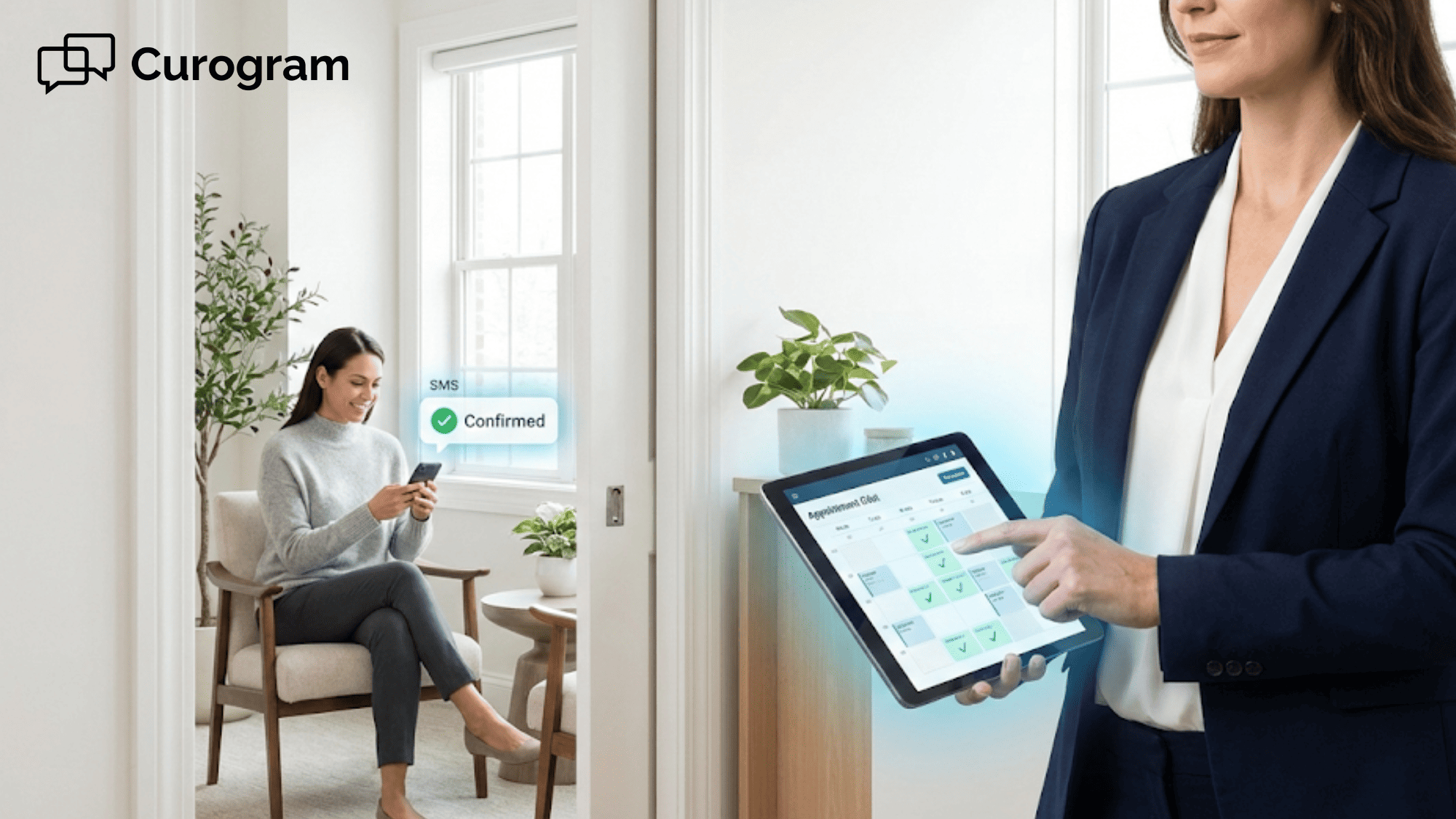
This is where automated appointment reminders for CollaborateMD change the game. Instead of chasing patients by phone, Curogram sends CollaborateMD SMS reminders straight to each patient's phone. Patients reply with a simple "Y" to confirm, and the status updates in your scheduler on its own.
Practices like Atlas Medical Center saw their no-show rates drop by 53% after setting up this system. Even better, 75% of their patients now confirm without a single staff call. That is not just a time saver. It is revenue you would have lost, now locked in.
In this article, we will break down why empty slots cost you so much, how 2-way appointment confirmation works with CollaborateMD, and what real results look like when you customize patient reminders the right way.
A no-show is not just an empty room. It is a missed charge, wasted prep time, and a gap in your revenue cycle that you can never get back. Let's put real numbers behind it:
|
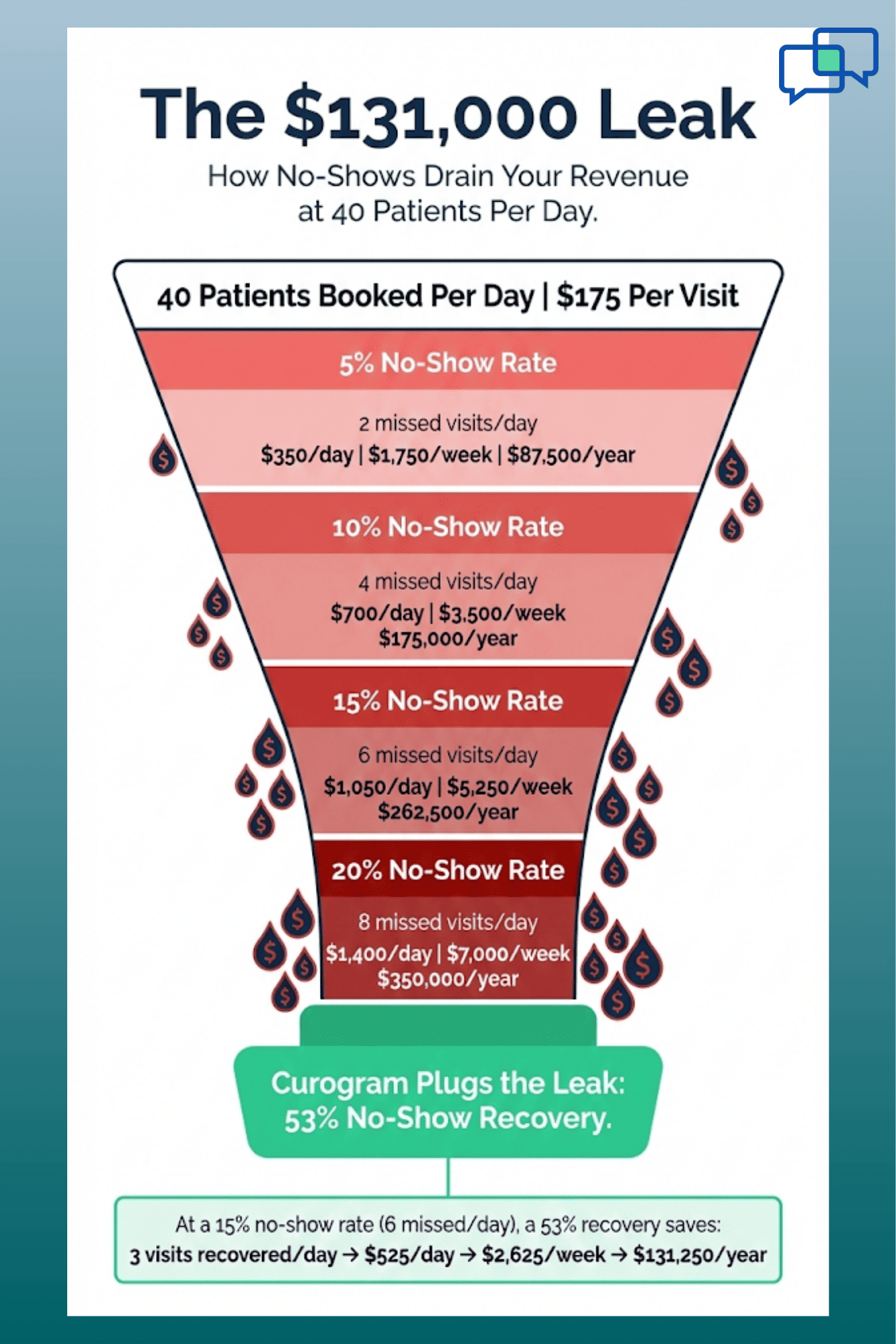
Say, your average visit brings in $175: That is a solid mid-range number for a primary care practice. If just three patients skip per day, that is $525 gone every single day. Over a five-day work week, you lose $2,625. Stretch that out over 50 working weeks, and the total hits $131,250 in one year. |
That number does not count the extra costs you still carry. Your staff is still on the clock. The exam room was prepped. Supplies may have been set aside. You are paying for a full day of work but only billing for part of it.
And if your no-show rate sits around 15% to 20%, which is common for many clinics, you are bleeding revenue every week without even knowing the full scope.
Most practices try to fight no-shows the old way: phone calls. A front desk team member pulls up the next day's schedule and starts calling every patient. In a busy clinic, that could mean 50 to 80 calls per day.
|
Here is what that looks like in practice: Your team member dials a number. It rings four times. Voicemail. She leaves a message. Moves on. Dials again. Another voicemail. Over and over. By the end of the day, she may have reached 10 to 15 patients out of 50. The rest are just question marks. Will they show up? You do not know. |
This eats up two to three hours per day of staff time. That is time your team could spend on things like checking insurance, collecting past-due balances, or helping patients in the lobby. Instead, they are stuck on hold.
Some offices hire extra staff just to handle calls. That adds $30,000 to $40,000 a year in salary, plus benefits. All to do a job that still has a low success rate.
CollaborateMD is built to handle billing and practice management well. It tracks claims, manages payments, and keeps your revenue cycle moving.
But there is a blind spot. If a patient does not show up, there is no claim to file. The billing engine has nothing to process. Your revenue cycle stops before it even starts.
Think of it this way: You can have the best billing system in the world, but if the patient is not in the room, it does not matter. The gap is not in your billing. The gap is in patient engagement before the visit.
This is the disconnect that costs practices the most. You are strong on the back end with claims and payments. But on the front end, you are relying on phone calls and hope. That is not a strategy. It is a gamble.
What you need is a bridge between your schedule and your patients, one that reaches them where they already are: on their phones. And that is exactly what medical scheduling automation through Curogram is built to do.

Now that you can see the real cost of the empty slot, let's talk about how to fix it. Curogram connects to CollaborateMD and turns your schedule from a hope-based list into a locked-down plan.
Here is how it works in plain terms: Once an appointment is booked in CollaborateMD, Curogram picks it up and sends a text to the patient. The message is simple and clear, something like: "Hi Sarah, you have a visit on Tuesday at 2:00 PM. Reply Y to confirm or N to cancel."
When Sarah texts "Y," Curogram reads that reply and writes the update back into your CollaborateMD scheduler. The status icon or color changes so your team can see at a glance who has confirmed.
No one has to open a second app. No one has to check a portal. It all shows up right where your staff already works.
This 2-way appointment confirmation removes the back-and-forth phone tag. It also means your schedule is more truthful. Instead of a list of names and time slots, you now have a clear picture of who is coming and who is not.
For a practice with 40 patients a day, this could save your staff two to three hours in phone time alone. Across a week, that is 10 to 15 hours freed up for tasks that bring in revenue, like following up on denied claims or calling patients with open balances.
Not every visit is the same, and your reminders should not be either. Curogram reads the appointment type from CollaborateMD and sends the right message for each one.
For a new patient, the text might say: "Please bring your insurance card and a valid photo ID." This small step helps your billing team get clean claims from day one. When a new patient walks in without their card, it slows down intake, delays billing, and can lead to denied claims.
For a follow-up visit, the message might be shorter: "See you Thursday at 10 AM. Reply Y to confirm." There is no need to ask for documents they have already given you.
For a telehealth visit, Curogram can include a link to the video platform right in the text. The patient taps the link and joins from their phone. No email to search for. No patient portal to log into.
This is what it means to customize patient reminders. Each patient gets the right info at the right time, with no extra work from your staff.
Cancellations happen. But an empty slot does not have to stay empty. When a patient texts "N" to cancel, Curogram alerts your staff right away. This gives your team a chance to act fast and fill that gap.
Some practices keep a waitlist of patients who want an earlier slot. With instant cancel alerts, your front desk can reach out to the next person on the list and book them before the day is over.
Without this system, cancellations often go unnoticed until the morning of the visit. By then, it is too late. The slot stays empty, and the revenue is gone. With Curogram, you turn a lost slot into a filled one, sometimes within minutes.
Numbers tell the real story. Let's look at what happened when Atlas Medical Center, a busy practice running on CollaborateMD, started using Curogram's automated reminder system.
Before Curogram, Atlas Medical Center dealt with the same problem as most clinics. Patients booked visits and just did not show up. Staff made calls. Most went to voicemail. The no-show rate stayed high, and the revenue hit kept adding up.
After switching to automated appointment reminders for CollaborateMD through Curogram, their no-show rate dropped by 53%. That is more than half of their missed visits, recovered.
|
Let's put that into dollars: Say, Atlas had 30 patients a day and a 20% no-show rate. That means six missed visits a day. At $175 per visit, that is $1,050 lost daily, or about $262,500 a year. A 53% cut brings the daily loss down from six missed visits to roughly three. That saves the practice over $130,000 a year just by sending texts instead of making phone calls. |
And this does not count the extra gains from filling those open slots with waitlist patients. The actual revenue impact is likely even higher.
This is the number that changes your front desk. At Atlas Medical Center, three out of every four patients confirmed their visit by text without any staff member picking up the phone.
Think about what that means for a 40-patient day. Thirty patients confirm on their own. Your staff only needs to follow up with 10 patients. That is a huge shift from calling all 40 and hoping for the best.
The reason is simple. People read texts. The open rate for SMS messages sits around 98%, compared to about 20% for emails. And most texts get read within three minutes. When you send CollaborateMD SMS reminders, you are reaching patients on the channel they actually use.
This also means your team can focus on the patients who did not respond. Instead of calling everyone, they only call the 25% who did not reply. That is a much shorter call list and a much better use of their time.
One of the biggest headaches with add-on tools is double entry. Your staff books the visit in CollaborateMD, then has to type the same info into a second system. That wastes time. It also opens the door to errors, like wrong dates or mixed-up phone numbers.
Curogram removes that step. It pulls patient data and schedule details straight from the CollaborateMD practice management module. Your staff does not need to enter anything into Curogram by hand. The system reads the schedule, grabs the info, and sends the right reminders at the right times.
This zero-entry setup was a key reason Atlas Medical Center saw results so fast. There was no learning curve for the front desk. No training sessions that took hours. Staff had about 10 minutes of setup, and the system started working on its own.
The Atlas case study is not a one-off success story. It shows what happens when you replace phone calls with a system that does the work for you. Here is a quick breakdown of how the numbers might look for different practice sizes.
If you see 20 patients a day with a 15% no-show rate, that is three missed visits. At $175 per visit, you lose about $2,625 a week. A 53% drop means you recover roughly $1,391 of that every week, or over $69,000 a year.
If you see 50 patients a day, the math scales fast. A 15% no-show rate means roughly 7 to 8 missed visits a day. That is nearly $1,400 lost daily. Cut that by 53%, and you save more than $175,000 a year.
These are not small numbers. For many practices, this is the difference between hiring a new staff member or not. It is the difference between upgrading equipment or putting it off for another year.
And the best part is, this does not require a complete system overhaul. You keep CollaborateMD as your billing and schedule hub.
Curogram layers on top of it and handles the patient engagement side. The two systems work together so your team does not have to change how they work.
See what the savings look like for your specific practice. Curogram's ROI Calculator lets you plug in your daily volume, current no-show count, and revenue per visit to get a custom estimate.

You cannot fix your revenue cycle if the cycle never starts. Every claim begins with a patient in the room. Every payment starts with a completed visit. If the chair is empty, your billing system has nothing to work with.
That is why automated appointment reminders for CollaborateMD matter so much. They are not a nice-to-have. They are the first step in making sure you get paid for the work your team is ready to do.
Think about what your practice looks like without reminders. Staff spend hours on the phone. Patients forget their visits. Slots stay empty. Revenue leaks out day after day, and no one has time to plug the gap.
Now, picture the opposite. Texts go out on their own. Patients confirm in seconds. Your schedule updates without any extra clicks. If someone cancels, your team gets an instant alert and fills the slot from a waitlist. That is not a wish. That is what Curogram delivers.
Curogram turns your CollaborateMD schedule from a hope list into a locked revenue plan. When 75% of patients confirm on their own, and no-shows drop by 53%, you are not just saving time. You are saving real money.
Why Curogram Is the Right Fit for CollaborateMD Practices
Curogram was built to work with the tools medical practices already use. It connects to CollaborateMD without needing a full tech overhaul.
Your team keeps using the same scheduler, the same billing module, and the same workflow. Curogram simply adds a layer of smart patient outreach on top.
What makes Curogram stand out is how fast it works. Setup takes about 10 minutes. There is no complex training needed. Your front desk staff can start seeing results the same week.
The platform handles more than just reminders. It supports HIPAA-compliant 2-way texting, which means your team can answer patient questions by text without putting data at risk.
It also sends smart recall messages to bring patients back for follow-up care, helping you reduce no-show rates medical practices struggle with and keep your schedule full.
Curogram also helps with intake. Patients can fill out forms on their phone before they arrive. This cuts down wait times and gives your billing team the info they need to file clean claims on day one.
For practices using CollaborateMD, Curogram is a direct plug-in that solves the biggest gap in the workflow: getting the patient through the door. And once they are there, your billing system can do what it does best.
The math is simple. If patients do not show up, you do not get paid. No matter how good your billing system is, an empty slot brings in zero dollars. That is the core problem, and it is one that phone calls alone cannot solve.
Automated appointment reminders for CollaborateMD give your practice a real fix. Curogram sends texts, patients confirm, and your schedule updates on its own. No extra staff hours. No phone tag. No wasted prep.
The results speak for themselves. A 53% drop in no-shows. A 75% auto-confirm rate. Zero manual data entry. These are not future goals. They are real outcomes from a real practice.
If you are still relying on phone calls to confirm visits, you are leaving money on the table every single day. The fix is not working harder. It is working smarter with a system that does the heavy lifting for you.
Your revenue cycle starts with one thing: a patient in the chair. Make sure they get there.
Plug the leak in your revenue. Schedule a demo with us and see how Curogram protects your schedule.
The system does not ignore it. Curogram routes that message to your team dashboard as a chat. A staff member can read the question, respond right away, and save the visit. This is a big deal because many patients who have questions will just skip the visit if they cannot reach someone fast. This turns a potential no-show into a kept visit.
Curogram pulls the next day's schedule straight from CollaborateMD's practice management module. It reads patient names, contact info, visit times, and appointment types, then sends reminders based on your chosen timing, with no staff input needed.
When a patient texts "N" to cancel, Curogram sends an instant alert to your staff dashboard. Your team can then contact the next person on your waitlist and fill the slot before the day of the visit, turning a lost visit into a billed one.
💡 Automated appointment reminders for Cerbo help functional medicine practices protect high-value clinical time and reduce no-shows. Sends 2-way...
💡 Integrative clinics can cut hours of admin work by using a Cerbo appointment reminder workflow with Curogram. 2-way SMS reminders that let...
💡 The cost of patient no-shows in CollaborateMD practices can top $150,000 per year for a 3-provider clinic. A single missed visit costs about...