9 min read
Automate Review Requests Across athenahealth Sites
Mira Gwehn Revilla
:
September 23, 2026
Table of Contents
- Checked-out appointment status is the trigger, so each site's review volume tracks its own visit volume
- Routing maps each athenahealth department to its own Google Business Profile, so satellite reviews never land on the flagship listing
- Requests go out a few hours after the visit, while the patient can still name who helped them
- Every patient gets the same ask, which keeps you clear of Google and FTC rules on gating
- Operations sees request, click, and post rates per location, instead of one network total
Pull two numbers for last month. Completed visits across the whole network. New Google reviews across the whole network. At forty locations the first number runs into the thousands, and the second usually fits on one line.
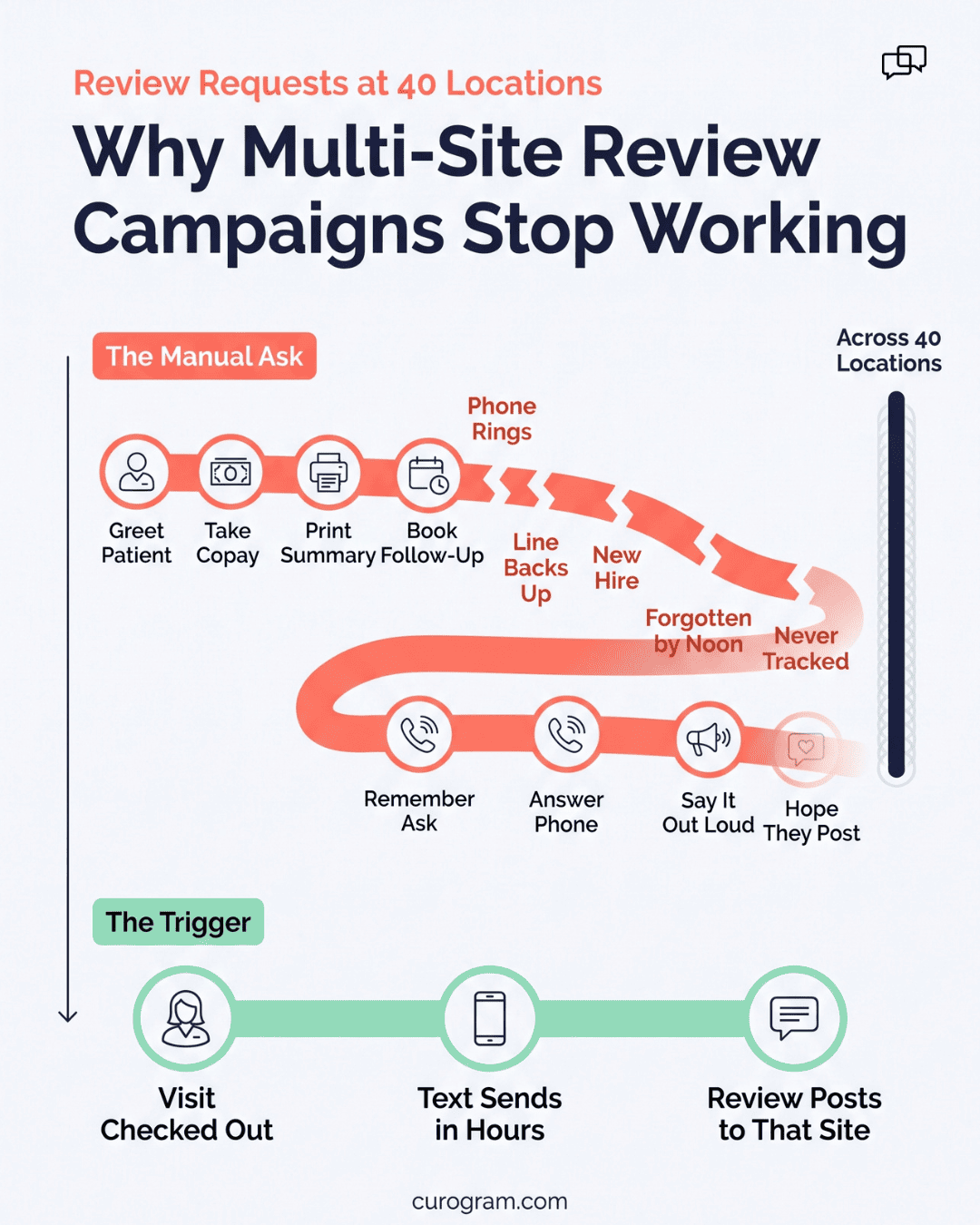
That gap has one cause. Forty front desks are being asked to remember one extra sentence at checkout, every day, forever.
Most networks have already run the campaign. Talking points go out, table tents show up, and week one produces a scattering of asks. By week three the asking has stopped at most sites, each on its own schedule, and no report anywhere shows the decay.
athenaOne already knows which visits finished. Status moves to checked out, the encounter closes, charges post. Automating review requests across athenahealth locations means treating that status change as the trigger and taking the person out of the loop.
One multi-location practice running this workflow collected 1,064 new 5-star reviews in three months, with about 90% of responding patients leaving five stars, based on our internal data. That's roughly a dozen reviews a day across the group. Staff hours spent asking: zero.
Reviews settle a lot before a patient ever calls you. A new family picks a location off a phone screen, usually in under a minute, and review count is doing most of the persuading.
About 90% of new patient leads look at your Google Business Profile before they reach your website, based on our internal data.
At one practice a thin profile costs you a few new patients. Across forty, your weakest profiles set the floor for how the brand shows up in local search.
The Manual Ask
Ask a network leader who owns review generation and the answer comes back as a department. Marketing owns the brand. Operations owns the sites. Front desk owns checkout, the copay, the visit summary, and a phone that does not stop.
Review Generation Belongs to Nobody
Checkout at a busy athenahealth practice is already a stack of tasks. Take the copay, send or print the visit summary, book the follow-up in athenaOne, pick up the line that's been on hold.
"And please leave us a review on Google" becomes the fifth task, and it's the only one with no consequence for skipping it.
Nobody gets coached for a missed review. So it goes first when the schedule runs hot.
Marketing feels the absence first, and marketing doesn't stand at checkout. The people who do are holding a copay, a phone line, and somebody's follow-up appointment.
Why the Asking Stops by Week 3
Campaign launches follow the same arc at almost every network. Week one, asks happen nearly everywhere, because the training is fresh. Week two, the busiest sites drop off. By week three the asking has stopped at most locations, each quitting on its own timeline.
Reporting is what makes this hard to catch. Network dashboards count reviews. Nothing in the stack counts asks. A flat review total gets blamed on Google's filter or on patient satisfaction, and the one thing that actually changed, whether anyone asked, never shows up in a report.
Leadership usually finds out a quarter later, when someone pulls location profiles for a board deck and half the satellites are in single digits.
Turnover Resets a Location to Zero
Front desk turnover runs high in outpatient groups, and each departure takes the habit with it. A new hire gets trained on athenaOne scheduling, check-in, and copay collection. Review requests sit near the back of the training doc, filed under nice to have.
Six months of normal turnover across forty sites means the program has partly relaunched dozens of times. No single relaunch is visible from the center. What you end up with is a network where review counts track staffing history instead of care quality.
Two sites can post the same patient satisfaction scores and land 20 reviews apart in a quarter. What separates them is that one kept its front desk lead.
You can usually guess a location's staffing stability from its Google profile before anyone opens an HR report. Long review gaps line up with the months a site was short-staffed.
Staff Workload and Reputation Management Pull Against Each Other
Reputation management that runs on staff workload has a hard ceiling, and the ceiling sits lowest where you most need volume. High-traffic locations see the most patients, so they could produce the most reviews. They also have the least slack at checkout, so they skip the ask first.
That inverts the result you want. Your busiest satellite, the one feeding the most new patients into the network, ends up with the thinnest public profile.
|
Site |
Completed visits per month |
New reviews last quarter |
|
Flagship, stable front desk |
610 |
24 |
|
Satellite A, two lead changes |
840 |
3 |
|
Satellite B, newest site |
290 |
11 |
Illustrative pattern, not client data
What a Competitor Does With That Quarter
Review counts don't reset, and they don't decay on a schedule you control. Every quarter of manual asking compounds for somebody else.
An independent clinic three miles from your satellite that adds 40 reviews a quarter sits at 160 after a year. Your satellite sits at 12.
Google's local pack treats those two profiles very differently, and so does a patient comparing them on a phone.
Patients aren't comparing your satellite to your flagship, either. They're comparing it to whatever else shows up in the map pack for that ZIP code, where review count and recency both carry weight.
Catching up later costs more than starting now, because the target keeps moving while you plan.

The Network Reputation Desk
Appointment reminders got reliable when they stopped depending on someone placing a call. Review requests get reliable the same way, by reading appointment data.
The Trigger Lives in Appointment Status
Curogram connects with athenahealth and watches appointment status. A visit that moves to checked out drops that patient into the review request queue for that location.
No list gets exported. No campaign gets built. Nobody at the site touches anything.
That's what separates post-visit review request automation network-wide from a marketing send.
A send needs a person to build it, so its volume depends on who has time that week. Triggered requests key off completed visits, and every location already produces those in the hundreds each month.
Review Request Timing Best Practice: Hours, Not Days
The review request timing best practice we land on is same-day, a few hours after checkout. Send at 15 minutes and you're competing with the drive home.
Send at three days and the detail worth writing about is gone: the scheduler who found a slot, the nurse who explained the imaging order. What survives is "it was fine," which produces a four-star rating with no text.
A few hours out, the patient is home and free, and can still name a person by name. Same-day timing also keeps the request attached to the right visit.
Patients in active treatment may come in weekly, and a request that arrives Thursday for Monday's visit gets answered about Wednesday's.
One Department, One Google Profile
Multi-location athenahealth groups run each site as a department under one practice. Every department carries its own ID, its own schedule, and in most cases its own Google Business Profile with its own address and phone number.
Routing has to honor that mapping or the program works against you. Reviews from the Chandler office landing on the flagship's profile inflate one listing and starve another, and Google's local pack ranks individual listings, so a strong brand average never carries a weak one.
Setup is a table you build once: athenahealth department ID, Google Business Profile, review link. After that, a patient checked out at department 14 gets department 14's link, every time, with nobody choosing.
What the Text Actually Says
Wording carries most of the compliance load, so it's worth seeing:
Hi Marcus, thanks for coming in to Desert Ridge Family Medicine today. Would you share how your visit went? It takes about a minute: [link]. Reply STOP to opt out.
Four things are working in those 30 words. Naming the location tells the patient which visit you mean. The ask is flat, with no rating question sitting in front of it.
A one-minute estimate converts better than an open request, because the patient knows the cost up front. And the opt-out keeps the message inside TCPA rules for patient texting.
No Review Gating: The Compliance Line
Every checked-out patient gets the same message. Nothing sorts happy patients toward Google and unhappy ones toward a private form.
Gating is prohibited, which is why the flat ask is the only defensible design. Google's review policies ban it outright, and the FTC rule on consumer reviews and testimonials, effective October 2024, covers review suppression directly.
Google review automation at enterprise scale is also far more visible than one clinic's workflow. Forty sites running an identical gated flow reads as policy rather than an accident.
Unhappy patients still have somewhere to go. The message accepts a reply, and a negative reply lands in that location's inbox while the visit is a day old, which is a service recovery window. Nothing stops the patient from posting publicly, and nothing should.
Per-Location Numbers Operations Can Manage
Review generation becomes manageable once it reports like everything else the network runs. Requests sent, links clicked, reviews posted, by location, by month.
That turns a soft goal into a benchmark with a floor under it. If 38 sites convert around 4% and two sit at 1%, you're probably looking at a wrong review link or a department pointed at the wrong profile. Both take about ten minutes to check.
Responding is where the risk moves next. OCR fined Manasa Health Center $30,000 for disclosing patient information in responses to online reviews. Give location managers a reply script that thanks the reviewer and confirms nothing about care.
Reviews as a Byproduct of Care
Take a shape we see often: a satellite running about 420 completed visits a month, sitting at 9 lifetime Google reviews because it opened two years ago and nobody has asked since.
Turn on triggered requests and every checked-out visit gets one. At a 5% post rate, which is conservative for a same-day ask, month one produces 21 reviews.
|
Month |
Completed visits |
Requests sent |
Reviews posted |
Profile total |
|
Start |
n/a |
n/a |
n/a |
9 |
|
Month 1 |
420 |
420 |
21 |
30 |
|
Month 2 |
435 |
435 |
22 |
52 |
|
Month 3 |
410 |
410 |
20 |
72 |
Illustrative math at a 5% post rate
That site ends the quarter at 72 reviews with no added task at checkout and no campaign built by anyone.
Automated Review Requests, Configured Against Your Location List
Curogram Automated Review Requests run off athenahealth appointment activity. The ask keys off a finished visit, so it never depends on a staff habit. Checkout in athenaOne is the only event needed. Everything after that runs without a person.
Nothing changes inside athenaOne, either. Curogram reads appointment activity, so your scheduling and charting workflow stays where it is.
Setup is per department. Each athenahealth department maps to its own Google Business Profile and review link, so the Chandler office builds the Chandler listing. Timing is set once and applies everywhere. A site that runs a late clinic can shift its own window.
The request is a plain text message with no rating filter in front of it. That keeps every location on the same compliant footing.
Replies come back into the two-way inbox your team already uses for confirmations and patient questions. An upset reply becomes a conversation that day, instead of sitting unread in a survey tool.
Reporting is where operations gets a grip on it. Requests sent, links clicked, and reviews posted are tracked by location. A site converting at 1% while the rest run near 4% shows up in the next monthly report instead of a year-end audit.
One multi-location group on this setup added 1,064 new 5-star reviews in three months, at roughly a 90% five-star rate, based on our internal data. That volume came out of visits already on the schedule.
Rollout doesn't need new front desk training or a campaign calendar. It needs your department list, your Google profiles, and one timing decision.
Conclusion: Retire the Manual Ask
Anything that depends on forty busy front desks remembering will lose to a system running off appointment data. Numbers make that hard to argue with.
One group collected 1,064 new 5-star reviews in three months, based on our internal data. Manual programs tend to produce close to nothing by week three.
athenaOne holds the record of the visit. Automated requests use that record to reach the patient while the visit is fresh, and while the detail worth writing about is still in their head.
Run one check before you plan anything else. Count completed visits across the network last month. Then count new Google reviews over the same period.
That space between the two numbers is reputation you already earned and didn't collect, and it widens every month the manual ask stays in place.
Start at the floor when you fix it. Weak satellite profiles are where 40 new reviews move a local ranking, and they're the sites a manual program was never going to reach. Your flagship will be fine either way.
Schedule a demo with Curogram and we'll configure request timing and per-department routing against your real location list in one working session.
Frequently Asked Questions
It removes the task instead of moving it. Requests fire from the checked-out appointment status in athenaOne. Nobody has to remember, track, or report anything at checkout. Some sites add a spoken "you'll get a text from us" handoff and see a small lift, but the system runs at full volume without it.
Variance compounds across sites. One clinic sending late loses a little detail in each review. Forty sites sending at different times produce quality that swings by location for reasons nobody can trace. A fixed same-day window gives every site the same conditions, which is what makes conversion rates comparable across your location list.
Send every checked-out patient the same message, with no rating question in front of it. Google's review policies ban gating, and the FTC rule on consumer reviews, effective October 2024, addresses review suppression. At forty sites a gated flow reads as policy rather than a local mistake, so the flat ask is the only safe build.
It reaches you faster than it reaches Google. Patients reply to the text, and that reply lands in the location's inbox the same day, which is a real service recovery window. Nothing blocks them from posting publicly. Keep public replies generic: OCR fined Manasa Health Center $30,000 over patient details in review responses.
Google ranks listings one at a time. A flagship at 312 reviews gains little from 20 more, while a satellite moving from 9 to 72 changes where it lands in local results. Satellites also tend to have the newest front desk teams, which is exactly where a manual ask fails first.