
Your Ultimate Guide on How to Collect Money From Patients
Struggling with how to collect money from patients? Our guide offers ways to maintain positive patient relationships and make payment collection...
15 min read

A patient walks out of your clinic owing $180. You bill them. You mail a statement. Nothing comes back. That story repeats in clinics every day. It is not a billing problem. It is a timing problem.
Money is easiest to collect while the patient stands in front of you. The moment they leave, your odds drop. Statements cost money. Staff time costs more.
Collection agencies then take a large cut of whatever they recover. Every step after checkout makes the same dollar worth less. Meanwhile, patients owe more than ever. High-deductible health plans pushed a bigger share of the bill onto the person. The flat $20 copay era is over.
Today, a patient may owe $40, or $400. Neither of you knows until someone checks. That is the real gap. Not willingness, but clarity. Most patients will pay. They just do not know what they owe or how to hand it over. Your front desk does not know either, unless someone verified benefits.
So the conversation gets awkward. It gets skipped. The balance drifts into accounts receivable and loses value.
This guide closes that gap. It walks through 12 best practices for collecting copays and deductibles from patients. All of them serve one idea: make paying easy, clear, and expected.
You will see how to verify benefits before the visit. You will learn to script the ask and widen your patient payment options. You will also handle the patient who cannot pay today. None of this requires a bigger staff. It requires a better sequence.
Learning how to collect copays from patients is not about pressure. It is about removing friction and surprise. Do that, and the money shows up on its own. Let us start with why patient financial responsibility now sits at the center of your revenue.
Front desk payments are not busywork. They are the most reliable revenue your practice controls, and the only kind that ignores a payer timeline. When that step gets loose, the damage rarely stays contained. It leaks into cash flow, staff hours, and eventually your standing with payers.
Copays and deductibles are money you have already earned. Not the money you are hoping for. You are owed them by contract, not by favor, and the patient agreed to them when they picked the plan. Collect at the desk, and that cash covers payroll this Friday, not sometime next quarter.
Skip the ask, and you have quietly handed the patient a loan. Nobody called it that. You did the work, they took the care home, and the bill now floats somewhere near their kitchen counter. You are financing it, interest-free, for as long as they take.
Small practices feel this first and feel it worst. Three weeks of soft collections can turn a profitable month into a nervous one. There is no cushion to absorb the lag, and no CFO to smooth it over.
A steady trickle of copays is easier to plan around than a lumpy insurance check that lands whenever it lands. You know roughly what walks through the door each week. Forty patients, forty copays, give or take. That rhythm is what makes a budget mean something.
Steadiness is what lets you hire without flinching, or finally replace the ultrasound machine. Volatility does the opposite. It makes every decision feel like a gamble, even the obviously good ones. Practices in that state tend to freeze.
Accounts receivable days measure how long your money sits somewhere other than your bank. The longer a balance ages, the less likely you ever see it. Thirty days is annoying, ninety days is a coin flip. Time is not neutral here, it is quietly working against you.
Here is the trick nobody mentions. The cleanest way to fix aging balances is to stop creating them. Collect upfront, and the balance never ages, never gets chased, never becomes a problem in March.
No statement gets printed. No follow-up call gets made. Nothing lands in a bucket labeled 90+ days. The entire downstream apparatus, the postage, the phone calls, and the awkward voicemails simply never spin up.
Every hour your team spends chasing a $35 copay is an hour lost. Lost to scheduling, prior authorizations, or the patient standing right there. That is a real trade. It just never shows up on a report, which is exactly why nobody notices.
Cut the chase work, and you hand that time back. Your staff stop moonlighting as a collections agency and go back to running a clinic. Ask them which they prefer. You already know the answer.
Unpaid patient balances do not linger forever. Eventually, somebody writes them off, and that is bad debt: a straight loss on your books. What makes it worse is that getting there was not even free. You paid for the privilege of not getting paid.
Printing, postage, phone calls, and staff time. It all piles up before you recover a single dollar. Each statement you mail carries a real cost, and practices rarely mail just one. Send three, and the arithmetic starts to look genuinely absurd.
Then an outside agency keeps a hefty share of whatever they actually recover. So you pay to chase the money, and you pay again to receive it. What finally reaches your account is a fraction of what the patient owed you in the first place.
Asking for payment at check-in costs you one sentence. That is the entire investment. No postage, no phone call, no agency taking a cut. It is the cheapest collections tool you will ever hold, and it is already sitting at your front desk.
Chasing that same payment later can cost more than the balance itself. That is the part practices consistently miss. You can burn $40 in staff time and postage recovering a $35 copay, then log it as a win. It was not a win.
Your payer contracts expect a genuine effort to collect the patient share. This is not buried fine print. It is the deal you signed. Waiving copays out of habit feels like kindness at the desk. On paper, it can be a contract breach.
Payers set their rates knowing the patient covers a slice of the bill. That assumption is baked into every number on your fee schedule. From their side it is not a courtesy or an option. It is the arithmetic.
So each time you quietly eat that slice, you are discounting your own work. A $30 copay waived twenty times a month is $600 you decided not to earn. Nobody made that decision on purpose. It just happened, one friendly gesture at a time.
A steady pattern of waived balances draws attention you do not want. Payers look for it, and the claims data makes it easy to spot. Nobody has to report you. The pattern reports itself.
In serious cases, the exposure runs well past a fine. It can put your network status at risk. Losing a major payer is not a bad quarter; it is an existential problem. Practices do not bounce back from that quickly.
One shift explains most of the pain here. Patients are simply on the hook for far more of the bill than they were a decade ago. That single change quietly rewrote the job description of every front desk in the country. Most practices never updated the training to match.
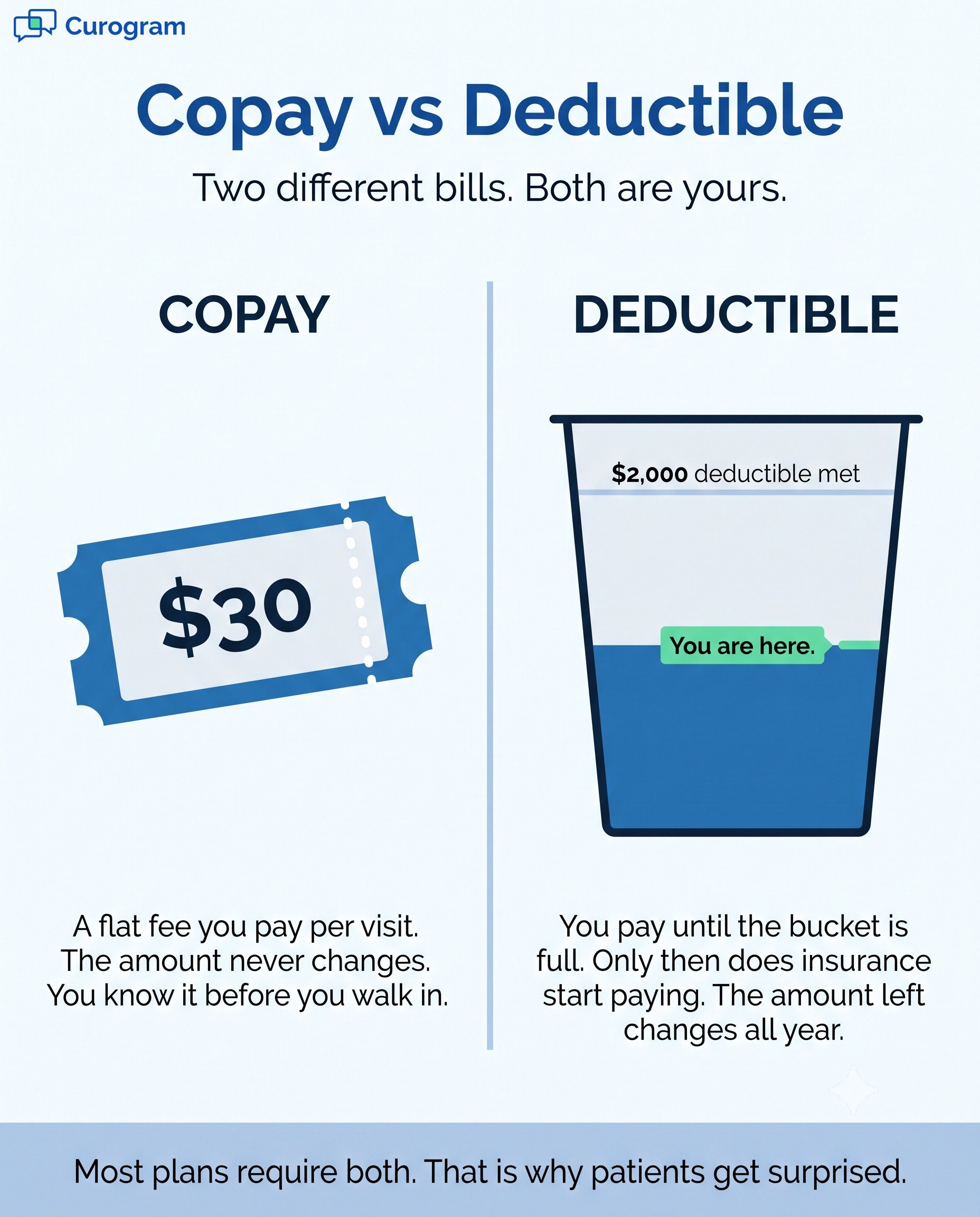
High-deductible health plans trade a lower monthly premium for a much heavier out-of-pocket load. The patient pays first, all the way to the deductible, sometimes thousands of dollars deep. Only then does the plan start contributing. It is not a small tweak, it is a different distribution of risk.
The insurer has not vanished. It has simply moved further back in line. Somebody still pays eventually. The order just changed, and so did who you have to ask.
That means a growing share of your revenue now arrives from people rather than institutions. People forget, get busy, move, and change their number. Insurance companies do none of these things. You are not facing a bigger version of the old problem; you are facing a different one.
A fixed copay is easy to ask for because everyone already knows the number. It is printed on the card. Nothing to explain, nothing to look up, nothing to argue about at eight in the morning.
A variable deductible balance is a different animal entirely. The amount shifts by plan, by service, and by whatever they already spent this year. Maybe on a knee scan they forgot about. Nobody at the desk can guess it, and nobody should try.
Almost nobody tracks their own deductible. They have insurance, so they assume the bill will be small. When it is not, they feel misled. The person absorbing that reaction is whoever is standing at your front desk.
A patient expecting $30 who hears $340 is going to react. Sometimes loudly, usually badly, occasionally in front of a full waiting room. That response is entirely predictable, and it is worth understanding what it actually is.
It is not really about the money. It is about being caught off guard. Nobody enjoys discovering a bill they did not know was coming, least of all in public. Read it as shock rather than defiance, and the whole conversation becomes manageable.
People rarely pay an amount they did not see coming. They stall, they ask to see it in writing, they promise to call back tomorrow. And they mean it when they say it. Then they walk out, and the balance lands in your A/R.
Send that identical number two days early, and it lands completely differently. Now they arrive prepared, or at least with their questions already answered. The amount never changed. Only the timing did, and timing turned out to be the whole game.
Your team can no longer read a number off an insurance card and be done with it. They have to look it up, explain what it means, and then ask for it out loud. That is three distinct skills, and most job descriptions still pretend it is one.
Guessing produces wrong amounts, awkward corrections, and refund paperwork three weeks later. It also chips away at trust, because the patient reasonably assumes you know what you are doing. One bad estimate can undo a year of goodwill in about four seconds.
Checking produces a number your staff can actually stand behind. When a patient pushes back, they have an answer instead of a shrug. That single difference changes the entire temperature of the conversation.
Your staff has to translate deductible and coinsurance into plain English, on the spot, with a line forming behind them. Most patients genuinely cannot tell you the difference between the two. Assuming otherwise is where these conversations quietly go wrong.
A patient who understands the charge is far more likely to pay it. That is not a nice bonus; it is the actual mechanism. What stalls the payment is almost never the amount. It is the confusion sitting on top of it.
These 12 practices are not a menu; they are a chain. Policy sets the rules, and verification supplies the number. Training and scripts deliver the ask, and technology strips out the friction. Pull one link and the rest start straining.
Nothing else in this list works without these three. They are the plumbing, and plumbing is boring right up until it fails. Together, they give your staff a real number to say out loud, and the standing to say it without apologizing.
Put it in writing. Keep it short. Say plainly that payment is due at the time of service.
Spell out accepted payments, payment plan rules, and what happens if a balance goes unpaid. Post it online and hand it out at registration. Have every new patient sign it. That signature is what gives your front desk the confidence to ask.
Patient eligibility verification is not a new-patient task. It is an every-visit task. Run it 24 to 48 hours ahead.
A good check tells you the copay, the deductible, how much of it is already met, and the coinsurance share. Now your staff knows the exact amount before the patient arrives. No guessing, no awkward math at the desk.
Your front desk is your collections team, whether you call them that or not. Train them like it.
Teach them to read a benefits report, explain a deductible in one sentence, and stay calm when a patient reacts. Role-play the hard ones: the forgotten wallet, the shocked patient, the flat refusal. Confidence at the desk is built, not born.
Once you know the number, the job changes. Now you are removing excuses. Tell the patient early, before they arrive guessing. Then hand them so many easy ways to pay that not paying takes more effort than paying.
Ambiguity is the enemy of collections. Put the amount in the reminder.
A text like "Your visit is tomorrow at 10 AM. Your copay is $50" does quiet, powerful work. For a large balance, a short call gives the patient room to prepare. Based on our internal data, Curogram clients average above a 75% appointment confirmation rate. Patients do read these messages.
Cash or check only is a collections strategy from 1995. Every extra option you add is another balance collected.
Take all major cards. Add an online portal so patients can pay at midnight if they want. Support mobile wallets and add text-to-pay. A secure link then lands right on the patient phone, where they already are.
A card on file policy is the closest thing to guaranteed payment. The patient stores an encrypted card in your system, with clear consent.
You charge the copay at check-in and the remaining balance once the claim clears. Statements shrink. Accounts receivable days drop. Be transparent about it: tell patients exactly when a charge happens and always notify them first.
The words matter more than most people expect. So does the moment you choose to say them. And so do the tools standing quietly behind your staff when a patient pushes back at 4:45 on a Friday.
Scripts create consistency and protect staff from freezing up. For pushback, lean on the signed policy. Say: "Our policy asks for payment at the time of service."
At check-in, try this: "Ms. Smith, your copay today is $40. Card or payment link?" Note the phrasing, because it assumes payment. Never ask "Do you want to pay today?" since that invites a no.
Check-in is your moment of maximum leverage. The patient is present, engaged, and waiting on you. Time-of-service collection works because attention has not left the building yet.
By checkout, they are thinking about parking and the drive home. Still, allow room for judgment. Let your office manager approve real exceptions for long-standing patients without loosening the rule for everyone.
Automated reminders never get tired, never feel awkward, and never forget. Use them.
A patient portal lets people view balances and pay on their own schedule. Automated text and email payment nudges chase post-visit balances without a single staff phone call. Your team stops chasing. The system does it quietly in the background.
Some balances will land after the visit no matter how tight your process is. That is not failure, that is insurance. What matters is closing them cleanly, then looking honestly at your own numbers instead of guessing.
A statement stuffed with codes gets ignored or triggers an angry call. Strip it down.
Show the date and service, what insurance was billed, what insurance paid, any adjustments, and a bolded balance due. Then say exactly how to pay it. If the patient has to decode the bill, you have already lost.
A $900 deductible balance is not going to get paid in one swipe. Demanding it in full often collects nothing.
Set a clear plan structure instead. Take a deposit, then auto-charge the rest across three or four months using the card on file. Something collected beats nothing collected. It also keeps a good patient from disappearing.
Collections is not a set-and-forget system. It drifts, quietly, the moment you stop watching. Put thirty minutes on the calendar each month and actually look.
Track your time-of-service collection rate, your accounts receivable days, and how many accounts go to collections. Notice who on your team collects well and let them teach the others. Find the leak, patch it, check again next month.
Where You Collect Changes What You Collect
|
Collection Point |
Patient Attention |
Cost to Collect |
Likely Outcome |
|---|---|---|---|
|
Before the visit (reminder) |
High |
Very low |
Patient arrives ready to pay |
|
At check-in |
High |
Very low |
Best time-of-service collection rate |
|
At check-out |
Low |
Low |
Often deferred or forgotten |
|
Statement after the visit |
Low |
Moderate |
Slower payment, higher A/R days |
|
Collection agency |
Very low |
Very high |
Partial recovery, damaged goodwill |
Best practices only stick once they stop being practices and start being habits. Nobody consults a checklist under pressure. But everybody follows a routine. Here is the same thinking, turned into something your team can run without thinking about it.
This stage quietly decides everything downstream. Do it well, and the desk conversation becomes easy, almost boring, which is exactly what you want. Skip it, and your staff ends up improvising in front of a patient. Nobody does their best work in that spot.
One to two days out, verify eligibility and benefits for every appointment. Not just the new patients. Coverage changes more often than people admit, and last month's number is not this month's number.
Pull the copay, the remaining deductible, and the coinsurance share. Then drop that number directly into the appointment record. It has to be visible at check-in or it may as well not exist.
Put the amount right in the appointment reminder. A single line does the work: your visit is tomorrow, your copay is $50. Simple, unremarkable, effective.
If the balance is large, pick up the phone instead. A text is not the right vehicle for a $400 surprise. The goal at every step is zero shock on arrival.
This is where most of your money is either collected or quietly lost. The whole thing takes about fifteen seconds. Treat it as a real step, not something wedged between two other tasks while a phone rings.
Say hello and confirm their details like you always would. Then move straight into payment without pausing. The pause is what makes it feel awkward, not the ask itself.
Try something like this: "Hi Sarah, you are all checked in. Your copay today is $50. Card or payment link?" Notice it assumes payment is happening. That framing does most of the work for you.
If the patient hesitates, do not argue and do not apologize. Both make it worse. Point calmly back to the signed financial policy and keep your tone completely normal.
Then give them a path forward rather than a wall. Offer a payment plan or send a payment link to their phone. A partial yes beats a flat no every single time.
Check-out is your backup, not your plan. By now, the patient is already mentally in the parking lot, keys out. Still, it is worth using well, especially when the visit changes along the way.
Extra procedures during the visit may have added a known fee. Your check-out staff should have an itemized list in front of them. Guessing at this stage creates billing corrections nobody wants.
Collect whatever is owed before the patient reaches the door. Once they are gone, that balance joins the queue. And you already know how that story tends to end.
A patient standing at your desk is a captive audience. They are already thinking about their care. It is the easiest scheduling conversation you will have all day.
Schedule the follow-up while you still have them. It costs nothing and saves a recall message later. Two birds, one very short conversation.
Some balances cannot be known until the claim comes back. That is fine, and it is not a process failure. What matters is how fast you move once it lands. Speed is worth more than polish here.
If you hold a card on file, notify the patient and charge the balance. No statement, no waiting, no chasing. The whole thing closes without anyone lifting a finger.
If you do not, send a clear statement and a payment link the same week. Not next month. Every week you wait makes that balance a little less collectible.
Never let follow-up depend on someone remembering to do it. People get busy, and balances slip. That is not a discipline problem, it is a system problem.
Automate the reminders and let them run until the balance clears. The system does not get tired or feel awkward about asking twice. That is precisely why it works.

Collecting copays and deductibles from patients is not a personality contest. It is not about finding one tough front desk person who is good at saying no. That approach burns people out, and it does not scale.
It is a system. Systems can be built, taught, and repaired when they break. Personalities cannot.
Look at what actually changed across these 12 practices. You verified benefits, so the number was real. You told the patient early, so nothing landed as a shock. You asked at check-in, while their attention was still in the room.
You offered a card, a portal, a link, so paying took seconds. You wrote it into policy, so the ask had backing. Nowhere in that list did anyone have to be pushy.
That is really the point. Most patients want to pay you. What actually stops them is confusion, surprise, and friction. Remove those three and the money stops being a fight.
The financial upside then follows on its own, without anyone chasing it. Time-of-service collection climbs. Accounts receivable days fall. Fewer accounts rot into bad debt, and your team stops quietly dreading the desk conversation.
And patients notice, even if they never say so. A practice that explains the bill clearly feels like a practice that respects their time. An easy way to pay just reinforces the impression.
Start small if you need to. Run patient eligibility verification 48 hours out for a single month, and watch what happens to your collection rate. Then add the reminder text with the amount in it. Then add text-to-pay.
Each step makes the next one easier. Momentum matters more than perfection here. You do not need the whole thing live by Monday.
None of this needs more staff. It needs a better sequence, and tools that quietly handle the repetitive parts. Your people should be talking to patients, not chasing $35.
Curious how automated reminders and text-to-pay would fit your current workflow? Book a quick demo with the Curogram team whenever you are ready.

Struggling with how to collect money from patients? Our guide offers ways to maintain positive patient relationships and make payment collection...

 Jo Galvez : 2/14/26, 3:00 PM
Optimize your revenue cycle with an automated patient billing SMS workflow. Learn how Curogram's secure text-to-pay reduces manual follow-ups.

A practical 2026 guide to healthcare payment technology: what the tools do, which layers matter, and how to roll out without jamming up your front...