

Skip to the main content.
💡 Healthcare staff communication training helps medical practices build teams that connect well with patients, reduce complaints, and run more smoothly. A strong program covers core skills like active listening, empathy, and clear verbal communication — as well as role-specific training for front desk staff, clinical teams, and providers.

An effective medical staff training program combines classroom learning, online modules, and real-world practice scenarios. It also covers communication technology tools — including patient texting platforms, telemedicine systems, and patient portals — so staff can handle every channel with confidence.

Practices that invest in healthcare communication skills for their teams see measurable results: fewer patient complaints, higher satisfaction scores, and stronger staff morale. Regular refresher training and a coaching culture keep these gains going long-term.


Strong communication is not just about being polite — it directly impacts clinical outcomes, operational efficiency, and revenue.

When patients clearly understand instructions, they are more likely to follow care plans, attend appointments and trust your providers. When they do not, confusion leads to missed visits, repeated calls, and unnecessary friction for your team.

It also shapes how your practice is perceived outside your walls. Today’s patients share experiences online, and communication issues often show up in reviews long before clinical quality is ever mentioned. A single negative interaction at the front desk or over the phone can outweigh an otherwise excellent visit.

For staff, the stakes are just as high. Poor communication workflows force teams to chase patients, repeat information, and manage avoidable conflicts throughout the day.

Over time, this constant strain contributes to stress, inefficiency, and burnout — especially for scheduling and front office roles.

The good news is that communication can be trained, standardized, and improved with the right structure.

By treating it as a core operational skill — not a soft afterthought — practices can create more consistent patient experiences, reduce staff workload, and build a stronger, more resilient organization.

Why Communication Training Is Worth Every Dollar

It might be tempting to think of staff communication as a soft skill — something people either have or do not have. In reality, it is a learned skill that directly affects your bottom line. Practices that invest in formal training see measurable improvements in patient satisfaction scores, complaint rates, and even revenue.

Think about the volume of communication happening in your practice on any given day — phone calls, check-ins, appointment reminders, post-visit instructions, billing conversations.

Each one is an opportunity to either strengthen or strain the patient relationship. When those moments go well consistently, the whole practice feels different.

The Hidden Cost of Communication Gaps

Consider what poor communication costs your practice. Patients who feel unheard or confused are less likely to follow care instructions, keep follow-up appointments, or recommend your practice to others.

These are not small losses — they add up quickly across hundreds of interactions each week.

The downstream effects go beyond patient satisfaction. Staff who lack clear communication tools often feel overwhelmed and unsure, which drives burnout and turnover. The financial and emotional cost of replacing a trained team member is significant on its own.

Poor communication also tends to create a cycle. When patients feel dismissed or confused, they call back with the same question, flood the front desk with complaints, or simply stop returning. Each of those outcomes costs your practice time and money that structured training could have prevented.

What the Numbers Show

The return on investment is not just theoretical. Based on our internal research, practices using structured communication tools and training report a 30%+ increase in staff productivity. No-show rates can drop by as much as 75% when communication is paired with the right systems — and that directly translates to recovered revenue and better use of your team's time.

When staff communicate well, the whole practice runs more smoothly. Complaints drop, repeat calls decrease, and patients leave feeling cared for — which builds loyalty and referrals over time.

It is also worth noting that communication training benefits staff just as much as it benefits patients. When your team feels equipped and confident, job satisfaction goes up. That matters in an industry where staff retention is a real and ongoing challenge.

Core Communication Skills Every Team Member Needs

Before you get into role-specific content, there is a set of foundational healthcare communication skills that apply to every single person on your team. These are the building blocks that make every patient interaction better — regardless of title or department.

Most staff are not starting from zero. They already know how to talk to people. But there is a big difference between casual conversation and the kind of communication that reassures a worried patient, defuses a tense moment, or explains a diagnosis in a way someone will actually remember. That gap is exactly what training closes.

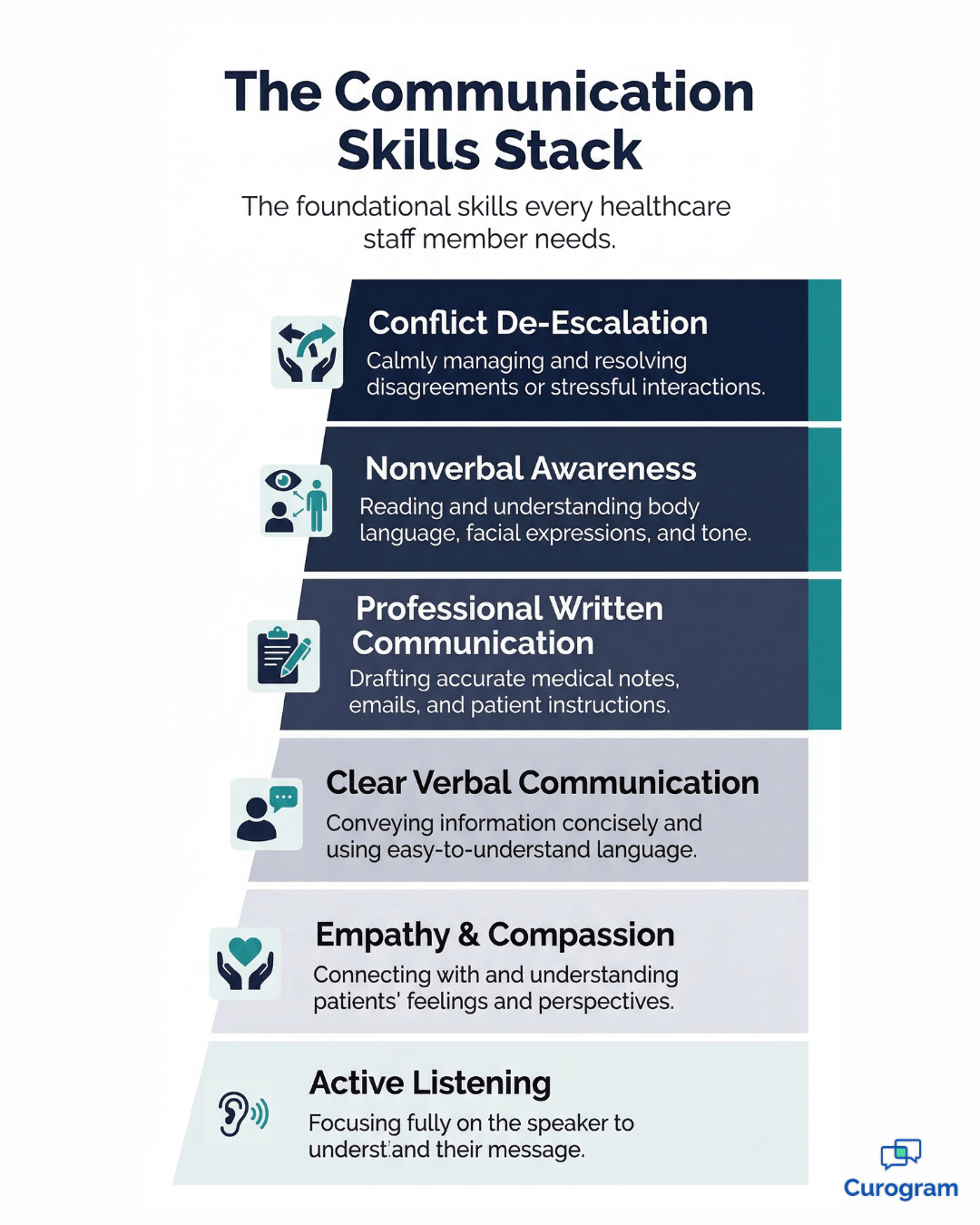
Each of the following skills plays a direct role in how patients experience your practice:

  • Active listening. Giving patients your full attention — not just waiting for your turn to speak — helps staff catch concerns early and makes patients feel genuinely heard.
  • Empathy and compassion. Patients often arrive anxious or in pain. Acknowledging that, even briefly, changes the entire tone of the visit.
  • Clear verbal communication. Staff need to explain information in plain language so patients understand what they need to do and why.
  • Professional written communication. Text messages, portal replies, and online forms are all touchpoints that reflect your practice's professionalism.
  • Nonverbal awareness. Body language, eye contact, and tone of voice send signals that words alone cannot.
  • Conflict de-escalation. When a patient is upset, the goal is not to win the argument — it is to calm the situation and find a solution.

These skills are teachable. With the right training, any member of your team can improve in all of them — and the results show up immediately in day-to-day patient interactions.

Training That Fits Each Role in Your Practice

Your billing coordinator and your physician need very different communication skills. A one-size-fits-all approach misses the mark for most roles. Effective medical office training gets specific about what each position actually needs — and how they are most likely to use those skills with patients every day.

When you tailor training to each role, staff take it more seriously. A nurse who recognizes real situations from her own workflow in the training material is far more likely to apply what she learns than someone sitting through a generic module that feels disconnected from her day.

Front Desk Staff

This team is the face of your practice. Front desk staff development should cover phone etiquette, professional check-in protocols, and how to handle difficult or upset patients with calm and confidence. They also need training on communicating wait times, billing questions, and scheduling changes without adding to patient frustration.

Because front desk staff interact with patients at peak stress points — arrival, long waits, billing surprises — their communication skills have an outsized effect on how patients feel about the entire visit. Even a brief, warm exchange at check-in can set a positive tone that carries through the appointment.

Clinical Staff

Nurses, medical assistants, and other clinical team members focus on patient education and empathetic care delivery. They need to explain procedures in plain language, check for understanding without making patients feel talked down to, and respond to emotional reactions with genuine care.

Clinical staff also serve as a bridge between patients and providers.

When they communicate clearly and compassionately, patients arrive at their appointments more prepared, less anxious, and more willing to engage honestly with their care team.

Providers

Physicians and nurse practitioners benefit most from training on patient engagement techniques and health literacy awareness. Many patients do not fully understand medical information on the first pass — providers who know how to check in and clarify make a meaningful difference in outcomes and follow-through.

Time is always tight in clinical encounters, which is why communication efficiency matters as much as warmth. Training providers to be concise, clear, and empathetic — without rushing patients — is one of the highest-value investments a practice can make.

Billing Team

Conversations about cost and insurance are stressful for most patients. Billing staff need specific patient service training on how to explain charges clearly, deliver difficult financial news with empathy, and guide patients through payment options without making them feel judged or dismissed.

A billing team with strong communication skills can turn a frustrating experience into a manageable one.

When patients feel respected during financial conversations, they are more likely to follow through on payment plans and less likely to dispute charges or leave negative reviews.

Management

Practice leaders need coaching and feedback skills so they can reinforce what staff learn in training.

A manager who gives clear, constructive feedback keeps communication standards high long after the formal training ends — and models the kind of culture you want your whole team to reflect.

Management also plays a key role in creating the conditions for good communication to happen. That means setting expectations, addressing issues quickly when standards slip, and recognizing staff who handle difficult interactions well.

healthcare staff communication training - mid

Getting Your Staff Ready for Today's Communication Technology

Modern healthcare does not run on phone calls alone. Your team uses patient texting platforms, electronic health record messaging, telemedicine integration systems, and patient portals every day. If staff are not trained on how to use these tools well, even the best technology underperforms.

Technology adoption without proper training is one of the most common sources of staff frustration in healthcare practices. When people do not feel confident using a tool, they avoid it, use it inconsistently, or make mistakes that create more work for everyone. Training eliminates that friction.

Key Platforms That Require Dedicated Training

Each communication channel has its own expectations and best practices.

Here is a quick look at where training makes the biggest difference:

  • EMR messaging. Staff need to know what to document, how to write it clearly, and how to flag urgent updates for the care team.
  • Patient texting platforms. Tools like Curogram let your team communicate with patients quickly — but staff need to know when to text versus call, and how to write messages that are clear and professional.
  • Telemedicine platforms. Staff need to guide patients through virtual visits calmly, manage technical issues with patience, and maintain the same professionalism as an in-person encounter.
  • Patient portals. Training staff to walk patients through portal features reduces inbound calls and improves patient engagement.

Multi-channel communication management is the skill that ties all of this together. Your team should know how to prioritize messages across channels, respond within expected timeframes, and keep their tone consistent no matter how the message arrives. That consistency is what patients notice — and remember.

It is also worth building in regular refreshers as your technology stack evolves.

New features, updated workflows, and platform changes all require staff to adapt.

Making technology training an ongoing part of your communication program — not a one-time onboarding event — keeps your team confident and current.


50%

Reduction in phone call volume when staff are trained on patient texting tools (based on our internal data)


How to Build a Training Program That Actually Works

A strong healthcare staff communication training program does not happen by accident. It takes planning, structure, and a clear sense of what you want to achieve. Here is how to build one step by step.

The practices that get the most out of communication training are the ones that approach it like any other operational initiative — with clear goals, defined roles, and a plan for measuring results. Treating it as a box to check once a year rarely moves the needle.

Start With a Needs Assessment

Survey your staff and review patient feedback to find out where communication gaps actually exist. This keeps your training focused on real problems rather than general topics. From there, define learning objectives for each role,

What should a front desk employee be able to do after training?

What about a nurse or a billing specialist?

Clear objectives make it easier to design content and measure results later.

Patient complaints and satisfaction data are particularly useful at this stage. If the same issue keeps appearing — patients feeling rushed, not understanding discharge instructions, or struggling to reach someone by phone — that is a signal about exactly where to focus your curriculum.

Design a Curriculum That Reflects Your Practice

When building your curriculum, aim for a mix of content types. Use scenarios and examples drawn from your own practice whenever possible — familiar situations are easier to learn from and harder to dismiss as irrelevant.

A blended delivery model tends to work well: some in-person or group sessions for discussion and role-play, plus online modules that staff can complete on their own schedule.

Keep the learning objectives front and center as you design. Every piece of content should connect directly to a skill your staff will use. If a module does not answer the question "what will my team do differently after this," it probably does not belong in the curriculum.

Plan the Scheduling and Budget

Scheduling is often where training plans fall apart. Build training into your workflow and block time for it just as you would for any other team meeting. Budget for it too. Whether you use off-the-shelf programs, bring in an external vendor, or develop materials in-house, there will be some cost involved.

Think of it as a practice investment, not an overhead expense.

Even a modest, well-organized training program delivered consistently outperforms an elaborate one that never gets scheduled. Start with what is realistic for your practice, build momentum, and expand from there.


Training Step Key Action
Needs Assessment Survey staff, review complaints and feedback
Learning Objectives Define goals by role — specific and measurable
Curriculum Design Mix of scenarios, skill practice, and knowledge content
Delivery Method Blended (in-person + online) works best for most practices
Scheduling Block dedicated time — do not leave it to chance
Budget Planning Account for materials, vendor fees, or staff time


How to Deliver Training That People Actually Remember

The way you deliver training matters just as much as what you teach. Sitting through a lecture about communication is far less effective than actually practicing it. Your delivery methods should match the skills you are trying to build.

Adults learn best when they can connect new information to real situations they have experienced. In healthcare, that means using examples from inside the practice, not generic corporate training scenarios. The closer the training feels to actual work, the faster staff will apply what they learn.

Practice Over Passive Learning

Role-playing and simulations are among the most powerful tools in communication training.

When staff act out a difficult patient conversation — and then receive feedback on it — they build real muscle memory for handling those moments on the job.

Real case studies from your own practice are especially useful here: when staff recognize the situations being discussed, the training feels applicable rather than abstract.

Practice and feedback loops are what make skills stick. Staff should have the chance to try new approaches, make mistakes in a safe environment, and get clear, constructive feedback before they apply what they have learned with real patients.

One of the most overlooked aspects of feedback is specificity.

Telling someone "you did great" after a role-play builds confidence but not skill.

Telling them "the way you paused and repeated back the patient's concern before responding was exactly right" gives them something concrete to repeat.

Formats That Work for Busy Healthcare Teams

Not every team member can step away from patient care for a long training block.

These formats are designed to fit healthcare workflows:

  • Microlearning modules. Short, focused sessions of 5 to 10 minutes can be completed between patients or during downtime — and are easy to revisit when staff need a quick refresher.
  • Scenario-based learning. Presenting staff with realistic patient situations and asking them to respond builds critical thinking alongside communication skills.
  • Group role-play sessions. Even a 20-minute huddle where staff practice a difficult conversation builds confidence in a way that a handout never will.

The key is variety.

Using different formats across your training program keeps staff engaged and reinforces skills through multiple learning approaches. When staff experience the same concept in more than one format, it is far more likely to stay with them.


Keeping Communication Skills Sharp Over Time

A one-time training session is not enough. Communication skills need to be reinforced regularly to stay sharp — and building a culture of ongoing development in your practice is what makes the investment pay off year after year.

Skills that are not used and reinforced tend to fade.

A staff member who went through training six months ago but has had no follow-up support may have slipped back into old habits without even realizing it.

Regular touchpoints prevent that backslide and keep standards consistent across your whole team.

Onboarding and Annual Refreshers

Every new hire should go through a structured communication training module before they interact with patients on their own.

This sets clear expectations and gives new staff the tools they need from day one. Annual refresher training keeps the whole team aligned and is also a chance to introduce new techniques, address patterns from patient feedback, and update staff on any new communication technology your practice has adopted.

Refresher sessions do not need to be long to be effective. Even a focused 30-minute team discussion built around a real patient scenario can reinforce key skills and surface communication habits that have drifted over time.

Nurse explaining care instructions to a patient during a medical office consultation

Just-in-Time Resources and Peer Learning

Just-in-time learning resources — quick reference guides, short video clips, or digital modules — give staff support exactly when they need it, without requiring them to sit through a full session again. Coaching and mentoring programs pair less experienced staff with colleagues who model strong communication habits, which reinforces skills through observation and practice rather than formal instruction.

Peer learning and shadowing are underused tools in most practices.

When staff observe each other and share what works, communication standards improve across the whole team — not just for the people who attended a formal training session.

Building a Learning Culture

The practices that sustain strong communication over time are the ones that treat it as an ongoing conversation, not a one-and-done event. That means recognizing staff who communicate well, addressing communication issues quickly when they arise, and making it easy for your team to access learning resources whenever they need them.

A learning culture does not require a big budget or a dedicated training coordinator. It starts with leadership making communication a visible priority — talking about it in team meetings, celebrating wins, and treating patient feedback as a tool for growth rather than just a performance metric.

Learning Touchpoint When It Happens Format
Onboarding training Before first patient interaction Structured module or live session
Annual refresher Once per year, whole team Group session + updated content
Just-in-time resources As needed, on demand Reference cards, short video clips
Coaching and mentoring Ongoing, as situations arise 1-on-1 with a senior team member
Peer shadowing Periodic, throughout the year Observation + debrief conversation

How to Know If Your Training Is Working

Investing in a medical staff training program without measuring results is like prescribing a treatment without checking whether the patient is improving.

You need clear indicators that tell you whether your training is having a real impact — and where you still have room to grow.

Measurement does not have to be complex. Even simple, consistent tracking of two or three key metrics before and after training gives you enough data to draw meaningful conclusions and make a case for continued investment.

Assessing Skills Directly

Pre- and post-training assessments are a simple starting point. Ask staff to describe or demonstrate how they would handle specific scenarios before training begins, then repeat the assessment after. The gap tells you how much learning actually happened.

Skills demonstration and competency checks go a step further — having a supervisor observe staff in real or simulated interactions and rate their performance against a clear standard gives you a much more accurate picture than a written test alone.

When conducting competency checks, use consistent criteria across your whole team so that evaluations are fair and comparable.

A simple rating rubric — covering things like active listening, clear language, and de-escalation technique — gives you structured data you can track over time.

Patient-Facing Metrics

The most meaningful measures come from your patients. Track patient satisfaction scores before and after your training rollout. Monitor complaint rates and the types of issues being raised — if communication-related complaints drop significantly after training, that is a strong sign it is working.

These metrics also give you concrete data to share with your team, which reinforces the value of what they are learning.

Online reviews are another useful signal. Patients who feel heard and well-informed are more likely to leave positive feedback — and more likely to mention specific staff members by name. Tracking review sentiment over time can reveal whether your training investments are showing up in the patient experience.

Staff Confidence and Return on Investment

Staff confidence surveys are worth running regularly. Ask your team how confident they feel handling difficult conversations, using technology tools, or explaining complex information to patients in plain language. Rising confidence scores are a reliable predictor of better real-world performance.

When you combine these data points with complaint rates and satisfaction scores, you can calculate a genuine return on investment for your training program — and make a clear case for continued investment.

Do not overlook retention as a measure of success. Practices with strong communication cultures tend to hold onto good staff longer. If your turnover rate drops in the months following a training initiative, that is a meaningful — and financially significant — outcome worth tracking.

Measurement Method What It Tells You
Pre/post assessments How much knowledge and skill improved
Skills demonstrations Whether staff can apply what they learned
Patient satisfaction scores Impact on the patient experience
Complaint rate tracking Whether communication-related issues are declining
Staff confidence surveys Team readiness and morale gains
ROI calculation Financial return on training investment

Resources and Tools to Support Your Training Efforts

You do not have to build your training program from scratch or manage it all on your own. There are many tools and resources available to help you create, deliver, and track communication training — and the right mix depends on your practice size, budget, and how quickly you need to get started.

The goal is not to find the most sophisticated solution — it is to find something your team will actually use. A simple, well-organized program that gets delivered consistently will always outperform a comprehensive one that sits on a shelf.

Off-the-Shelf vs. Custom Programs

Both options have real advantages, and the right choice depends on your goals:

  • Off-the-shelf programs. Good for practices that need to move quickly or have a limited budget. Many vendors offer healthcare-specific communication modules that cover core topics well and can be rolled out with minimal setup.
  • Custom curriculum development. A better fit for practices that want training tailored to their specific workflows, patient population, and team structure. An external training vendor can design this with you, or your own internal subject matter experts can contribute scenarios and examples that feel immediately relevant to your staff.

Many practices start with an off-the-shelf foundation and layer in custom scenarios over time as they identify the specific communication challenges their team faces most often. This hybrid approach gives you speed and relevance without building everything from scratch.

Internal Experts and Job Aids

Your most experienced front desk lead or your strongest clinical communicator is an underutilized training resource. These people can contribute meaningfully to curriculum design and delivery — and their real-world knowledge makes content credible to colleagues in a way that outside materials sometimes cannot.

Pairing their insight with practical job aids (laminated reference cards, quick-start guides, sample scripts for common scenarios) gives staff something to rely on in the moment, not just during training.

Job aids are especially valuable for newer staff or for situations that come up infrequently but require a confident response — like a patient asking about a billing error or a family member demanding information in a waiting room.

Having a reference point reduces hesitation and keeps communication consistent across your team.

Learning Management Systems

As your training program grows, a learning management system (LMS) can help you organize, deliver, and track all of your content in one place. Most LMS platforms include reporting features that make it easy to see who has completed training and how they performed.

For smaller practices just getting started, a simple shared folder with reference materials and video modules works fine — you do not need a complex system to run effective training.

When evaluating an LMS, look for one that integrates with your existing workflows and does not require heavy IT involvement to maintain. The easier it is for your team to access training content, the more likely they are to use it.


Conclusion 

Strong communication does not just happen — it gets built, reinforced, and measured over time. When your team has the right skills and tools, every patient interaction goes better. Appointments run more smoothly, complaints drop, and patients leave feeling genuinely cared for.

The practices that stand out are the ones that treat communication as a core competency, not an afterthought. That means investing in structured training, giving every role what they actually need, and revisiting skills regularly as your team grows and your tools evolve.

Technology plays a growing role in all of this. Platforms like Curogram make it easy for staff to communicate with patients through text, manage multi-channel messages, and stay on top of appointment reminders — all within a HIPAA-compliant system. But the technology only works as well as the people using it. That is why training and the right tools need to go hand in hand.

If you are ready to see what a well-trained team and smart communication technology can do for your practice.

Book a demo We will show you how our platform supports your staff, simplifies patient communication, and helps your practice run at its best.


Frequently Asked Questions

What should be included in a healthcare staff communication training program?

A complete program covers core skills like active listening, empathy, clear verbal and written communication, and conflict de-escalation. It also includes role-specific training for front desk staff, clinical employees, providers, and billing — plus training on communication technology tools such as patient texting platforms and telemedicine systems.

How often should medical staff receive communication training?

New hires should complete communication training during onboarding. The full team should have an annual refresher, and just-in-time resources should be available whenever staff need a quick review. If your practice adopts new technology or sees a spike in communication-related patient complaints, that is a good signal to add a targeted training session.

How do I measure whether communication training is effective?

Use a combination of pre- and post-training assessments, real-world skills observations, patient satisfaction data, and complaint tracking. Staff confidence surveys are also useful. Comparing these metrics before and after your training rollout gives you a clear picture of what changed and what still needs work.

What delivery methods work best for busy healthcare teams?

A blended approach works well — some in-person or group sessions for practice and discussion, combined with short online modules that staff can complete at their own pace. Microlearning formats (5 to 10 minutes per module) are especially useful for practices where staff cannot easily step away from patient care for long stretches.

Do I need a learning management system to run staff training?

Not necessarily, especially for smaller practices. Many teams start with simple materials, shared resources, and scheduled group sessions. As your program grows, an LMS can make it easier to track who has completed training and monitor results over time. Start simple and scale up as your needs evolve.


Call Center Management for Medical Practices: Complete Guide (2026)

Call Center Management for Medical Practices: Complete Guide (2026)

💡 Medical call center management covers how a medical practice handles incoming and outgoing patient calls. It includes staffing, scheduling,...


Read More
Front Desk Optimization: Reduce Chaos, Improve Experience

Front Desk Optimization: Reduce Chaos, Improve Experience

💡 Front desk optimization in a medical practice means making your front office run smoother, faster, and with less stress for everyone involved....

Read More
What is The Best Approach to Handling Patient Cancellations and Minimizing Canceled Appointments?

What is The Best Approach to Handling Patient Cancellations and Minimizing Canceled Appointments?

Missed appointments and last-minute appointment cancellations are more than just minor inconveniences in a healthcare practice; they represent a...

Read More