
19 min read
Multi-Location Practice Management: Centralization Strategies
Aubreigh Lee Daculug
:
April 18, 2026
Effective multi-site healthcare management relies on centralizing the functions that benefit most from scale: scheduling, patient communication, billing, and technology infrastructure. Functions that require local judgment — like clinical care decisions and on-site patient relationships — are best kept at the site level.
Healthcare practice consolidation of operations doesn't mean stripping away flexibility. It means giving every location a shared foundation, so your team can deliver consistent, high-quality care without reinventing the wheel at every site. Platforms like Curogram help practices unify patient communication and workflow across all locations from a single, HIPAA-compliant system.
Imagine this: it's a Tuesday morning, and your front desk manager at Location A calls to tell you the scheduling system isn't syncing with Location B again. Meanwhile, a patient at Location C just complained that she got a different intake form than the one she filled out last month at your main office.
And your billing team? They're reconciling claims from three different software platforms — manually.
You didn't open a second or third location to create more chaos. You did it to grow, to serve more patients, to build something bigger. But somewhere along the way, more locations started to mean more problems.
That's the reality of multi-location practice management when it's done without a plan. Growth multiplies everything — not just revenue, but also operational complexity, communication gaps, and the risk of inconsistency.
A process that worked perfectly at one site starts breaking down when you apply it across four.
Here's what nobody tells you: the practices that scale well don't just add locations. They build systems. They decide early on what should be controlled from the center and what should stay local. They invest in the right technology, create standard processes, and lead their teams with clear accountability — no matter which building those teams happen to work in.
This guide is built for medical practices that are managing multiple clinics right now, or are planning to. Whether you're dealing with scheduling coordination, inconsistent patient communication, or billing headaches that span multiple sites, you'll find practical strategies here.
We'll cover the most common operational challenges, what to centralize versus what to keep local, how to structure your technology and teams, and where to start if you're ready to bring more order to how your organization runs.
Let's get into it.
Why Running Multiple Locations Is Harder Than It Looks
One location has problems. Two locations have the same problems — but doubled. Three or more? That's when things start to fall apart in ways you didn't anticipate.
Multi-location practice management is fundamentally different from running a single site. The complexity doesn't grow in a straight line — it grows exponentially. Every new clinic you add introduces new staff, new patient populations, new workflows, and new failure points.
And unlike single-site problems, which are usually contained and easy to trace, multi-site problems have a way of hiding until they've already done real damage.
The Operational Gaps Add Up Fast
Think about what happens when each location operates independently. One site uses text reminders. Another relies on phone calls. A third has no reminder system at all. Patients who visit more than one of your locations notice the difference immediately, and that inconsistency erodes trust.
The same problem shows up in billing, intake forms, appointment policies, and staff training. When every location is doing things slightly differently, you spend enormous energy just maintaining the status quo — instead of improving it. Leadership ends up playing catch-up rather than driving the organization forward.
What makes this especially costly is that most of these inefficiencies are invisible on any single day.
No individual patient complaint or missed claim triggers an alarm.
But over twelve months, the cumulative effect of fragmented operations shows up clearly — in your revenue cycle, your staff turnover rate, and your patient satisfaction scores. By the time you notice, the damage is already priced in.
Research on healthcare group practices consistently shows that administrative overhead is one of the fastest-growing costs as organizations expand. For practices managing multiple clinics, that overhead can represent 20–30% of total operating costs — and most of it is waste that a centralized model can eliminate.
|
The Scale of the Problem: Administrative overhead: 20–30% of total operating costs For a 5-location practice generating $5M in annual revenue, that's up to $1.5M per year spent just running the operation — before a dollar goes toward growth, staffing, or patient experience improvements. |
Technology Integration Is Often the Biggest Bottleneck
Many practices find that their systems simply weren't built for multi-site use. They added tools as they grew, and now they're managing a patchwork that doesn't connect cleanly.
In practice, that fragmentation shows up in very specific ways:
- Scheduling tools that show availability at one site but not others
- EMRs that don't surface the same patient records at every location
- Communication platforms configured differently — or not at all — at each site
- Billing systems that can't generate a consolidated view across the organization
Staff coordination suffers as a result. When a call center agent at one site can't see provider availability at another, or when a patient's record doesn't follow them from clinic to clinic, the cracks in your infrastructure become visible to the patient — which is the last place you want them to appear.
These technology gaps also create extra work for your team. Staff end up manually transferring information between systems, duplicating data entry, and troubleshooting integration failures that should never happen in the first place. That's time and energy pulled away from actual patient care, and it adds up across every location, every day.
The good news is that these challenges are solvable — but solving them requires a deliberate approach to how your practice operations are structured.
Central Control or Local Flexibility? You Probably Need Both
There's a common mistake practices make when they try to get organized: they either over-centralize everything or leave too much to individual sites. Both extremes create problems.
Over-centralization makes your organization rigid. It slows down decisions that should be made on the ground, frustrates site managers who feel like they have no authority, and creates bottlenecks at the top.
Under-centralization does the opposite — it lets inconsistency spread unchecked, makes organization-wide improvement nearly impossible, and guarantees that every location reinvents the same wheel at its own pace and cost.
The right answer is a hybrid model — one that centralizes the functions where consistency and scale matter most, and preserves local control where front-line judgment is essential. Getting that balance right is what separates practices that scale smoothly from ones that grow into chaos.
What Works Best at the Center
Some functions deliver measurably better results when run from a single hub.
These include:
- Scheduling and patient access: A centralized contact center or booking system ensures patients can reach your practice through one consistent channel, regardless of which location they need.
- Patient communication: Unified messaging platforms — like Curogram — allow you to manage appointment reminders, intake forms, and follow-up messages across every site from one dashboard.
- Billing and claims management: Centralizing revenue cycle functions reduces duplicate work, improves claim accuracy, and gives leadership a clearer financial picture across all locations.
- Reporting and data: When every location feeds into the same system, you can compare performance, identify outliers, and make data-driven decisions across your organization.
The common thread here is scale. These functions get better — and cheaper — when they're run consistently from one place. A single billing team that handles all five of your locations will always outperform five separate billing setups, both in cost efficiency and in claim accuracy.
What Works Best Locally
Not everything should be managed from the top down. Clinical protocols often need to adapt to local patient demographics. On-site patient relationships are built by the staff who work there every day. Office culture and team morale are driven by local leadership, not a policy manual from headquarters.
Think about how different a primary care clinic in a suburban community feels from an urgent care center downtown, even if they're part of the same group.
The patient mix is different. The pace is different. The staff dynamics are different.
Forcing both sites into identical operational models for every single function ignores those realities and tends to produce resistance rather than results.
The goal of practice operations centralization isn't to strip away what makes each location work. It's to remove the friction of redundant, inconsistent administrative work — so your local teams can focus on what they do best. Give them a shared foundation and let them build their local culture on top of it.
A Simple Decision Framework
Before deciding whether to centralize a function, ask three questions
- Does this function benefit from scale or standardization?
- Does inconsistency in this area hurt patient experience or revenue?
- Can this be managed remotely without sacrificing quality?
If your answer is "yes" to all three, that function belongs in your centralized model. If even one answer is "no,"
it's worth keeping some degree of local ownership — or at least designing the centralized model with enough flexibility to accommodate site-level differences.
One Front Door for Every Location: How Centralized Scheduling Works
Patients don't care which of your locations has an opening at 2 p.m. on Thursday. They just want to get in quickly and conveniently. That's the core argument for centralizing your scheduling and patient access.
When scheduling is managed site-by-site, you end up with a fragmented patient experience. One clinic may have a two-week wait while another has same-week availability. Patients who don't know to ask simply assume all of your locations are equally unavailable — and they go somewhere else.
That assumption costs you real patients and real revenue, and it happens quietly, without a complaint or a cancellation to flag it.
The Business Case Is Clear
The revenue impact of scheduling friction is easy to underestimate — until you do the math.
|
Revenue-at-Risk Scenario (5-Location Practice) 5 locations × 200 appointments/week = 1,000 weekly appointments 5% lost to scheduling friction or lack of cross-site visibility = 50 missed bookings/week 50 × 52 weeks × $150 avg. reimbursement = $390,000/year quietly walking out the door This is an illustrative example. Your numbers will vary based on specialty and payer mix. |
Centralized scheduling eliminates that gap. A shared booking system gives your team real-time visibility into provider availability at every location, so patients can be routed to the first available appointment regardless of site. Nobody is turned away because their usual clinic looks full when another location has openings an hour away.
Beyond filling gaps, centralized scheduling also reduces the number of missed opportunities caused by inconsistent follow-up.
When a patient calls and can't get through at one site, a centralized team ensures the call is answered, the appointment is booked, and the follow-up actually happens — across every location, every time.
Cross-Location Booking Changes Patient Behavior
Patients who can book across locations — whether online, by phone, or via text — are more likely to stay within your network. They're less likely to seek care elsewhere when their usual location is booked out. That loyalty has a direct impact on patient retention, lifetime value, and your practice's long-term growth.
This behavioral shift is especially important for practices that offer specialty services at only some locations.
When a patient who normally visits Location A can easily get referred to a specialist at Location C — without friction, without a new intake process, without starting from scratch — you deepen the relationship between that patient and your entire organization, not just one building.
A centralized contact center, combined with a unified scheduling platform, also reduces the burden on individual site staff. Instead of each front desk team managing their own call volume, a shared team handles routing, booking, and follow-up — freeing your on-site staff to focus on in-person patient care.
For high-volume practices, that shift in responsibility alone can meaningfully reduce front desk burnout and improve day-to-day morale at each site.
Keeping Every Patient Message Consistent Across Every Site
Imagine a patient who visits two of your locations in the same month. At one, she gets a text reminder the day before her appointment and a digital intake form she can fill out on her phone. At the other, she gets a phone call she missed and a paper form she fills out in the waiting room.
Same practice. Very different experience.
That inconsistency isn't just frustrating for patients — it signals a lack of coordination that can undermine your brand and patient trust over time. And in healthcare, trust is the one thing that's very slow to build and very fast to lose.
Unified Communication Changes Everything
This is where centralized patient communication delivers some of its most visible results. A platform like
Curogram allows you to manage all patient-facing messaging from a single dashboard that covers every location in your network:
- Automated appointment reminders and confirmations
- Digital intake forms sent before the visit
- Post-visit surveys for feedback and review generation
- Two-way texting for real-time, HIPAA-compliant patient communication
Instead of each site configuring its own reminders or using different tools, your entire organization sends consistent, on-brand messages. Patients experience the same communication workflow regardless of which clinic they visit. That consistency is what turns a collection of locations into a recognizable, trustworthy healthcare brand.
Multi-location appointment reminders can be configured at the organizational level and customized slightly by location if needed — giving you both consistency and flexibility.
For practices that run call centers, this unified layer means agents can see the full communication history for any patient across any site, so no conversation starts without context and no patient ever has to repeat themselves.
The Impact on Staff Goes Beyond Patient Experience
When communication is centralized, your front desk staff at every location spends less time chasing confirmations over the phone and more time on meaningful patient interactions. Studies have shown that manual phone-based outreach takes significantly more staff time per confirmation than automated text-based workflows.
Across a five-location practice, that efficiency gap compounds quickly — and the savings show up both in staffing costs and in staff satisfaction.
There's also a compliance dimension worth considering. When patient communication runs through a centralized, HIPAA-compliant platform like Curogram, you eliminate the risk of staff using personal devices or unsecured channels to reach patients. Every message is logged, auditable, and protected — which matters both for regulatory compliance and for the confidence of your leadership team.
The Numbers Back It Up
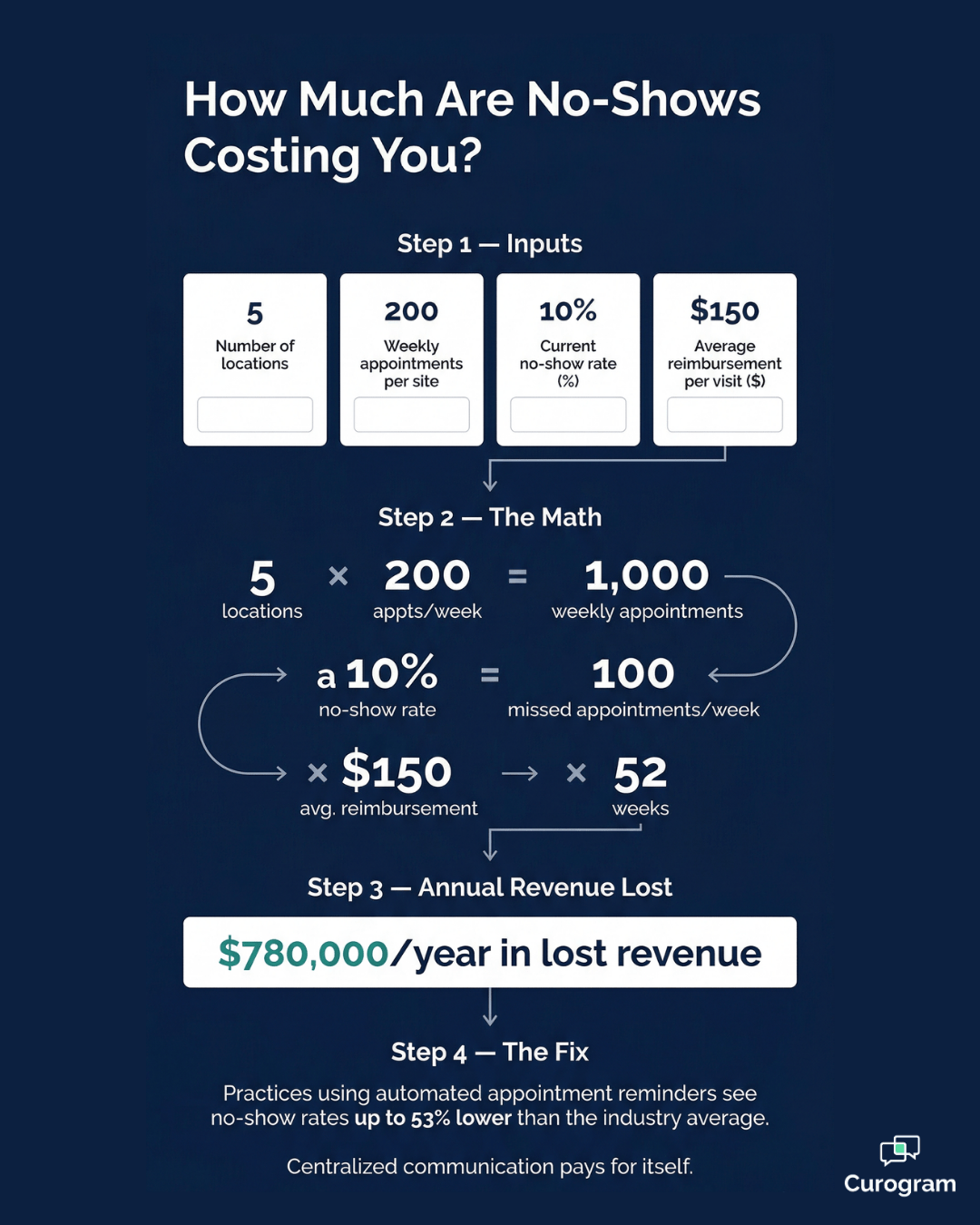
The revenue impact of fixing patient communication is concrete. Practices using automated multi-location appointment reminders through platforms like Curogram see no-show rates up to 53% lower than the industry average. For a five-location practice with 200 appointments per week per site, reducing no-shows by even 10% could recover 100 appointments per week — worth roughly $780,000 annually at a $150 average reimbursement.
That's not a small efficiency gain. That's a meaningful revenue recovery that comes directly from bringing your communication infrastructure under one roof.
And unlike many operational improvements that take months to show results, automated reminder systems typically show measurable changes in no-show rates within the first few weeks of deployment.

One Billing Team, Every Location: The Case for Centralizing Your Revenue Cycle
Billing is where multi-site complexity becomes most financially dangerous. When each location handles its own claims, reconciliation, and collections, you end up with inconsistent processes, missed follow-ups, and revenue that simply disappears between the cracks.
A centralized billing office changes that dynamic entirely.
One team. Consistent workflows. Organization-wide visibility into where your revenue is at every stage of the cycle. It sounds simple. Most practices are surprised by how much changes when they finally make the shift.
What Centralized Billing Actually Looks Like
In practice, this means a single billing team — whether in-house or outsourced — manages claims for every location. They use one system to track submission, adjudication, denials, and collections. Financial reporting is available at both the location level and the organizational level, so leadership can see which sites are performing well and which need attention.
The economies of scale are real. A centralized billing team working across five locations is significantly more cost-efficient than five separate billing operations. Staffing costs go down. Denial management improves because the same team develops deep expertise in your payer contracts rather than re-learning them at each site.
And because every claim runs through the same process, errors get caught earlier — before they become denials, and before denials become write-offs.
There's also a leadership advantage that's easy to overlook. When financial data from every location flows into one system, you gain the ability to spot patterns that would otherwise stay hidden. A site that's consistently producing high denial rates for a specific payer, or one where days in accounts receivable are creeping up, becomes visible — and addressable — before it becomes a serious revenue problem.
A Sample Cost Comparison
| Billing Model | Annual Staffing Cost (5 Locations) | Denial Rate (Estimated) | Revenue at Risk |
|---|---|---|---|
| Decentralized (1 biller/site) | ~$250,000 | 8–10% | High |
| Centralized team (3–4 billers) | ~$160,000 | 4–6% | Lower |
| Estimated Annual Savings | ~$90,000 | — | Improved by ~$120K+ |
These are illustrative estimates, but they reflect patterns commonly reported by multi-site practices that have made the transition. The savings come from both direct labor costs and improved revenue recovery.
Shorter Collection Cycles With Text-to-Pay
Text-to-pay tools — like those available through Curogram — further support centralized billing by making it easier for patients to settle outstanding balances via SMS.
When a patient can pay with a single tap on their phone, you reduce the volume of aging accounts receivable and shorten the time between service and collection.
That improvement flows directly to your bottom line, and it requires no additional billing staff to deliver.
Patient payment behavior has shifted significantly in recent years. More patients expect a simple, mobile-friendly way to pay their healthcare bills — and practices that offer that experience tend to collect more, faster. Combining a centralized billing operation with a modern text-to-pay solution closes the loop on your revenue cycle in a way that fragmented, location-specific billing simply can't match.
The Tech Stack That Actually Connects Your Locations
Technology is either the backbone of your multi-site operation or the thing holding it back. There's rarely a middle ground.
The challenge is that most practices didn't build their technology infrastructure with multiple locations in mind. They added tools as they grew — a new scheduling system here, a different patient communication platform there — and now they're managing a patchwork that doesn't connect cleanly.
Each tool works fine in isolation. Together, they create friction, gaps, and duplicated work that quietly drains your team's time every single day.
What You Actually Need
Effective technology infrastructure for multiple clinic management centers on three core priorities:
- Unification: A single EMR or practice management system ensures that patient records, scheduling data, and clinical documentation are consistent across every site.
- Integration: Your patient communication platform needs to connect with your EMR so data flows automatically — no double entry, no syncing errors. Curogram integrates with virtually any EMR, so the data your team already manages doesn't have to be re-entered just to send a reminder or collect a form response.
- Visibility: Every system in your stack should feed into centralized reporting, so leadership can see performance data across all locations without manually pulling from separate dashboards.
Cloud-based platforms make this far more accessible than it was even five years ago. You don't need a dedicated IT team at each location to keep things running — you need the right tools configured correctly from the start. The investment in getting your tech stack right at the organizational level pays for itself in reduced complexity and reduced labor costs almost immediately.
When evaluating any new technology for your organization, the most important question to ask isn't "does this work well?"
It's "does this work well with everything else we use?" Interoperability — the ability of systems to share data without manual intervention — is the single most important characteristic of a healthy multi-site technology architecture.
Centralized Reporting Is a Game-Changer
When your systems talk to each other across locations, you gain real-time visibility into how your organization is actually performing. You can see which locations have the highest no-show rates, identify which providers have long scheduling gaps, and track patient communication response rates by site.
That level of insight allows you to manage proactively, rather than reacting to problems after they've already cost you revenue or patient satisfaction.
This reporting advantage extends beyond operations.
When you can pull financial, scheduling, and patient experience data across all locations in a single view, strategic planning becomes much more concrete.
You stop making decisions based on gut instinct and start making them based on actual performance data — which location needs more staff, which provider schedule needs restructuring, which site is underperforming on collections. The data is there. You just need a system that surfaces it.
IT support models for multi-site practices also benefit from centralization. Instead of relying on local staff to troubleshoot technology issues, a centralized IT function — even if outsourced — gives you consistent support standards and faster resolution times across every site.
When something breaks at Location C, the fix comes from a team that knows your entire infrastructure, not from a front desk coordinator who is also trying to check patients in.
Same Standards, Every Time, Everywhere
Operational standardization is the invisible infrastructure of a well-run multi-site practice. Patients don't see it. But they feel it — every time they have a seamless experience at any of your locations.
Without standard operating procedures, each site develops its own habits. Some of those habits are good.
Many are inconsistent. And a few are quietly costing you efficiency, compliance exposure, or patient satisfaction without anyone realizing it. The danger isn't any single bad habit — it's the accumulation of hundreds of small variations across your locations that add up to a meaningfully different experience depending on which site a patient walks into.
Building SOPs That Actually Get Used
Effective standard operating procedures are specific enough to be useful but flexible enough to account for local variation. A good SOP for patient intake, for example, defines the required steps and tools but doesn't dictate every word a front desk staff member says.
The goal is consistency of outcome, not uniformity of personality.
The most important SOPs to establish across multiple clinic management include:
- Patient intake and check-in procedures
- Appointment reminder and confirmation workflows
- No-show and cancellation management protocols
- Patient complaint and escalation processes
- End-of-day reconciliation and reporting
Once these are documented and deployed consistently, your team spends less time figuring out what to do and more time doing it well. That shift alone can meaningfully improve staff productivity and reduce the kind of variation that frustrates patients.
The format of your SOPs matters too. A twenty-page document no one reads isn't a standard operating procedure — it's a filing cabinet artifact. The most effective SOPs are short, visually clear, and accessible within the tools your team already uses every day. If staff have to go looking for the procedure, most of them won't.
Quality Assurance Across Sites
Regular quality reviews — even simple ones — make a significant difference. A monthly review of key metrics by location gives leadership early warning when a site is drifting from standard performance before it becomes a real problem.
| Metric to Review | Why It Matters | Suggested Frequency |
|---|---|---|
| No-show rate by location | Early sign of reminder or scheduling breakdown | Monthly |
| Patient satisfaction scores | Tracks experience consistency across sites | Monthly |
| Claim denial rate | Flags billing process errors before they compound | Monthly |
| Staff productivity benchmarks | Surfaces training gaps or workflow inconsistencies | Quarterly |
Staff training also needs to be standardized. When a new hire at Location C gets a fundamentally different onboarding experience than one at Location A, you introduce variation from day one. A consistent training program — especially one delivered through shared tools and platforms — closes that gap before it opens.
Quality assurance doesn't have to be a heavy lift.
The practices that do it best aren't running elaborate audits every month — they're pulling a handful of numbers, comparing them across sites, and asking one question:
Is this where we expect to be? That discipline, applied consistently, is what keeps a multi-site organization operating like a unified system rather than a collection of independent clinics.

Where to Start: A Practical Roadmap for Centralization
The biggest barrier to centralization isn't technology or money. It's knowing where to begin.
Most practices that successfully centralize their operations don't try to do everything at once. They prioritize the areas with the highest impact, implement in phases, and build organizational buy-in along the way.
Phase 1: Assess What You Have
Before you change anything, map your current state. What systems are you using at each location? Where do workflows diverge most significantly? Which operational gaps are costing you the most — in revenue, patient satisfaction, or staff time?
This assessment doesn't have to be exhaustive. A focused review of scheduling, communication, and billing processes across your sites will reveal the biggest opportunities quickly.
Phase 2: Pick Your First Win
Choose one high-impact function to centralize first. Patient communication is often the best starting point — it's visible to patients, measurable, and doesn't require a complete overhaul of your clinical workflows.
Deploying a unified communication platform across all locations simultaneously is more achievable than it sounds, especially with a tool like Curogram that integrates with your existing EMR. You can be sending consistent, automated appointment reminders across every site within weeks — not months.
Phase 3: Standardize and Scale
Once your first centralization effort is producing results, use that momentum to tackle the next function. Billing consolidation, scheduling integration, and reporting unification typically follow in that order — though the right sequence depends on your specific pain points.
Phase 4: Measure What Changed
Track performance metrics before and after each centralization phase. No-show rates, claim denial rates, patient satisfaction scores, and staff productivity benchmarks give you concrete data to justify the investment and guide the next phase of implementation.
| Phase | Focus Area | Key Metric to Track |
|---|---|---|
| 1 | Current state assessment | Baseline cost per location |
| 2 | Patient communication | No-show rate, reminder response rate |
| 3 | Billing & scheduling | Denial rate, days in A/R |
| 4 | Measurement & expansion | Revenue per location, patient satisfaction |
Change management is the thread that runs through every phase. Involve your site managers and frontline staff early. Explain the why behind each change, not just the what. Practices that treat centralization as something done to their teams — rather than with them — tend to face the most resistance and the slowest adoption.
Leading a Team That's Spread Across Multiple Sites
Managing people is hard enough in one building. Across multiple locations, it requires a fundamentally different leadership model.
The biggest mistake multi-site practices make is assuming that strong site managers alone are enough. They're not — at least not without clear accountability structures, consistent communication channels, and centralized visibility into team performance. Individual capability at the site level matters, but it can't compensate for structural gaps in how your organization is set up to lead and communicate.
Structure Matters
The most effective model for multi-site healthcare management combines central oversight with local autonomy. Each site needs a capable on-site leader who handles day-to-day operations and staff management. That person reports to a centralized operations or practice manager who has visibility across all locations.
This structure works when roles and expectations are clearly defined.
What decisions can site managers make independently? What requires escalation? Without clear answers to those questions, you'll either have managers who feel micromanaged or sites operating without enough oversight.
The line between those two failure modes is narrower than most administrators realize — which is why documenting the accountability structure matters as much as building it.
Accountability also needs to be tied to metrics, not just intentions. A site manager who knows their no-show rate is reviewed monthly — and compared to other locations — behaves differently than one who gets feedback informally, once a quarter, in a conversation that covers twenty other topics. Structure creates the conditions for consistency; metrics create the incentive to maintain it.
Communication and Culture Across Distance
Team culture doesn't maintain itself across multiple sites. You have to actively build it.
Regular all-hands meetings — even virtual ones — help reinforce shared values and keep distributed teams connected. Recognition programs that highlight performance across locations (not just at one site) send a powerful signal about organizational identity.
When staff at Location D know that their counterparts at Location B were recognized for reducing no-shows by 20%, it creates positive momentum across the whole network.
It's also worth investing in the small moments that build culture over time — shared wins communicated to all sites, leadership visibility at each location on a regular cadence, and forums where staff can raise operational concerns without going through multiple layers of management. These aren't soft extras. In high-turnover healthcare environments, culture is often the deciding factor in whether good staff stay or leave.
Internal communication tools that allow secure, real-time messaging between locations also reduce the friction of daily coordination. Curogram's internal feature, for example, gives staff a secure, HIPAA-compliant way to communicate across sites without resorting to personal phones or unsecured channels.
When your team can reach each other quickly and safely, coordination improves, problems get surfaced faster, and the organization starts to feel less like a set of separate buildings and more like a single, connected team.
Conclusion
Running multiple locations doesn't have to mean managing multiple sets of problems. The practices that scale successfully share one thing in common: they stop trying to manage complexity and start eliminating it.
Centralization isn't a one-size-fits-all approach, and it's not something you do overnight. But the practices that have done it well — standardizing communication, consolidating billing, unifying their scheduling and technology — consistently see the same outcomes: lower costs, higher revenue, better patient experiences, and teams that aren't constantly fighting fires.
The path forward starts with one honest question: where is the most operational friction in your organization right now? That's where you begin.
If patient communication is scattered, inconsistent, or costing you appointments, that's a solvable problem today. Curogram helps multi-location practices unify their patient messaging, automate appointment reminders across every site, streamline intake forms, and manage two-way texting from a single, HIPAA-compliant dashboard.
No double entry. No disconnected tools. No patients falling through the cracks between locations.
Practices using Curogram see no-show rates up to 53% lower than the industry average — and a 10–20% increase in revenue from recovered appointment slots alone. For a five-location practice, that can mean hundreds of thousands of dollars back in your revenue cycle each year.
Your patients deserve the same quality of experience at every location you've built. Your staff deserves tools that actually make their jobs easier. And your organization deserves a communication infrastructure that scales with you, not against you.
Book a demo with Curogram today and see how straightforward it is to bring consistency, efficiency, and growth to every location in your network.
Frequently Asked Questions
Multi-location practice management refers to the systems, processes, and strategies used to operate and coordinate a medical practice that operates from more than one physical site. It includes centralized scheduling, billing, communication, reporting, staff coordination, and technology infrastructure — all designed to ensure consistency and efficiency across every location. The goal isn't just operational control — it's building an organization that delivers the same quality of care and patient experience regardless of which site a patient walks into.
The functions that benefit most from centralization are those where consistency and scale matter most: patient communication, appointment scheduling, billing and revenue cycle management, financial reporting, and IT infrastructure. Clinical care decisions and on-site patient relationships are generally best managed at the local level. A hybrid model — where administrative functions are centralized and clinical judgment stays local — tends to produce the best outcomes for both efficiency and patient experience.
Centralized communication platforms like Curogram allow you to send automated appointment reminders, confirmations, and follow-ups to patients across all locations from a single system. Consistent, timely reminders significantly reduce the likelihood of missed appointments. Practices using automated reminder systems have documented no-show rates up to 53% lower than the industry average — a reduction that translates directly into recovered revenue and more efficient use of provider time.
At a minimum, you need a unified EMR or practice management system, a centralized patient communication platform, a shared scheduling tool with cross-location visibility, and a single billing system. Cloud-based platforms that integrate with each other are strongly preferred, as they eliminate the need for manual data entry and allow for real-time reporting across all sites. The most important criterion when evaluating any tool for a multi-site practice is interoperability — whether it connects cleanly with your existing systems without requiring manual workarounds.
The timeline depends on how many locations you have, how different their current workflows are, and how much change management is required. Most practices that approach centralization in phases — starting with one high-impact function like communication — can see measurable results within 60 to 90 days of implementation. Full operational centralization across billing, scheduling, and technology typically unfolds over six to eighteen months, depending on the size and complexity of your organization.