
Skip to the main content.

22 min read

True Cost of Administrative Inefficiency in Medical Practices (2026)

True Cost of Administrative Inefficiency in Medical Practices (2026)
 💡 Administrative inefficiency in healthcare costs U.S. medical practices billions of dollars every year. From missed appointments and manual data entry to delayed billing and staff burnout, the price adds up fast — and most practices don't realize how much they're losing.

Common sources of waste include excessive phone calls, insurance verification delays, scheduling errors, and technology features that go unused. These issues drive up practice overhead costs, push good staff out the door, and leave patients frustrated with their experience.

The good news is that many of these losses are preventable. Practices that automate key workflows — like appointment reminders, confirmations, and patient messaging — see real gains in revenue, staff productivity, and patient satisfaction. Identifying where you're losing time and money is the first step toward fixing it.

You probably already know that running a medical practice isn't just about delivering great care. It's also about keeping a business running — and that business is under constant pressure.

Administrative tasks eat up more time, more money, and more staff energy than most practice managers realize. The question isn't whether your practice is dealing with administrative inefficiency; it's how much it's costing you.

Healthcare in the United States spends roughly 25% of its total budget on administrative tasks alone. That's more than double what comparable countries spend on the same activities. Yet most practices haven't mapped out where that spending goes — or what they could recover if they ran a tighter operation.

This article breaks down the true cost of administrative inefficiency in healthcare. You'll see exactly where time is being wasted, how that waste turns into real revenue loss, what it does to your staff and patients, and — most importantly — what you can do about it.

Whether you're a practice manager building the case for change or a physician trying to understand the financial side of your operation, this analysis gives you the numbers and the roadmap.

By the end, you'll have a clear picture of how to measure what your practice is losing — and how to start turning that around.

Why Healthcare Administration Has Become a Crisis

Healthcare administration in the United States has grown into a massive cost center. Administrative spending accounts for roughly 25% of all healthcare costs — and the U.S. spends nearly twice as much on these tasks as other high-income countries.

Much of that spending isn't delivering better care. It's just covering the cost of doing business in an increasingly complicated system.

What makes this especially difficult is that the growth in administrative work hasn't come from a single source. It's been a slow accumulation of new requirements, new payers, new compliance demands, and new systems — each one adding a small amount of friction until the total weight becomes genuinely hard to manage.

For context,

The average physician in the U.S. now spends close to two hours on administrative work for every hour of direct patient care.

That ratio has worsened significantly over the past decade as payer requirements have become more complex and documentation standards have tightened. The result is a growing disconnect between what healthcare workers trained to do and what their workdays actually look like.

What's Driving the Complexity

The healthcare administrative burden didn't balloon overnight.

Three compounding forces have made it much harder to manage over time:

  • More insurance plans with conflicting rules mean every payer interaction requires extra verification steps.
  • Growing documentation and compliance requirements pull clinical staff into paperwork that doesn't directly serve patients.
  • Siloed systems and manual workflows mean that even routine tasks require more labor than they should.

Each of these layers adds time and cost to your daily operations. Practices end up hiring more administrative staff just to keep up, which pushes practice overhead costs higher without actually improving care or revenue.

The problem is compounded by the fact that many of these systems weren't designed to work together. An EHR built by one vendor, a billing platform from another, and a scheduling tool from a third don't automatically share data. Your staff becomes the connector — manually moving information between systems, reconciling errors, and filling gaps that technology should be handling automatically.

This complexity takes a serious toll on clinicians, too.

When physicians and nurses spend a significant portion of their day on paperwork instead of patients, morale drops and burnout accelerates.

Research consistently links administrative overload to physician burnout — and burnout creates its own set of costly ripple effects, from increased errors to higher physician turnover rates that are far more expensive to address than the underlying administrative problems.

The business case for getting this under control is clear. Reducing healthcare administrative waste isn't about cutting corners.

It's about making sure your resources go toward the things that actually matter:

Patient care, staff wellbeing, and a practice that stays financially healthy for the long term. The good news is that the path forward doesn't require rebuilding your practice from scratch.

It starts with identifying where the biggest inefficiencies are hiding — and addressing them systematically.

Where Your Staff's Hours Are Really Going

Think about how much time your front desk spends on the phone.

Research suggests that medical office staff spend between 15 and 20 hours per week managing calls related to appointment scheduling, reminders, and patient questions.

That's nearly half of a full-time employee's week — just on phone calls. And in most practices, those calls aren't producing anything that couldn't be handled more efficiently through automated messaging or digital communication.

The issue isn't that patients shouldn't be able to reach your office. The issue is that the majority of those calls are routine and repetitive — confirmation requests, appointment reminders, basic scheduling changes.

Each one takes one to three minutes to handle, but across a full week, those minutes add up to a substantial portion of your team's available capacity. That capacity isn't being spent on complex problems that require a real human; it's being spent on transactions that automation handles easily.

Manual data entry is another major time drain that tends to fly under the radar. When your systems don't connect with each other, staff end up re-entering the same patient information multiple times across different platforms.

That duplicate work doesn't just waste time;

It increases the chance of errors, which creates even more cleanup work down the line.

This is a classic example of how healthcare administrative waste compounds itself — one inefficiency creates another, and the hours keep stacking up.

The cost of these errors is often invisible in day-to-day operations but shows up clearly in monthly financial reports. A wrong insurance ID entered during check-in triggers a claim denial two weeks later. That denial requires a staff member to research the error, correct it, and resubmit — burning another 20 to 30 minutes on a problem that could have been prevented by a system that auto-populated the field correctly the first time.

The Bottlenecks That Slow Everything Down

Beyond phones and data entry, two more areas consistently stall daily operations in ways that are easy to overlook:

  • Insurance verification and prior authorization. Staff often spend hours on hold with payers or chasing approvals through phone trees, waiting for decisions that better-integrated tools could handle faster and with far less manual effort.
  • Scheduling and rescheduling. Each cancellation, when handled manually, triggers a fresh round of calls to fill the open slot — all while other tasks pile up and wait.

What makes these bottlenecks so costly isn't just the time they take in isolation. It's that they pull your most experienced front desk staff away from tasks that actually require human judgment, like handling complex patient concerns or coordinating referrals.

When your team is stuck in the weeds of manual processes, the work that needs a skilled hand gets delayed or done poorly.

Prior authorization alone has become one of the most significant sources of frustration in medical office management. The process is time-consuming, frequently inconsistent across payers, and often requires multiple follow-ups before a decision is issued.

Practices that have mapped the actual staff hours spent on authorization requests are often stunned by the total — and even more stunned when they realize a significant portion of those requests are eventually approved anyway after unnecessary delays.

Billing and claims follow-up complete the picture. When claims are submitted late or with errors, your team has to track them down, correct them, and resubmit — often while managing a full patient load. All of this is medical office efficiency lost to processes that could be automated without sacrificing accuracy. Add it all up and the weekly toll on your practice becomes clear.

Estimated Weekly Time Cost by Administrative Task

Task Estimated Hours Per Week
Phone calls (scheduling, reminders, questions) 15–20 hours
Manual data entry and duplicate entry 5–8 hours
Insurance verification and prior authorization 4–6 hours
Billing follow-up and claim rework 3–5 hours
Scheduling and rescheduling 3–5 hours
Total estimated 30–44 hours

How Inefficiency Drains Your Practice's Revenue

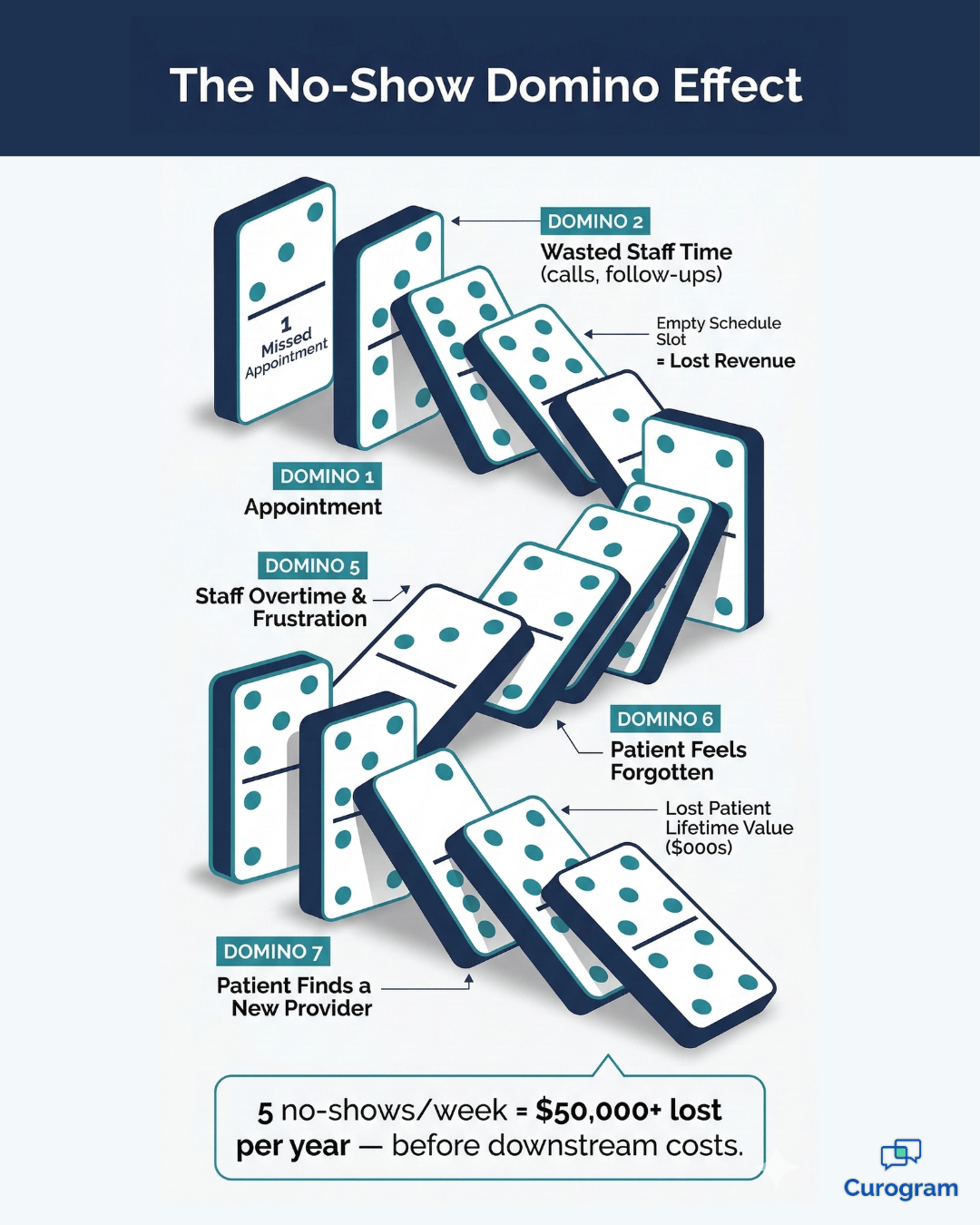
Every missed appointment is a missed billing opportunity. No-shows typically cost a practice between $150 and $300 per slot. Multiply that by just five no-shows per week at $200 each, and you're leaving more than $50,000 on the table every year.

 For many practices, the actual number is even higher — and no-shows are just the beginning of the revenue story.

What's important to understand is that these losses aren't random. They're driven by specific process failures — appointment reminders that don't go out, confirmation calls that take too long, scheduling gaps that never get filled.The revenue impact of administrative inefficiency in healthcare is predictable and, to a large degree, preventable.

The timing of these losses matters, too. Revenue that's delayed by even 30 to 60 days due to slow billing creates real cash flow problems for practices operating on thin margins. And when denied claims require rework, that delay extends further — pushing revenue into a future billing cycle while current expenses continue to accumulate.

Many practices underestimate the cash flow damage of billing inefficiency because the revenue eventually arrives;

They just don't see how much they're paying in the form of carrying costs and administrative labor to collect it — insights confirmed by real-world clinic results.

Three Revenue Leaks Worth Tracking

  • Delayed billing. The longer it takes to submit a claim after a visit, the more likely it is to get lost, rejected, or forgotten. Practices that let billing lag behind their patient volume end up chasing payments that should have been processed weeks earlier, creating cash flow problems on top of the revenue loss itself.
  • Denied claims. These are expensive twice over — you lose the original payment, and you spend staff time fixing and resubmitting. Denial rates in many practices run between 5% and 10% of all submissions, which is a significant chunk of revenue requiring extra effort to recover.
  • Missed appointment opportunities. When your schedule has gaps from no-shows or poor patient recall processes, those slots rarely get refilled in time. That's revenue that simply disappears — and if it happens consistently, it also means your scheduling capacity is being chronically under-utilized.

It's worth noting that not all denied claims get appealed or resubmitted. Many practices write off a percentage of denials as not worth the staff time to pursue, especially for smaller claim amounts. That write-off rate represents pure revenue loss — money that was earned through a completed patient visit but never collected because the administrative process broke down somewhere between the appointment and the payment.The connection between administrative process and top-line revenue is more direct than many practices realize. Based on our internal data, practices using automated reminders and confirmations see dramatic drops in no-show rates.

One client reduced their no-show rate from 14.20% to 4.91% in just three months — three times better than the industry average — showcasing real-world clinic results of automated reminders and patient communication.

That kind of shift reframes the administrative inefficiency healthcare costs conversation from an operational issue into a revenue recovery opportunity.

Real-World Impact:

One practice cut its no-show rate from 14.20% to 4.91% in just three months using automated reminders — three times better than the industry average. Based on our internal data, that kind of shift translates directly to a 10–20% increase in recovered revenue.

Patient recall is another revenue lever that often goes underutilized. Many patients who haven't scheduled a follow-up aren't actively avoiding care — they've simply forgotten, gotten busy, or assumed they'd hear from your office when it was time.

A proactive recall system closes that gap with minimal staff effort and can bring a surprising volume of lapsed patients back through the door.

It also changes how you prioritize improvements. When you can tie a specific process failure to a specific dollar amount, the decision to fix it becomes much easier to make — and much easier to justify to the rest of your leadership team.

No-show domino effect infographic showing revenue loss chain reaction in medical practices

The Hidden Price of Burnout and Staff Turnover

Inefficiency doesn't just cost money in the moment. Over time, it wears down your team in ways that have their own serious financial consequences.

When staff spend their days on repetitive, manual tasks — answering the same calls, entering the same data, chasing the same authorizations — frustration builds steadily. And frustrated staff don't stay.

The connection between administrative workload and turnover is well documented across healthcare settings. Front desk staff and medical assistants report that feeling overwhelmed by repetitive, low-value tasks is one of the top reasons they consider leaving their role.

When your staff can see that a process is broken but feel powerless to fix it, the sense of helplessness compounds the frustration. Over time, even capable and committed employees reach a threshold and start looking elsewhere.

Replacing a single employee can cost anywhere from $30,000 to $50,000 when you factor in recruiting, onboarding, and the time it takes a new hire to reach full productivity. That figure doesn't include the losses during the vacancy period itself, when your remaining staff are stretched thin and patient experience often suffers as a result.

For a small to mid-sized practice, losing two or three people in a year to burnout-related turnover creates a serious financial hole.

What makes turnover costs so hard to see clearly is that they tend to be distributed across multiple budget lines. Recruiting costs show up in one place. Onboarding and training time show up as reduced productivity in another.

The errors and service gaps that occur during the transition don't show up anywhere directly, but they're real. Taken together, the true cost of a single departure is almost always higher than the number that gets reported.

How Burnout Compounds the Cost

Burnout affects the quality of work long before people actually leave.

Staff who feel overwhelmed and under-supported make more errors — and those errors have downstream consequences that go well beyond the initial mistake.

A missed insurance verification leads to a denied claim. A billing oversight leads to delayed revenue. A miscommunicated appointment leads to a frustrated patient who leaves a negative review.

Practice overhead costs rise not just from direct expenses, but from the accumulated ripple effects of an overloaded workforce.

The Turnover Math:

Losing just two employees per year to burnout can cost your practice $60,000–$100,000 in recruiting, onboarding, and productivity loss alone — before accounting for the errors and service gaps that occur during the transition.

Burnout also has a contagious quality. When one team member is struggling under an unsustainable workload, others notice.

They pick up the slack, which increases their own workload. Morale shifts as the entire team starts to feel that the practice's systems are working against them rather than for them. This kind of cultural erosion is slow and quiet — but it accelerates turnover across the whole team, not just among the most burned-out individuals.

The emotional toll matters, too. When your front desk team is constantly firefighting instead of doing meaningful work, the culture of the practice shifts. Staff who once took pride in delivering a smooth patient experience start to feel like they're just putting out fires. That shift in attitude is hard to reverse once it sets in, and it tends to accelerate turnover even among people who initially seemed committed.

There's also the opportunity cost of unfilled positions to consider. When a role sits open, other staff absorb the extra load — which accelerates their own burnout and creates a self-reinforcing cycle that gets harder to break with each passing month.

Reducing the administrative burden on your team isn't just a quality-of-life improvement. It's a retention strategy — and for many practices, it's one of the most cost-effective investments they can make.

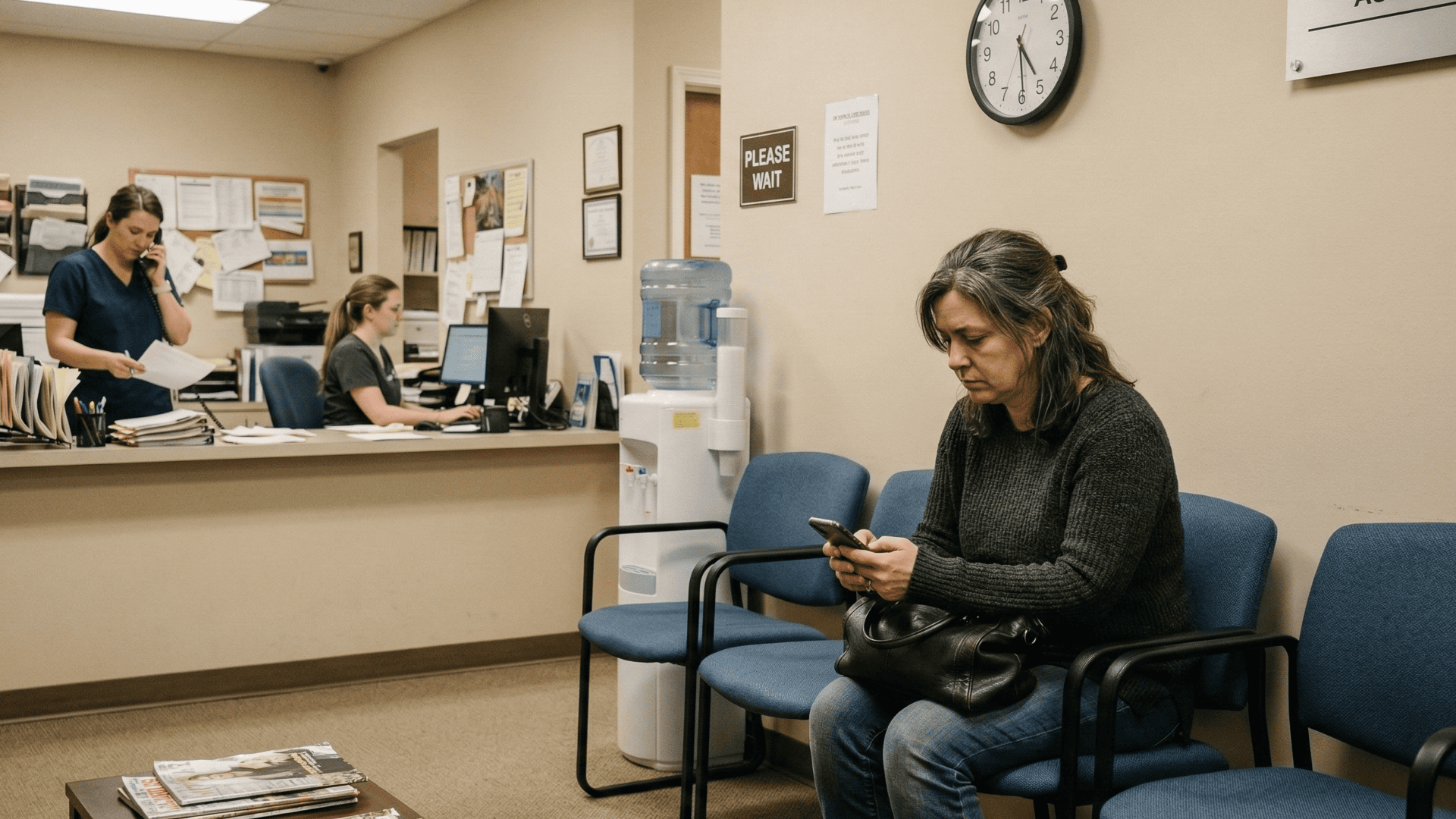
Patient waiting alone in medical office ignored by busy front desk staff in background

What Poor Patient Experience Really Costs You

Administrative problems are often invisible to clinicians but very visible to patients. Long hold times, scheduling errors, confusing intake paperwork, and missing appointment reminders all signal to patients that your practice isn't organized. And patients who feel that way don't always complain directly — they just quietly find another provider, often without giving you any warning or feedback.

This is one of the most important and underappreciated aspects of administrative inefficiency in healthcare: the damage it does to patient relationships is largely silent.

Patients rarely call your office to say,

"I'm leaving because your scheduling process is frustrating." They just stop scheduling. They transfer their records, find a new provider, and you find out months later when you notice a drop in returning visits. By then, the loss has already compounded.

The challenge is that most practices measure patient satisfaction through post-visit surveys or online reviews, which only capture a small slice of the full picture.

Many dissatisfied patients simply disengage. They skip their follow-up, delay rescheduling, or tell a friend about the poor experience without ever telling you. By the time you notice the pattern in your retention numbers, the damage is already widespread.

Word of mouth is still one of the most powerful forces driving patient acquisition in healthcare. When a patient has a genuinely smooth experience — easy scheduling, clear communication, no hold music, timely reminders — they tell people.

When the experience is frustrating, they also tell people. The difference is that negative word of mouth tends to travel faster and reach a wider audience, especially in the age of social media and online review platforms.

What Patients Notice — and Remember

The friction points that most often push patients toward a competitor tend to cluster around communication and access:

  • Difficulty getting through on the phone, or waiting too long for a callback when they have a question
  • Appointments that feel disorganized because intake forms weren't completed or available ahead of time
  • No reminder before a visit, leading to no-shows or last-minute scrambles to reschedule
  • No follow-up after an appointment, leaving patients unsure about next steps, referrals, or results

These are all solvable problems — and they're all rooted in administrative process, not clinical care. Fixing them doesn't require your physicians to do anything differently. It requires the right communication infrastructure.

It's also worth noting what these problems signal to patients beyond mere inconvenience. A missed reminder or a confusing intake process doesn't just create frustration in the moment. It plants doubt about whether the practice is attentive to detail, which is exactly the quality patients want to trust in the providers managing their health.

Administrative sloppiness and clinical sloppiness feel related to patients, even when they're not. That perception matters enormously for trust and long-term loyalty.

The financial stakes are significant. Losing a patient to a competitor isn't just one lost visit. When you calculate the lifetime value of a loyal patient — including annual check-ups, referrals, follow-up care, and family members who tend to follow — a single departure can represent thousands of dollars in long-term revenue.

Acquiring a new patient typically costs five to seven times more than keeping an existing one, which means every retained patient has real, measurable value to your bottom line.

Negative online reviews compound the damage further.

A frustrated patient who couldn't get through on the phone, or who showed up to a poorly scheduled appointment, is a likely candidate for a one-star review.

Those reviews are public, persistent, and disproportionately damaging to your ability to attract new patients who are doing their research online before choosing a provider.

35%

Recalled patients booked an appointment within one month of receiving an SMS reminder — and one practice recovered 1,240 visits from recall messages alone (based on internal Curogram data)


Simple, consistent communication is one of the most cost-effective tools for closing this gap. Patients who hear from your practice regularly — through reminders, follow-ups, and proactive outreach — feel cared for, even between visits.

That feeling drives retention more reliably than any single aspect of the clinical experience, and it starts with fixing the administrative processes that create friction between your practice and your patients in the first place.

Paying for Technology You're Not Fully Using

Most practices today have made real investments in technology. EHR platforms, practice management systems, billing software — these tools represent significant recurring costs, and they come with a wide range of features designed to reduce administrative work.

The problem is that in most offices, only a fraction of those features are actually being used.

This gap between what the technology can do and what staff actually use it for is one of the most quietly expensive problems in healthcare operations.

You're paying for capability you're not deploying, while still relying on manual processes to fill the gap. The result is the worst of both worlds: high software costs and high labor costs, with neither delivering its full potential value.

The underutilization problem is particularly common with EHR systems, which are often purchased for their clinical documentation capabilities but come bundled with scheduling tools, patient communication features, and billing automation that never gets turned on.

Some practices don't even know these features exist. Others know but have never had the time or support to configure and deploy them properly. Either way, the ROI from the technology investment is being left on the table.

Why Good Tools Go Unused

It usually comes down to one of three patterns:

  • Gaps in training. Staff may not have received adequate onboarding when the system was first implemented. Without proper training, people default to what they already know, even when a faster and more accurate option is built right into the platform they're using every day.
  • Habit over efficiency. Workarounds become entrenched over time. A manual process adopted as a temporary fix two years ago is now just "how things are done here" — and no one questions whether there's a better way.
  • Poor system integration. When your EHR doesn't connect cleanly with your billing platform, your scheduling system, or your patient communication tools, data has to be moved manually between them. That disconnect creates duplicate work, raises error rates, and turns every cross-system task into a friction point.

The integration problem is especially worth examining closely. Even when individual tools are good, a lack of connection between them creates its own layer of administrative burden. Your staff becomes the integration layer — manually exporting data from one system, reformatting it, and importing it into another.

This isn't just inefficient; it introduces errors at every transfer point and makes it nearly impossible to have a single, accurate view of patient information across all your systems.

The irony is that the whole point of investing in digital tools is to reduce administrative friction. But when systems are poorly integrated or underutilized, they can actually make operations more complicated, not less. Staff end up managing both the software and the manual workarounds simultaneously, which is more work than either approach alone.

The return on investment from your technology only materializes when the tools are used correctly and to their full potential. Platforms like Curogram are built to integrate directly with your existing EHR, which means your team isn't doing double data entry or toggling between disconnected systems.

Everything flows through a single communication hub that connects patients, staff, and clinical workflows in one place — and that reduces the administrative load instead of adding to it.

If your practice is already paying for an EHR with patient communication or scheduling features, the first step is a simple audit: which features are you actively using, and which are sitting idle?

The answer often reveals low-hanging fruit — capabilities you're already paying for that could eliminate hours of manual work per week with minimal setup time.

How to Measure What Your Practice Is Losing

Before you can fix a problem,

You need to know its actual size. Measuring the cost of administrative inefficiency in healthcare starts with something simple: a time study.

Have your staff track how they spend their time for one to two weeks, broken down by task category. You don't need expensive software to do this — a shared spreadsheet works fine.

The results are often surprising, and sometimes alarming. Most practices find that a significant share of staff hours are going to tasks that could be partially or fully automated.


The value of a time study isn't just in the data it produces. It's in the conversations it starts. When a front desk team sees in concrete terms how much of their week goes to phone calls, data entry, and authorization follow-ups, the case for change becomes personal. People who were resistant to new tools often become advocates once they understand the scale of what they're currently absorbing.

The time study creates shared context and shared motivation — both of which matter when it comes to actually implementing improvements.

Time data alone isn't enough, though. The real insight comes when you translate hours into dollars.

Once you know how much time is being spent on each category of administrative work, you can apply an actual cost per hour — salary plus benefits — and arrive at a true labor cost figure. That number is almost always higher than people expect, and it's the foundation for building a compelling case for change.

It helps to layer in your revenue data alongside the labor cost data. No-show rates, claim denial rates, and days-to-payment metrics all tell part of the story. When you combine the labor cost of administrative inefficiency with the revenue impact of the same process failures, the full financial picture becomes hard to ignore.

That combined figure is what moves leadership

from "we should probably look at this someday"

to "we need to act on this now."

A Three-Step Framework for Getting Clear Numbers

Once you have your time data, the cost analysis follows naturally through three steps:

  • Step 1: Calculate labor cost by task. Take the hourly cost of each staff member — salary plus benefits — and multiply it by the weekly hours spent on each task category, then annualize the result. Even a modest reduction in time spent on manual work translates into real savings.
  • Step 2: Benchmark your key metrics. Compare your no-show rate, claim denial rate, and staff-to-patient ratio against industry data. Many EHR vendors provide built-in reporting tools that surface these figures automatically. If yours doesn't, industry benchmarks are widely available through practice management associations and healthcare consulting groups.
  • Step 3: Build your full inefficiency profile. Pull together time lost, revenue lost, staff cost impact, and patient retention impact into a single summary. This snapshot is what you'll use to prioritize investments and make the case to leadership that change is worth pursuing.

Once your inefficiency profile is complete, rank your findings by financial impact. This prioritization step is critical because it keeps the improvement effort focused, and a practice ROI calculator can help quantify which areas deliver the biggest return.

Practices that try to fix everything at once often make little progress on anything. Practices that start with the two or three highest-impact items tend to see measurable results quickly, which builds the confidence and momentum to keep going.

It's also worth revisiting this exercise periodically, not just as a one-time project. Practices change, patient volume shifts, and new processes get layered on top of old ones over time. An annual review of administrative cost profile keeps you from drifting back into inefficiency without realizing it.

The table below gives you a quick-reference framework to estimate the annual financial impact across the major cost categories. Use it as a starting point — your actual numbers will vary — but the process of filling it in will reveal where the biggest opportunities for improvement are hiding.

Quick-Reference Cost Calculation Framework

Area of Inefficiency How to Measure It Typical Annual Impact
No-shows and cancellations No-show rate × avg. appointment value × annual visits $50K–$150K+
Staff time on manual tasks Hours/week × hourly cost × 52 $20K–$80K
Claim denials and rework Denial rate × total claims × avg. claim value $15K–$60K
Staff turnover Number of exits per year × $30K–$50K replacement cost Varies widely
Lost patient lifetime value Patients lost × avg. annual spend × retention years $10K–$100K+

What Efficiency Investments Actually Return

Once you've mapped the problem, you can evaluate the solutions with real clarity. Automation tends to be the highest-ROI investment available to a medical practice because it doesn't just save time — it recovers revenue that would otherwise be permanently lost.

Based on our internal data, practices using Curogram see no-show rates that are 53% lower than the industry average, and each recovered appointment contributes directly to the revenue line. Our data also shows practices can see a 10–20% increase in revenue from time slots that would otherwise have gone unfilled.

It's also worth noting that the financial return from efficiency investments extends well beyond the immediate cost savings.

When your staff spends less time on manual processes, they have more capacity to handle patient volume, follow up on outstanding claims, and deliver a better patient experience — all of which compound over time into stronger retention and a healthier practice.

One of the most underappreciated aspects of investing in automation is what it does for your staff. When repetitive manual tasks are handled automatically, your team gets to spend more of their day on work that actually requires their skills and judgment.

That shift in day-to-day experience has a measurable effect on job satisfaction and retention — which, as we've established, has its own significant financial value.

Where the Returns Come From

  • Automation and communication platforms cut the time your staff spends on phone calls and manual follow-ups, freeing them for higher-value work. Clients using Curogram confirm over 1,100 appointments per month on average through automated workflows — with no added staff effort required.
  • Process improvement initiatives — like redesigning patient intake, streamlining check-in, or standardizing billing submission — often deliver strong returns without requiring new technology. Sometimes the biggest gains come simply from cleaning up a workflow that has accumulated unnecessary steps over time.
  • Staff training and development ensure that the tools and workflows you already have are being used to their full potential. Staff who know exactly what to do and have the right support make fewer errors, need less oversight, and stay in their roles longer.

These three return streams tend to reinforce each other. Automation reduces the volume of manual work. Better processes make the remaining work more consistent and less error-prone.

Well-trained staff using good tools deliver better results across the board. When all three are working together, the cumulative effect on both costs and revenue is substantially larger than any single initiative would produce on its own.

By the Numbers:

Based on our internal data, Curogram clients confirm more than 1,100 appointments per month through automated workflows alone — fully hands-free. That's 1,100+ revenue-generating visits protected without adding a single staff hour.

Payback periods for well-chosen efficiency investments are often much shorter than practice managers expect. When you're recovering tens of thousands of dollars in avoided no-show losses and saving 20 or more staff hours per week, a communication and automation platform can pay for itself within just a few months of deployment. The ongoing return after that is essentially pure gain.

It's also worth thinking about these investments as protection against future cost increases. Staff wages and benefit costs are rising. Payer complexity isn't decreasing.

Practices that build efficient, automated workflows now are positioning themselves to absorb future pressures without proportionally increasing their overhead — and that's a significant competitive advantage over time.

The practices that get the best results from efficiency investments are typically those that approach it as an ongoing commitment rather than a one-time project. Reviewing performance metrics quarterly, adjusting workflows as patient volume changes, and staying current with platform features all help ensure the ROI stays strong long after the initial deployment.

Making the Case for Change in Your Practice

Even when the data is compelling, getting buy-in for change isn't always straightforward. Physicians and administrators are already stretched thin, and new investments require both budget approval and the willingness to navigate short-term disruption during implementation.

The numbers may make a strong case, but how you present them often determines whether leadership is ready to act.

One common mistake is framing efficiency improvements purely as cost-cutting. In healthcare, that can raise concerns about reducing staff or services. A more effective approach focuses on revenue recovery and staff capacity. The goal isn’t to do less — it’s to free up time and resources so staff can focus on work that actually supports patient care and practice growth.

Starting with financial impact can make the conversation more persuasive. When inefficiencies like no-shows, claim denials, or billing delays are connected to clear dollar amounts, the issue becomes easier for leadership to prioritize.

Benchmarking against peer practices can reinforce the point, showing that inefficiency isn’t just an operational inconvenience but a competitive disadvantage.

It’s also important to prioritize. Trying to fix every operational problem at once often slows progress. Many practices see the fastest results by addressing high-impact areas first, such as appointment no-shows, manual scheduling, or delayed billing processes.

Early improvements create measurable ROI and build momentum for broader operational changes.

Finally, successful implementation depends on more than the technology itself. Staff training, clear communication, and involving frontline teams in the rollout all help ensure new workflows are adopted smoothly. When staff understand the purpose behind the change and feel included in the process, adoption tends to be faster and the long-term benefits become easier to sustain.

Conclusion

Every week you delay addressing administrative inefficiency is another week of revenue walking out the door — which patient engagement features can help recover through reminders and streamlined communication.

The numbers in this article aren't hypothetical — they reflect what practices across the country are losing right now, often without knowing exactly where the money is going.

The good news is that the solutions are available, proven, and often faster to deploy than you'd expect. From automated appointment reminders that cut no-show rates significantly, to two-way patient texting that replaces dozens of daily phone calls, to integrated workflows that eliminate duplicate data entry, the tools exist to make a real and lasting dent in your practice’s overhead costs.

What separates practices that act from those that don't is usually one thing: a clear picture of the problem. Now you have that picture. You know where time is being wasted, what it's costing in dollars, what it's doing to your team, and what your patients are noticing. That's the foundation for meaningful change.

Curogram helps medical practices reduce their healthcare administrative burden through smart automation and integrated communication — without replacing your existing EHR. If you're ready to see how much your practice could save, we'd love to walk you through it.

Book a demo with today and find out what better medical office efficiency actually looks like in practice.


Frequently Asked Questions

How much of healthcare costs come from administration?

Administrative tasks account for roughly 25% of total healthcare spending in the United States. That's significantly more than comparable high-income countries spend on the same activities, which means there's substantial room for improvement without compromising the quality of patient care.

How much does a no-show actually cost a medical practice?

Each missed appointment typically costs a practice between $150 and $300 in lost revenue. For a practice averaging five no-shows per week at $200 each, that adds up to more than $50,000 per year. Practices that use automated reminder systems can dramatically reduce this figure — based on our internal data, one client cut their no-show rate from 14.20% to 4.91% in just three months.

What's the best way to reduce administrative burden in a small practice?

Start with automation. Automated appointment reminders, two-way patient texting, and digital intake forms replace the most time-consuming manual tasks with minimal staff effort. These tools also integrate with most existing EHR systems, so you don't need to overhaul your current setup to start seeing meaningful results fairly quickly.

How does staff turnover connect to administrative inefficiency?

Repetitive, manual administrative work is a leading driver of staff frustration and burnout. When your team spends most of their day on tasks that could be automated — like phone calls, data re-entry, and scheduling changes — job satisfaction drops and retention suffers. Replacing a burned-out employee costs between $30,000 and $50,000, which makes staff retention a direct financial issue tied to how efficiently your practice operates day to day.

What ROI can a practice expect from communication automation?

Based on our internal research, practices using automated communication tools see no-show rates that are 53% lower than the industry average and report revenue increases of 10–20% from recovered appointment slots. Add in the time savings from reduced phone calls and manual follow-ups, and most practices see a positive return within the first few months of deployment.