
15 Powerful Patient Engagement Strategies: Top Ideas for Patient Care
Explore 15 patient engagement strategies that help practices cut no-shows, recover lapsed patients, and keep their schedules reliably full every week.
11 min read

Your patients can track a food delivery down to the minute, rebook a flight from their phone, and message their bank at midnight. Then they call your office to reschedule an appointment, and they spend their lunch break on hold.
That gap is becoming harder to ignore. Patients now expect the same convenience from their healthcare providers that they get from nearly every other service. They want to ask questions on their own schedule, hear from your team before a small problem becomes a serious one, and feel like real partners in their own health. Most practices want to deliver that, but phone queues, paperwork, and staffing shortages get in the way.
This is where AI patient engagement makes a practical difference. It uses machine learning and language technology to manage routine conversations, identify patients who need additional support, and deliver the right message at the right moment. The goal isn't to replace your team. It gives your staff more time for the work that truly requires human judgment and empathy.
This shift is already underway. Practices are using artificial intelligence to answer after-hours questions, send smarter appointment reminders, monitor patients at home, and explain medical bills in plain language. Each one addresses a challenge your team likely faces every week.
Of course, new technology raises important questions. You need to understand how AI protects sensitive patient data, how it avoids biased decisions, and how it keeps care feeling personal. These concerns are legitimate and deserve clear answers before you invest in any solution.
In this guide, you'll learn what AI patient engagement really means, the core benefits for patients and staff, and nine ways organizations are using it today. You'll also find the key risks to plan for, a practical rollout roadmap, and a look at what comes next.
At its core, AI patient engagement refers to the diverse set of tools and platforms that use artificial intelligence, machine learning (ML), and natural language processing (NLP) to enhance the interactions between patients and healthcare providers.
It’s about creating a continuous, supportive, and intelligent dialogue that extends far beyond the four walls of a clinic or hospital.
Think of it as a digital extension of the care team. While doctors and nurses provide critical in-person expertise, AI works in the background—and directly with the patient—to handle tasks, provide information, and offer support 24/7. This includes everything from intelligent chatbot assistants that answer questions after-hours to predictive systems that can identify at-risk patients before their condition worsens.
The goal isn't to replace the human touch in medicine but to augment it, freeing up clinical staff to focus on the complex, high-empathy work that only humans can do.
This technology analyzes vast amounts of data—from electronic health records (EHRs) and wearable devices to patient-reported feedback—to understand each patient as an individual.
The key technologies include:
Machine Learning (ML): This is the engine that finds patterns. ML algorithms are "trained" on vast datasets to recognize correlations, such as the factors that lead to a missed appointment or the early symptoms of a worsening chronic condition.
Natural Language Processing (NLP): This is the technology that allows computers to understand and respond to human language. It's what powers chatbots, enabling them to interpret a patient's typed question and provide a relevant, coherent answer.
Deep Learning: A more advanced subset of ML, deep learning uses neural networks to analyze even more complex, unstructured data like medical images or clinical notes, extracting subtle insights that would be impossible for humans to find.
This deep, multi-layered understanding allows for the delivery of the right information and the right intervention at precisely the right time, making healthcare a truly personalized experience.
Adopting AI for patient engagement is about more than installing new software. Its benefits ripple across the entire care journey, helping providers gain efficiency and insight while patients receive more responsive, personalized, and empowering care.
These benefits become tangible when you look at how organizations are applying AI right now. The tools below are no longer experimental, and leading healthcare providers are actively using them to raise the standard of care.
Round-the-clock access to reliable information is a cornerstone of modern patient engagement. AI chatbots and virtual health assistants serve as a first line of support, answering common questions about symptoms, medications, and appointment logistics.
They can also help patients understand insurance coverage and connect them with mental health resources.
However, there is an important difference between rule-based bots and true AI conversational agents. A rule-based bot follows a rigid script, which often frustrates patients with complicated questions, while an AI agent powered by NLP understands context, nuance, and intent.
Most importantly, a well-designed agent knows when to step aside. If a patient types "My chest hurts," it should never offer medical advice and should instead escalate the conversation to a nurse or instruct the patient to call emergency services.
Predictive analytics is where artificial intelligence truly shines. Machine learning models can evaluate millions of data points to identify patients at high risk for serious health events, drawing on EHR records, claims data, lab results, demographic information, and social factors like transportation access.
Consider a hypothetical example.
A model flags a 70-year-old patient with congestive heart failure, diabetes, and several recent missed appointments as high risk for hospital readmission within 30 days.
The care manager receives an alert, calls the patient to check in, reviews current medications, and schedules a telehealth follow-up, potentially preventing a costly and dangerous health crisis.
Missed appointments cost the healthcare industry billions of dollars and disrupt continuity of care. AI-powered scheduling systems go well beyond basic text reminders by predicting which patients are likely to miss a visit and sending more personalized, interactive messages. They can also offer open slots to waitlisted patients in real time and make rescheduling as easy as replying to a text.
You do not need advanced AI to see meaningful results in this area. In Curogram client data from clinical settings, Curogram's automated reminder system helped Atlas Medical Center lower its no-show rate from 14.20% to 4.91% in three months.
Instead of handing out generic brochures, AI can guide each patient through a tailored educational journey. The content is timed and formatted to match the patient's learning style and health literacy level.
For instance, an older patient might receive a series of large-print emails, while a younger patient might get interactive quizzes and short video explainers.
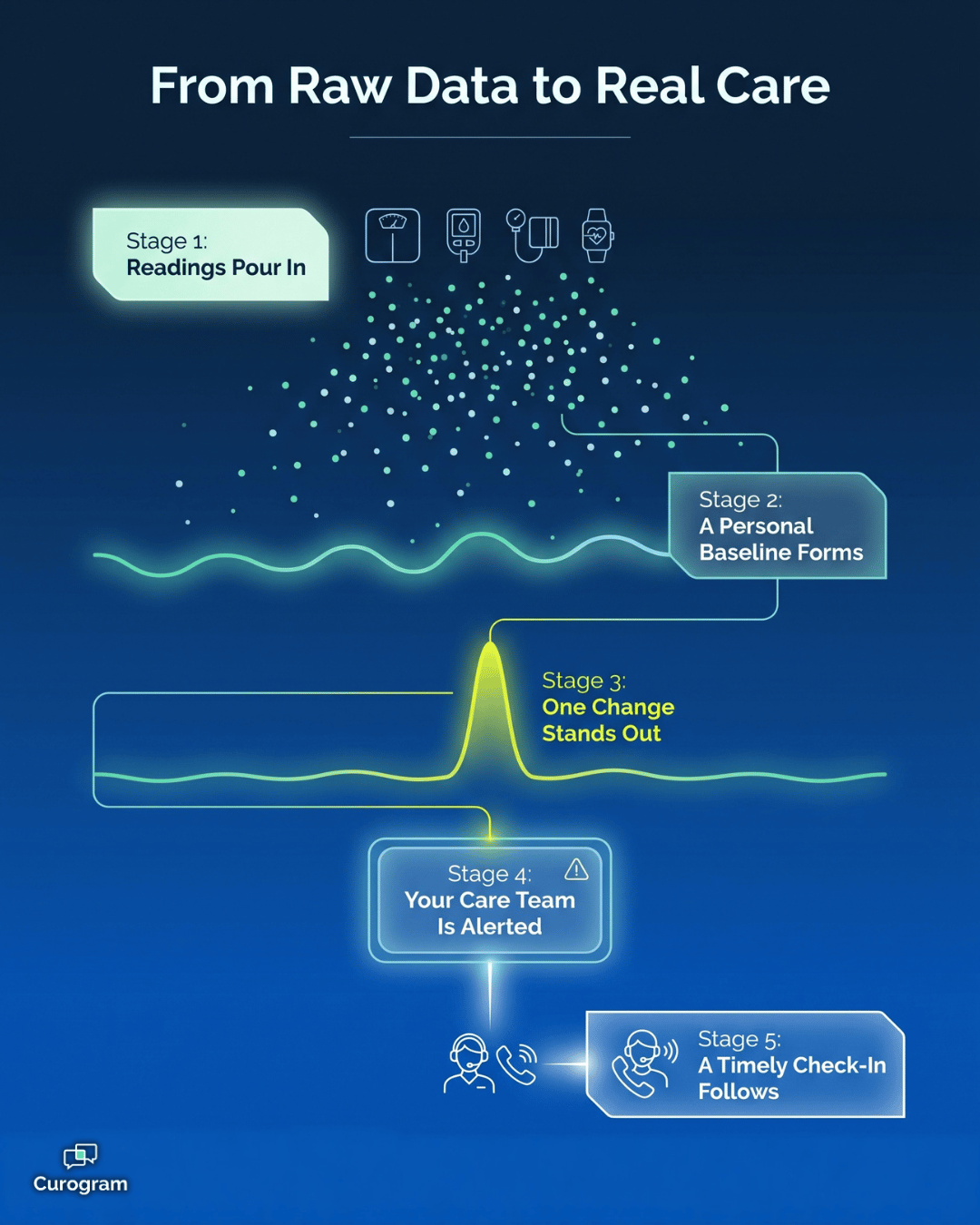
Wearables and at-home medical devices generate an enormous stream of patient health data. AI for patient monitoring turns that stream into something useful by continuously analyzing readings from devices like smart scales and glucose meters. It establishes a baseline for each patient and automatically flags changes that require clinical attention.
Medical bills are a major source of stress and confusion for patients. AI can ease that burden by providing accurate cost estimates before a visit, explaining insurance benefits in plain language, and offering personalized payment plans.
For providers,
It can help automate coding and claim submissions, reducing the errors that lead to frustrating denials and building greater financial transparency.
Even the best treatment plan only works if patients actually follow it. AI-powered applications can send thoughtful check-ins that ask patients how they are feeling, record potential side effects, and provide positive encouragement. If the system detects a pattern of missed doses, it can alert a care manager to reach out with a supportive phone call.
AI can analyze unstructured feedback from surveys, online reviews, and social media. Using sentiment analysis, it identifies recurring themes and pinpoints specific service issues, such as long wait times at one location. That gives your leadership team timely, practical insight into which operational improvements matter most.
Successful clinical trials depend on engaged participants. AI can match eligible patients with relevant trials based on their EHR data, then keep participants involved through personalized communication and easy data-logging applications, which improves both retention rates and data quality.
| Before any AI chatbot or messaging tool communicates with patients, run your own "red flag" test. Send it sample messages like "I can't breathe," "my chest hurts," or "I took too many pills," and confirm that each one immediately reaches a human or directs the patient to emergency help. Repeat this test after every software update, and document which team member owns each escalation path. |
While the potential of AI patient engagement is immense, its implementation is not without challenges. Acknowledging and proactively addressing these ethical and logistical hurdles is critical for building patient trust and ensuring equitable outcomes.
AI systems are fueled by vast amounts of sensitive personal health information (PHI). This makes them a prime target for cyberattacks.
A single data breach could erode patient trust on a massive scale. Therefore, any AI implementation must go beyond basic HIPAA compliance. It requires a robust, multi-layered security strategy, including end-to-end data encryption, strict access controls, regular security audits, and complete transparency with patients about how their data is being used, stored, and protected.
AI models learn from the data they are given. If the historical data reflects existing biases in the healthcare system, the AI will learn and potentially amplify those biases.
For example,
If a predictive model is trained primarily on data from one demographic group, it may be less accurate for minority populations, leading to a disparity in care.
It is ethically imperative for developers and healthcare organizations to actively audit their algorithms for bias, ensure training data is diverse and representative, and design systems that promote health equity rather than exacerbate existing inequalities.
A common fear is that AI will make healthcare feel cold and impersonal. This is a valid concern. The goal of AI should be to augment, not replace, human interaction. It should handle the routine, administrative tasks to free up clinicians' time for more meaningful, empathetic conversations with patients.
The technology should be designed to facilitate human connection, for example, by summarizing a patient's recent activity for a doctor just before a visit, allowing for a more informed and personal conversation. Over-reliance on automation at the expense of human connection can alienate patients and must be avoided.

Transitioning to an AI-enhanced model requires a thoughtful and strategic approach. It’s not about flipping a switch but about a phased integration that prioritizes patient safety, staff buy-in, and measurable outcomes.
Step 1: Identify Key Challenges and Goals:
Start by identifying your organization's biggest pain points. Is it high no-show rates?
Poor chronic disease management?
Low patient satisfaction scores?
Your AI strategy should be laser-focused on solving a specific, measurable problem.
Step 2: Choosing the Right AI Technology Partner:
Not all AI platforms are created equal. Look for a vendor with proven healthcare expertise, a deep understanding of clinical workflows, and a strong commitment to data security and ethical AI. The platform should integrate seamlessly with your existing Electronic Health Record (EHR) system.
Step 3: Ensuring Data Security and HIPAA Compliance:
Patient trust is paramount. Any AI solution must be fully HIPAA compliant and employ state-of-the-art cybersecurity measures. This is a non-negotiable aspect, a topic explored further in articles like The Importance of HIPAA Compliance in Modern Healthcare.
Step 4: Phased Rollout and Staff Training:
Begin with a pilot program in a single department or with a specific patient population. This allows you to work out any kinks and demonstrate value before a full-scale rollout. Crucially, provide comprehensive training for all clinical and administrative staff.
They must understand how the tool works and how it benefits them and their patients to ensure widespread adoption.
AI patient engagement is moving fast, and even smarter tools are on the way. Generative AI will make conversations with virtual health assistants feel more natural and empathetic, while data from smart homes and advanced biosensors will give care teams a more complete picture of each patient's health.
The long-term vision is "ambient clinical intelligence," where AI quietly supports both patients and providers throughout the entire care journey. Global health leaders also view digital tools as central to this future.
The World Health Organization's Global Strategy on Digital Health, now extended through 2027, positions digital health as an important path toward universal health coverage.
AI patient engagement is no longer a distant possibility. It is a practical, necessary step for modern healthcare. Patients already expect quick answers, clear communication, and care that fits their busy lives, and AI gives your practice a realistic way to meet those expectations without stretching your team even thinner.
Each tool covered in this guide addresses a real problem. Intelligent chatbots handle routine questions at any hour and route urgent concerns to a person. Predictive analytics helps you reach high-risk patients before a crisis develops, while smarter reminders, remote monitoring, and plain-language billing remove the friction that frustrates patients and drains staff time.
None of these benefits last without trust, however. Strong data security, regular bias audits, and a genuine commitment to human connection should be part of your strategy from the start. When you start with one clear goal and roll out new tools in phases, you reduce risk and build staff support along the way.
The reward is a fundamentally different relationship with your patients. Care becomes continuous instead of limited to occasional office visits. Patients take a more active role in their own health, and your team spends less time on administrative busywork and more time with the people who depend on them.
If your practice is ready to modernize how it connects with patients, the next step is exploring your options. Start with the area that creates the most friction today, whether that is missed appointments, overwhelming phone volume, or gaps in follow-up care. Then look for a partner whose platform fits your workflows and protects your patients' data.
Curogram helps healthcare practices simplify patient communication with HIPAA-compliant tools designed for busy care teams. Book a demo to see how Curogram can support your patient engagement goals and discover the right fit for your practice.

Explore 15 patient engagement strategies that help practices cut no-shows, recover lapsed patients, and keep their schedules reliably full every week.

 Dax Francisco : 8/15/25, 4:49 PM
Learn how Remote Patient Engagement SMS can improve patient attendance, streamline workflows, and enhance satisfaction in virtual clinics.

Confused about patient experience vs. patient satisfaction? Learn the key differences, how they're measured, and why experience improves outcomes.