
What is Patient Engagement? Strategies, Platforms & Solutions
What is patient engagement in healthcare? Learn how it differs from satisfaction, which 15 strategies work, and how to choose the right platform.
13 min read

Most practices already have every tool they need for patient engagement. They have a portal. They have a texting line. They have a survey nobody reads.
What they don't have is a schedule that holds. A 14% no-show rate means roughly one in seven booked slots produces nothing — no care delivered, no revenue collected, no room given back to the patient who needed it.
Based on our internal data, Atlas Medical Center sat at 14.20% before changing anything about how it reached patients. Three months later it was at 4.91%.
Nothing about the clinical care changed. What changed was whether patients confirmed.
That's the argument this guide makes: patient engagement isn't a philosophy problem, it's a workflow problem, and the practices that fix it fastest are the ones that stop treating it as a values exercise and start treating it as a series of specific, measurable steps.
The 15 patient engagement strategies below range from a text you can turn on this week to programs that take a year to build.
They include the human work — plain-language education, shared decision-making, culturally competent care — because none of that is optional. But the sequencing matters. A practice that can't reliably get a patient to confirm an appointment is not ready to run a health literacy program.
Improving patient engagement means closing the gaps where patients actually fall out: between the reminder and the confirmation, between the visit and the follow-through, between the last appointment and the one that never got booked.
We'll show you where those gaps sit, what each one costs, and which patient engagement ideas close them first.
Engaged patients cost less to care for and get better results. That's the short version. The longer version is that engagement touches nearly every metric a practice tracks, from no-show rates to reimbursement under value-based contracts.
Here's where the payoff shows up.
Patients who understand their condition follow through on it. They take medications as prescribed, keep follow-up appointments, and catch problems early.
Improving patient engagement moves the needle on chronic disease control, recovery time, and readmissions. It works because the patient stops being a bystander and starts owning the plan.
Patients who feel heard stay. They also talk.
Reputation follows engagement more closely than most practices expect. Based on our internal data, one clinic we work with rebuilt its Google rating from 1.67 to 5.0 and grew from 101 to 479 reviews. The same practice saw a 24% drop in inbound calls, because patients could find answers without dialing.
That matters because 90% of new patient leads check a practice's Google Business Profile before they ever visit the website.
Increasing patient engagement cuts spend in three places:
Value-based models pay for outcomes, not volume. Preventive screening uptake, chronic disease control, and patient-reported experience are all scored — and all three depend on whether patients participate.
Patient engagement strategies healthcare organizations adopt aren't a side project under these contracts. They're the delivery mechanism.
Non-adherence is one of the quietest, most expensive failures in medicine. Patients skip doses, delay refills, and drift out of follow-up.
Clear communication, plain-language education, and well-timed reminders close that gap. The mechanism is simple: patients act when they know what to do, when to do it, and why it matters.

Patient engagement means enabling patients to take part in their own health decisions. It's a shared effort between the patient, their family, and the care team.
There's no single tool that does it. Effective approaches mix technology (portals, telehealth, secure texting) with human practice (shared decision-making, teach-back, health coaching).
Most patient engagement strategies rest on five components:
| Component | What It Looks Like in Practice |
|---|---|
| Information Sharing | Plain-language material matched to the patient's condition and reading level |
| Shared Decision-Making | The patient helps choose the plan, not just receive it |
| Self-Management Support | Tools and skills to handle the condition day to day |
| Two-Way Communication | Patients can reach the team and get an answer |
| Accessibility | Care, records, and support are easy to get to |
Build on those five and the rest of the work gets easier.
Here are 15 patient engagement ideas you can put in place. Some are one-week changes. Others are quarter-long projects. We'll help you sort them at the end.
A generic brochure gets left on the chair. Material matched to the patient's condition, language, and reading level gets read.
The fix isn't a bigger library. It's a matching rule: pull content off the diagnosis code the clinician just entered, hand it over before the patient stands up, and confirm they understood it with teach-back. That last step is the one practices skip, and it's the one that determines whether the education was real.
Start with your five most common diagnoses. You'll cover most of your volume with a fraction of the content build.
Watch for: Patients who need a different language or a lower reading level rarely say so. Write everything at a level everyone can follow, and you don't have to guess.
Portal adoption stalls in the 20–30% range at practices that treat enrollment as an email they send later. It climbs when the front desk enrolls the patient at check-in, on the patient's own phone, while they're standing there.
Once they're in, what keeps them coming back is answers, not access. A lab result posted as raw numbers generates a phone call. The same result with one plain sentence of interpretation does not.
Watch for: Keep the phone path open. A portal that becomes the only way to reach you shuts out the patients who need you most.
Shared decision-making means the clinician lays out real options, the patient says what matters to them, and they choose together. Patients who help pick the plan commit to the plan.
The obstacle is time. A genuine SDM conversation takes minutes a 15-minute slot doesn't have. Practices that make it work don't add time — they add structure: a decision aid the patient reviews in the waiting room, so the visit starts at the comparison instead of the explanation.
Document the stated preference in the chart. It's the only proof the conversation happened.
Telehealth widens access. RPM widens visibility between visits. They solve different problems and get lumped together anyway.
| Best For | What It Fixes | |
|---|---|---|
| Telehealth | Routine follow-ups, med checks, simple acute issues | The patient who can't get there |
| RPM | Hypertension, diabetes, post-op recovery | The 89 days you can't see |
Send device setup instructions before the first reading is due. Practices that send them after spend the next two weeks on tech support calls.
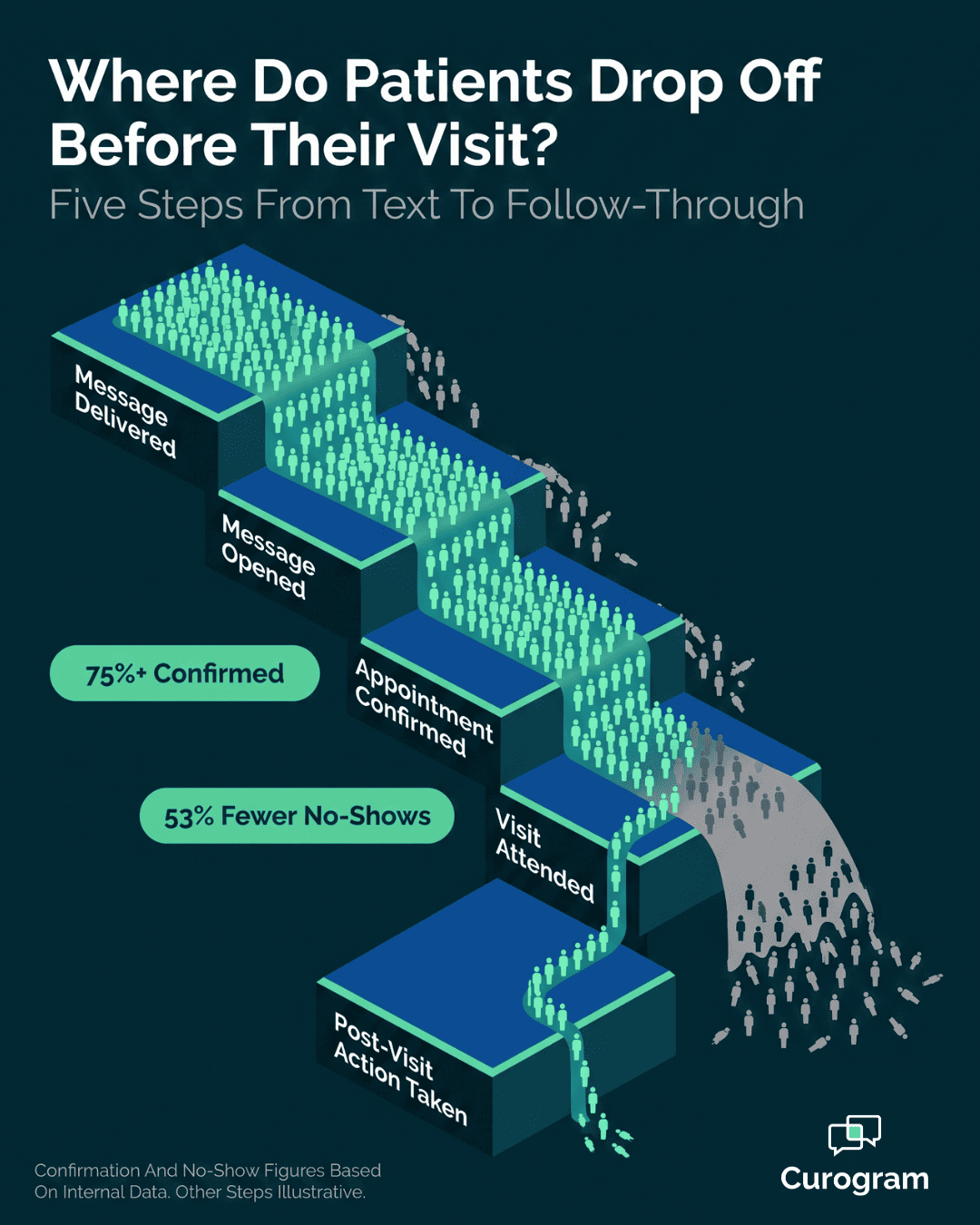
This is the highest-yield, lowest-effort item on the list, and it's the one most practices under-build. They send one reminder, 24 hours out, and call it a program.
Based on our internal data, Curogram clients hold a 75%+ appointment confirmation rate and run no-show rates 53% below industry average. Atlas Medical Center cut no-shows from 14.20% to 4.91% in three months. Covina Arthritic Clinic now confirms over 1,100 appointments a month.
What separates those numbers from a reminder that gets ignored:
| Weak Reminder | Reminder That Gets a Reply |
|---|---|
| Generic, sent once | Timed to the patient's actual behavior |
| Email, unopened | SMS, opened within minutes |
| No action available | One-tap confirm or reschedule |
| Same for everyone | Pre-op instructions, refill nudge, post-visit summary |
Watch for: Alert fatigue is real. If every message is a reminder, none of them are.
Asking for feedback signals the patient's opinion has weight. Acting on it proves it. Collecting surveys nobody reads is worse than not asking, because now you've made a promise you didn't keep.
Timing decides whether the ask works at all. Based on our internal data, practices running automated review requests generated 1,064 new 5-star reviews in three months, at roughly a 90% five-star rate. The request lands while the visit is still fresh — not three days later, when the patient has moved on.
Then close the loop. Tell patients what changed because of what they said. That's the step that converts a survey into engagement.
Many adults struggle with basic medical language. Almost none of them will tell you.
So don't try to identify them. Use plain language everywhere — spoken, written, printed, texted. Use teach-back after every instruction that matters. Offer materials in the languages your patients actually speak, not the ones your vendor happened to include.
The payoff is safer medication use and fewer preventable calls. The cost is mostly rewriting things you already have.
Patients with the same condition help each other in ways a clinician can't. A newly diagnosed diabetic will hear something from another patient that they wouldn't hear from you.
Run groups for specific conditions — diabetes, cancer recovery, new parents. Virtual works fine and removes the travel barrier. Or partner with a community organization already doing it well, instead of building your own.
Watch for: Groups need real facilitation and written privacy rules. An unmoderated forum becomes a liability, not an asset.
Points, streaks, and step counts turn a health task into something a patient will repeat. Progress you can see is progress you'll keep making.
Pull fitness tracker data into the portal so the patient sees their own trend line. Award points for completed screenings. Run group challenges if your population skews younger.
Watch for: Competition motivates some patients and discourages the rest. Anchor goals to personal bests, not leaderboards, or you'll lose the people who were already behind.
Waiting for patients to call is a strategy that fails quietly. Nobody reports it. The slots just don't fill.
Based on our internal data, SMS recall campaigns produce a 35% reconversion rate, and one campaign recovered 1,240 lapsed patients. Those patients were already yours. They didn't leave — they drifted.
Build recall lists by age, risk, and screening interval. Then write the message like a person: why this screening, why this patient, why now, and one tap to book.
A confusing bill damages trust faster than almost anything else in the visit. Patients who can't predict what they'll owe start avoiding care they need.
You can't quote exact numbers under most insurance plans. You can do the next best thing: publish estimates for your ten most common procedures, explain patient responsibility before the service, and send an itemized bill a non-clinician can read. Put a real phone number on it that reaches a real person.
Fewer disputes, faster payment, less anxiety in the waiting room.
Care that ignores a patient's background gets ignored back.
Provide interpreter services. Translate materials into the languages your panel actually speaks. Train staff on how to ask rather than assume — about family involvement in decisions, about dietary needs, about who else should be in the room.
Watch for: Cultural competence is not a checklist of stereotypes. Two patients from the same background will want different things. Ask the individual.
The clipboard is the first thing a patient experiences. It sets the tone for everything after.
Online self-scheduling and digital intake sent before the visit fix most of it. The patient fills out forms at home, on their phone, while they're not annoyed. Check-in becomes a hello instead of ten minutes of handwriting.
Watch for: Digital intake only helps if it writes back into your EHR. If your staff have to retype what the patient typed, you've moved the work, not removed it.
The most dangerous week in a patient's care is often the one right after they leave your building.
Book the follow-up before discharge, not after. Call or text inside 24–72 hours. Reconcile medications, because that's where the errors are. Spell out the specific warning signs that mean "call us today," in words a frightened person can process.
You can't do this for everyone. Risk-stratify and spend your staff hours where they change outcomes.
Open notes change how a patient relates to their own care. They come to appointments prepared. They catch errors in their own record. They understand why the plan is the plan.
Clinicians usually fear two things here: patient anxiety and a flood of extra messages. What mostly happens instead is better questions — the same volume of contact, aimed at something useful.
Share the notes through the portal, present the data in a format a non-clinician can read, and teach patients how to interpret what they're seeing.
Knowing the strategies is one thing; successfully improving patient engagement requires a thoughtful implementation plan. Here’s a practical guide on how to increase patient engagement within your healthcare organization:
Start with what's actually happening, not what you assume is happening. Most practices are surprised by at least one of these numbers.
| Metric | What It Tells You |
|---|---|
| Portal adoption rate | Whether patients can self-serve, or still have to call |
| No-show rate | The size of the leak in your schedule |
| Confirmation rate on reminders | Whether your messages are landing at all |
| 30-day readmission rate | How well discharge instructions are being followed |
| Review volume and rating | What new patients see before they ever reach you |
Then walk over and ask the front desk what breaks most often. They know before the dashboard does, and they'll name the specific thing — the reschedule requests that pile up on the voicemail, the intake forms that come back half-filled.
Vague goals produce vague effort. "Improve patient satisfaction" is not a goal; it's a mood.
A usable goal has a number, a deadline, and a name attached:
Cut no-shows from 14% to under 8% by the end of Q3, owned by the practice manager. Add 200 reviews in 90 days, owned by the front desk lead. Raise portal adoption 20 points in six months, owned by whoever handles check-in.
Write down the current number before you start. Otherwise you'll spend the review meeting arguing about whether anything changed.
Not every strategy fits every practice, and the fifteen above are not equal. Sort them by what they cost you against what they return.
| Effort | High Impact | Lower Impact |
|---|---|---|
| Low | Automated reminders, review requests, digital intake | Portal feature tweaks |
| High | Health literacy programs, culturally competent care, post-discharge follow-up | Gamification, VR education |
Start in the top-left box. Those are the projects that show a result inside one quarter, and the credibility you earn there is what buys you room to attempt the harder work in the row below.
A practice with a 14% no-show rate has no business building a VR education module.
A strategy your staff work around is a strategy that failed.
Train on the skill, not the software. Teach-back, plain language, and how to run a shared decision-making conversation are habits, and habits need practice. Nobody has ever gotten better at explaining a diagnosis by watching a vendor demo.
Then rewrite the workflow so the new step has a place in the day and a name on it. If sending review requests belongs to "everyone," it belongs to nobody, and it will be the first thing dropped the week two people call out sick.
Leadership has to say out loud that this matters. Otherwise the front desk will correctly read it as optional.
Pull the same five numbers you started with. Review them monthly, not annually — a year is long enough for a failed initiative to become policy.
Keep what moved. Fix what stalled. Kill what nobody used, and say so plainly, because quietly abandoning a project teaches staff that the next one won't be real either.
Ask your team what's slowing them down. They will tell you, they will be right, and the fix is usually smaller than you expect.
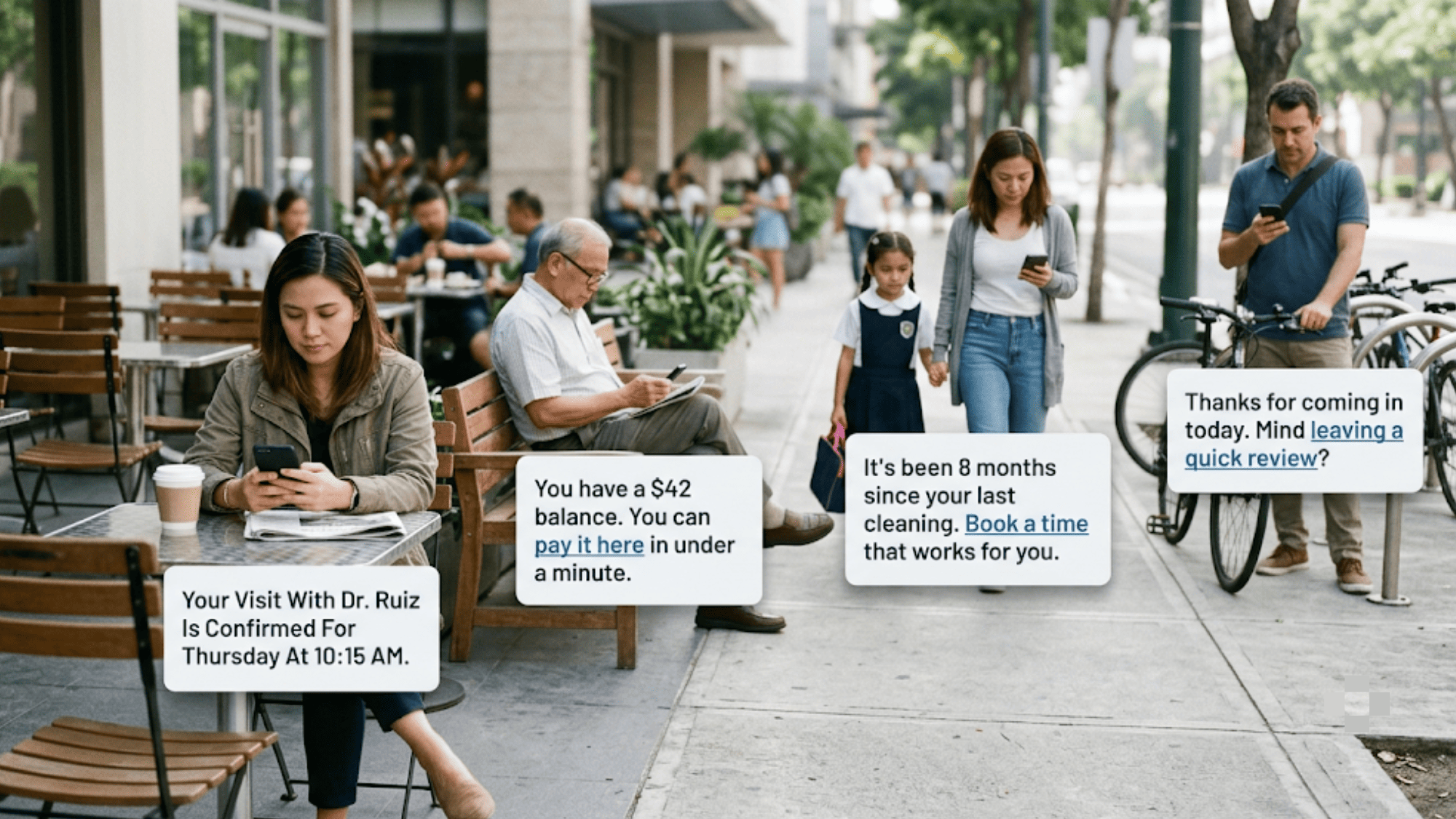
Patient expectations are changing faster than most practices are. A few shifts worth watching:
None of these replace the basics. A practice that can't reliably confirm an appointment won't be saved by VR.
Fifteen strategies is a lot to hold. You don't need all of them.
Most practices have the same two leaks, and they show up in the same place. Patients who were reminded but never confirmed. Patients who lapsed and were never called back. Both are quiet failures. Neither generates a complaint. Both cost you real money every week they go unfixed.
They're also the two easiest things on this list to solve. Automated confirmation and SMS recall don't require new staff, a culture change, or a year of planning.
Based on our internal data, Atlas Medical Center moved its no-show rate from 14.20% to 4.91% in three months. SMS recall campaigns bring back 35% of lapsed patients. Those results came from workflow, not willpower.
The harder work — health literacy, shared decision-making, culturally competent care — matters enormously and takes far longer. It deserves the year it needs. But it's very difficult to build any of it on top of a schedule that's still leaking 14% of its slots.
So start where the numbers move. Fix the confirmation gap. Rebuild the recall list. Prove to your team that a patient engagement project can produce a visible result inside one quarter, because that's what earns you permission to attempt the next one.
Then pick the next.
Want to see what automated confirmations and recall look like inside your own EHR? Book a Curogram demo and we'll walk you through the exact workflow, using your schedule and your patient list.

What is patient engagement in healthcare? Learn how it differs from satisfaction, which 15 strategies work, and how to choose the right platform.
 Carylee Gali : 4/4/22, 7:00 AM
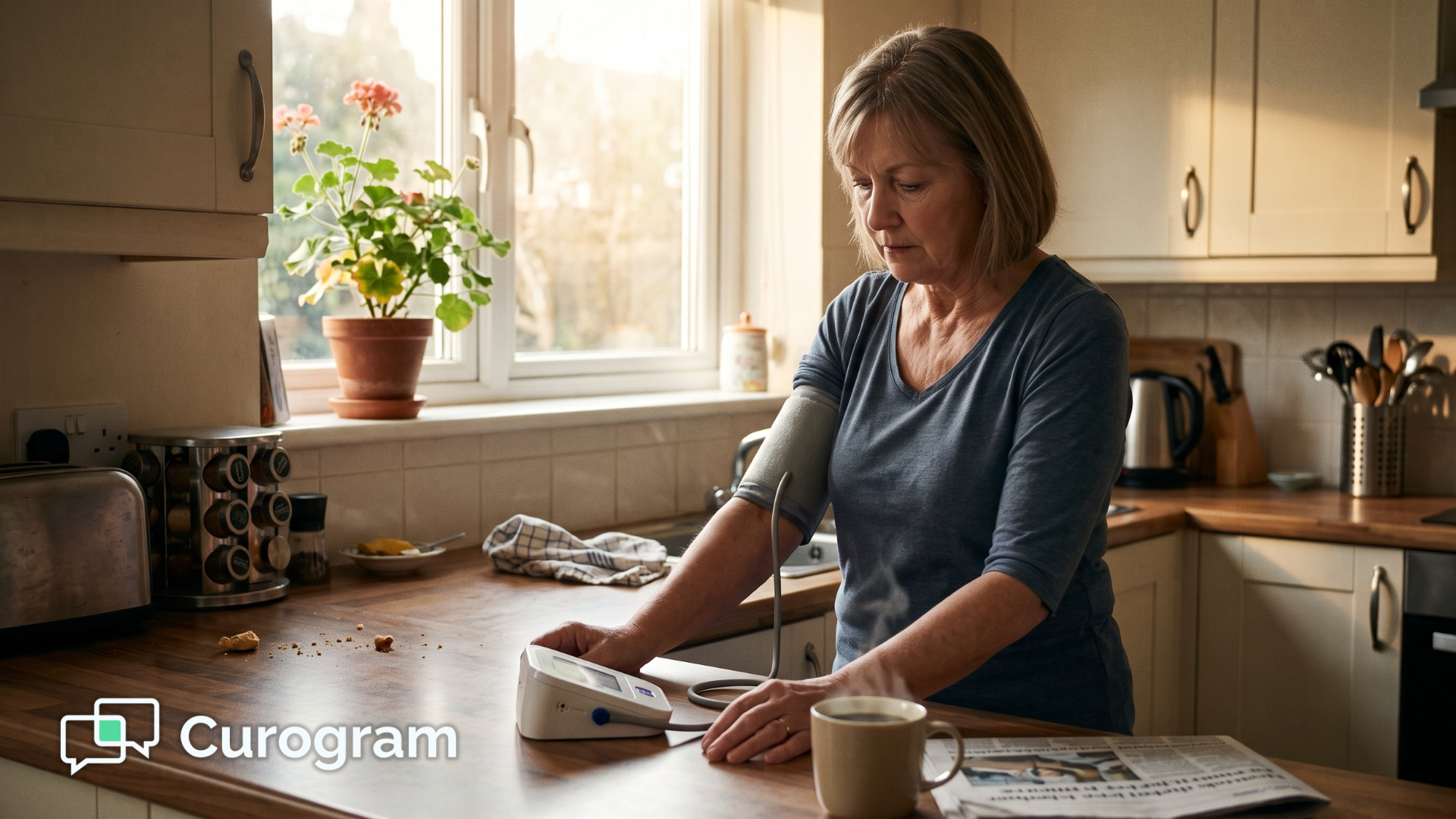
Telehealth helps establish patient engagement and expands care beyond the office using video conferences, SMS, and remote patient monitoring (RPM).

Discover why patient engagement matters for better outcomes, proactive care, improved quality, and stronger long-term health results.