
1 min read
15 Powerful Patient Engagement Strategies: Top Ideas for Patient Care
💡 Patient engagement strategies are the specific workflows that get patients participating in their own care: confirmations, education,...
18 min read

Portal enrollment gets treated as the engagement score. A practice registers 40% of its active patients, reports the number at the quarterly meeting, and considers the matter handled. Then no-shows stay where they were, the phones still ring all afternoon, and half the diabetic panel misses the three-month recheck.
Enrollment counts logins. What is patient engagement in practice comes down to something narrower: whether patients act. Do they confirm the visit? Come back for the follow-up? Open the result, answer the survey, pay the balance?
Those are behaviors, which means patient engagement in healthcare is an operations problem you can measure, not a values statement you adopt.
Reachability drives most of it. When a message actually lands, patients respond at rates that show up on the schedule within a quarter.
Atlas Medical Center dropped its no-show rate from 14.20% to 4.91% in three months, and one multi-location group brought 1,240 patients back through SMS recalls, both based on our internal data.
This guide covers what engagement is built from, how it differs from satisfaction and experience, and what a patient engagement platform does day to day.
It runs through 15 patient engagement strategies. The selection and rollout sections give you the questions to ask vendors and the order to do things in.
One thing worth saying up front, because it shapes the order everything else follows. Culture change is real work and takes about two years to show. The schedule can move this quarter.
Practices that want to improve patient engagement usually get further starting with reach, then building the harder things on top of patients who are already answering.
Patient engagement is a working partnership between patients, their families, and the people treating them. Patients get the knowledge, skills, confidence, and openings to take part in their care, make informed decisions, and help manage their health.
It takes effort from both sides. A patient who never asks a question isn't engaged. Neither is a practice that never invites one.
| Part | What It Looks Like |
|---|---|
| Clear information | Records patients can open, diagnoses in plain words |
| Two-way communication | Staff listen, invite questions, answer in language that fits |
| Shared decision-making | Goals set together, options weighed against what the patient values |
| Self-management support | Medication routines, lifestyle changes, home monitoring |
| Active participation | Patients speak up and question a dose that looks wrong |
Weak information makes shared decision-making impossible. Nobody weighs options they never understood.
Satisfaction measures how content a patient is with what they received. Experience covers every interaction they had with us, from the parking lot to the billing statement. Engagement is behavior.
Across our clients, more than 75% of patients confirm appointments by text, based on our internal data. Satisfaction comes from a survey. That number comes off the schedule.
Two things get mistaken for engagement. Perfect attendance is one, and a patient can sit through four visits a year without knowing why they take a statin. Portal logins are the other. A login says nothing about whether anyone read anything.
Beliefs drive the behavior: whether patients think they're at risk, whether they believe acting helps, how much control they feel over their own health. Patient engagement strategies built around those beliefs get further.
The Patient Activation Measure (PAM) scores where someone sits, from passive recipient to active co-manager, so we can start per person instead of running one approach for everyone.
Medicine ran the other way for decades, with the provider holding the information and the decisions. Better outcomes, respect for patient autonomy, and newer tools moved it.
Patient engagement in healthcare pays off in four places: clinical results, patient experience, operating cost, and performance under value-based contracts. All four show up in numbers most offices already track, starting with the no-show column.
Patients who understand why a treatment matters follow it more closely, and that follow-through is what moves the rest.
Based on our internal data, 35% of one multi-location practice's patients booked an appointment within a month of getting an SMS recall, bringing 1,240 patients back through the door.
A patient engagement platform is software that handles the back-and-forth between a practice and its patients. Patients get their health information, a way to reach us, and tools to manage their own care. We get a way to reach them that doesn't tie up the phones.
Most platforms bundle several patient engagement solutions in one place: two-way messaging, scheduling, reminders, intake forms, payments, telehealth. Whether any of it helps depends on the connection to the EHR you already run. A platform that can't read the schedule can't confirm an appointment.
Features vary by vendor, and so does depth. Here's the core set worth checking for.
Encrypted, HIPAA-compliant texting between patients and whoever needs to answer: the doctor, a nurse, or the front desk. Nobody has to be free at the same moment. A patient sends a question at 9pm and someone picks it up at 8am.
Most of what comes through is small. A refill request. A question about whether to take the new pill with food. A rash that showed up two days after starting an antibiotic. None of that needs a phone call or an appointment, and all of it used to get one. Staff can also send discharge instructions or check on a patient after a procedure without playing phone tag.
Volume is the real challenge. Once patients learn they can text, they text. Practices need someone assigned to the inbox, a response window they can actually hold, and a clear line for patients about what belongs in a message and what means calling 911.
Patients book, move, or cancel visits online at whatever hour suits them, which is often 11pm.
The bigger win sits on our side of the desk: the afternoon round of confirmation calls stops. Pair online booking with automated SMS reminders and confirmation rates across our clients run above 75%, based on our internal data.
The hard part is accuracy. Provider schedules carry blocks, template rules, and last-minute changes, so the platform has to read the EHR in real time. A booking page showing a slot that closed an hour ago causes more work than it saves.
The portal is where patients open their own chart: lab results, imaging reports, medication and allergy lists, immunization records, visit summaries. Results now post automatically in most systems, often before anyone has called.
That creates a real problem worth planning for. A patient reads an abnormal value on a Friday night with no context. Practices that handle this well add plain-language explanations to results and tell patients up front when to expect a call.
Video visits, secure chat, and image sharing cover a lot of routine work: medication check-ins, chronic condition follow-ups, specialist consults, anything that doesn't need hands on the patient.
For someone 90 minutes from the office or using a walker, the difference between a visit and no visit is often the drive.
Watch three things. Reimbursement rules shift by payer and state. Some patients can't manage the tech without help. And a rushed video visit reads as dismissive in a way a rushed in-person one doesn't.
Generic handouts go in the recycling. A platform that reads diagnosis, upcoming procedure, and visit history can send the surgery prep video three days before surgery instead of stapling it to a discharge packet.
Content is the constraint. Someone has to write or license material that's accurate, current, readable at a low grade level, and available in the languages our patients speak.
Blood pressure cuffs, glucometers, smart scales, and wearables send readings straight to the care team. A weight climbing three pounds in two days flags a heart failure patient before they're short of breath.
Two failure modes show up fast. Patients stop using the device after week three. And nobody has time to read 400 readings a day, so alert thresholds have to be set before go-live, not after.
PROMs ask patients how they're doing. PREMs ask how the care felt. Sent automatically after a visit, both tell us things a chart never will, like whether the knee actually hurts less at six weeks.
Response rates decide whether any of it is usable, and long surveys kill them. Closing the loop matters just as much: patients who never hear what changed stop answering.
Paper statements arrive weeks after the visit and sit unopened. Sending the balance by text with a payment link lifts our clients' collection rates and cuts the time it takes to collect. Cost estimates before a procedure prevent the angriest phone calls we get.
Billing system connections are usually the messy part, and unclear statements will undo everything else.
Patients see their active list and request refills without calling. Reminders help the ones taking six things at different times of day.
Turnaround is what patients judge. A refill request that sits three days sends them back to the phone, which defeats the point.
Registration, history updates, and consent forms get done at home instead of on a clipboard in the lobby. Check-in drops to a name and an ID. Data lands typed rather than hand-printed, so staff aren't guessing at a medication name.
The clinical gain is quiet but real: the provider has read the history before walking in.
| Type | Built For | Trade-Off |
|---|---|---|
| Standalone | Practices that want depth in messaging, reminders, or reviews | Lives outside the EHR, so the connection has to be solid |
| EHR-Integrated Module | Groups already committed to one EHR vendor | Tightest link to the chart, thinnest feature set |
| Enterprise | Large health systems | Heavy customization, long build, priced accordingly |
| Small Practice | Single sites and small groups | Cheaper and faster to launch, fewer options later |
| Specialty-Specific | Oncology, cardiology, mental health | Workflows already fit the specialty, less use elsewhere |
Most practices land between the first two. The question is whether the built-in module does enough, or whether a separate patient engagement platform earns the extra connection work.
Everything on these platforms is PHI. That means encryption, access controls, and audit trails as a baseline, plus HIPAA compliance in the US or GDPR in Europe.
Interoperability decides whether any of it works day to day. The platform has to read from and write back to the EHR: appointment status, patient demographics, visit notes. Without that, staff retype everything and the second system becomes a second chore. Poor data exchange is still one of the industry's biggest unsolved problems, and it's the reason plenty of patient engagement solutions stall after month two.
Reporting is how we find out what's actually happening. Platforms track which messages get opened, which patients never log in, how surveys score, and how those patterns line up with outcomes.
Practical use looks like this: pull the list of patients who ignored three reminders, then call them. Analytics also make the spend defensible, since confirmation rates and no-show numbers give finance something to compare against the invoice.
None of these work alone. Culture without tools stays a poster in the break room, and tools without culture become software nobody logs into. The ones near the top take a year. The ones near the middle can start Monday.
Leadership has to model it before anyone else copies it. Open staff meetings with one real patient story, good or bad, and name what the team did right. Recognize the receptionist who stayed on the line an extra four minutes rather than only the one who cleared the most calls.
Metrics shape behavior, so check what gets measured. A front desk graded purely on call handle time will rush people, no matter what the values poster says. Culture change runs on a two-year clock, and the only useful early signal is patient feedback naming specific staff.
Teach-back is the highest-yield habit: the patient explains the plan back in their own words before leaving. Not "any questions?" but "tell me how you'll take this at home." Roughly a quarter of what gets said in a visit is gone by the parking lot.
Written material needs the same treatment. Aim for a sixth-grade reading level, short sentences, and one instruction per line.
Offer the top two or three languages your patient population actually speaks, and check the translation with a bilingual staff member instead of trusting the software.
Keeping that library current is ongoing work, not a one-time project.
Lay out the reasonable options with their benefits and risks, then ask what matters to the patient. A 78-year-old weighing a knee replacement may care more about missing her granddaughter's wedding in June than about the ten-year revision rate.
Decision aids do the heavy lifting: short videos, one-page option grids, printed risk charts. Document the preference in the EHR so the next clinician sees it and doesn't restart the conversation.
This costs visit time. Practices that make it stick either add five minutes to those appointment types or send the decision aid ahead by text so the patient arrives having already thought about it.
Availability isn't adoption. Enrollment works best at check-in, on the patient's own phone, with a staff member watching the first login happen. Emailed invitations sent after the visit convert far worse.
Give patients a reason to come back. Labs posted within 24 hours, notes released promptly, and a working refill button all beat a portal that only holds a two-year-old visit summary.
Track the number that matters: patients who logged in at least twice. First logins measure your enrollment push. Second logins measure whether the portal is worth opening.
Segment by diagnosis, upcoming procedure, and where someone sits in their care plan. A colonoscopy prep video sent three days out beats a brochure handed over at the front desk, because the patient watches it when the instructions actually apply.
Timing carries as much weight as content. Post-op wound care lands on day two, not at discharge when the patient is groggy and holding six pages. Diabetes education spaced across four short messages sticks better than one long packet.
Channel preference should be stored and honored. Patients who ignore email will read a text.
Decide which visit types work by video before turning it on. Medication follow-ups, chronic condition check-ins, results reviews, and behavioral health sessions do well. New musculoskeletal complaints and anything needing an exam usually don't.
Build the workflow alongside in-person care rather than beside it. Same schedule, same intake forms, same billing path. Two parallel systems double the work for the front desk.
Someone has to own tech support for patients who can't get the link to open. That role is often a single trained staff member calling 15 minutes ahead of the first-time patients, which is far cheaper than the no-show.
Start with a narrow list: uncontrolled hypertension, heart failure, poorly managed diabetes. Broad enrollment produces data nobody reads.
Three decisions belong before launch, not after:
Patient drop-off usually hits around week three. A short check-in call at day 10 keeps more people in the program than any device feature does.
Reminders, refill alerts, preventive care prompts, and care gap notices go out on rules instead of staff time.
Atlas Medical Center cut no-shows from 14.20% to 4.91% in three months this way, based on our internal data. Across our clients, more than 75% of patients confirm by text.
A workable cadence looks like this:
| Timing | Message |
|---|---|
| 7 days out | Confirm or reschedule |
| 2 days out | Reminder with prep instructions |
| Morning of | Time, address, parking |
Recalls deserve their own sequence. One multi-location practice saw 35% of recalled patients book within a month, bringing back 1,240 patients, based on our internal data.
Send more than that and patients tune out, so cap it.

Short beats thorough. A two-question message sent within an hour of the visit gets answered; a 20-question survey emailed the next week does not.
One multi-location practice we work with gathered 1,064 new five-star reviews in three months, with about 90% of responders leaving five stars, based on our internal research.
Closing the loop is the part most practices skip. When feedback changes something, tell patients: a note in the lobby, a line in the next newsletter, a sentence on the website.
A Patient and Family Advisory Council adds depth that surveys can't reach. Six to ten patients, quarterly, with a real agenda item they can influence.
Open the clinical notes, not just the results. Patients catch errors in medication lists and allergies, remember more of the visit, and trust what they can read for themselves.
Provider worry about workload is the usual objection, and it typically fades within a few months of doing it. Two habits help: write the note as though the patient will read it, and avoid shorthand that reads as judgment.
Plan for the Friday-night lab result. Tell patients up front when to expect a call about abnormal values, so an unexplained number doesn't turn into a weekend of panic.
Online pre-registration, digital forms, cost estimates where you can produce them, and a payment link sent by text. Paper statements arrive weeks late and sit unopened on kitchen counters.
Every step removed from check-in shortens the lobby queue. Forms completed at home also arrive typed, so nobody is deciphering a handwritten medication name at 8:45am.
Legacy billing systems are the usual holdup. Scope that connection early and ask the vendor for a named reference running your exact billing setup.
Hospital to home and primary care to specialist are where patients get lost. A discharged patient holding six new prescriptions and a follow-up "in one to two weeks" often books nothing at all.
Four things make transitions hold:
Readmission risk concentrates in the first week, so front-load the effort there.
Qualified interpreters, translated materials, and staff trained in cultural humility form the baseline. Family members shouldn't be interpreting clinical instructions, and children never should.
Channel choice is an equity decision too. Portals demand a smartphone, an email address, and enough confidence to reset a password. Texts reach a flip phone with no app and no account, which is why we build around SMS.
Outreach has to account for what shapes health outside the exam room: transport, work hours that don't allow weekday visits, housing, and cost. Collecting that information is only useful if someone acts on it.
Wearables, apps, and home devices produce plenty of data, and very little of it is clinically useful by default. Step counts rarely change a treatment plan. Morning blood pressure readings and daily weights often do.
Tell patients which numbers matter and how often to record them. Vague instructions produce either nothing or 400 data points nobody asked for.
Set the review protocol first: who looks, how often, and what happens when a value is out of range. Data arriving in the chart with no owner creates liability without benefit.
Patients learn things from each other that we can't teach them. How to time an insulin dose around a night shift. Which side effects faded by week three. Whether the cardiac rehab class is worth the drive.
Practices can host groups, sponsor space for them, or point people toward established advocacy organizations already running programs. Sponsoring is usually the lowest-effort start.
Moderation is non-negotiable for anything online. Set clear rules about sharing personal health details, keep a staff member watching, and remove medical advice from non-clinicians quickly.
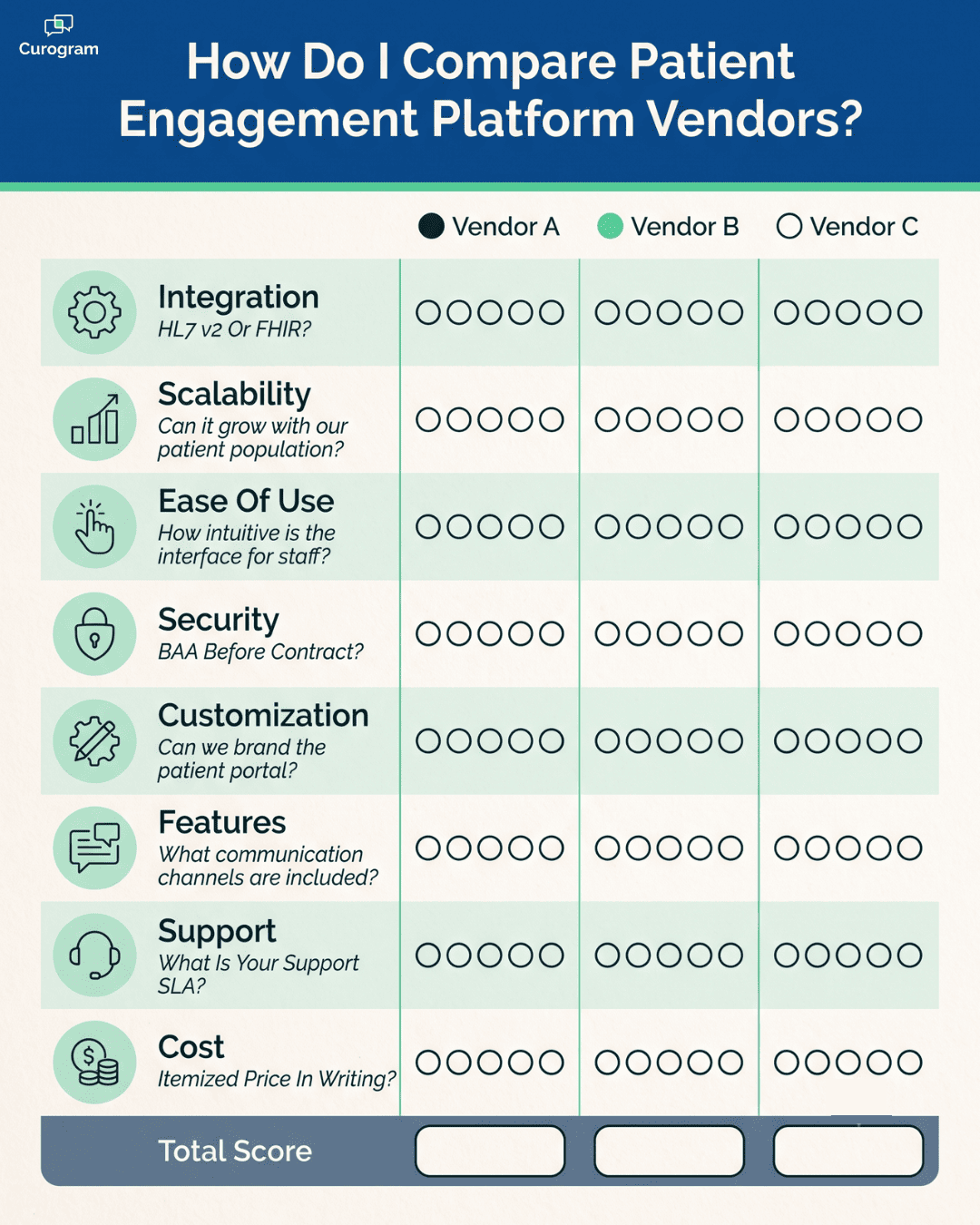
Most bad platform decisions trace back to one thing: the practice never wrote down what problem it was buying a solution for. A thorough needs assessment, defining specific goals, pinpointing operational gaps, and understanding your patient population, steers everything after it.
Answer five questions before taking a single demo.
Here are key considerations when selecting a patient engagement platform:
| Criterion | Ask On The Call |
|---|---|
| EHR integration | HL7 v2 or FHIR? Name a reference on our exact version. Real-time or batch? |
| Scalability | How does this hold at double our volume or three more sites? |
| Ease of use | Can we test it with staff and patients before signing? |
| Security | Encryption at rest and in transit? Will you provide the BAA before contract? |
| Configuration | What can our team change without paying you? |
| Functionality | Show each feature against our listed problems. Can we turn off the rest? |
| Support | What's your SLA and escalation path? Can we call clients you didn't pick? |
| Cost | Send an itemized price: setup, subscription, integration, training. |
Two answers matter most: the named reference on your EHR version, and the itemized quote. For successful implementation of a patient engagement platform, follow these steps:

Staff resistance sinks more rollouts than software problems do. Five things keep a launch from stalling.
Leaders have to be visible. Not an email from the practice manager. The physician owner using the platform in front of the team, and asking about it in Monday huddles.
Say why, in plain terms. Staff hear "new system" and assume more work. Tell them the specific thing it removes: the 4pm confirmation calls, the clipboard handoffs, the voicemails nobody returns.
Ask the people who'll use it. The receptionist knows which reminder wording gets patients to answer. Bring her into the configuration decisions before go-live, not after the first complaint.
Train for the job, not the software. Billing staff need the payment screens. Nurses need the message queue. A single all-hands session covering everything teaches nobody anything.
Name the early wins out loud. When no-shows drop in the pilot department, put the number in front of the whole team. Atlas Medical Center went from 14.20% to 4.91% in three months, based on our internal data, and that kind of figure moves skeptics faster than any training deck.
Most of this already runs somewhere. Practices don't need to buy any of it now, but it's fair to ask vendors which items sit on the roadmap and which are sales copy.
| Trend | What It Changes |
|---|---|
| AI and machine learning | Risk scoring flags the diabetic patient whose glucose and activity readings point toward trouble, so outreach goes out early. Chatbots cover routine questions overnight. |
| Personalized messaging | Content matched to reading level, language, and where a patient sits in their care plan, not just the diagnosis code. |
| VR and AR | Pain distraction during procedures, gamified physical therapy, surgery previews that lower anxiety. AR overlays showing correct inhaler technique. |
| SDOH screening | Platforms ask about food, housing, transport, and isolation, then refer to community organizations and track whether the referral closed. |
| Voice interfaces | Booking, refills, and symptom logging by speaking, which helps older patients and anyone with limited dexterity. |
| Data portability | TEFCA aims at nationwide health information exchange. Patients pull records from every provider and decide who sees them. |
| Gamification | Challenges and rewards tied to real health markers, past the points-and-badges stage. |
| Digital therapeutics | Prescribed software for diabetes, depression, or insomnia, delivered through the same platform. |
Each carries a cost worth naming. Algorithms trained on skewed data score some patients wrong, and nobody notices until outcomes diverge.
Voice and VR assume hardware plenty of our patients don't own, so leaning on them widens the same gaps we're trying to close. A platform that answers everything can also remove the human contact patients came for.
Ask vendors two questions: how they test for bias, and what happens when a patient wants a person instead.
Engagement gets discussed as a philosophy. It shows up as behavior: whether patients confirm, come back, open the results, answer the survey.
Which means you can measure where you stand today. Pull last quarter's no-show rate. Count the hours your front desk spends on confirmation calls.
Check how many patients due for follow-up ever booked one. Those three numbers say more about engagement in your practice than any framework will.
Start with whichever one hurts most. Culture work is real and takes about two years to show; the schedule can move this quarter.
Atlas Medical Center cut no-shows from 14.20% to 4.91% in three months on automated reminders alone, based on our internal data. Across our clients, more than 75% of patients confirm by text, and one multi-location group brought back 1,240 patients through SMS recalls.
The platform question narrows once you know the target. Everything else in this guide, from shared decision-making to health literacy protocols, gets easier once patients are reliably reachable. Reach comes first because the rest depends on it.
Book a demo and we'll run your own numbers — your no-show rate, your call volume, your recall list — against what two-way texting and automated reminders would change.

1 min read
💡 Patient engagement strategies are the specific workflows that get patients participating in their own care: confirmations, education,...

1 min read
💡Patient engagement in healthcare is what patients do to take part in their own care. They confirm a visit, fill out intake before they arrive,...

1 min read
 Jess Koslow : 3/3/22, 7:00 AM
💡 Introducing new technology to patients works best when practices teach it inside visits they already have, then support it afterward.Six...