
 Joshua Inciso
6 Drivers of Patient Satisfaction
Learn some industry insights into what drives patients' satisfaction, improving patient retention, staff morale, and profitability.
Most advice about patient surveys is about what to ask. The harder problem is getting anyone to answer.
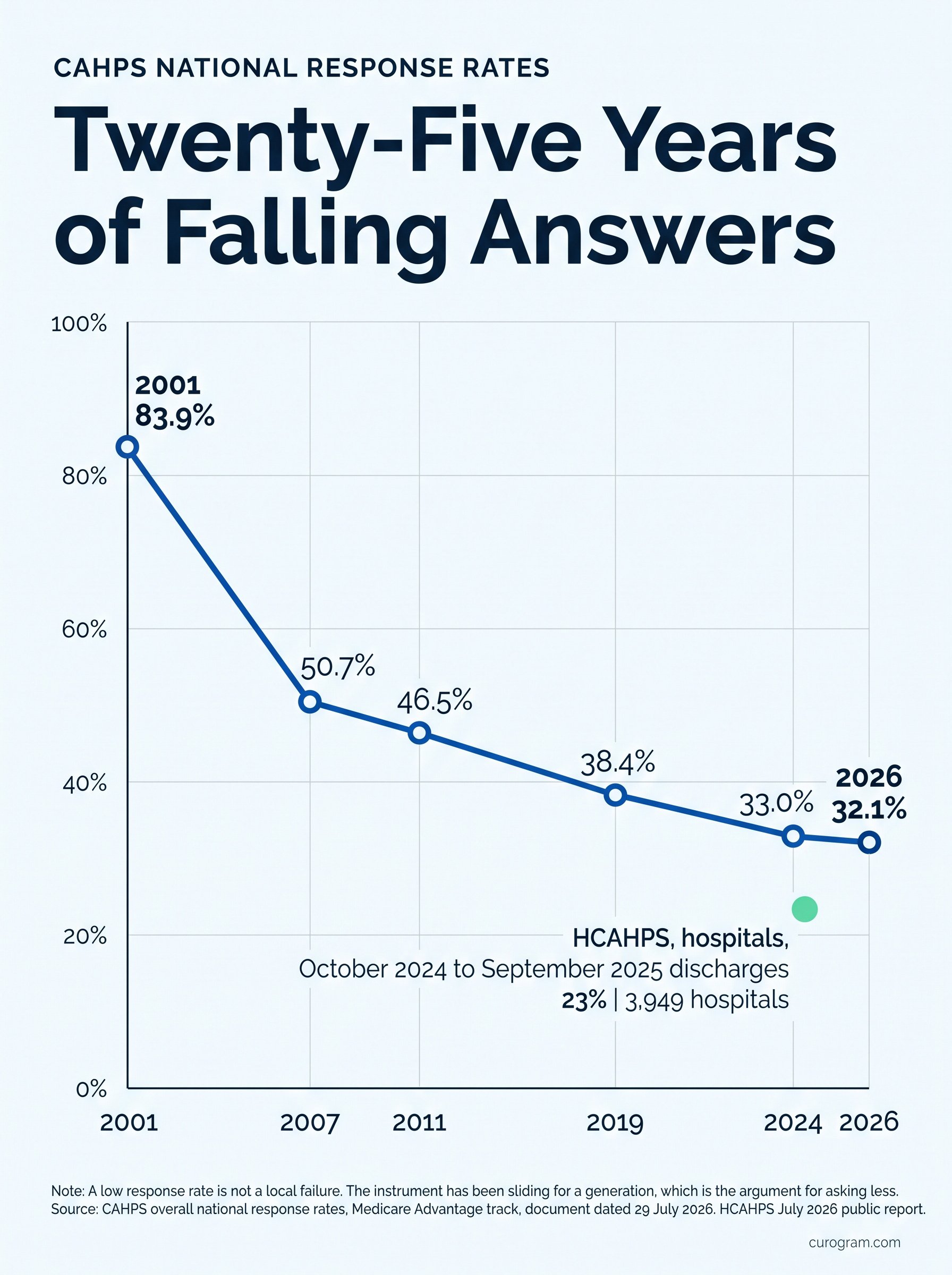
Medicare Advantage CAHPS had an 83.9% response rate in 2001. In 2026 it sits at 32.1%. The national HCAHPS rate across 3,949 hospitals is now 23%. Roughly three in four patients say nothing at all. That trend changes how a short survey should be read. Five questions is a design decision rather than a shortcut.
Each question you add is paid for in answers you do not get. The five below are chosen to survive that trade. Two of them, as commonly written, waste their slot. We rewrite those in place and say why. Below: the five questions, how to send them so they come back, and what to do with the replies.
None of this is a local failure. The slide shows up in every national instrument, which is worth knowing before you blame your own list.
|
Year |
Medicare Advantage |
Part D plans |
|---|---|---|
|
2001 |
83.9% |
Not surveyed |
|
2011 |
46.5% |
40.0% |
|
2019 |
38.4% |
38.9% |
|
2026 |
32.1% |
34.8% |
Ask this one on a zero-to-ten scale. It is the net promoter score question, and the scale is what makes it comparable month to month. A single number also travels well. It fits in a board pack, a staff meeting, and a quarterly review without translation.
Treat it as a trend rather than a verdict. One month at 42 means little; six months sliding from 60 to 42 means something specific. Do not fold it into anything else. Mixing a zero-to-ten score into a one-to-five average is the usual way this gets ruined.
As written, this is a yes or no, and that wastes the slot. You learn that something went wrong, never how badly.
Ask how easy it was to get an appointment, on a one-to-five scale. Same subject, usable answer. Access is also the item most likely to move. Phone hold times and next available dates are things a practice can change this quarter.
Ask it of everyone, including patients who got an appointment easily. A scale only works when the top of it is populated.
Same problem, same fix. Ask how well their questions were answered, on a one-to-five scale.
Name the clinician in the text. A score attached to a person is actionable in a way a practice-wide average never is. Expect these to run high and cluster tightly. The useful signal is the outlier, not the mean.
Keep the clinician name in a merge field rather than writing practice. Patients answer about a person more readily than an organization.
Open boxes earn their place because they tell you what to protect. Scores tell you what is broken.
Tag the answers into a handful of buckets as they arrive. Staff, wait, parking, cost, communication cover most of them. Read these aloud at the staff meeting. Named praise does more for retention than most of what a practice spends money on.
Keep the box small. A short field signals a short answer and gets filled in more often than a large one.
This is the one that generates work, which is why practices drop it. Keep it, and decide in advance who reads the replies and how fast. A complaint answered within the hour often never becomes a review. Three of the same comment in a month is an operational finding rather than a bad day.
Word it as what we can do rather than what went wrong. One invites a suggestion, and the other invites a complaint. Reply to anyone who leaves a name. A survey nobody answers teaches patients not to answer the next one.
Send it the way you send a form, because a survey is one. The mechanics that get intake completed get surveys completed. We covered secure online intake forms for rural clinics on Azalea Health. That link has to work on a phone with one bar.
Our piece on eliminating manual data entry for CharmHealth intake forms covers the half that matters. Answers have to land in the chart. We looked at online patient forms in InSync for the same reason. A form that gets retyped has moved the work rather than removed it.
Timing beats wording. A text link the day after the visit beats a polished email the following week. Keep it to one screen with no login. Every tap between the patient and question one is a share of your response rate.
Send once, then stop. A second reminder buys a little and a third costs goodwill you will want later. Check what the link looks like on an old phone. Survey tools get tested on the newest handset in the building.
 Patient Feedback Is Important
Practices consistently guess wrong about what patients care about. Clinical quality is assumed; access and waiting are what get written about.
Segment before you average. New patients and long-standing ones answer differently, and the gap is usually the finding. Split by provider and by location too. A practice-wide score hides the one site doing badly.
Ask your staff to predict the answers before you look. The gap between their guess and the result is the most useful hour in the exercise.
Hold the wording steady between quarters. Changing a question mid-year makes the trend meaningless and nobody notices until it matters. Watch which questions people skip. An item everyone leaves blank is either unclear or none of your business.
Survey data points at process rather than medicine. Instructions nobody understood, results nobody explained, a follow-up nobody booked. Those are fixable without a clinical decision. They are also the things patients remember six months later.
Pick one item per quarter and leave the rest alone. Practices that chase every score change nothing durably. Give each item a name against it. An unowned finding gets discussed at three meetings and actioned at none.
Record what you changed and when. Six months on, nobody remembers, and the score movement becomes unattributable. Tell patients what changed. A line on the site or in a reminder closes the loop and lifts the next response rate.
A survey sits upstream of a review. The unhappy patient who gets a reply is the review you never had to answer in public. Route low scores to a named person the same day. That routing rule is the whole mechanism.
Ask everyone rather than the memorable ones. Volume is what moves a star rating, and the quiet middle is where volume lives. Send the review request separately from the survey. One asks for private feedback and the other asks for a public post.
Ask every patient rather than only the happy ones. The FTC rule on consumer reviews targets suppressing negative ones. A process that only invites high scorers sits close to that line.
Reviews are the only part of your reputation that a stranger reads before deciding. Everything else is seen after they arrive. They also skew to the extremes, because delighted and angry patients both write and the middle does not.
A steady flow of ordinary four and five star reviews is what dilutes an old bad one. Nothing else does.
Reply to the bad ones in public, briefly and without detail. HIPAA means you cannot discuss the visit, and a short neutral reply is read by everyone who comes after.
The older version of this page carried a set of figures on this from a May 2021 vendor survey. We removed them.
The publisher merged into another company that November, and the brand was retired in April 2024. Nothing stands behind those numbers now.
The behavior is real and does not need a stale statistic. Check what a search for your practice name actually returns this week. Run that search on a phone, signed out. What a prospective patient sees is rarely what the practice assumes.
The preference is real and weaker than vendors suggest, which is worth knowing before you rebuild anything.
A CMS field test, reported by Press Ganey, added a web option for people with an email address on file. Response rates rose by four points.
Of those offered the web option, 79% still answered by mail or phone. Offering a channel is not the same as moving people onto it. So add the digital route and keep the others open. Removing a channel costs you the people who use it.
Keep a paper option for the part of the panel that wants one. In most practices that group is small and loud.
Text wins on one thing that matters more than preference, which is being seen the same day. A survey sent by text is read while the visit is still recent. An emailed one competes with everything else in the inbox.
Replies may contain clinical detail, so the survey belongs behind a secure link rather than in the message body. A business associate agreement should come as standard with whatever tool you use for this. Check the number you send from. A reply that cannot reach anybody loses the feedback you just asked for.
Curogram HighlightCurogram's Online Patient Forms send a secure link by text, and the answers write back to the patient record. The same mechanic carries a survey. Intake before the visit and five questions after it are the same job pointed two directions. Replies land in the inbox staff already work from, which is what makes same-day routing of a low score realistic. |
Run the five for one quarter before changing anything else. You need a baseline more than you need a better instrument.
Count the response rate as carefully as the scores. A rising score on a falling rate usually means only your happiest patients are still replying. Then decide whether to go longer. Some practices should, and the decision should follow the data rather than precede it.
If you get there, our guide to building a fuller patient experience survey goes deeper. It covers question banks, scales and analysis.
Until then, five questions answered beats twenty-five ignored. That is the entire argument.
Decide today who reads the replies and how quickly. Without that, a survey is a data collection exercise rather than an improvement one. Write the routing rule before the first send. Who reads a two, how fast, and what they can do about it without asking.
Share the response rate with staff alongside the scores. People who know how many patients replied read the comments differently.
Then leave the instrument alone for three months. Five questions to gauge patient satisfaction, asked the same way each time, beat a longer survey nobody finishes.
Book a Curogram demo. One pass covers the secure link, the write-back to the chart, and where a low score lands.

Learn some industry insights into what drives patients' satisfaction, improving patient retention, staff morale, and profitability.

 Joshua Inciso : 4/22/22, 7:00 AM
Digital patient surveys beat paper on response rate, speed, and cost. See what two trials measured, and why the best result still uses a second...

Unlock better care with our complete guide to the patient experience survey. Learn to create, analyze, and act on feedback and improve patient...