Skip to the main content.

5 min read

Why Digital Patient Satisfaction Surveys Are Better Than Paper Surveys

Why Digital Patient Satisfaction Surveys Are Better Than Paper Surveys
💡Digital patient surveys get more replies than paper ones. A Permanente Journal study of 1,486 knee surgery patients found 36% answered electronically against 22% on paper. A 2024 trial of 36,001 hospital patients found the best result came from adding web to mail and phone, at 36.5%. Digital also costs less, because a mailed survey needs a $0.78 stamp each way.

Most practices still hand a clipboard across the counter at checkout. It comes back with six words on it, or it does not come back at all.

Digital patient surveys do get more replies. That gap is real, and it has been measured twice, a decade apart. What the research shows is narrower than the usual pitch, and more useful.

Our position: go digital, and keep a second way to reach people. In the largest trial on this question, the best result came from running web alongside mail and phone, not from dropping paper entirely.

High Response Rate

A survey response rate is the share of people asked who actually answer. Two studies set the range, and they are not interchangeable.

What the Old Number Measured

This page has cited one figure for years: 36% for electronic surveys against 22% for paper. That number is real. It comes from The Permanente Journal in 2014, and what it measured is worth knowing.

Researchers tracked 1,486 patients in a Kaiser Permanente knee reconstruction registry between 2005 and 2010. They sent a knee outcome questionnaire, not a satisfaction form. Electronic came back at 36%, paper at 22%, with 42% overall.

So the gap holds up. It was measured on surgical patients before smartphones were everywhere, which makes it a floor rather than a forecast.

The Study to Quote Instead

A 2024 randomized trial in JAMA Health Forum tested six survey setups on 36,001 discharged patients across 46 US hospitals. Single channels did worst. Pairing two did better. All three together did best.

Survey protocol

Response rate

Phone only

22.1%

Mail only

24.3%

Web and phone

30.3%

Web and mail

30.6%

Mail and phone

31.1%

Web, mail, and phone

36.5%


Web on its own was not one of the six protocols. Any page claiming digital-only beats everything is not citing this trial.

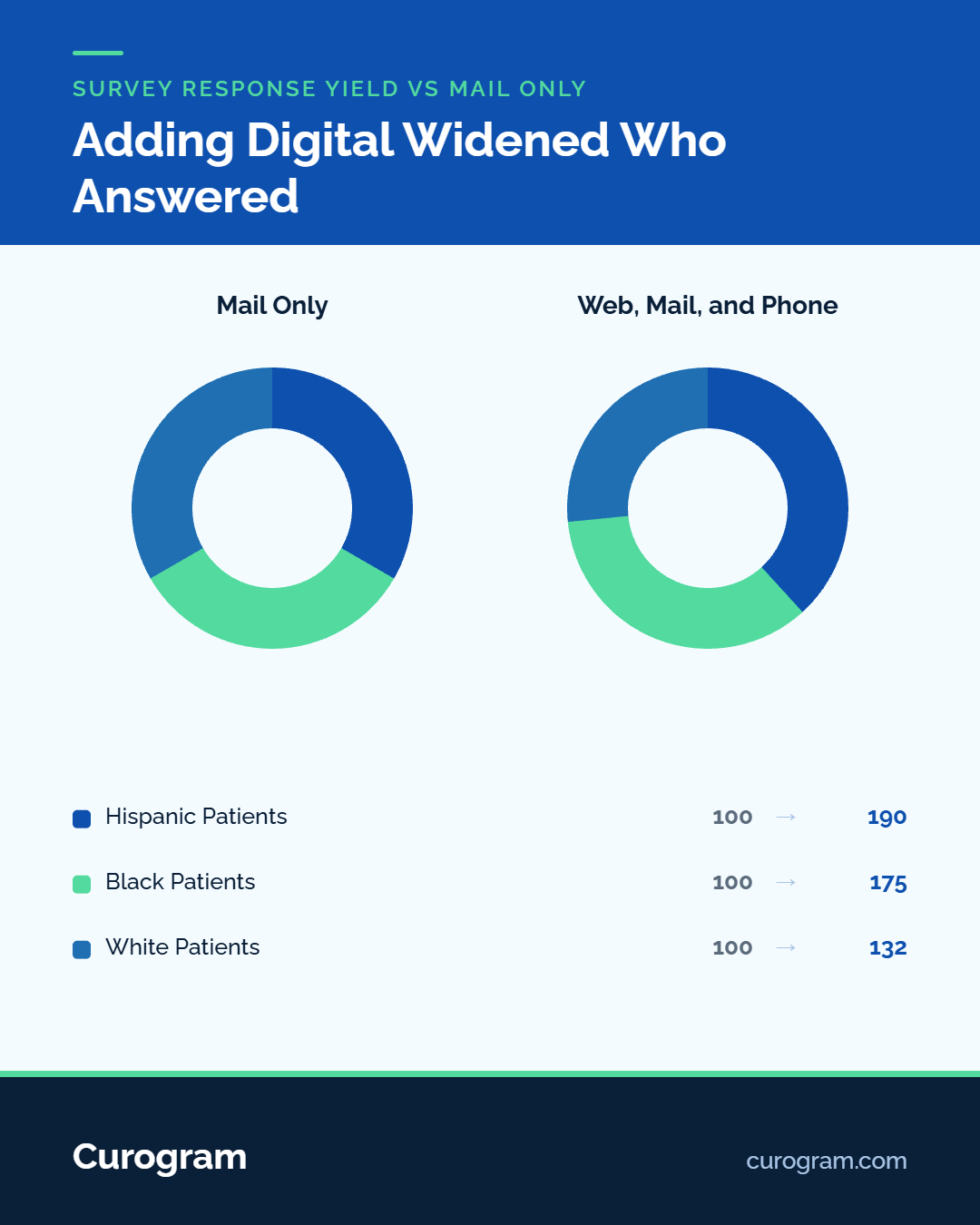
Chart showing survey response yield rose most for Hispanic and Black patients when digital channels were added to mail

Wide Reach

Reach is not a headcount. It is which patients answer, and adding a channel changes that more than it changes the total.

Who Starts Answering

Set against mail alone, the three-channel setup in that 2024 trial raised responses from Black patients by 75% and from Hispanic patients by 90%. For white patients, the lift was 32%.

Adding a digital channel widened the sample. A practice worried that going digital would skew its patient feedback toward the youngest and most online patients has the opposite result on record.

Curogram Highlight: Surveys That Follow the Schedule

Curogram's Patient Surveys go out after the visit without anyone building a list, because tomorrow's schedule arrives from the EMR. Messages send by text, email, or both, and the practice picks the delay.

For everything outside the daily run, mass text messaging covers a whole week of visits, one location, or a single provider's panel. Replies land in the same thread, so a patient who rates the visit poorly gets a person rather than another form.

Scale changes the work more than the tool. A fifty-site group needs results split by site before they mean anything. That is why bulk outreach across Oracle Health networks runs per location instead of as one blast. Curogram is HIPAA compliant and SOC 2 Type II certified.


Real-Time Feedback

Memory of a visit fades within hours. Timing decides whether an answer is useful or just a mood.

The Window That Closes

A survey that arrives four days later gets a rating. One that arrives the same afternoon gets the detail: the 20-minute wait in room three, the front desk that could not find a referral.

Details are what a manager can act on. Ratings only tell you something went wrong somewhere.

Ask Everyone, Not Just the Happy Ones

Our older copy framed fast feedback as a way to catch problems before a bad review appears. Speed does help there.

Send the form to the whole visit list, though, rather than a filtered slice. Screening out the patients you expect to be unhappy turns a measuring tool into a reputation filter. The signal you wanted is the first thing it costs you.

Flexibility

Six questions, same order, every patient. That is the ceiling on a printed form.

Logic That Branches

Digital forms branch. Rate the wait as poor, and the next question asks which part ran long: check-in, the exam room, or the pharmacy. Rate it fine and the patient is finished in 20 seconds.

Alerts branch too. A score under a set threshold can page the office manager while the patient is still in the parking lot.

Segments Before Sends

Who gets asked matters as much as what they are asked. Pulling that list from the chart beats building it by hand every week.

Clinics where AdvancedMD users run mass messaging segment on age, last visit date, and payer before anything sends. A post-op form reaches post-op patients, and nobody gets asked about a procedure they never had.

Survey Presentation

Print 500 copies with a typo, and you own 500 copies with a typo.

Editing After It Ships

A digital form is fixed once, and every patient from that moment sees the correction. Same for a new logo, a renamed location, or a question that turned out to confuse people.

Branding holds up better too. A form that matches the practice website reads as part of the patient experience instead of a stray link.

What It Looks Like on a Phone

A survey sent by text gets opened on a phone, because that is where the text arrived. Tap targets have to be thumb-sized, with no pinch-zoom and no sideways scroll.

Keep it short. A five-question form finished in the parking lot beats a twenty-question form opened there and abandoned.


Lower Cost

Postage is the line everyone sees. It is rarely the expensive part.

What Paper Actually Costs

A First-Class Forever stamp runs $0.78, and a mailed survey usually needs two: one going out, one on the prepaid return envelope. For 500 patients, that is $780 before anything is printed.

The US Postal Service held rates flat in January 2026, after raising the stamp from $0.73 earlier. Nobody should plan a yearly paper program around that staying still.

The Cost Nobody Budgets

Keying in the answers is the bigger number. At 90 seconds a form, 500 paper surveys take 12.5 hours of someone's week. That figure is illustrative, so time your own stack of forms before trusting it.

A digital reply arrives already counted. It is a row, not a stack.

Most practices have paid for the channel already. Clinics using Practice Fusion mass messaging for patient recalls already have the broadcast list built and consent tracked. A survey is one more message type through a door that is open.

Why Are Digital Patient Satisfaction Surveys More Effective Than Paper Surveys?

Digital wins on the three things a survey has to do: get answered, get answered quickly, and cost little enough to run every month. Paper surveys lose on all three.

Keep the second channel anyway. That 36.5% came from web, mail, and phone together, and so did the jump in who replied.

See how automated post-visit surveys run on your schedule and your patient list. Book a Curogram demo.

Frequently Asked Questions

What response rate should we expect from a digital patient survey?
Published trials land between 22% and 37%, based on how many channels you use. One digital channel sits near 30%. Adding mail or phone next to it is what pushes past 36%.
Why keep paper surveys at all if digital does better?
In the 2024 JAMA Health Forum trial, every two-channel setup beat every one-channel setup. Paper is a cheap backup for patients who will not open a text. It also widens who answers.
When should a post-visit survey go out?
Same day, while the visit is still fresh in mind. A form sent four days later collects a mood. One sent that afternoon collects the detail a manager can act on.
How do we keep a digital patient survey HIPAA compliant?
Keep clinical detail out of the text. Send a short note with a secure link. Sign a business associate agreement with the vendor, and keep answers in the platform, not a staff inbox.
What should a short patient survey ask?
Five questions at most. One overall rating, one on wait time, one on the clinician, one open comment box, and one permission question. Longer forms get dropped on a phone screen.
Types of Patient Satisfaction Surveys and their Uses to Improve Healthcare and Patient Retention

1 min read

Types of Patient Satisfaction Surveys and their Uses to Improve Healthcare and Patient Retention

💡 Patient satisfaction surveys are not interchangeable. Each type answers a different question, and sending the wrong one leaves you with data...


Read More
Patient Satisfaction Survey Examples to Transform Your Practice

1 min read

Patient Satisfaction Survey Examples to Transform Your Practice

💡Patient satisfaction survey examples are ready-made feedback forms that clinics send after a visit. They ask patients to rate scheduling, wait...

Read More
55+ Patient Satisfaction Survey Questions, Templates and Strategies

1 min read

55+ Patient Satisfaction Survey Questions, Templates and Strategies

💡 A patient satisfaction survey is a short, structured set of questions that measures how patients experienced your practice, from booking the...

Read More