Fill Schedule Gaps in Prime Clinical | Revenue on Demand
💡 To fill schedule gaps in Prime Clinical Systems, the most direct method is targeted broadcast messaging through Curogram. Practices filter...
Table of Contents
You have patients who came in once and then vanished. They meant to come back. Life got in the way. And no one from your clinic ever followed up.
For many small Practice Fusion clinics, this is a daily reality. The overdue patient list grows quietly in the background while the front desk handles calls, check-ins, and billing. Nobody has time to work the recall list manually. So it just sits there.
This is not a patient loyalty problem. It is a systems problem. When the tools to follow up don't exist — or require weeks of manual calling — the revenue those patients represent simply disappears.
Practice Fusion mass messaging for patient recall changes that. Instead of calling patients one by one, your office manager can send a single bulk SMS to your entire overdue list in under 60 seconds.
Replies come back to a central dashboard. Patients can self-book using a link in the text. And everything syncs back to Practice Fusion automatically.
This guide covers how the dormant patient problem develops, what it costs your practice, and how a simple recall broadcast text can flip that script. We will walk through the math, a real-world story, and what metrics you should track once you deploy.
By the end, you will have a clear picture of what overdue patients are worth and what it takes to bring them back.
Every small Practice Fusion clinic has a silent cost center: the dormant patient list. These patients showed up, received care, and then stopped coming back.
No one chased them. No bulk SMS went out. No recall reminder landed on their phone. The relationship just ended quietly, and at a cost most practices never fully calculate.
Dormant lists don't appear overnight. They build up slowly as the daily grind takes over.
For a 3-provider clinic seeing 40–60 patients per day, the overdue list can hold 300–500 patients at any given time. Many of them simply slipped through after a visit and were never contacted again.
When recalls only happen by phone, they almost always fall to the bottom of the priority list. Phones ring. Walk-ins arrive. Insurance paperwork stacks up. The recall project gets pushed back and then forgotten.
If half of those 300–500 patients were overdue for preventive care, annual physicals, or chronic disease check-ins, that is 150–250 potential appointments your practice is missing each month. At $150–$300 per visit, the math is stark: $22,500–$75,000 in lost monthly revenue sitting in your EHR, untouched.
Manual patient recall is not just slow. It is structurally broken for small practices.
If one front desk staff member spends 20 minutes a day on recall calls, they can complete 15–20 calls at best. To reach 300 overdue patients, that person would need 15–20 straight days of nothing but calling.
That is not realistic. Office managers at small practices wear too many hats to dedicate that kind of time to a single project.
Most manual recall calls go to voicemail. Of those, few get returned. The cold-call response rate for patient recall hovers around 5–10%.
Compare that to the 35% appointment reconversion rate seen with a well-targeted SMS recall, based on our internal data.
The difference is not small. It is the gap between a project that barely moves the needle and one that fills your schedule in 48 hours.
The result? A 3-provider clinic can lose $60,000–$80,000 in potential monthly revenue just because the tools to reactivate those patients don't exist natively in Practice Fusion. That is not a staffing problem. It is a software gap.
Curogram's Recall Engine replaces the phone-call bottleneck with a single broadcast that reaches hundreds of overdue patients at once. It works inside Practice Fusion — no extra systems, no IT setup, no steep learning curve.
The recall workflow is built around speed and simplicity. Even the most stretched office manager can run a full campaign in under a minute.
Your office manager opens the recall feature, selects a filter — for example, 'last visit more than 12 months ago' or 'overdue for annual physical' — and previews the matched patient list.
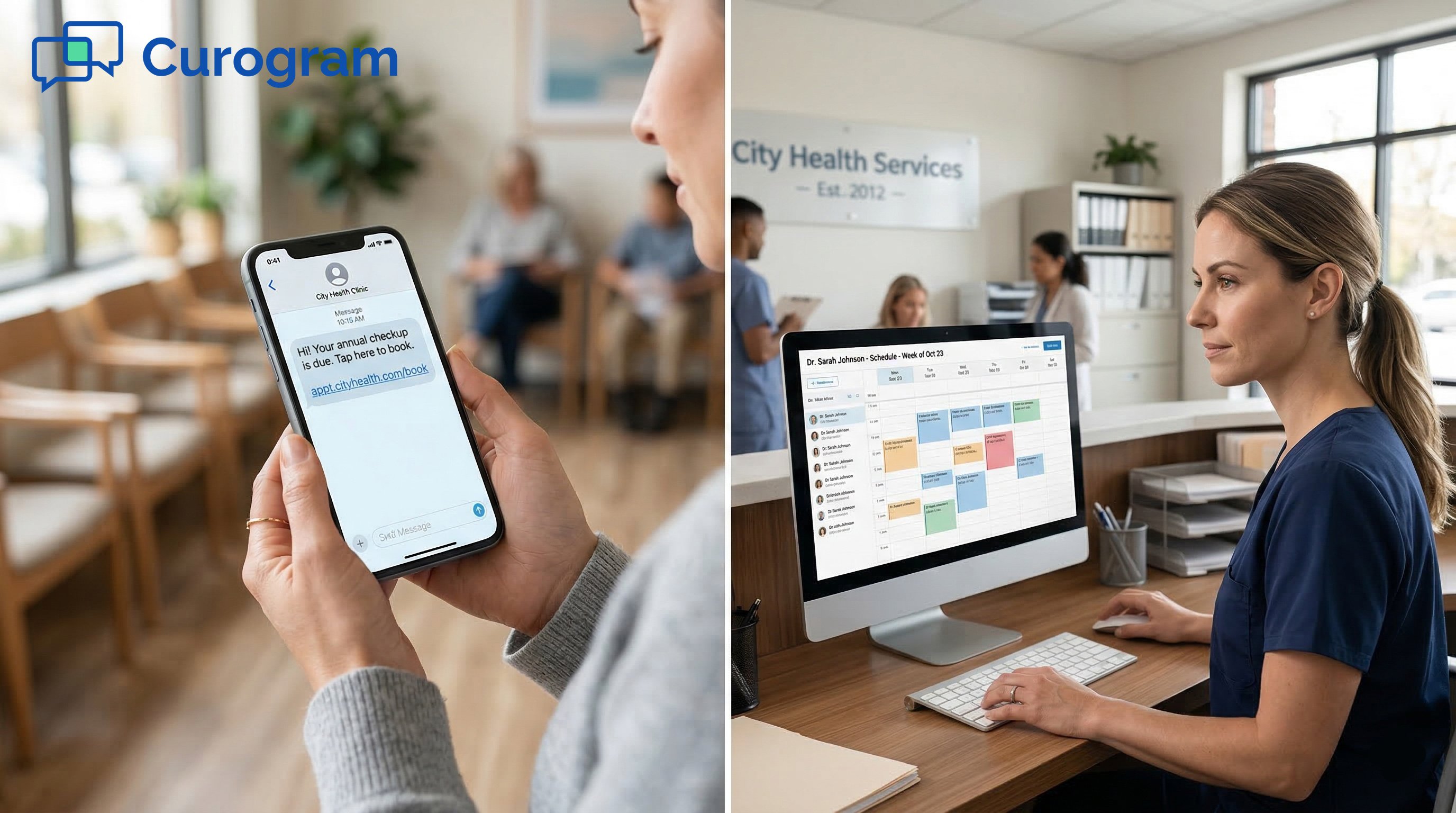
One click sends a personalized SMS to every patient on that list: 'Hi! Your annual checkup is due. Tap here to book: [link]. Reply if you have questions.'
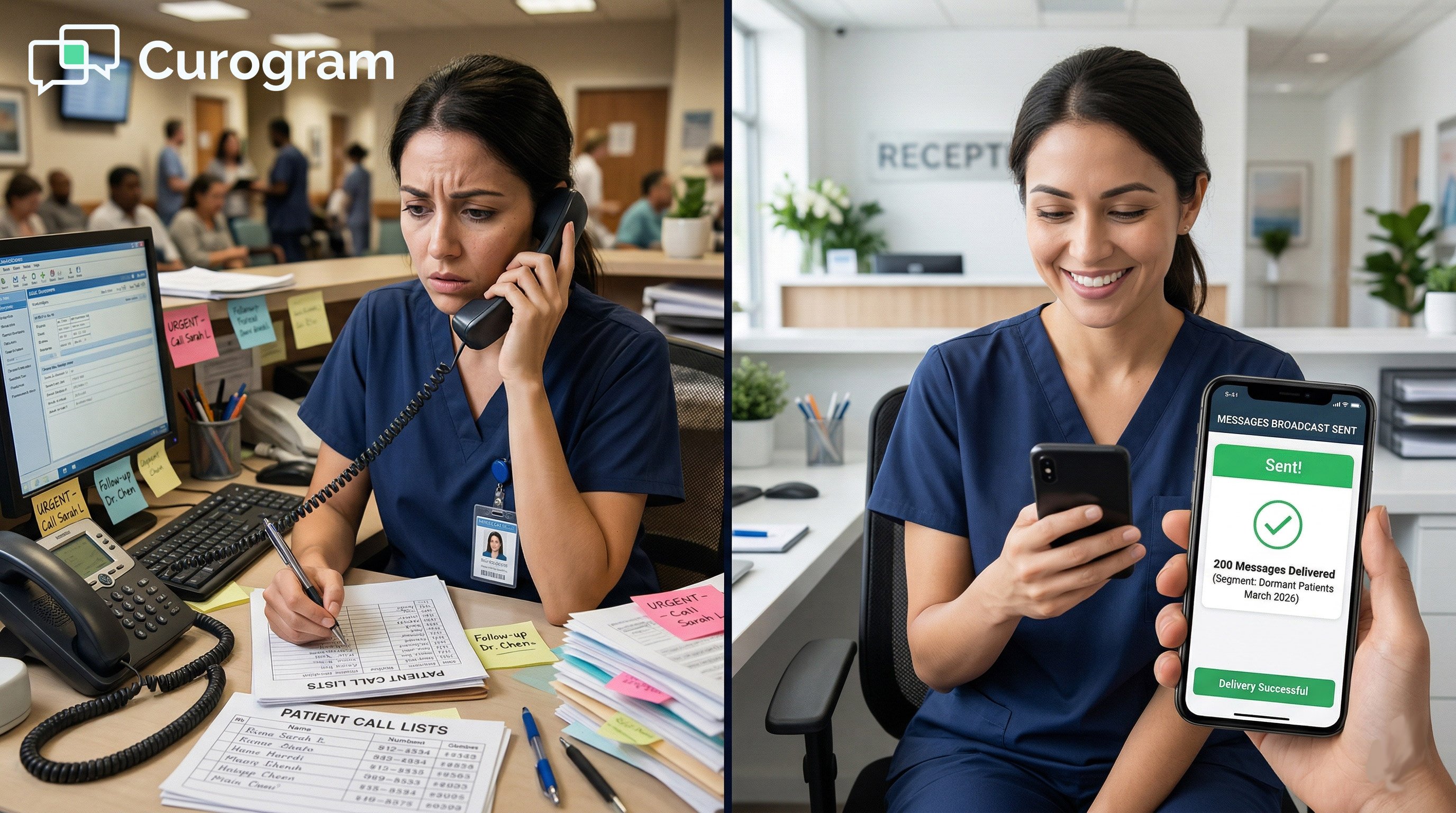
The whole process takes under 60 seconds. That one action replaces what would otherwise take 15–20 days of manual calling.
Patient replies come back to the Curogram dashboard in real time. They sync automatically to Practice Fusion, so nothing falls through the cracks.
Patients who want to reschedule can tap the booking link in the text and self-book from their phone, no callback needed. Staff only step in when a patient needs help choosing a slot. For everyone else, the process is completely hands-free.
There are a few options on the market for patient recall, but most fall short for small Practice Fusion clinics in critical ways.
Practice Fusion has no built-in mass messaging feature. Updox offers a group messaging add-on, but it comes at an additional monthly cost and still requires manual list building.
Curogram's Recall Engine connects directly to Practice Fusion's FHIR API, meaning patient data is already there — no imports, no duplicate records, no reconciliation. Every message sent and every reply received writes back to the EHR automatically.
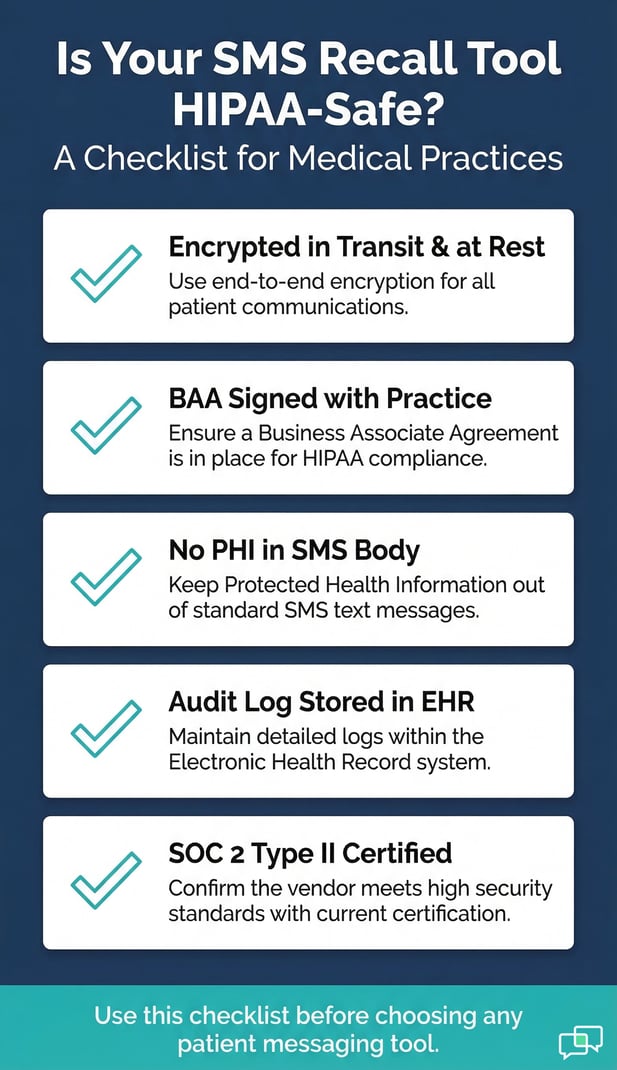
All recall broadcasts through Curogram are HIPAA-compliant and SOC 2 Type II certified. Patient data is encrypted in transit and at rest.
The SMS itself contains only a personalized greeting, the reason for the recall, and a secure booking link.
No protected health information is exposed in the message. Every interaction is audit-logged within Practice Fusion, which makes compliance reviews straightforward.

The financial case for patient recall via mass messaging is not complicated. The numbers speak for themselves, and they are significant enough to make this a priority, not a nice-to-have.
Most practices underestimate how much revenue their overdue list represents. Here is a simple way to see it clearly.
|
Scenario |
Overdue Patients |
Avg. Visit Value |
Monthly Dormant Revenue Lost |
|
Small practice (1–2 providers) |
150 |
$175 |
$26,250 |
|
Mid-size practice (3 providers) |
300 |
$200 |
$60,000 |
|
Larger small practice (4–5 providers) |
500 |
$225 |
$112,500 |
These are not hypothetical. A 3-provider practice with 250 overdue patients and a $200 average appointment value is walking away from $50,000 per month in potential revenue. Annualized, that is $600,000 in patient relationships that could have been reactivated with a broadcast text.
Every month you wait, that dormant list grows. Patients who haven't heard from your clinic in 12–18 months are harder to re-engage.
The longer the gap, the more likely they are to have found another provider, or simply stopped seeking preventive care. Acting early, and acting consistently, is what keeps the dormant list from becoming permanent attrition.
Based on our internal data, a single SMS recall campaign achieves a 35% appointment reconversion rate. That is the share of messaged patients who schedule an appointment within a month.
|
Overdue Patients Messaged |
35% Reconversion Rate |
Avg. Visit Value |
Revenue Recovered |
|
150 |
53 appointments |
$175 |
$9,275 |
|
250 |
88 appointments |
$200 |
$17,600 |
|
400 |
140 appointments |
$200 |
$28,000 |
|
500 |
175 appointments |
$225 |
$39,375 |
For context, the average cold-call reconversion rate sits between 5–10%. That means SMS recall is roughly 3–7x more effective than phone-based outreach — at a fraction of the time and cost.
Numbers tell part of the story. But it helps to see how this plays out in a real practice — through the eyes of the person who runs it day to day.
Riverside Family Medicine is a 3-provider family practice in suburban Ohio. Sarah Chen is the office manager. On any given day, she handles check-in, scheduling, patient calls, insurance checks, and billing. She is, essentially, the operational backbone of the clinic.
Riverside had 400 overdue patients sitting in Practice Fusion. Many were 6–12 months past their last visit. Some needed annual physicals. Others were overdue for chronic disease management appointments — diabetes, hypertension, and asthma.
Sarah knew those appointments represented $60,000–$80,000 in potential revenue. But she had no way to reach those patients without spending weeks on the phone.
Each day, Sarah would manually scroll through Practice Fusion, identify overdue patients by their appointment history, and start calling.
On a good day, she finished 20 calls. Most went to voicemail. She rarely heard back.
After two weeks, she had reached maybe 50 patients. The project felt endless. Nobody was being recalled in any real, organized way. Revenue was leaking out of the EHR — and no one was accountable for stopping it.
When Curogram was integrated with Riverside's Practice Fusion instance, Sarah's first recall campaign took 45 seconds.
Sarah opened the recall feature, filtered for patients whose last visit was more than 12 months ago, and previewed the list: 237 matched patients.
She customized the message to mention annual wellness visits and disease management appointments. She hit send.
All 237 patients received an SMS at once: 'Hi! Your annual wellness visit is due. Schedule now: [link]. Reply if you have questions.'
Within 48 hours, 82 patients had replied — a 35% response rate. Of those, 73 confirmed they wanted to reschedule. And 59 patients self-booked using the link in the text, with no phone call needed on either side.
By the end of week one, Riverside had rebooked 140 of the 237 recalled patients. At $200 per appointment, that is $28,000 in new revenue. Based on our internal data, results like these are consistent across similar campaigns.
Sarah's own words: "I didn't have to call anyone. I just sent one message and got 59 appointments booked."
By week two, she was running a second campaign targeting patients overdue for chronic disease management visits. Three months later, Riverside's problem was no longer an empty schedule — it was managing an appointment backlog.
Sending a bulk SMS to patients raises a fair question: Is this safe?
For HIPAA-covered practices, compliance is not optional. Here is why mass messaging through Curogram is built to meet that standard.
Any tool that touches patient data in a healthcare setting must follow HIPAA's rules around privacy and security. That means encryption, access controls, audit logs, and signed Business Associate Agreements (BAAs).
Not every messaging platform meets all of these requirements. Some consumer texting tools do not — and using them for patient recall can create real liability.
All Curogram recall messages are encrypted in transit and at rest. Patient data is never exposed in the SMS itself. The message contains only a personalized greeting, the recall reason, and a secure booking link.
No diagnoses, no appointment details, no protected health information appears in the text body. Curogram signs a BAA with every practice, making the compliance relationship explicit and documented.
Every message sent, every reply received, and every appointment booked is automatically logged in Practice Fusion. There is no separate spreadsheet to maintain, no external system to reconcile.
If your practice ever needs to show that a recall was sent — or that a patient responded — that record is already in the EHR. This makes compliance reviews and audits significantly less stressful for office managers.
One of the biggest concerns with any add-on tool is data hygiene. When messages live in one system and patient records live in another, things get messy fast. Curogram eliminates that problem.
Everything that happens in a recall campaign — the send, the reply, the booking — syncs back to Practice Fusion in real time. There is no manual export. No copying data between platforms. No mismatched patient records.
The Recall Engine works within the EHR, not outside of it. This is a critical distinction for small practices that don't have IT staff to manage multiple data sources.
Curogram connects to Practice Fusion through its FHIR API. This means the integration is standards-based, not a workaround.
Patient lists are pulled directly from Practice Fusion. Recall criteria are applied against live EHR data.
You are not working from an outdated export or a manually maintained spreadsheet. The data is always current, and the risk of sending a recall to the wrong patient — or a patient who has already scheduled — is minimized.

Deploying a recall campaign is the first step. Knowing whether it worked — and how to improve the next one — requires tracking the right numbers. Here are the four metrics that matter most for small Practice Fusion clinics.
Every recall campaign should be measured against a consistent set of benchmarks. This makes it easy to spot what is working and where to adjust.
|
Metric |
What It Measures |
Benchmark |
|
Reconversion Rate |
% of recalled patients who schedule |
35% (vs. 5–10% for cold calls) |
|
Self-Booking Adoption |
% of responders who self-book via link |
70%+ of respondents |
|
Staff Time Saved |
Recall calls replaced by the broadcast |
~15–20 days replaced by 60 seconds |
|
Revenue Recovered |
Gross revenue from rebooked appointments |
250 patients × 35% × $200 = $17,500/mo |
Of all the metrics above, the reconversion rate tells you the most about the health of your recall program. A rate below 20% suggests your patient list needs better filtering.
You may be messaging patients who have already moved, transferred to another clinic, or are no longer active in your area. A rate at or above 35% signals that your message is reaching the right people at the right time, based on our internal research.
Self-booking adoption directly affects how much staff time you save. When patients book via the link rather than calling back, the office does not need to handle inbound scheduling calls.
To push this number up, keep the booking link prominent in the message and make sure the booking page is mobile-friendly. Patients responding to a text are almost always on their phone — if the booking flow is clunky on mobile, they will drop off.
Two metrics often go unmeasured but have an outsized impact on how practice owners evaluate the return on any new tool.
If your front desk person earns $18/hour and spends 2 hours per day on manual recall calls, that is $36/day in labor and likely fewer than 20 successful connections. One 60-second broadcast that reaches 250 patients replaces weeks of that effort.
Multiply the hours saved by the hourly cost and you have a clear picture of what the Recall Engine saves — before you even count the new appointments.
Revenue recovery is the metric that justifies the investment to a practice owner or lead physician. A simple formula: overdue patients × reconversion rate × average visit value = monthly recovered revenue.
For most small practices, a single campaign pays for Curogram's platform cost many times over. The ROI payback period is typically 48 hours or less from the first broadcast.
Small Practice Fusion clinics with more than 200 overdue patients are well-positioned to see meaningful results from mass messaging right away.
The setup is fast, the integration is seamless, and the first campaign can go out in minutes.
If you have been relying on manual recall calls — or not doing recall at all — the gap between what you are earning and what you could be earning is likely larger than you think. A single broadcast to your overdue list can surface that difference within 48 hours.
For most practices, the first recall broadcast functions like a revenue event — not a software rollout.
Schedule a demo to see how the Recall Engine works with your Practice Fusion instance.
Curogram connects to Practice Fusion through its FHIR API and lets your office manager filter patients by recall criteria — like 'last visit more than 12 months ago.'
One click sends a personalized SMS to every matched patient at the same time. Replies route back to the Curogram dashboard and sync to Practice Fusion. Patients can self-book directly from the link in the text, with no phone call needed.
Text messages reach patients on the device they use most, and they do not require someone to pick up at a specific time. Based on our internal data, SMS recall achieves a 35% appointment reconversion rate, compared to 5–10% for cold-call recall. Patients can also respond and book at their own convenience, which removes one of the biggest barriers to rescheduling.
Curogram is HIPAA-compliant and SOC 2 Type II certified. All messages are encrypted in transit and at rest, and no protected health information appears in the SMS body itself.
Curogram signs a BAA with every practice, and all recall activity is audit-logged within Practice Fusion. This makes compliance documentation straightforward and eliminates the risk that comes with using unsecured consumer messaging tools.
The integration with Practice Fusion requires no custom IT setup — it works through the FHIR API. Once connected, the first recall broadcast typically takes under 60 seconds to configure and send. Most practices see patient responses and self-booked appointments start flowing in within 24–48 hours of the first campaign.
The four key metrics are reconversion rate, self-booking adoption, staff time saved, and revenue recovered. Curogram tracks all of these automatically, with every response and booking synced back to Practice Fusion.
A reconversion rate at or above 35% is a strong signal that the campaign is working well. Revenue recovered — calculated as booked appointments times average visit value — is typically the number practice owners use to evaluate the investment.
💡 To fill schedule gaps in Prime Clinical Systems, the most direct method is targeted broadcast messaging through Curogram. Practices filter...
💡 Boosting engagement with Allscripts mass texting is what health organizations need. You can help your organization reach more patients in ways...
💡 Mass texting in Office Ally helps you send patient notifications without overloading staff. By integrating mass texting to your EMR, you can: ...