PF Patient Recall | One-Click Broadcast Replaces Phone Calls
💡 Patient recall phone calls drain staff time at small Practice Fusion clinics. Front desk teams spend 3 to 4 hours each week chasing overdue...
A patient walks out the door after their last visit. Weeks pass. Then months. Their name still sits in your Practice Fusion patient recall list, flagged as overdue. Your team has tried email.
They have tried the portal. They have tried calling. Nothing works. The patient is not gone because they stopped caring. They are gone because no one reached them in a way that actually got through.
That is the quiet crisis happening inside thousands of small clinics every week. Lapsed patient re-engagement sounds like a marketing problem.
But it is really a communication problem. The wrong tools create friction. Friction creates silence. And silence means lost care and lost revenue.
Text messaging changes the equation. Texts get read. They get read fast, often within minutes of delivery. A warm, personal message from a trusted provider, paired with a simple booking link, can do more in one tap than a week of phone tag.
No app download. No portal password. Just a clear invite to come back.
This article looks at why lapsed patients fall through the cracks in Practice Fusion clinics, how a mass text recall fills that gap, and what that process looks like for real patients and real practices.
If you have a list of overdue patients and a need to fill your schedule, this is for you.
Most patients do not leave a clinic on purpose. They drift. A missed follow-up turns into a gap. A gap turns into a year.
By then, the practice feels like a distant memory. Understanding why this happens is the first step to fixing it.
When life gets busy, healthcare slides down the list. A patient skips one follow-up, then another. The clinic marks them inactive in the EHR.
But the patient never made a conscious choice to leave. They just got busy and never heard from anyone.
The problem gets worse when practices try to reconnect using the wrong tools. Email recall campaigns land in crowded inboxes, where they compete with dozens of other messages. Most get deleted without a second glance.
Patient portals are another hurdle. Patients cannot log in to a system they do not remember signing up for. And phone calls? Most people do not pick up numbers they do not recognize. Voicemails go unchecked.
The average person gets over 100 emails a day. A recall message from a clinic has no real chance against newsletters, work threads, and promotions.
Portal messages have it even worse. A patient who has not visited in 12 months is unlikely to remember their login. Even if they do, logging in just to read a message feels like effort they did not plan for.
Patients who feel forgotten by their provider do not usually seek them out to reconnect. They find another clinic, or they delay care altogether. Either way, the original practice loses the relationship. What feels like a simple administrative gap on the practice side can feel like indifference to the patient.
Re-engaging a lapsed patient does not require a complicated plan. It requires one clear, personal message sent through a channel the patient already uses every day.
Text messaging is that channel. Studies show that text messages have an open rate above 90%, and most are read within 5 minutes of delivery.
Compared to email and portal messages, the gap is huge. A patient who would never open a recall email will tap a text from their doctor in seconds.
One reason text recall works so well is that it removes every decision between the message and the appointment. The patient reads the text. They tap the link.
They see open slots. They book. No extra steps. No waiting on hold. No creating a new account. The simpler the path, the more patients follow it.
A text that says "Hi Marcus, it's time for your diabetes check-in" hits very differently from a generic "You are due for an appointment."
Patients respond to messages that feel personal. Even a simple name and a reason for the visit can increase booking rates significantly. It signals to the patient that the practice still knows who they are and still cares about their health.
Understanding the problem is one thing. Having a tool that solves it at scale is another. Curogram's Welcome-Back Text is built to handle exactly this, letting small Practice Fusion clinics reach hundreds of lapsed patients with a single campaign and a few clicks.
Curogram's mass messaging feature lets a practice pull a list of lapsed patients from their Practice Fusion records and send a personalized text recall to all of them at once.
The message includes the patient's name, the reason for the visit, and a direct appointment booking link. Each patient gets what feels like a one-on-one message. The practice sends it all at once.
This is a key difference from traditional outreach. Staff do not need to call each patient one by one. They do not need to manage email bounces or portal notifications. They send one campaign, and the system handles the rest.
This is the core advantage over Patient Fusion portal messages. The entire patient journey happens inside SMS. The patient gets a text, taps the link, picks a slot, and confirms the booking.
There is no app to download, no account to create, no password to remember. For lapsed patients, removing those steps is the difference between booking and ignoring.
The message template pulls the patient's first name and can include a visit-specific note, like "time for your annual physical" or "overdue for your follow-up."
This level of detail makes the message feel personal, even though it is part of a mass send. Higher perceived relevance leads to higher booking rates.
From the patient's side, the experience is as smooth as ordering food from a phone. They get a text. They tap a link.
A simple page shows available times with their provider. They pick one, confirm, and they are done. No friction. No phone tag. No waiting.
This self-booking flow also has a real impact on show-up rates. When patients choose their own time, they commit to it.
That is why SMS-booked appointments tend to show up at 85%+, compared to 50-70% for phone-recalled appointments. The patient owns the decision.
Once a campaign goes out, the practice can track opens, clicks, and bookings in the Curogram dashboard. Every interaction is logged.
When a patient books, the slot fills automatically in Practice Fusion. Staff do not need to manually add appointments or follow up. The system does it.
Setting up a Welcome-Back campaign is designed to be fast. The practice selects its lapsed patient list, picks a message template, and reviews before sending.
Most practices can launch their first campaign in under 5 minutes. The barrier to action is low, which means more clinics actually use it.

Numbers tell part of the story. But a real patient experience shows how this works in practice. This is a story about Marcus, a 45-year-old patient who fell through the cracks of his clinic's recall system, and how one text changed that.
Marcus started seeing Dr. Chen at Sunnyvale Family Medicine for high blood pressure. He came in for his first visit, got his prescription, and was supposed to return in three months.
Then a work deadline hit. Then he moved apartments. He felt fine on his medication, so the follow-up stayed at the bottom of his list. One missed visit became two. A year passed.
Marcus did not leave Dr. Chen's practice. He just forgot about it. That is the quiet reality for millions of lapsed patients. They are not gone by choice. They are gone by neglect, and often their own.
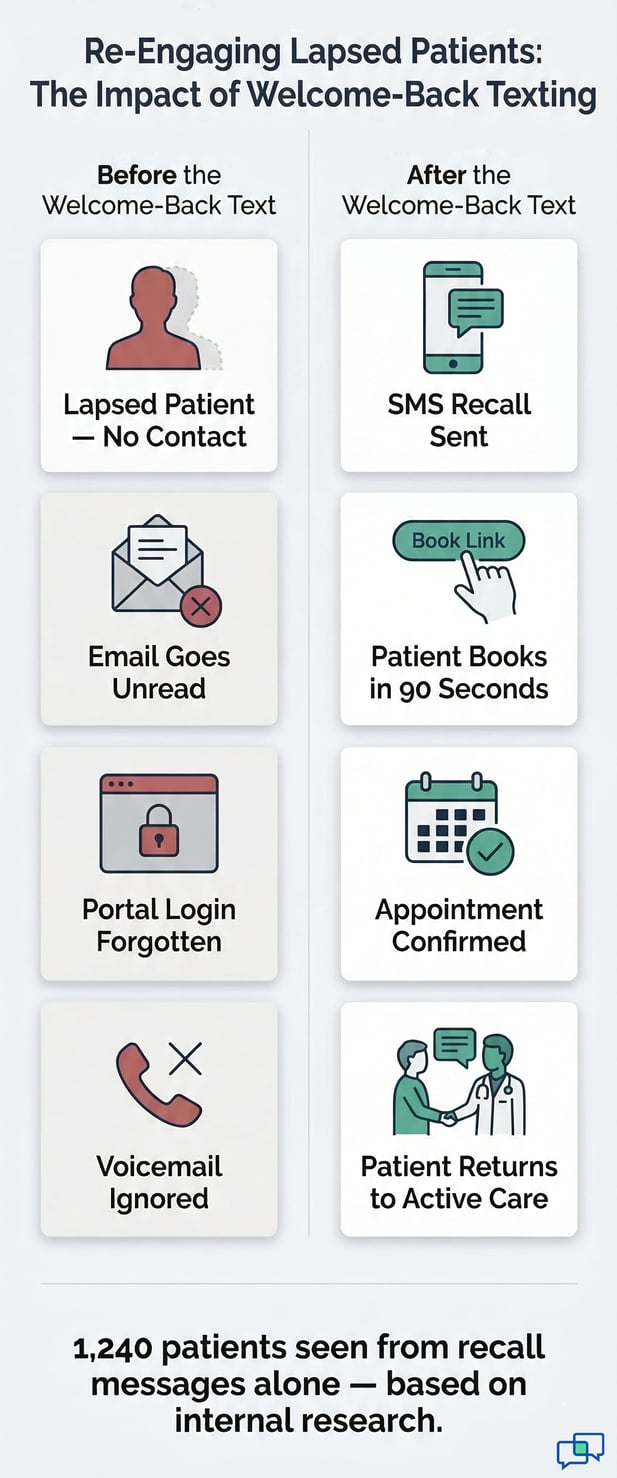
Sunnyvale Family Medicine did not ignore Marcus. They sent an email recall. He never saw it. They called his number. He did not pick up. They left a voicemail. He never listened to it.
They sent a message through the Patient Fusion portal. He had no memory of ever creating an account. By the clinic's records, they had done outreach. By Marcus's experience, he had heard nothing.
Marcus had high blood pressure. That is not a condition that manages itself. Without regular follow-ups, small changes can become serious problems.
From the practice's side, one chronic care patient who stops coming in represents recurring lost revenue, not just a single missed appointment. The stakes for re-engaging patients like Marcus go beyond filling one slot.
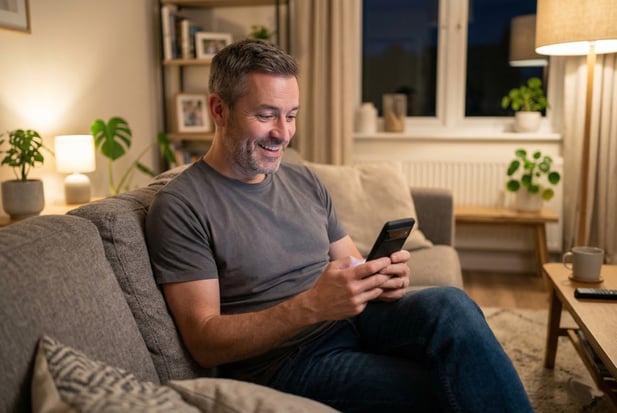
When Sunnyvale started using Curogram's Welcome-Back Text, Marcus received a message on a Tuesday evening while sitting on his couch.
It said: "Hi Marcus, we haven't seen you in a while and want to make sure your blood pressure is under control. Let's schedule your follow-up. Open here: [link]."
He tapped the link. He saw available times with Dr. Chen. He booked Thursday at 4 p.m. right from his phone. The whole process took less than 90 seconds.
Three things made that text land where emails and calls had failed. It was specific. It named his condition. It was personal. It used his name.
It was frictionless. One tap led directly to a booking page. No login. No confusion. No reason not to act.
Marcus showed up for his appointment. Dr. Chen reviewed his medication, made an adjustment, and Marcus became an active patient again.
When Dr. Chen asked what brought him back, Marcus said, "I got a text. I didn't realize how long I'd been gone."
That one text reconnected a patient with a chronic condition to the care he actually needed. For the clinic, it recovered a relationship and the ongoing revenue that came with it.
Beyond one patient's story, the numbers tell a broader picture. Understanding why mass text recall works, and what to track when you use it, helps practices set realistic goals and measure real impact.
The core reason is simple: patients already live in their text messages. Unlike email or patient portals, SMS requires no setup, no account, and no extra effort from the patient. It meets them where they are, on a device they check dozens of times a day.
Here is how the main recall channels compare:
|
Recall Channel |
Avg. Open Rate |
Avg. Booking Rate |
Show-Up Rate |
|---|---|---|---|
|
SMS / Text Message |
90%+ |
30-40% |
85%+ |
|
Email Recall |
~20% |
~5% |
50-70% |
|
Patient Portal Message |
~10% |
~3% |
50-70% |
|
Phone Call / Voicemail |
Varies |
~10-15% |
50-70% |
SMS recall reaches patients across age groups and tech comfort levels. You do not need a smartphone app or a working email address.
As long as a patient has a phone number on file, the text gets through. That makes it one of the most inclusive recall tools available.
When patients self-book through a text link, they choose a time that works for them. That act of choosing creates a commitment.
Compare that to a front desk calling to book a slot on the patient's behalf, which gives the patient less ownership and more reasons to cancel or forget. The result is a meaningful difference in show-up rates.
Running a Welcome-Back campaign without tracking results is a missed opportunity. The right metrics help practices refine their messaging, improve future campaigns, and understand the real revenue impact of re-engagement.
Key metrics to watch after each campaign:
|
Metric |
What It Measures |
Target Benchmark |
|---|---|---|
|
Lapsed Patient Booking Rate |
% of recipients who book an appointment |
30-40% |
|
Self-Booking Rate |
% who book via the SMS link vs. calling in |
70-80% |
|
Show-Up Rate |
% of SMS-booked patients who attend |
85%+ |
|
Revenue Recovered |
Total billing from re-engaged patients |
Varies by practice |
One booking from a lapsed patient is good. A lapsed patient who becomes active again is far more valuable.
Tracking lifetime value recovery means looking beyond the first visit to how many patients from a campaign continue to book regularly. That number is where the real return on a Welcome-Back campaign shows up.
Every campaign generates data: which messages had higher click rates, which visit types drove more bookings, which patient segments responded best.
Practices that review this data between campaigns can sharpen their messaging and improve results over time. A 30% booking rate today can become a 40% rate with the right adjustments.
Knowing that SMS works is useful. Knowing how to measure it in your own practice is what turns insight into action. This section breaks down the key data points and what they mean for small Practice Fusion clinics.
This is the most direct measure of a campaign's success. It answers the question: how many lapsed patients actually came back?
Based on our internal research, 35% of patients who received an SMS recall scheduled an appointment within a month. For a list of 400 lapsed patients, that translates to 140 new bookings from a single send.
That kind of return is hard to match with any other outreach method. Email recall averages around 5%. Portal messages hover near 3%.
The gap between SMS and every other channel is not small. It is the difference between meaningful re-engagement and noise.
If 140 patients book appointments worth $200 each, a single campaign generates $28,000 in recovered revenue. Run one campaign per month, and the annual impact is substantial.
That is without factoring in the ongoing value of patients who stay active after their first return visit. The revenue math makes a strong case for consistent recall campaigns.
Knowing your booking rate is only useful if you know what good looks like. Tracking your results against industry benchmarks (30-40% for SMS, 5% for email, 3% for portal) helps practices understand where they stand and what is possible with better tools or messaging.
When a patient books directly through the SMS link, it signals more than a confirmed appointment. It signals that the patient took control of their own care.
That ownership tends to make them more likely to show up and more likely to book again. A self-booking rate of 70-80% means that most patients who respond to a text recall do not need to call the office.
That reduces callback volume for staff and gives patients a better experience at the same time.
Every patient who self-books is one fewer callback your front desk has to make. For a small clinic, this adds up fast.
A campaign that brings in 140 bookings with a 75% self-booking rate means staff only need to follow up with about 35 patients manually. That is a meaningful reduction in workload, especially for lean teams.
The data is consistent: patients who book through an SMS link show up at higher rates than those recalled by phone.
An 85%+ show-up rate for SMS-booked patients versus 50-70% for phone recalls means fewer empty slots, better use of provider time, and more consistent daily revenue. For small practices with tight margins, that difference matters.
Bring Lapsed Patients BackYou already have the list. Every Practice Fusion clinic has a segment of patients flagged as overdue.
The question is whether to let them drift further or to reach out and invite them back. A Welcome-Back Text campaign gives you a direct, low-effort way to do that at scale.
Getting started with Curogram's Welcome-Back Text does not require a big setup. The process is simple: pull your lapsed patient list from Practice Fusion, build a short, warm message with a booking link, and send. Most practices complete their first campaign in under 5 minutes.
The message does not need to be complicated. Something like "Hi [Name], we haven't seen you in a while. Let's schedule your check-up. Book here: [link]" is clear, personal, and actionable. No medical jargon. No pressure. Just a simple invite.
Start with patients who have not visited in 6 to 12 months. These are the most likely to respond to a recall message.
Patients who have been inactive for over two years may need a different approach, but those in the 6-to-12-month window often just need to be reminded that their care is overdue and that booking is easy.
A message that references the patient's condition or visit type performs better than a generic one. If your list includes patients overdue for a physical, say so.
If it includes chronic care patients, reference their condition. The more the message feels like it was written for them, the more likely they are to act.
Once the campaign goes out, bookings start coming in. Some patients respond within minutes. Others take a day or two.
The Curogram dashboard lets you track which patients clicked, which booked, and which still need a follow-up nudge.
Based on our internal research, 1,240 patients were seen from recall messages alone at one multi-location practice. That kind of volume does not come from phone calls or portal messages.
It comes from reaching patients in the way they actually communicate, with a message that makes it easy to say yes.
The practices that see the biggest impact from Welcome-Back campaigns are the ones that run them consistently.
A monthly recall campaign, targeting patients who hit the 6-month or 12-month inactive mark, keeps your active patient count stable and prevents the slow drift that leads to empty schedules. One text message, once a month, can change the shape of your practice.
Schedule a demo with Curogram because filling your schedule should not require a phone bank. One well-timed text can do the work.
Any phone that can receive text messages can receive a Welcome-Back Text. The booking link opens in a mobile browser, which works on most basic smartphones and many older devices. Patients do not need to download an app or have a data plan to receive the SMS itself.
Patient portals require a login that many lapsed patients have forgotten. SMS needs nothing from the patient except a tap. The fewer steps between a message and an action, the more patients follow through. Text messages also arrive in a space patients constantly check, which portal messages simply do not.
The key metrics are booking rate, show-up rate, and revenue recovered. Based on our internal research, practices see a 30-40% booking rate from SMS recall campaigns. Tracking how many of those patients stay active after their first return visit gives a fuller picture of long-term value.
When patients choose their own appointment time, they take ownership of the decision. That sense of control makes them more likely to follow through. Compare this to a phone recall where staff pick a time on the patient's behalf, which gives the patient less investment in showing up.
Curogram's Welcome-Back Text is built to work alongside Practice Fusion without adding admin burden. The setup takes under 5 minutes. Campaigns are sent in bulk, bookings fill automatically in the calendar, and the dashboard tracks results in real time. Staff do not need to change how they manage their day to run a recall campaign.
💡 Patient recall phone calls drain staff time at small Practice Fusion clinics. Front desk teams spend 3 to 4 hours each week chasing overdue...
💡 Practice Fusion mass messaging for patient recall lets small clinics send bulk SMS to hundreds of overdue patients at once. Practice Fusion has...
💡 Boosting engagement with Allscripts mass texting is what health organizations need. You can help your organization reach more patients in ways...