9 min read

Curogram vs Weave: Clinical Workflow Automation for Practices

Curogram vs Weave: Clinical Workflow Automation for Practices
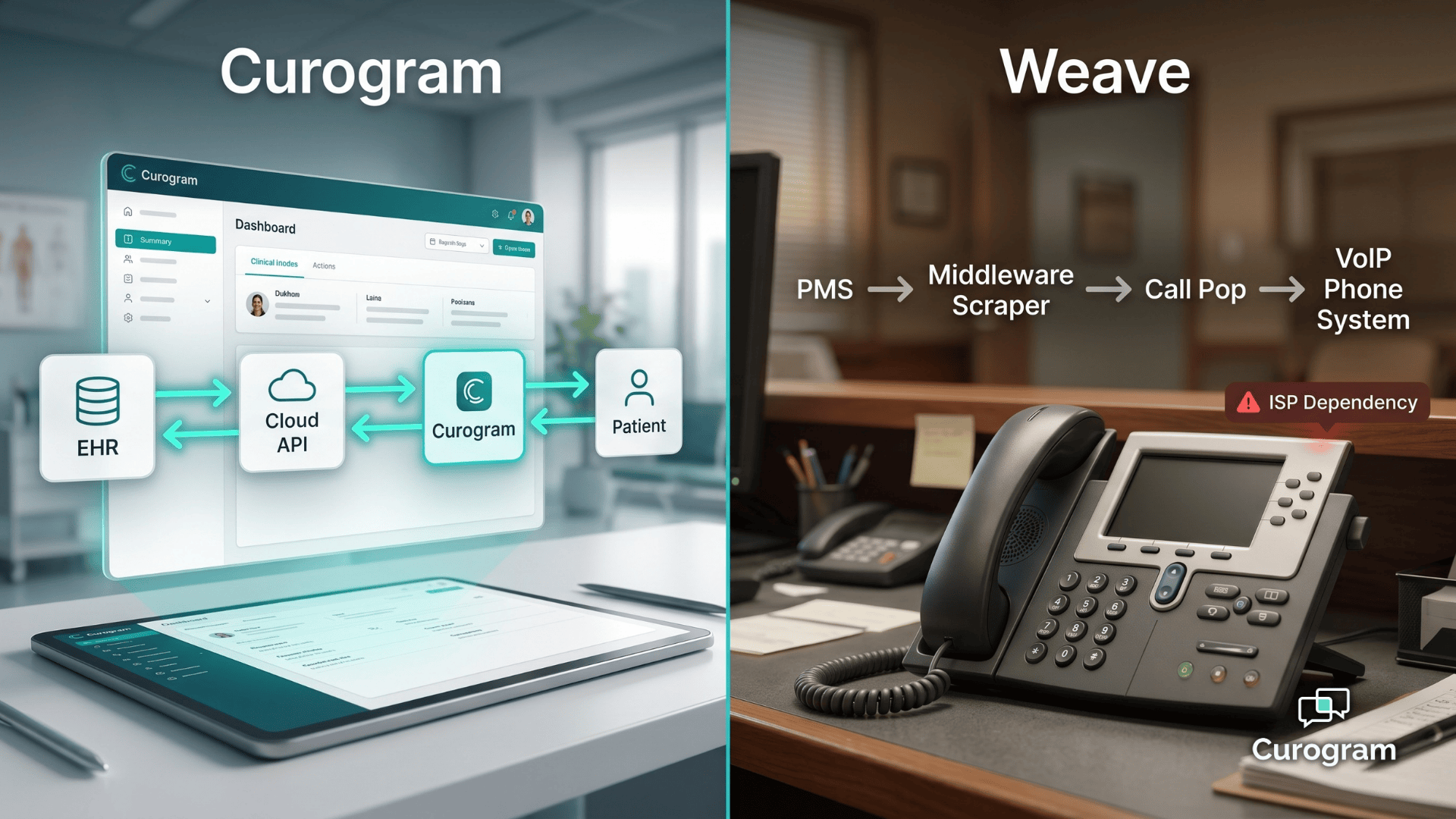
💡 Curogram and Weave take different paths to patient engagement. Curogram is built around clinical workflow automation, meaning confirmations, intake, and messaging write data directly back to the EHR without staff effort. 

Weave is built around a VoIP phone system, with engagement features layered on top.     

For practices with complex intake workflows and multi-specialty data, the gap between bi-directional APIs and read-only scraping means true automation vs. ongoing manual transcription.

The short version: Weave centralizes calls and messages.

Curogram resolves the clinical data behind them. For medical practices with complex, multi-specialty workflows, that architectural gap changes how much manual work your front desk carries each day.

Picture your front desk on a Monday morning.

The phones are already ringing. Three patients are walking in for 9 a.m. appointments, two more are calling to confirm, and someone on hold has been waiting four minutes. Your receptionist is doing her best.

But every call, every reminder, every intake form still ends the same way: she has to open the EHR and type in what just happened.

That is the hidden cost most medical practices never put on a spreadsheet.

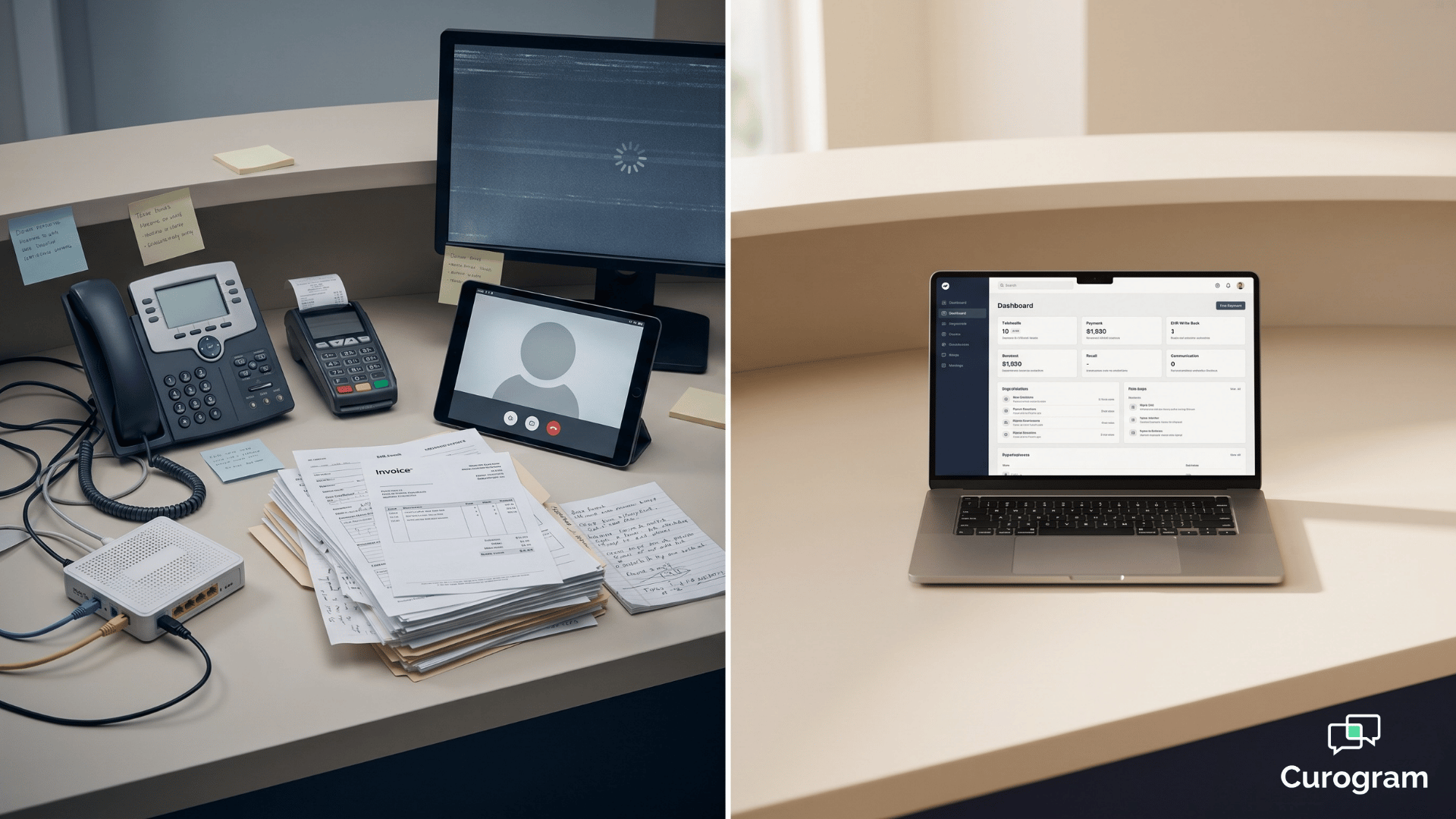
Your software looks modern.

 The phones ring. The reminders go out. Patients get texts. On paper, everything works. In practice, your staff is still the glue holding it all together.

They are the ones updating charts, reconciling schedules, and chasing no-shows by hand.

This is the real difference between a communication platform and a clinical one. One organizes the conversations. The other finishes the work those conversations create.

That distinction sits at the heart of the curogram weave clinical workflow automation debate.

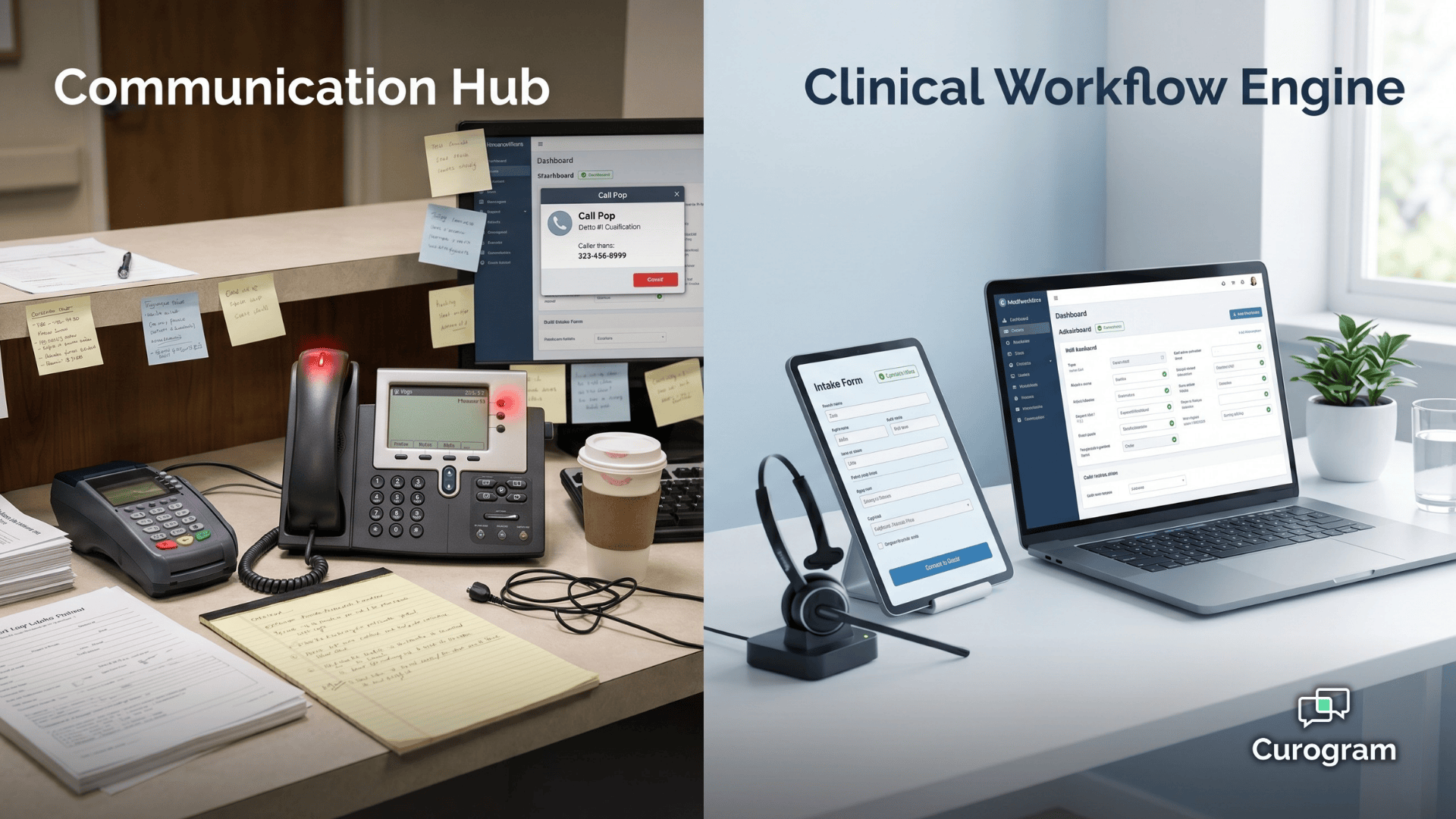
Weave gives you a clean VoIP hub with caller pop-ups, texting, and reminders. Curogram gives you a medical-first automation engine that writes structured data back into the EHR the moment a patient responds.

It sounds like a small difference. It isn’t.

For a practice fielding 80 or more inbound calls a day across multiple specialties, every unfinished workflow adds minutes. Minutes become hours. Hours become FTEs. And every FTE spent on data entry is one not spent on patients.

In this guide, you’ll see where each platform shines, where Weave’s phone-centric model runs into medical-practice limits, and how clinical automation changes the math on staffing, no-shows, and revenue. Let’s break it down.

How the Platform Is Built Changes What It Can Do

Patient engagement platforms in 2026 fall into two camps. One camp starts with a phone system and adds patient features on top. The other starts with clinical data and adds communication on top.

That starting point decides everything.

The two platform DNAs

A platform built on a VoIP core will always think in calls, rings, and hardware. A platform built on clinical data will think in charts, fields, and workflows. Both can send a text. Only one can finish the job that text was meant to start.

This is the core of the patient engagement VoIP hub vs clinical automation conversation.

It isn’t about which platform has more features. It’s about which one resolves the work your staff is doing by hand right now.

Why this matters to your front desk

Medical practices feel this every day. You don’t just need a call to be answered.

You need four things to happen for every patient interaction:

  • The patient confirmed
  • The schedule updated
  • The intake mapped to the right chart field
  • The follow-up scheduled

A communication hub helps with step one. A clinical workflow engine owns all four. That’s the difference that shapes your headcount for years.

Choose a phone-first platform and you keep paying staff to close loops.

Choose a clinical-first platform and those loops close themselves.

Who this comparison is really for

This guide is written for front desk coordinators and office managers in medical practice environments.

If you run a dental or veterinary SMB, Weave is a strong fit and we’ll say so openly.

If you run a medical clinic with an EHR, multiple specialties, and heavy call volume, the math looks different.

Medical-First Automation Versus a VoIP Communication Hub

Let’s get specific about how each platform actually handles a patient interaction.

On Curogram, an appointment confirmation is a closed loop.

The system sends a text. The patient replies “yes.” The EHR updates the status automatically. The schedule reflects it in real time.

No one touches a keyboard.

On Weave, that same confirmation lights up the reminder system and shows activity in the messaging thread.

But the EHR status? That usually still needs a staff member to log in and update it by hand.

The reminder went out. The workflow didn’t finish.

This is what clinical workflow engine vs communication hub healthcare really means in day-to-day operations.

One resolves the data. The other displays it.

Where Weave’s phone-first model works well

Weave’s VoIP core is genuinely impressive for the markets it was designed for. Call Pop shows caller history the moment the phone rings. Hardware terminals consolidate payments. Desk phones, texting, and reviews all live under one roof.

For a two-dentist practice or a three-room vet clinic, this is a clean, all-in-one setup.

That’s why the weave dental SMB vs medical enterprise workflow distinction matters. Dental and veterinary offices have simpler clinical workflows, fewer integrations, and less EHR complexity. Weave fits that shape.

Where it runs into weave phone system clinical limitations medical practice teams notice

Medical practices are a different animal. You have multi-specialty scheduling, complex EHR fields, referral loops, and discrete data requirements.

Verified reviewers consistently point out the same pattern:

Weave handles the conversation, but the clinical data behind it still needs manual entry.

That creates friction in three specific places:

  • Intake forms arrive, but the data doesn’t map cleanly to discrete EHR fields
  • Reminders go out, but confirmations don’t auto-update appointment status in medical EHRs
  • Call handling is strong, but reliability depends on your internet and phone hardware

Each of these is a small tax. Stack them across 80+ daily calls and the tax gets expensive.

This is where front desk automation phone-centric platform users start to feel the ceiling of what a VoIP hub can do for them.

The Numbers Behind Medical-First Clinical Automation

Let’s put real numbers on the difference. Because at the end of the day, architecture only matters if it shows up in your revenue and your staffing.

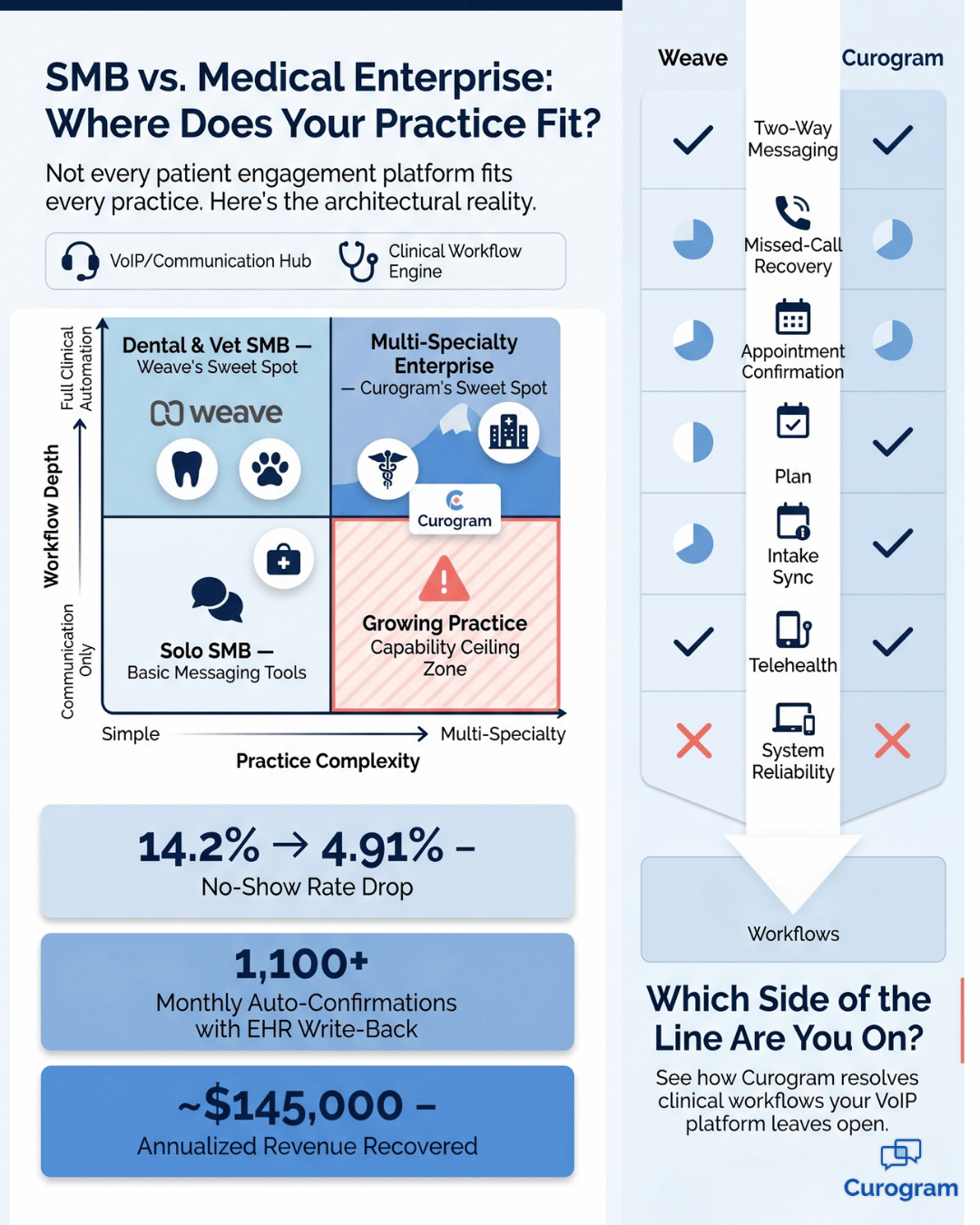
Matrix comparing Weave SMB fit versus Curogram clinical workflow automation for medical practices

No-shows: a drop that pays for itself

Atlas Medical cut its no-show rate from 14.2% to 4.91% in three months after moving to Curogram. That’s a 65% reduction.

Here’s what that means in plain dollars.

A practice seeing 200 patients a week at an average visit value of $150 would lose roughly $4,260 a week at 14.2% no-shows.

At 4.91%, that loss drops to about $1,473.

This didn’t come from sending more reminders. It came from deterministic confirmations that wrote back to the EHR automatically. Every “yes” closed the loop without a staff touch.

Confirmations at scale

Covina Arthritic Clinic processes over 1,100 automated confirmations per month on Curogram. Each one completes the full cycle: patient confirms, EHR updates, schedule reflects, no staff intervention.

Now run that same volume on a VoIP-centric platform without deep medical EHR write-back.

Each confirmation still needs a staff member to update the status by hand. At roughly 90 seconds per update, that’s 1,650 minutes a month, or about 27.5 hours, or nearly a full workweek of wasted time.

~$2,800

Recovered every week for a sample practice running 200 visits at $150

On the revenue side, that same 200-visit practice recovers close to $2,800 every week once no-shows drop from $4,260 in weekly losses to about $1,473.

That is one workflow. Multiply it across intake, recalls, and referrals and you’re looking at a full FTE.

Recalls, reviews, and text-to-pay

Curogram’s SMS recall campaigns brought back 1,240 patients at a 35% reconversion rate for one practice. Reviews jumped by 1,064 new 5-star ratings in three months. Text-to-pay removed the need for hardware terminals entirely.

~$145,000

Annualized revenue recovered from the no-show workflow alone

Zoom out and the no-show workflow alone recovers roughly $145,000 a year for that same sample practice, and that’s before counting recalls, reviews, or reclaimed staff hours.

None of this is magic.

It’s what happens when every patient touchpoint is a structured workflow instead of a phone notification.

For your team, it means fewer tasks bouncing back to the front desk and more closed loops running in the background.

Patient confirming appointment by text at home using Curogram medical practice automation platform

Telehealth that’s actually native

Curogram includes a native telehealth module with a virtual waiting room, patient queueing, and integrated pre-visit intake.

Weave does not offer native telehealth. If your practice needs virtual care, that’s a full platform you’d otherwise have to bolt on, pay for, and train staff to use.

Side-by-Side: Clinical Workflow Capabilities

Here’s how the two platforms stack up across the workflows medical practices care most about.

Workflow Capability Curogram Weave
Two-way messaging Native unified inbox, app-less patient experience Messaging as an extension of VoIP, phone-centric
Missed-call recovery Native missed-call-to-text with automated routing Call Pop shows caller info, no native call-to-text automation
Appointment confirmation Deterministic with real-time EHR auto-update, 75%+ rate Reminders sent, limited clinical write-back in medical EHRs
Intake data sync Discrete write-back to structured EHR clinical fields Link-based forms, limited discrete sync, manual EHR update often needed
Telehealth Native virtual waiting room + structured patient queueing Not a native platform capability
Text-to-pay Native text-based, no hardware required Integrated payments, hardware terminal dependent
System reliability Cloud-native, enterprise-grade, ISP-independent VoIP-dependent, verified reports of dropped calls and glitches
Target market Medical specialties and enterprise Dental, veterinary, optometry SMB

Reading between the rows

Read this table carefully. The feature names look similar. The architecture behind them isn’t.

Stop playing phone tag! Reduce your call volume by 50% with Curogram's HIPAA-compliant 2-way texting platform.  

Weave’s column is strong where phone-system integration is the main job. Curogram’s column is strong where the clinical workflow needs to finish inside the EHR, not just show up on a screen.

That is the entire argument in one table.

Moving from a Communication Hub to a Clinical Workflow Engine

The gap between these two platforms is not a feature gap. It is an architectural one.

Why features can’t close the gap

A phone-first platform can add messaging, reviews, and reminders. It cannot retroactively build deep bi-directional EHR integration, discrete write-back, or cloud-native reliability. Those are foundational. They either live in the core or they don’t.

This is why medical practices that start on Weave and grow into complex multi-specialty operations often hit a wall. The features keep expanding. The ceiling doesn’t move.

What changes when the platform matches the practice

When your platform resolves clinical workflows through discrete data exchange instead of routing calls and displaying caller info, three things happen fast:

  • Your staff stops being the glue — no more retyping confirmations, chasing intake forms, or reconciling schedules by hand
  • Your no-shows drop because the confirmation workflow actually completes, not because patients get more texts
  • Your ISP stops being a liability — cloud-native means no desk phones freezing, no dropped calls, no hardware to replace

Recalls come back on their own because the system knows who hasn’t been in and reaches them automatically. Reviews grow because every visit ends with a structured prompt.

The work that used to live on your front desk now lives in the platform.

The practical shift

For most practices, the switch is less about a new tool and more about reclaiming staff capacity. One front desk coordinator running on clinical automation can do the work of two running on a communication hub.

That math is what makes the category change pay for itself within the first quarter for most offices.

Conclusion

Every practice we talk to says the same thing at the start: “Our current system works.” And it does, on the surface. The phones ring, the texts send, the reminders go out.

But when you look underneath, your staff is still carrying the weight.

That is the real test. Not whether the platform sends a message, but whether the workflow behind the message actually finishes without a human closing it.

For dental and veterinary SMBs, a phone-first hub like Weave handles that well enough. For medical practices with EHR complexity, multi-specialty scheduling, and high call volume, the gap gets expensive fast.

Curogram was built for that gap. Confirmations that write back to your EHR automatically. Intake that lands in discrete clinical fields. Missed calls that turn into text conversations without a single staff touch. Native telehealth. Text-to-pay without hardware.

Recall campaigns that reconvert 35% of lapsed patients. All on a cloud-native platform that doesn’t care how strong your internet is on a Tuesday.

If you’re already spending hours each week on manual EHR updates, schedule reconciliation, or recall outreach, that’s your baseline.

Now picture those hours back in your week, every week, and what your team could do with them.

The best way to see the difference is to see it running in a practice like yours. A short demo walks you through the exact workflows you handle today and shows how each one closes itself on Curogram.

No pressure, no lift from your team, just a clear look at what medical-first automation actually does.

Schedule a Demo with Curogram today and see how curogram weave clinical workflow automation comparisons play out in a real medical practice. Your front desk will thank you by the end of the week.


Frequently Asked Questions

How does Weave’s clinical workflow automation compare to Curogram for medical practices?

Weave operates mainly as a VoIP communication hub. You get a consolidated phone system, Call Pop caller display, basic messaging, and automated reminders, all tuned for dental and veterinary SMB workflows. It does not provide deep clinical write-back for medical EHRs. Curogram, on the other hand, delivers medical-first deterministic clinical automation: confirmations update the EHR automatically, intake data writes to discrete fields, and missed calls convert to text conversations. In short, Weave centralizes communication. Curogram automates the clinical workflow behind it.

Does Weave offer native telehealth like Curogram?

No. Weave does not include native telehealth as a core platform capability. If you want virtual visits on Weave, you’ll need a separate tool. Curogram includes a native telehealth module with a virtual waiting room, structured patient queueing, and integrated pre-visit intake. It all runs inside the same clinical automation platform, so you don’t juggle third-party logins or duplicate patient data.

Why do medical practices experience reliability issues with Weave that Curogram avoids?

Weave is fundamentally a VoIP phone system, so its performance depends on your internet connection and proprietary phone hardware. Verified 2025 and 2026 reviews consistently cite dropped calls, system glitches, and phones that freeze and need a restart. Curogram is a cloud-native digital platform that runs independently of local telephony. That means no desk phones, no ISP dependency, and no hardware-related interruptions. For practices that can’t afford downtime during peak hours, that architecture matters.

Is Curogram a good fit if my practice already uses Weave for calls and texting?

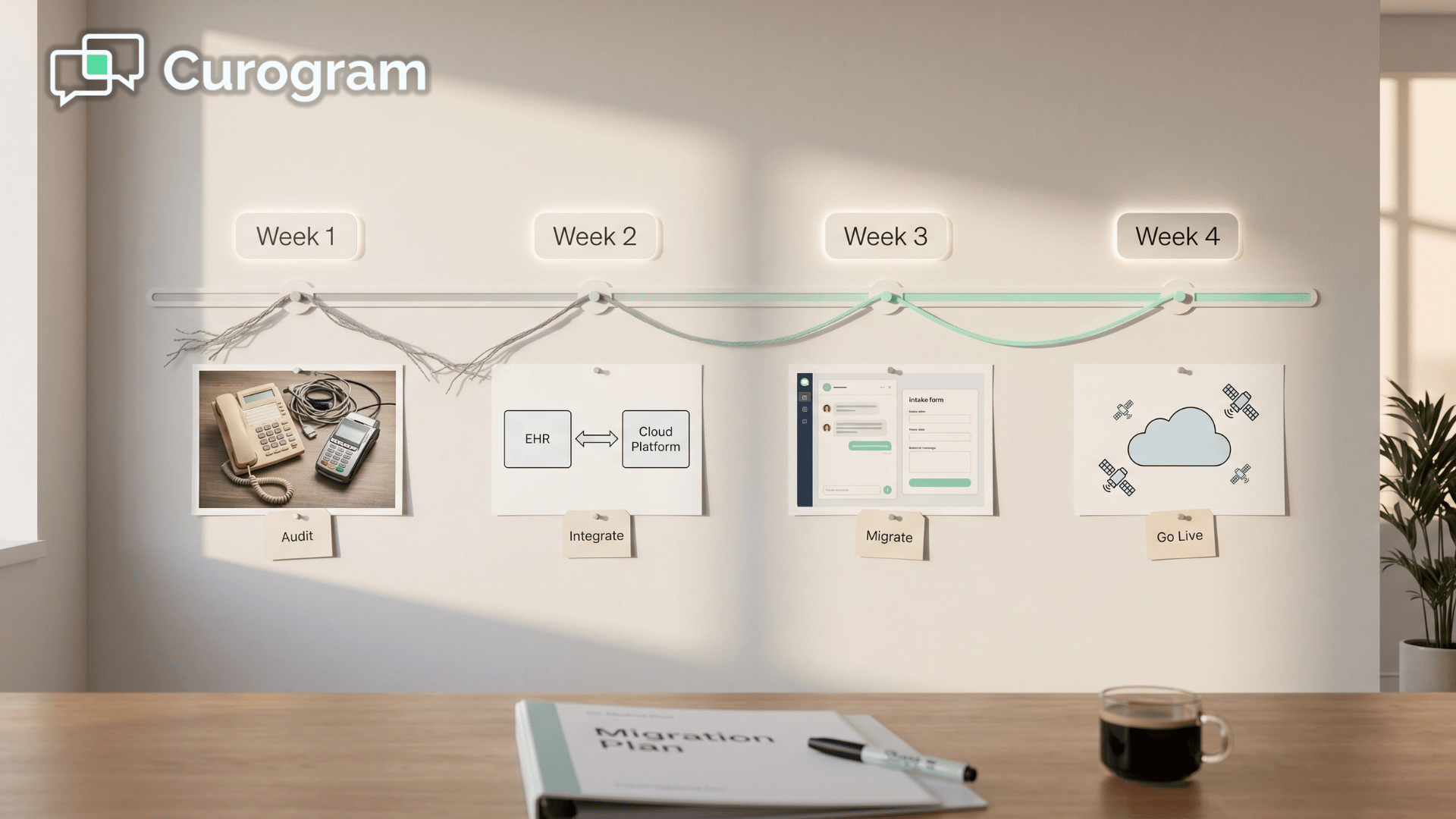
Yes, and it’s a common switch. Most practices that move from Weave to Curogram aren’t unhappy with the phone system itself. They’ve simply outgrown it. Once your staff spends more time manually updating the EHR after reminders, intake forms, and confirmations than they do answering calls, you’ve crossed the line from SMB to medical enterprise workflow. Curogram’s migration path is designed for that exact scenario. You keep the communication capabilities you already rely on and add the deep clinical automation Weave can’t provide natively.

How long does it take to see ROI after switching to Curogram?

Most practices see measurable results within the first 30 to 90 days. The fastest wins usually come from the no-show reduction workflow, since deterministic confirmations with EHR auto-update start closing loops on day one. Recall campaigns, automated reviews, and reclaimed staff hours build on top of that over the following weeks. For a sample practice running 200 weekly visits, the annualized recovered revenue from no-shows alone is often enough to cover the platform cost many times over, which is why most offices break even well before the first quarter ends.