
Uncovering Why Do Patients No-Show for Appointments: A Deep Dive into Causes and Effective Strategies
Discover the real reasons why do patients no-show for appointments—from financial worries and transportation issues to communication gaps and...
10 min read

Many practices treat no-shows as a cost of doing business. A few slots go empty each day, the front desk shrugs, and the schedule moves on.
The research supports a different reading. A 2020 review in Risk Management and Healthcare Policy found no-show rates ranging from 12% to 80% across health care settings.
It traced most misses to four causes: patient-related issues, environmental barriers, cost, and scheduling. Each of those causes leaves a trail you can see before the slot goes empty.
Our view is that most no-shows are lost in the weeks between booking and the visit, and that a practice can win that stretch back with the right tools.
Consider who misses. A patient booked eight weeks out forgets, or a new work shift now clashes with the time. Another has no ride on a rainy morning. A third worries about a copay after switching to a high-deductible plan. Someone else feels fine and decides the follow-up can wait.
Your front desk can reach every one of these patients before the visit. A two-way text gives the patient a way to say “I can’t make it” two days ahead, while you still have time to call the waitlist.
A telehealth option keeps the visit for the patient without a ride. A short prep sheet sent by text can calm a nervous patient before a first scan.
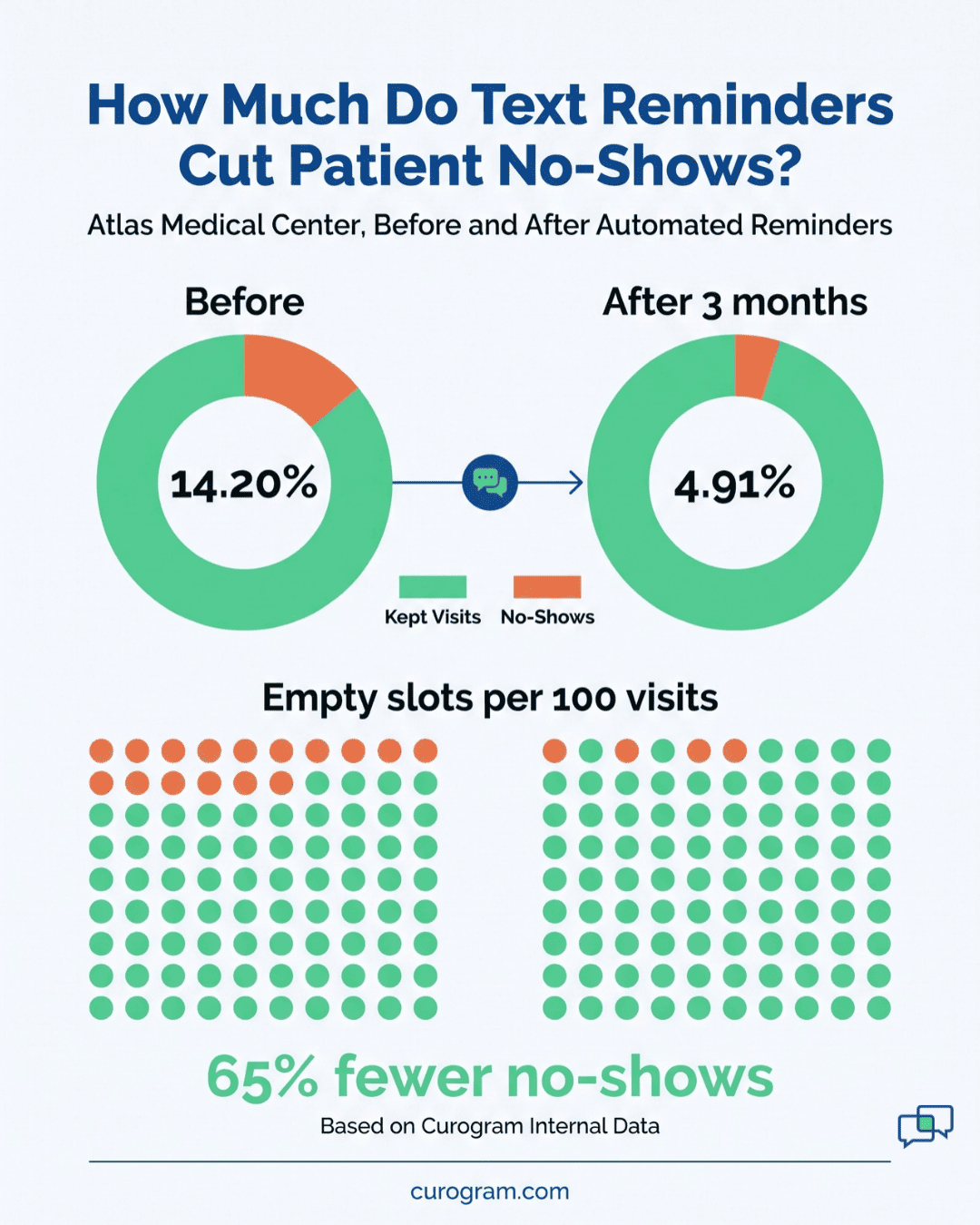
The results come quickly when the pieces work together. Based on our internal data, Atlas Medical Center cut its no-show rate from 14.20% to 4.91% in three months with automated reminders and confirmations.
A no-show is a patient who doesn’t come to a booked visit. Most practices also count patients who cancel at the last minute or never call back to rebook, because the slot sits empty either way.
The causes are well studied. A 2020 paper in the journal Risk Management and Healthcare Policy reports no-show rates from 12% to 80% across health care settings. It sorts the main drivers into four groups:
| Category | How It Can Show Up at Your Front Desk (Illustrative) |
|---|---|
| Patient-related issues | The patient forgets, or feels better and skips the visit |
| Environmental factors | No ride, bad weather, or a long drive to the clinic |
| Financial situation | Worry about a copay or an open balance |
| Scheduling-related issues | A visit booked weeks out, a work conflict, or a long wait in the lobby |
The research behind that paper also links missed visits to lead times, wait times, and service quality. A patient who waited 40 minutes last time has less reason to protect the next slot.
Who misses also follows a pattern. The same paper notes that no-shows are more common among men, younger patients, and people with lower socioeconomic status.
For your schedule, that points to timing. A single reminder sent weeks ahead does the least for the patients most likely to miss.
Many missed visits start with how the patient sees the appointment. If it doesn’t feel urgent, it slides down the list behind work, kids, and errands.
Feeling well is the most common trigger. A patient skips an annual physical because nothing hurts. Another drops a sick visit or a follow-up once the symptoms fade and they decide they’ve recovered.
Fear keeps others away. Clinical settings, from a primary care office to a radiology suite, make some patients anxious enough to avoid the visit. Language barriers add a different strain, since trouble following staff, forms, or instructions builds frustration until the patient stays home.
Some reasons are plain logistics. A sitter cancels, and the patient can’t leave a toddler or an aging parent alone. And some patients just forget the date or oversleep.
For the rest of the refresh, I’ll use a table only when the section compares numbers or several items across the same columns. Ready for the next section.
Getting to the clinic is its own hurdle. A patient without a car has to line up a bus or a rideshare, and each added step is another chance to miss the visit. The problem is wide: 5.8 million people in the U.S. delayed medical care in 2017 because they had no transportation, according to a 2020 study in the American Journal of Public Health.
Parking matters too. A full lot can turn a late arrival into a skipped one.
Weather does the rest. Patients cancel or stay home on the hottest afternoons, the coldest mornings, and the wettest days of the year.
You can often see these misses coming. A storm in the forecast or a patient who mentioned a ride problem at the last visit are both early signs. A reminder that makes it easy to reschedule a day ahead gives you the slot back while you can still fill it.
Cost stops some patients before they reach the door. Someone with thin insurance coverage, a high copay, or a large deductible weighs the bill and decides the visit can wait.
That choice is common. In a KFF survey fielded in May 2026, 28% of adults said they had skipped or put off needed care in the past year because of cost. Having insurance only helps so much. About 3 in 10 insured adults ages 18 to 64 reported the same problem.
Your front desk often sees the warning signs early. A patient asks what the visit will cost, mentions a new high-deductible plan, or still has a balance from the last visit. Sharing the expected copay ahead of time, and offering a payment plan for older balances, gives that patient a reason to keep the slot.
The longer the gap between booking and the visit, the more likely the slot goes empty. A 2020 review in Risk Management and Healthcare Policy gives a visit booked eight weeks out as an example of a high lead time that raises no-show risk. One study it cites found the risk starts to climb once lead time passes two weeks.
Long gaps cause two kinds of misses. Some patients forget. Others find that a time that worked when they booked now clashes with a new shift or a school pickup.
The COVID-19 pandemic made this worse for a while. Fear and uncertainty kept some patients away from visits, even with providers they trusted.
Lead time is one no-show driver your team controls directly. Booking follow-ups closer in, and sending a reminder in the final days before any visit booked weeks ahead, gives patients a chance to confirm or free the slot.

Every no-show costs three groups: the patient who missed, the patients who couldn’t get that slot, and your practice.
The patient who misses loses continuity. A skipped follow-up can stall a care plan, push longer waits onto the next visit, and lead to frequent or avoidable ER trips. ER care costs far more than a routine visit, and preventive care often keeps patients out of it.
Other patients lose access. An empty 10 a.m. slot could have gone to someone on your waitlist.
Double booking is a common answer, and it misfires both ways. When both patients show, your schedule runs late, waits climb, and patients leave unhappy. When neither shows, you still have the gap.
Revenue takes the last hit. An industry report covered by Healthcare Finance News puts the cost of missed and open appointments at $150 billion a year. The same report estimates that one empty 60-minute slot costs a physician about $200, and that no-show rates reach as high as 30%.
Run those figures on one provider with eight hour-long slots a day, as illustrative math. A 30% no-show rate means about 2.4 empty slots, or roughly $480 a day. Over 20 working days, that’s close to $10,000 a month.
Most of the causes above share one weak point: the patient’s attention between booking and the visit. Technology closes that gap by reaching patients on the phone they already carry, with no extra calls for your front desk.
Automated text reminders do most of the work. A text goes out days ahead and again the morning of the visit, and a one-word reply confirms, cancels, or asks to reschedule.
Cancelled slots open early enough for your team to fill them from the waitlist. Two-way texting also lets patients ask about a copay or directions before they give up on the visit.
The results show up fast. Based on our internal data, Atlas Medical Center cut its no-show rate from 14.20% to 4.91% in three months with automated reminders and confirmations. Across our clients, the average confirmation rate sits above 75%, and no-show rates run 53% below the industry average.
Many no-shows start at booking. A patient who has to call during work hours to move a visit often doesn’t call at all, and the slot sits empty.
Secure online booking lets patients book, cancel, or reschedule on their own. When the tool syncs with your providers’ calendars, patients see real openings in real time, including the next available slot. They can pick a day and time that fits around work, school runs, or caring for a parent.
Your front desk gains time as well. Requests already match provider availability, so staff stop trading voicemails to find a time that works. An accurate schedule also means shorter lobby waits and fewer idle exam rooms.
When you compare scheduling tools, check for these features:
The last item pays off over time. With scheduling, the EHR, and practice management linked, you can use a patient’s history to spot patterns, such as a patient who often moves Monday visits, and offer a better slot from the start.
Forgetting is the easiest no-show cause to fix. An automated reminder reaches the patient without anyone on your team picking up the phone, and a secure text keeps the details where the patient will see them.
Personal details make the reminder useful. It should carry the patient’s name and the day, time, and location of the visit. A sample (illustrative):
Hi Maria, this is Lakeside Family Medicine. You’re scheduled with Dr. Chen on Thursday, May 14 at 9:30 a.m. at 210 Oak St. Reply C to confirm or R to reschedule.
Patients should also have a say in how and when they hear from you. Some don’t want a daily reminder and would rather get one text two or three days before the visit. Others prefer a text over a phone call.
Reminders move the numbers. In a 2019 study at a breast imaging center, published in Clinical Imaging, telephone reminders cut the no-show rate from 20.99% to 7.07%. Text reminders build on that result and remove the staff time spent dialing.
HIPAA-compliant two-way texting adds the reply. Patients can confirm, or text your office to reschedule, in the same thread as the reminder.
A video visit removes most of the environmental hurdles behind missed appointments. Patients join from home or a break at work, so transportation, parking, and arranging childcare drop off the list. They also skip the waiting room, which matters to patients who feel it wastes their time or puts their health at risk.
Some visits suit video better than others. Follow-ups, medication checks, and test result reviews work well on a screen. New problems that need a hands-on exam still belong in the clinic.
Video slots can still go empty. The usual cause is the link: the patient can’t find it, can’t log in, or gets stuck downloading an app. Sending the join link by text, in the same thread as the reminder and with nothing to install, keeps that step simple.
Coverage is steady for now, since Medicare’s telehealth flexibilities are extended through December 31, 2027.
Some no-shows come from what patients believe. A patient who feels fine may think an annual physical is optional. Another may not see why a follow-up matters once the pain is gone.
Patient education corrects those beliefs and builds confidence. When patients understand why preventive care, diagnosis, and treatment visits matter, they’re more likely to keep them.
Format matters as much as the message. Infographics, short videos, and brochures can ease the anxiety that keeps some patients away. A one-page prep sheet sent before a first MRI, for example, answers the questions a nervous patient might otherwise avoid by skipping.
Delivery decides whether patients see it. A brochure handed out at checkout often ends up in the car. Your communication platform can send the same material by text, a few days before the visit, alongside the reminder.
Most no-shows give you notice, if you have a way to hear it. The weak point is the stretch between booking and the visit, and that’s where a practice keeps or loses the slot.
A two-way text thread is the most practical way to manage that stretch. A reminder that invites a reply turns a silent no-show into a reschedule you can still fill. A video option keeps the visit on the books for patients who can’t make the trip, and it keeps your providers’ time in use.
One-way outreach leaves the gap open. A call that goes to voicemail, or a portal message nobody opens, gives the patient no easy way to tell you their plans changed.
The payoff shows up quickly. Based on our internal data, Atlas Medical Center cut its no-show rate from 14.20% to 4.91% in three months with automated reminders and confirmations. Fewer empty slots mean shorter waits for patients on your waitlist and steadier revenue for your practice.
Start with last month’s no-show list and count how many of those patients ever confirmed. That number shows where your current reminders stop working.
Then book a Curogram demo. Bring your no-show report, and we’ll show you how automated reminders, two-way texting, and telehealth links would run on your real schedule.
Discover the real reasons why do patients no-show for appointments—from financial worries and transportation issues to communication gaps and...

 Joshua Inciso : 5/16/22, 7:47 AM
Convenience is key when it comes to patient engagement. Here are 10 reasons you need to tap into the power of technology - and online scheduling.
 Aubreigh Lee Daculug : 2/14/26, 1:00 PM
Discover how appointment reminder workflows reduce medical no-shows by 75%. Learn to automate patient confirmations.