Skip to the main content.

13 min read

Text-to-Pay for Multi-Location Clinics: Simplified Centralized Billing

Text-to-Pay for Multi-Location Clinics: Simplified Centralized Billing
💡 Multi-location healthcare networks face a common challenge: managing payments across different sites with separate systems. This creates billing errors, delayed collections, and an inconsistent patient experience.

Text-to-pay for multi-location clinics offers a solution by centralizing payment automation through secure text messages. With centralized billing healthcare systems, clinic networks can unify their payment workflows across all locations. Patients receive branded payment links via text, making it easy to pay from any device.

Multi-site healthcare payments become streamlined when all locations use the same platform. This approach reduces admin work, speeds up collections, and improves oversight. EMR integrated payment systems ensure accurate data flows between billing and clinical records.

Automated healthcare billing eliminates manual tasks and reduces errors. The result is scalable payment automation that grows with your network while keeping costs down and patient satisfaction high.

Running a multi-location clinic network comes with many moving parts. Each site has its own staff, schedules, and patient base. But when it comes to billing, many networks still use different systems at each location.

This creates real problems. One clinic sends paper bills while another uses email. Payment data sits in separate systems. Staff at each site follow their own processes. The result is confusion for patients and headaches for managers.

Patients who visit different locations expect the same smooth experience every time. When billing varies by site, it erodes trust. They wonder why one clinic texts payment links while another mails invoices. This inconsistency hurts your brand.

For operations teams, the cost adds up fast. Staff spend hours reconciling payments from multiple platforms. Finance teams struggle to get a clear view of collections across the network. Audits become complex when data lives in different places. Manual work multiplies as you add locations.

There's a better way to handle multi-location patient billing. Centralized billing healthcare systems bring all your sites onto one platform. Text-to-pay for multi-location clinics makes it simple. Every patient gets the same branded experience no matter which location they visit.

With scalable payment automation, you can add new clinics without adding complexity. One dashboard shows payments from all sites. Staff follow the same workflows. Patients receive secure payment links via text message. Collections happen faster with less manual work.

This approach transforms how networks operate. Instead of managing many separate billing systems, you oversee one unified platform. Data flows smoothly between locations. Reports give you real-time visibility. Your team spends less time on billing admin and more time serving patients.

The shift to centralized, automated billing isn't just about convenience. It's about building a sustainable foundation for growth while improving patient satisfaction at every touchpoint.


The Complexity of Multi-Location Billing

Multi-site healthcare payments create unique challenges that single-location practices never face. When you operate multiple clinics, billing complexity grows with each new site.

Disconnected Systems Lead to Data Silos

Each clinic location often uses its own billing workflow. One site might use paper statements. Another sends email invoices. A third location handles phone payments. This fragmentation creates data silos where payment information gets trapped in separate systems.

Finance teams waste hours each week pulling reports from different platforms. They manually combine data to understand total collections. This takes valuable time away from strategic work. Human error creeps in during manual data entry, leading to accounting mistakes that cost money to fix.

Inconsistent Patient Experience

Patients who use multiple locations notice when billing varies by site. One clinic texts them a secure payment link. Another mails a paper bill that takes days to arrive. The lack of consistency makes your network feel disorganized.

This inconsistency damages patient trust. They start to question if all your locations follow the same quality standards. Small billing differences create doubt about bigger operational issues.

Revenue Leakage Across Locations

When each site manages its own billing, some payments fall through the cracks. A patient who owes one location might pay a different site by mistake. Tracking down these errors takes staff time and delays revenue.

Billing inconsistencies can cost networks thousands monthly in missed or delayed collections. Without centralized oversight, you lack visibility into which locations have collection problems. Issues go unnoticed until they show up in quarterly reports.

Complex Reporting and Compliance

Audits become nightmares when billing data lives in multiple systems. Compliance teams must check each location separately. Creating network-wide reports requires combining data from various sources. This manual work increases the risk of errors and makes it hard to spot trends.

Different EMR systems at each site make integration even harder. Data formats don't match. Fields have different names. Moving information between systems requires custom workarounds that break when software updates.

These challenges multiply as your network grows. Adding a new location means adding another system to manage. The administrative burden scales faster than revenue, eating into margins and limiting growth potential.


Why Centralized Billing Is the Future of Healthcare Networks

Healthcare networks that want to grow need systems that scale without adding complexity. Centralized billing healthcare platforms make this possible by bringing all locations onto one unified system.

Patient Expectations Drive the Shift

Modern patients expect seamless experiences across all touchpoints. They use mobile banking, one-click shopping, and instant digital payments in their daily lives. When they interact with your clinic network, they expect the same convenience.

Patients who visit multiple locations want consistent communication. If they receive text payment links at one clinic, they expect the same at another. Centralized systems deliver this uniformity. Every patient gets the same branded experience regardless of which site they visit.

When billing works the same way at every location, patients trust your network more. They see a professional organization that has its operations under control. This consistency extends your brand and reinforces quality across all sites.

Financial Transparency Enables Better Decisions

Leadership teams need clear visibility into financial performance. Centralized billing healthcare systems provide real-time dashboards that show collections across all locations. You can spot trends, identify problems, and make data-driven decisions quickly.

Multi-location patient billing becomes easier to track when all data flows through one platform. You see which sites collect faster, which have higher outstanding balances, and where processes need improvement. This transparency helps you optimize operations network-wide.

Simplified Audits and Compliance

Compliance requirements don't decrease as you grow. If anything, they become more complex. Centralized systems make audits simpler by keeping all billing data in one place. Auditors can review network-wide practices without jumping between systems.

An EMR integrated payment system ensures billing data stays accurate and compliant. Information flows automatically between clinical and financial systems. This reduces manual data entry errors that create compliance risks.

Operational Efficiency at Scale

As your network expands, operational efficiency becomes critical. Automated healthcare billing eliminates repetitive tasks that drain staff time. Instead of manually processing payments at each site, automation handles routine transactions.

Scalable payment automation grows with your network. Adding a new location doesn't mean adding new billing staff or learning new systems. The same platform serves all sites. Training becomes simpler because everyone learns one system.

This efficiency directly impacts your bottom line. Staff spend less time on billing admin and more time on patient care. Collections happen faster. Errors decrease. The cost per transaction drops as volume increases.

Networks that embrace a centralized billing position themselves for sustainable growth. They build infrastructure that supports expansion without proportional increases in administrative overhead.

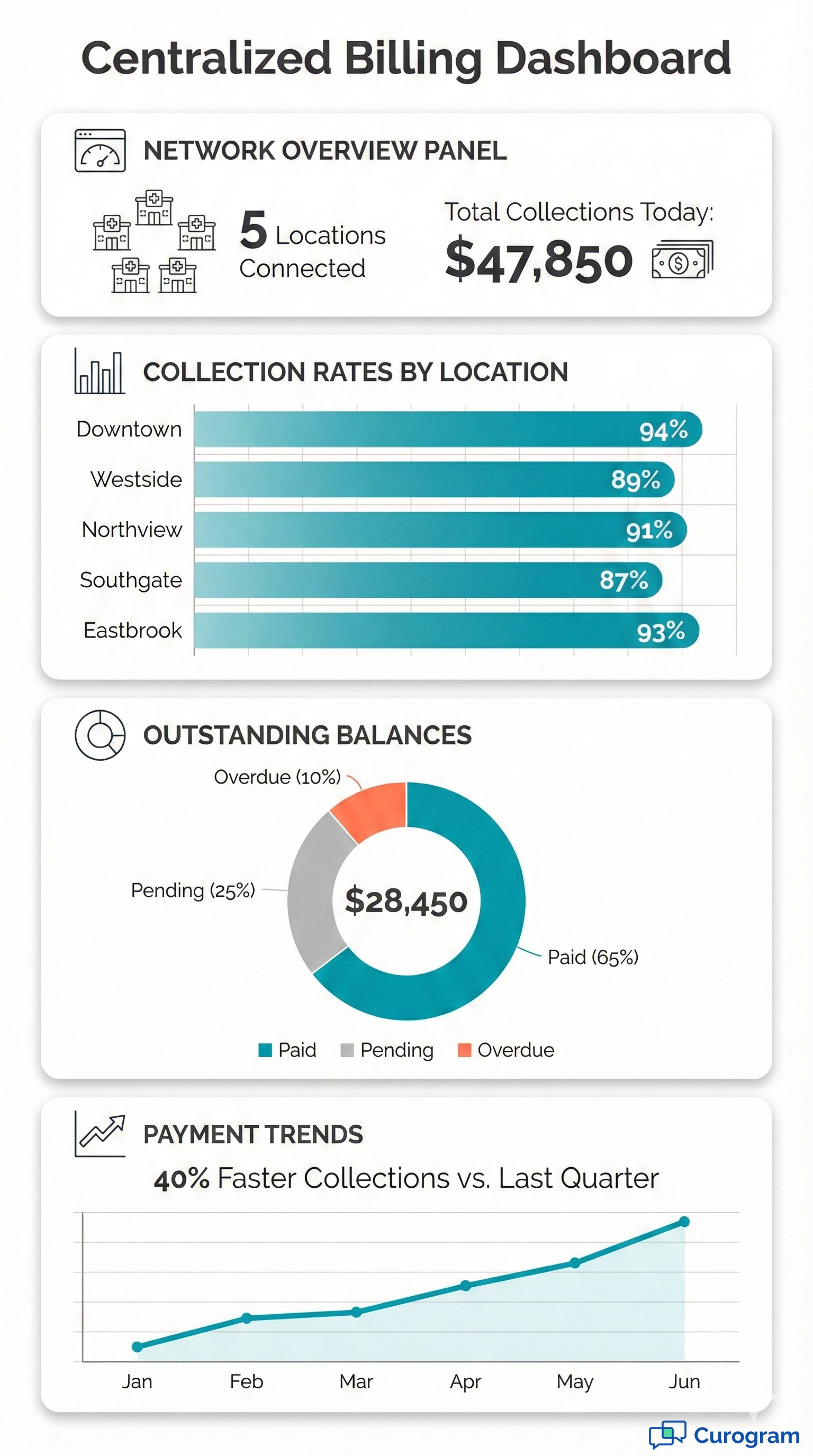
Centralized billing dashboard infographic showing clinic network collections, rates, and trends

How Curogram's Text-to-Pay Scales Across Locations

Text-to-pay for multi-location clinics works because it brings all your sites onto one platform while giving each location the tools it needs. Here's how the system scales to meet enterprise needs.

One Dashboard for Network-Wide Visibility

A central dashboard gives leadership teams a complete view of payment activity across all clinics. You see total collections, outstanding balances, and payment trends in real time. No more waiting for month-end reports or manually combining data from multiple systems.

The dashboard breaks down performance by location, making it easy to compare sites. You quickly identify which clinics excel at collections and which need support. This visibility drives better decision-making at the network level.

When issues arise, you know immediately. If a location experiences a sudden drop in collections, the dashboard alerts you. You can investigate and fix problems before they impact revenue significantly.

Role-Based Access Controls Protect Data

Different team members need different levels of access. Billing staff at individual clinics see their location's data. Regional managers view multiple sites. Finance leaders access the entire network.

Role-based permissions ensure staff only access information relevant to their job. This protects patient privacy and maintains HIPAA compliance. You control who can view reports, process refunds, or modify billing settings.

EMR Integration Ensures Data Accuracy

An EMR-integrated payment system eliminates double data entry. When a patient checks out, their billing information flows automatically from your practice management system to the payment platform. This reduces errors and saves staff time.

Integration works with major EMR systems used by multi-location networks. The connection is secure and HIPAA-compliant. Patient data stays protected while moving between systems. Updates happen in real time, so billing information always matches clinical records.

Automated healthcare billing handles routine tasks without staff intervention. Payment reminders go out automatically. Failed payments trigger retry attempts. Receipts are sent immediately after successful transactions.

HIPAA-Compliant Text Messaging

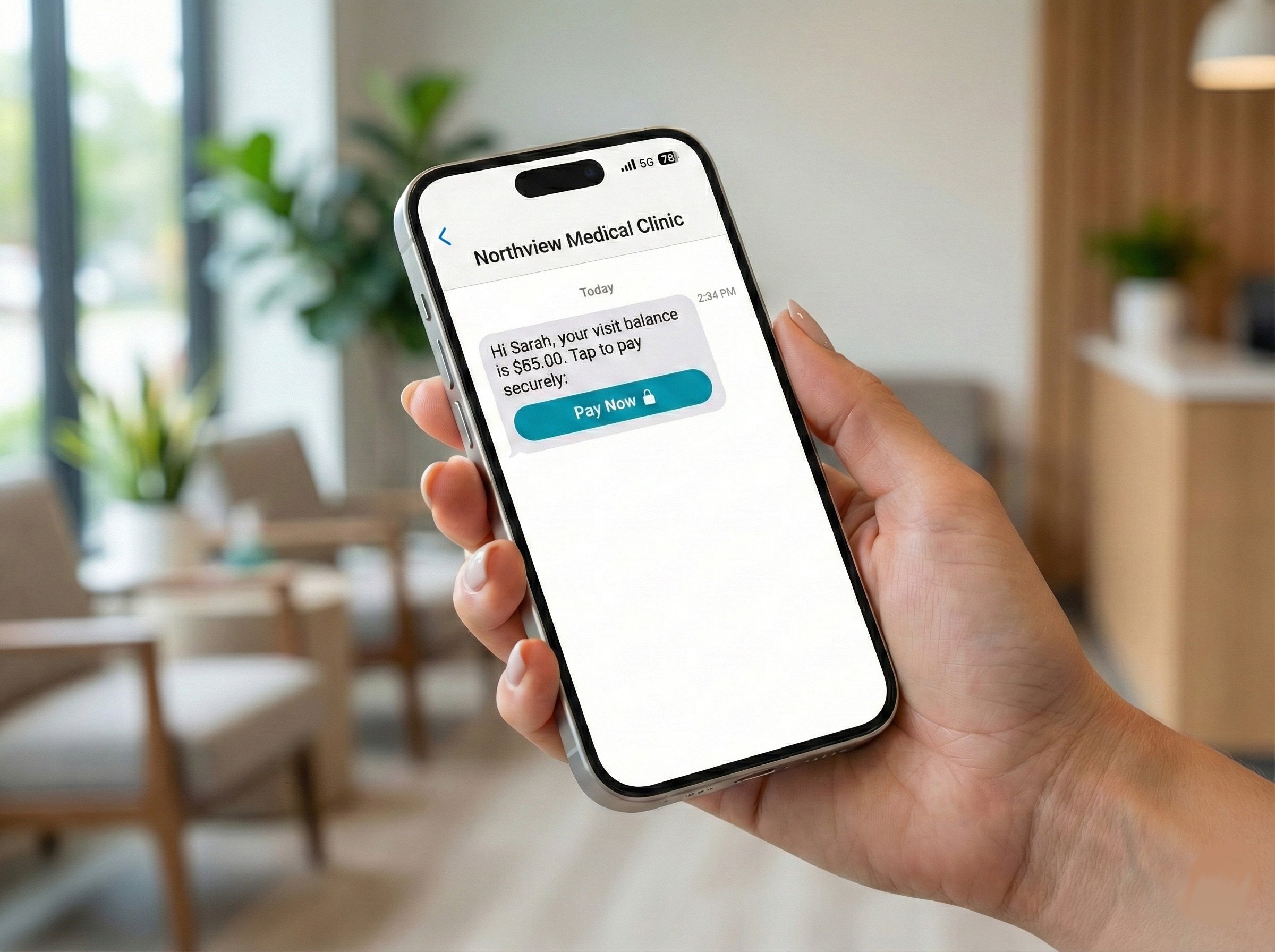
All patient communications use secure, HIPAA-compliant text messaging. Payment links never expose sensitive health information. Messages contain only the amount due and a secure link to pay.

Patients can pay from any device without downloading apps or creating accounts. They click the link, enter payment information, and submit. The process takes less than a minute. Confirmation arrives instantly via text.

Branded Messaging Strengthens Your Network Identity

Every text message carries your network's branding. Patients see your logo and name, not a generic payment processor. This reinforces brand recognition and builds trust.

Multi-site healthcare payments benefit from consistent branding. Whether a patient visits your downtown clinic or suburban location, they receive the same professional communication. This uniformity makes your network feel cohesive and well-managed.

Scalable Infrastructure Supports Growth

The platform handles high transaction volumes without performance issues. As your network grows from five locations to fifty, the system scales seamlessly. You don't need to upgrade infrastructure or migrate to new software.

Adding a new clinic takes minutes, not days. You set up the location in the dashboard, configure permissions, and start sending payment texts. No complex integration projects or IT resources required.

This scalable payment automation approach lets you focus on growth strategy instead of technical logistics. The technology adapts to your needs rather than constraining your expansion plans.


Operational and Financial Benefits

Centralized billing healthcare systems deliver measurable improvements across operations and finances. Here's what multi-location networks experience after making the switch.

Faster Payments and Better Cash Flow

Text-to-pay for multi-location clinics reduces the time between service delivery and payment. Patients receive payment links immediately after their visit. Many pay right away, often before leaving the parking lot.

This speed matters for cash flow. Networks see up to 40% faster payments across sites compared to paper billing. Money arrives in your account sooner, improving working capital and reducing the need for credit lines.

Faster collections mean lower accounts receivable balances. Instead of carrying 30-45 days of outstanding payments, networks often reduce this to 15-20 days. The improvement directly strengthens the financial position.

Fewer Billing Errors Save Time and Money

Automated healthcare billing eliminates common mistakes that plague manual systems. Wrong amounts, duplicate charges, and payment misallocations decrease dramatically. Staff spend less time fixing errors and issuing refunds.

An EMR integrated payment system keeps billing data synchronized with clinical records. When patient information updates in your EMR, it updates in billing too. This prevents errors caused by outdated contact information or insurance details.

Simplified Reconciliation and Reporting

Finance teams love centralized reporting. Instead of logging into multiple systems to pull data, they access one dashboard. Reports generate automatically, showing exactly what they need to know.

Reconciliation that once took days now takes hours. The system matches payments to invoices automatically. Discrepancies get flagged for review. Month-end closes happen faster with fewer surprises.

Every transaction creates a complete audit trail. You can track who sent a payment request, when the patient paid, and how the money was processed. This documentation satisfies auditors and simplifies compliance reviews.

Measurable Cost Savings

Multi-location patient billing costs drop significantly with automation. Paper, printing, envelopes, and postage add up quickly across multiple sites. Networks typically see a 95% reduction in these costs after switching to digital payments.

Staff time represents the bigger savings. When billing admin work decreases by 30%, you can either reduce headcount or redirect staff to higher-value activities. Many networks choose to reinvest the time saved into patient care and satisfaction initiatives.

Improved Patient Satisfaction

Patients appreciate the convenience of text-to-pay. They can settle bills immediately without writing checks or making phone calls. The simple process reduces friction and improves their overall experience.

Patient satisfaction scores often rise after implementing automated billing. Comments praise the ease of payment and professional communication. This positive sentiment strengthens patient loyalty across your network.

Real Results from Healthcare Networks

The benefits aren't theoretical. Networks using scalable payment automation report consistent improvements. A typical multi-location clinic sees 95% lower paper costs, 40% faster payment processing, and 30% less admin work.

These metrics compound over time. The efficiency gains from year one continue in year two and beyond. As you add locations, the benefits scale without proportional cost increases. This creates a strong financial foundation for network expansion.


Simplify Oversight Without Losing Control

Multi-location networks need centralized oversight without micromanaging individual sites. The right billing platform balances these competing needs effectively.

Cloud-Based Access from Anywhere

Modern centralized billing healthcare systems run in the cloud. Leadership teams access the platform from any device with internet access. Whether you're at corporate headquarters, visiting a clinic, or traveling, you maintain full visibility.

Cloud infrastructure eliminates the need for on-premise servers at each location. Updates happen automatically without IT involvement. The system stays current with the latest features and security patches.

Not everyone should access everything. The platform uses role-based permissions to control what each user can see and do. Clinic managers view their location's performance. Regional directors see their assigned sites. Finance executives access network-wide data.

Real-Time Performance Monitoring

Directors monitor key metrics without requesting reports from each site. The dashboard updates continuously, showing current collection rates, outstanding balances, and payment trends. You spot problems early and address them quickly.

Multi-site healthcare payments become transparent when all data flows through one system. You see which locations excel and which struggle. This visibility helps you allocate resources effectively and share best practices across the network.

Different roles need different information. The platform generates custom reports for each stakeholder group. Clinic managers get operational reports focused on daily performance. CFOs receive financial summaries showing revenue trends and forecasts.

Maintain Local Autonomy Within Standard Workflows

Centralization doesn't mean removing all flexibility. Each location retains some autonomy while following network-wide standards. Local staff can adjust payment plans for individual patients or handle special cases.

The platform enforces consistent processes for routine transactions while allowing approved exceptions. This balance prevents the chaos of completely independent operations without creating rigid bureaucracy.

Standardized Training Reduces Onboarding Time

New locations join the network faster when everyone uses the same system. Staff training becomes standardized. You develop one training program that works for all sites. New hires learn the same workflows regardless of which clinic they join.

This consistency extends to staff transfers between locations. When an employee moves from one clinic to another, they already know the billing system. There's no retraining or adjustment period. This mobility strengthens your workforce.

Centralized systems make it easier to maintain consistent documentation across locations. Policy updates roll out to all sites simultaneously. Everyone follows the same procedures for handling payments, refunds, and disputes.

Scalable Oversight That Grows with You

As your network expands, oversight complexity doesn't multiply. The dashboard accommodates five locations as easily as fifty. You add sites without adding management layers or creating bottlenecks.

This scalability matters for long-term growth. Networks that plan to double or triple in size need infrastructure that scales smoothly. Text-to-pay for multi-location clinics provides that foundation.

Focus Leadership Attention on Strategy

When routine oversight happens automatically, leadership teams spend more time on strategic initiatives. Instead of tracking down payment data or investigating billing discrepancies, they focus on growth opportunities and operational improvements.

The platform handles day-to-day monitoring. Alerts notify you of issues that need attention. Everything else runs smoothly in the background. This frees up mental bandwidth for higher-level decision-making that drives network success.

text-to-pay-for-multi-location-clinics---mid-stock

Why Curogram Fits Enterprise-Level Needs

Enterprise healthcare networks require more than basic payment tools. They need a robust infrastructure that meets strict security and compliance standards while scaling effortlessly.

SOC 2 Type 1 and HIPAA Compliance

Security and compliance aren't optional for healthcare organizations. Curogram maintains SOC 2 Type 1 certification and full HIPAA compliance. These certifications demonstrate our commitment to protecting patient data and maintaining industry standards.

All payment data is transmitted through encrypted channels. Patient information stays protected at rest and in transit. Regular security audits verify that protections remain effective. Your network's reputation stays safe when you work with a compliant partner.

Integration That Works Simply

Curogram connects smoothly with popular EMR and practice management systems. You don't export data by hand or switch between platforms constantly. Patient info, appointment details, and billing amounts sync on their own.

Most practices go live within days of signing up. The system's easy design means staff learn quickly and see benefits right away. No long training periods or complex rollouts needed.

The platform runs on enterprise infrastructure designed for high availability and reliability. Redundant systems ensure uptime even during peak usage or unexpected issues. Your billing operations never stop because the technology never fails.

Proven Track Record with Multi-Site Networks

Curogram serves healthcare networks of various sizes and specialties. We understand the unique challenges of multi-location operations. Our platform reflects years of feedback from enterprise clients who demand reliability and performance.

Networks trust us with millions of dollars in patient payments monthly. This volume proves the platform's capability to handle enterprise-scale operations without issues.

Pricing That Scales with Your Growth

Enterprise pricing models align with network growth. You pay based on actual usage, not arbitrary seat counts or location limits. As your network expands, costs scale predictably without sudden jumps or hidden fees.

This transparent pricing helps with budget planning. Finance teams can forecast costs accurately as they plan for new locations or increased patient volume. No surprises appear when you cross arbitrary thresholds.

Larger networks benefit from volume pricing. As transaction counts increase, per-transaction costs decrease. This creates a financial incentive for consolidating all locations onto one platform rather than using multiple vendors.

Dedicated Support for Large Organizations

Enterprise clients receive dedicated support resources. You work with a designated account team that understands your network's specific needs and workflows. Support happens quickly because your team already knows your setup.

Implementation support ensures smooth rollout across all locations. Training resources help staff at every site learn the system efficiently. Ongoing support addresses issues before they impact operations.

Integration Support for Complex EMR Environments

Multi-location networks often use different EMR systems at various sites. Curogram's integration team works with you to connect all systems, even when they're not identical. This flexibility ensures smooth data flow across your entire technology stack.

Technical teams provide ongoing support as your EMR systems update or change. You don't need internal IT resources to maintain integrations. We handle the technical complexity so your staff can focus on patient care.


Unify Your Network — Simplify Your Billing

Multi-location healthcare networks face a choice: continue managing separate billing systems at each site, or unify operations under one platform. The benefits of centralization are clear.

Text-to-pay for multi-location clinics eliminates the complexity that holds networks back. Instead of juggling multiple platforms, you oversee one system. Data flows smoothly between locations. Reports give you complete visibility. Patients receive consistent, professional communication at every site.

Scalable payment automation grows with your network without adding administrative burden. When you open a new clinic, you simply add it to the existing platform. Staff training stays consistent. Workflows remain standard. The technology adapts to your expansion rather than constraining it.

Centralized billing in healthcare delivers measurable results. Collections happen 40% faster. Paper costs drop by 95%. Administrative work decreases by 30%. These improvements compound over time, creating lasting financial benefits.

HIPAA compliance and SOC 2 certification protect your network's reputation. You never compromise on security or data protection. Patients trust you with sensitive information because you use enterprise-grade systems.

The shift to automated, centralized billing positions your network for sustainable growth. You build operational infrastructure that supports expansion without proportional increases in cost or complexity. This foundation lets you focus on patient care and strategic initiatives.

Take the first step toward unified, efficient billing. Your network, your staff, and your patients will benefit from the change.

Ready to centralize billing across all your locations? Book a free demo and see how Curogram simplifies network-wide payments.


Frequently Asked Questions


How does text-to-pay work for patients at different clinic locations?

Patients receive a secure payment link via text message after their appointment at any network location. They click the link, enter their payment details, and submit.

The process takes less than one minute and works from any mobile device. All locations send the same branded messages, creating a consistent experience across your network.

Why is centralized billing better than separate systems at each location?

Centralized billing eliminates data silos and gives leadership complete visibility across all sites. You see collections, trends, and problems in one dashboard instead of checking multiple systems.

Staff follow the same workflows, reducing training time and errors. Patients experience consistent, professional communication regardless of which clinic they visit.

How quickly can we add new clinic locations to the billing platform?

Adding a new location takes just minutes through the central dashboard. You enter the clinic information, set up user permissions, and configure billing settings. The new site immediately gains access to all platform features. No complex integration projects or IT resources are required.

How does the system handle different EMR platforms across locations?
The platform integrates with major EMR systems and can connect to different systems simultaneously. If your locations use various EMR platforms, each integration is configured separately to ensure smooth data flow. Technical support teams handle the setup and maintain connections as systems update.
What security measures protect patient payment data across our network?

All payment data is transmitted through encrypted channels and receives HIPAA-compliant protection. The platform maintains SOC 2 Type 1 certification and undergoes regular security audits.

Role-based access controls ensure staff only view data relevant to their job. Every transaction creates an audit trail for compliance purposes.


A Simple Guide to HIPAA-Compliant Text Payments for Clinics

A Simple Guide to HIPAA-Compliant Text Payments for Clinics

💡 HIPAA-compliant text payments help clinics collect money from patients while keeping their health data safe. These systems use special links sent...

Read More
Why Patient Payments Are Delayed — and How Text-to-Pay Solves It

Why Patient Payments Are Delayed — and How Text-to-Pay Solves It

💡 Patient payment delays cost clinics time and money. Most practices wait 30 to 90 days to collect payments after service. This creates cash flow...

Read More
Healthcare Text-to-Pay ROI: Smart, Affordable Way to Get Paid Faster

Healthcare Text-to-Pay ROI: Smart, Affordable Way to Get Paid Faster

💡 Text-to-pay ROI healthcare systems help clinics get paid faster while cutting costs. The results are clear and quick. Clinics see payments arrive...

Read More