Skip to the main content.

9 min read

Telemedicine Arizona: Rules and Regulations | Blog

Telemedicine Arizona: Rules and Regulations | Blog
💡Telemedicine in Arizona runs under one of the broader state telehealth laws in the country. HB 2454, signed in 2021, made the pandemic coverage rules permanent. Insurers must cover telehealth services they would cover in person, and pay audio-visual visits at the in-person rate. The old rural-only limit and the approved-facility list are gone, so a covered visit can happen wherever the patient is.

Providers still need an Arizona license, a compact privilege, or a registration under A.R.S. 36-3606. Verbal or written consent is required before care, and verbal consent has to be documented. The chart must show the visit was telemedicine and whether it ran audio-only or audio and video. Schedule II prescribing requires an in-person or audio-visual exam. Medicare telehealth rules run through 2027, and DEA prescribing flexibilities run through the end of 2026.

A patient in Show Low books a Tuesday video visit. The front desk confirms by email. Tuesday arrives, nobody joins the call, and the provider watches an empty waiting-room screen for eleven minutes.

Arizona rules are not what makes that visit hard. HB 2454 repealed the rural-only restriction and the approved-facility list in 2021, then wrote payment parity into statute.

Licensing, consent, records, and prescribing still carry real requirements. Below is what applies as of August 2026, and where virtual visits leak money for reasons unrelated to compliance.

The Benefits of Telemedicine in Arizona

Arizona covers 113,990 square miles and concentrates most specialists in two metro areas. That gap is the argument for virtual care here.

Access Where Distance Is the Problem

A patient in Kayenta who needs a 20-minute endocrinology follow-up in Flagstaff faces roughly 150 miles each way. That trip costs a workday and a tank of gas.

AHCCCS covers real-time video statewide with no geographic restriction. Cardiology, dermatology, neurology, endocrinology, rheumatology, oncology, and behavioral health all qualify. A Kayenta patient and a Scottsdale patient are treated the same on the claim.

Fewer Empty Slots on the Schedule

Virtual visits are cheap to schedule and easy to skip. No drive means no sunk cost, and a patient who would have grumbled through an hour in the car clicks away from a video link instead.

That flips once confirmations are automated. Atlas Medical Center cut its no-show rate from 14.20% to 4.91% in three months after moving reminders onto text, based on our internal data.

Covina Arthritic Clinic confirms more than 1,100 appointments a month the same way. Two-way texting also carries the intake form, consent capture, and copay.

No-show reduction after automating reminders and confirmations

Measure

Before

After

No-show rate, Atlas Medical Center

14.20%

4.91%

Time to reach the confirmation

Manual calls

Automated text

Window to the result

n/a

Three months

Source: Curogram internal case data.


Telemedicine vs. Telehealth in Arizona

Older guides say Arizona treats the two terms as interchangeable. That is no longer accurate on the Medicaid side, and the difference shows up on claims.

How Arizona Defines Each Term

A.R.S. 36-3601 defines telehealth as the interactive use of audio, video, or other electronic media, including store-and-forward and remote patient monitoring. Fax, instant messages, voicemail, and email are excluded by name.

AHCCCS narrows telemedicine inside that. Telehealth is its umbrella term, while telemedicine means real-time synchronous care through interactive audio and video.

Where the Distinction Hits the Claim

AHCCCS wants the GT modifier for telemedicine and GQ for asynchronous store-and-forward. Place of service is the originating site, meaning wherever the member physically sat.

A member at a rural health clinic seen by a Phoenix provider gets POS 72. Medicare dual members take POS 02 instead.

Audio-only carries its own test. For private coverage the patient needs an existing relationship, video must be unavailable for a listed reason, and the patient has to request the encounter.

Behavioral health and substance use disorder services skip the relationship requirement.

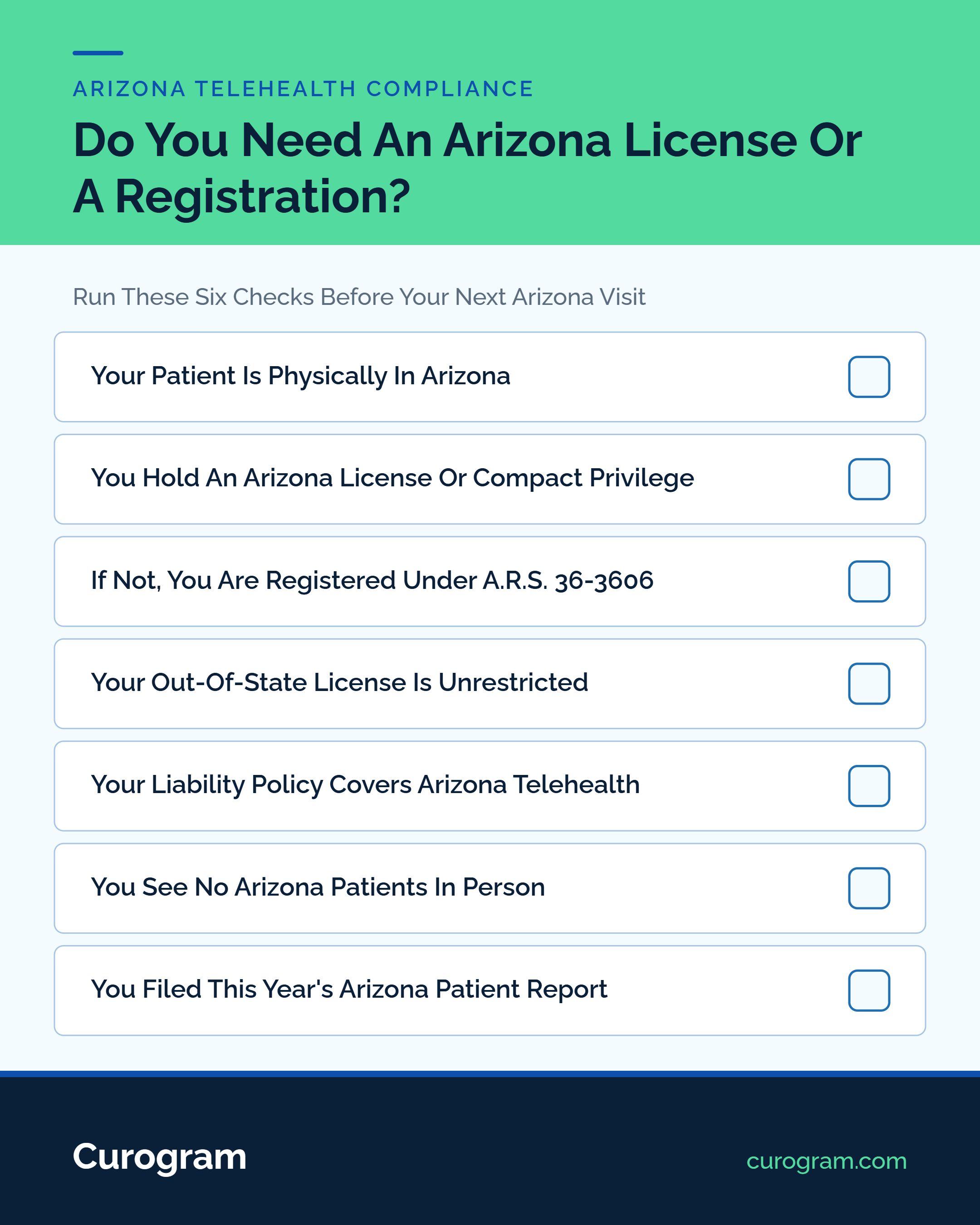
Checklist to see whether you need an Arizona license or a registration

Arizona Telemedicine Rules and Regulations

Six areas carry the Arizona telemedicine requirements a practice has to operationalize.

Licensing

Any provider offering telemedicine in Arizona needs a current Arizona license, a privilege through a compact the state has joined, or a registration under A.R.S. 36-3606.

Arizona belongs to eight compacts, including the Interstate Medical Licensure Compact, the Nurse Licensure Compact, and PSYPACT. Check the compact site for issuing status.

Registration is not a license. Registrants may not see anyone in person here, and fees vary by board. The Board of Psychologist Examiners charges $600 with no renewal fee.

When A.R.S. 36-3606 registration is not required

Situation

Condition

Emergency medical condition

No registration needed

Consultation with an Arizona-licensed provider

That provider holds final authority over diagnosis and treatment

After-care following an in-person procedure

Procedure was delivered in person in another state

Patient is a resident of another state

You are their primary care or behavioral health provider there

Low volume

Fewer than ten telehealth encounters in a calendar year

Source: A.R.S. 36-3606(E).


Standard of Care

Telehealth here meets the same standard as in-person care. A.R.S. 36-3605 adds a step most practices skip: a good-faith call on whether the service belongs on telehealth at all.

That call weighs diagnosis, symptoms, history, age, physical location, and access to technology. One flat prohibition sits in statute: A.R.S. 36-3604 bars using telehealth to provide an abortion.

Informed Patient Consent

A.R.S. 36-3602 requires verbal or written consent before care. Electronic consent counts, and verbal consent has to be documented in the record.

Minors add a step. Consent given through telehealth requires verifying the parent identity at the consent site.

Operationally this belongs in the reminder, not the visit. A secure form link sent two days out means consent is captured and filed before anyone joins the call.

Prescriptions

Arizona allows the required physical or mental health status exam to happen through telehealth. Schedule II drugs are the exception, permitted only after an in-person or audio-visual exam.

Federal rules are the moving part. A fourth temporary DEA extension lets registered practitioners prescribe Schedule II through V by telemedicine without a prior in-person exam. It expires December 31, 2026.

Medical Records

Arizona providers are required to maintain comprehensive medical records for every telehealth patient, on the same terms that apply to in-person care.

AHCCCS adds a rule that catches practices reviewing charts late. Under Medical Policy Chapter 940, the record must identify the visit as telemedicine and state whether it ran audio-only or audio and video.

That one field decides whether a claim survives audit. It also decides which parity rule applies.

What Replaced the Location Restrictions

Through 2020, Arizona limited virtual visits to rural areas and required patients to sit at an approved site such as a hospital, an IHS clinic, or an FQHC.

Both limits are gone. Covered telehealth may now be provided regardless of where the subscriber is located or the type of site.

Location still matters twice over. Claims need the originating site as place of service, and behavioral health rules require verifying where the client physically is.

What Changed After the COVID-19 Emergency Orders

The 2020 executive order everyone remembers has expired. What replaced it is stronger, and the federal layer above it runs on two clocks.

From Executive Order to Permanent Statute

On March 25, 2020, Governor Doug Ducey ordered health plans to cover telemedicine for any service they would cover in person. That was emergency policy with an end date.

HB 2454 made it permanent in 2021 and went further, writing service and payment parity into statute and creating the interstate registration pathway. SB 1089, the 2019 bill older articles cite, has been overtaken.

Where Federal Rules Sit Now

Medicare telehealth flexibilities lapsed twice, on September 30, 2025 and again on January 30, 2026. Congress extended them through December 31, 2027.

DEA telemedicine prescribing runs on a shorter clock, expiring December 31, 2026. Arizona parity requirements carry no sunset.

That asymmetry is worth planning around. Any staffing model built on virtual visits should have both federal dates in the calendar.

Three telehealth clocks a practice should track

Rule

Who sets it

Runs through

Payment and service parity

Arizona statute (HB 2454)

No end date

Medicare telehealth flexibilities

Congress (CAA 2026)

December 31, 2027

Controlled substance prescribing by telemedicine

DEA and HHS temporary rule

December 31, 2026


Telemedicine Reimbursement in Arizona

Payment parity is real here, which is more than most states can say. It carries two carve-outs that rarely make it into summaries.

Private Payer Parity and Its Carve-Outs

Arizona insurers must pay the same rate for equivalent services, whether delivered by audio-visual telehealth or in person. Audio-only parity covers behavioral health and substance use disorder services.

Parity does not apply to encounters run through a payer-sponsored platform. Read the next clause too. A payer may not require you to use its platform as a condition of network participation.

Cost sharing cannot exceed what an in-person visit would carry. If a payer waives a copay in a way that cuts your contracted rate, it owes you the difference. Patients also have to be told beforehand if there is a charge.

AHCCCS and Medicare

AHCCCS covers medically necessary telehealth from registered providers, with no geographic restriction. Store-and-forward reimbursement covers nine disciplines, and remote patient monitoring is covered both synchronously and asynchronously.

For Medicare patients, geographic and originating-site limits are lifted through December 31, 2027. A patient home counts as an originating site during that window.

CMS has signaled new telehealth billing modifiers for 2027. Auditing your coding now is cheaper than reworking it under a deadline.

Telehealth coverage in Arizona by payer type

Modality

Private payers

AHCCCS

Real-time audio and video

Covered, paid at parity

Covered, paid at parity

Audio-only

Covered per advisory committee code set

Covered when video is not reasonably available

Store-and-forward

Included in the telehealth definition

Covered for nine listed disciplines

Remote patient monitoring

Included in the telehealth definition

Covered, synchronous and asynchronous

Teledentistry

Not addressed as a separate category

Covered for members under 21


The Potential Challenges of Practicing Telemedicine in Arizona

Legal barriers came down. Three practical ones did not.

Broadband Is Still the Limiting Factor

Parts of Arizona with the thinnest specialist coverage often have the thinnest bandwidth. Audio-only is the statutory fallback, and it works.

It also pays differently. Outside behavioral health and substance use disorder services, parity is not guaranteed, so a rural practice leaning on phone visits may be covered without being paid the in-person rate.

The Registration Paperwork Has a Tail

Groups registering out-of-state providers under 36-3606 signed up for recurring work, not a one-time filing. Liability coverage and a statutory agent both have to stay current.

Registrations are updated annually and filed with a patient-count report. Any license restriction anywhere triggers a five-day notice to the Arizona board.

For a group with a dozen out-of-state clinicians, that is a compliance calendar somebody owns. It usually lands on the practice manager.

Virtual No-Shows Cost More Than They Look

A missed video visit reads as a small loss because nothing was consumed. Your provider still blocked the time, and follow-up care still slipped.

Platform choice moves this number. One Curogram client recall campaign brought back 1,240 patients, with 35% of SMS recall recipients booking within a month, based on our internal data.

A mass texting channel handles that kind of outreach in an afternoon. Calling 1,240 people one at a time does not.

Choosing a Telemedicine Platform for an Arizona Practice

Most vendor comparisons focus on video quality. Arizona rules put the weight on what happens before and after the call.

What the Rules Require of the Software

Five requirements come straight out of the statutes above. Consent has to be captured before care, and the chart has to record whether a visit ran audio-only or audio and video.

Three more follow. Patient location has to be knowable, claims need the right modifier and originating-site place of service, and every channel has to be HIPAA compliant.

Curogram is built to HIPAA and SOC 2 Type II standards. Evaluating other telehealth software, ask for HIPAA compliance and a signed BAA, then confirm both directly.

Where the EHR Connection Matters

Double entry is the tax on virtual visits. Staff copy consent status and visit type between systems, and the errors surface at billing.

Curogram connects with more than 70 EHR and practice management systems, adding texting, telehealth, reminders, forms, and payments on top of the chart you already keep. Data flows one way into the EHR, so Curogram complements your system of record rather than replacing it.

Systems Curogram connects with include:

  • Curogram (patient communication and telehealth layer)
  • athenahealth, Oracle Health, NextGen Healthcare, Epic
  • eClinicalWorks, AdvancedMD, Veradigm, Greenway Health
  • Tebra (formerly Kareo), DrChrono, Elation Health, ModMed
  • Practice Fusion, Office Ally, CureMD, Cerbo
  • GE Centricity, Prime Clinical, Konica Minolta Exa, Osmind, TherapyNotes

Curogram also supports API, HL7, and direct database connections for systems outside this list.

Telemedicine by State

Rules differ sharply across state lines, which matters if your providers hold licenses in more than one.

Guides are live for 29 states so far, including California, Texas, New York, Florida, Illinois, Ohio, and Georgia. For a payer-by-payer view, see our guide to telemedicine reimbursement by state.

Conclusion

Arizona did the hard part. The rural-only rule is gone, the site list is gone, and parity sits in statute rather than an executive order that expires.

What remains is the work: a license or registration, consent captured before the call, a chart naming the visit type, and a claim coded to the originating site.

If virtual visits are on your calendar and no-shows are climbing, the fix usually sits upstream of the video call. Book a Curogram demo, and we can walk through how confirmations, forms, and consent capture fit your current EHR.


Frequently Asked Questions

How do out-of-state providers get approved to treat Arizona patients?
They register with the Arizona board that licenses their profession under A.R.S. 36-3606, pay that board’s fee, and show an unrestricted license held elsewhere. Compact privileges through IMLC, PSYPACT, or the nurse licensure compact are a separate route. Registration does not permit in-person care or an Arizona office.
Why does Arizona require the visit type to be recorded in the chart?
The modality decides which payment rule applies. Audio-visual visits get full parity, while audio-only parity covers behavioral health and substance use disorder services. AHCCCS Chapter 940 requires the record to name the visit as telemedicine and state whether it ran audio-only or audio and video.
How does informed consent work for a telehealth visit in Arizona?
Verbal or written consent is required before care under A.R.S. 36-3602, and electronic consent counts. Verbal consent must be documented in the chart. Sending a secure form link with the appointment reminder captures it before anyone joins the call.
Why do federal telehealth rules keep changing while Arizona law stays put?
Arizona wrote parity into permanent statute through HB 2454, so it has no expiration. Federal telehealth authority runs on temporary extensions tied to appropriations. Medicare flexibilities currently run through December 31, 2027, and DEA prescribing flexibilities through December 31, 2026.
How can a practice cut no-shows on virtual visits specifically?
Confirmations that go out by text and process replies automatically work better than email for video appointments, because there is no drive to anchor the commitment. Atlas Medical Center dropped from 14.20% to 4.91% in three months using that approach, based on our internal data.


Telemedicine in New York: Laws, Policies, and Regulations | Blog

1 min read

Telemedicine in New York: Laws, Policies, and Regulations | Blog

💡 New York treats telehealth as the umbrella term, with telemedicine as one form of it, under Public Health Law Article 29-G. Four modalities...

Read More
Telemedicine Virginia: A Comprehensive Guide

1 min read

Telemedicine Virginia: A Comprehensive Guide

💡 Telemedicine is legal and widely covered in Virginia, but three rules decide whether a visit is valid and paid.First, licensing follows the...

Read More
Telemedicine in Missouri: Law, Policies, Rules, and Regulations

1 min read

Telemedicine in Missouri: Law, Policies, Rules, and Regulations

💡Missouri lets licensed providers deliver telemedicine and telehealth across the state. Both terms share one legal meaning: care given through...

Read More